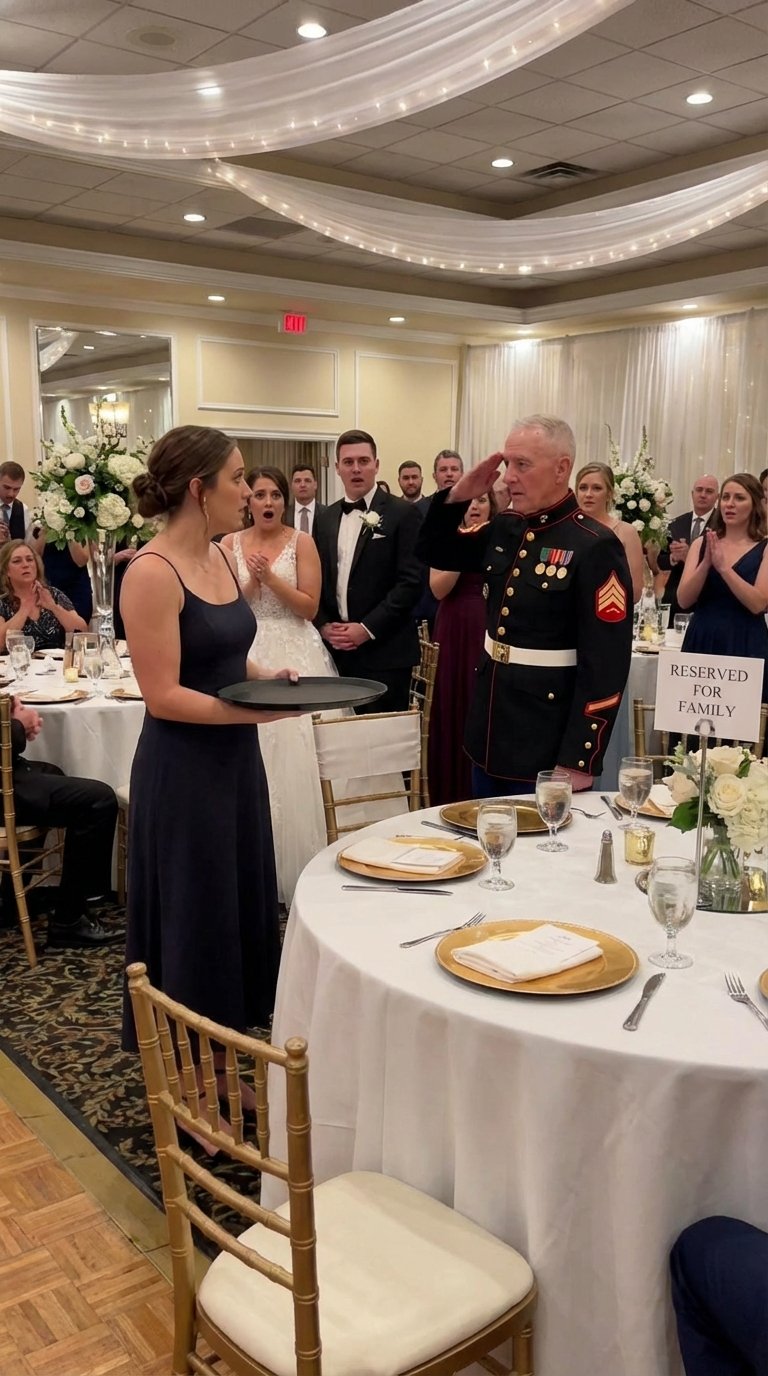
I’ve been to enough weddings to know that they’re rarely about love alone, despite what the florists and planners try to sell you, because beneath the peonies and champagne flutes there’s always a current of old rivalries, unspoken comparisons, childhood hierarchies that never quite died, and if you come from a family like mine—one that measures worth in applause and bank statements—you learn early that a wedding is not a celebration, it’s a stage, and if you’re not the one in white, you’d better know your place.
My name isn’t Harper Vance, not anymore. That was the name stitched onto fatigues and whispered over encrypted radios, the name that appeared in reports no civilian would ever read. The name my parents liked to pretend didn’t exist. On my birth certificate I’m Eleanor Ashford, firstborn daughter of Richard and Vivienne Ashford, older sister to the golden child, Camille Ashford, who married into money so old it smells faintly of mahogany and entitlement.
If you had walked into the Belgrave Conservatory that afternoon, you would have seen a spectacle engineered to impress governors, hedge fund managers, retired ambassadors, and anyone else whose last name could open doors. The glass ceiling arched high above like a cathedral for the wealthy, sunlight streaming through panels polished so obsessively they reflected the chandeliers beneath them, and everywhere you looked there were arrangements of ivory roses and imported orchids, flown in from somewhere tropical enough to make the guests feel worldly just by inhaling.
You would not have noticed me at first. That was by design.
I was standing near the service corridor, holding a tray of miniature crab cakes while a catering manager barked orders about table assignments and dietary restrictions, and I wore a black server’s uniform that hung awkwardly over shoulders more accustomed to ballistic vests than polyester. My hair, cut short in a way my mother once called “aggressively unfeminine,” was slicked back into something resembling compliance. A thin white scar traced from my right temple into my hairline, faint now but impossible to erase. I had not come dressed as a bridesmaid. I had not come dressed as a guest. I had come dressed as staff.
That part had been my mother’s idea.
“Don’t make a scene, Eleanor,” she’d said the week before, standing in the marble foyer of the house my military salary had quietly helped pay off years ago. “Camille’s wedding is not the time for your… persona. We’ve told people you’re doing something administrative for the government. Clerical. It’s easier.”
“Easier for whom?” I’d asked.
“For everyone,” she replied, as if that settled it, and then, after a pause that tasted faintly of contempt, “And frankly, darling, with your schedule and your… disposition, you’d be more helpful behind the scenes anyway.”
Helpful. That word has a way of shrinking a person if they let it.
So there I was, weaving through clusters of guests whose perfume cost more than a junior officer’s monthly pay, offering appetizers while snippets of conversation floated past me—mergers, yacht charters, speculation about who would inherit what when which patriarch finally surrendered to age. No one looked at my face long enough to recognize me, and those who did simply saw a woman in black carrying a tray.
Near the center of the conservatory stood Camille in a gown that could have funded a small hospital wing, its train cascading behind her like a declaration of victory. She looked luminous, I’ll give her that, and when she laughed, people leaned closer as if proximity might grant them access to whatever charmed future she was about to secure.
Beside her stood Nathaniel Cole, the groom, son of retired General Thomas Cole—a man I knew well, though we had never shared a family dinner. Nathaniel had a softness about him, an earnestness that seemed almost misplaced among the calculating smiles of our relatives. He caught my eye once as I passed with the tray. There was a flicker of recognition there, quickly buried, as if he wasn’t sure whether he was allowed to acknowledge what he saw.
My mother intercepted me before I could retreat back toward the kitchen.
“Why are you standing so straight?” she hissed, adjusting a centerpiece that didn’t need adjusting. “Relax your shoulders. You look intimidating.”
“I am intimidating,” I replied calmly.
Her fingers dug into my forearm, nails pressing through fabric. “Not today you’re not. Camille is the focus. And for heaven’s sake, if you see Governor Whitmore, don’t engage. We told him you weren’t able to attend due to ‘health reasons.’ It’s cleaner.”
“Health reasons,” I repeated, tasting the absurdity.
“You never know what you’ll say,” she added sharply. “We can’t risk you… oversharing.”
Oversharing. As if classified briefings and diplomatic negotiations were cocktail gossip.
My father, Richard Ashford, appeared then, adjusting his cufflinks with theatrical precision. “Vivienne,” he said to my mother, not looking at me, “make sure the champagne pyramid is refreshed before the toasts. We don’t want it looking half-empty in photos.”
He finally glanced at me. “And you,” he added, “try not to draw attention. Camille worked very hard to curate this guest list.”
Curate. As if I were a piece of furniture that might clash with the décor.
I nodded once and moved away, because there’s a discipline that comes from years in uniform—you pick your moment, you don’t waste ammunition on small irritations, and you let people underestimate you until it serves your objective.
The first crack in the façade came during the cocktail hour.
A cluster of Nathaniel’s military friends—men and women in tailored suits, hair cropped in ways that hinted at regulations even out of uniform—were gathered near the string quartet. I recognized at least four of them from joint operations overseas, though they pretended not to see me. That had been part of the arrangement. General Cole had insisted on it when we spoke two nights earlier in a quiet office far from prying ears.
“They don’t know?” he had asked me then, voice low.
“They know what they want to know,” I’d replied.
“And you’re certain?” he pressed.
“I’m certain,” I said. “Let them run the full performance.”
Back in the conservatory, Camille was preparing for the first toast. Guests began taking their seats at round tables draped in linen so thick it absorbed sound. I was near the head table when my mother’s voice sliced through the air behind me.
“Eleanor, where is the second bottle of Bordeaux?” she demanded.
“On the sideboard,” I answered.
“Then why is it not on the table?” she snapped. “Do I have to do everything myself?”
Without waiting for a reply, she grabbed the bottle from a passing server and thrust it into my hands. “Take it up. And try not to spill it. That vintage cost more than your first car.”
I carried the bottle toward the raised dais where Camille and Nathaniel sat. There was an empty chair to General Cole’s right, its place card turned face down. I noticed it immediately, though no one else seemed to question it.
Camille leaned toward me as I approached. “You missed a spot on Table Seven,” she murmured through clenched teeth, smile frozen in place for the photographer. “And why are you sweating?”
“It’s seventy-five degrees under glass,” I replied evenly.
“Don’t be clever,” she shot back. “You’re here to help. Act like it.”
I set the bottle down carefully, intending to step away before the next round of humiliations could be scripted. That’s when Camille’s heel caught in the edge of her own gown. She stumbled, wine sloshing in the glass she had just picked up. A red arc splashed across the pristine white of her skirt.
For a heartbeat, she looked stunned. Then her gaze snapped to me.
“You did that,” she hissed.
“I was three feet away,” I said.
“You bumped the table,” she insisted, voice rising. “You always ruin things.”
Before I could respond, she seized the bottle from the table. There was no pause, no rational calculation—just a flash of rage so pure it eclipsed reason. She swung.
The impact against my temple was sharp, heavy, the kind of blow that sends a white flare across your vision before pain registers. The bottle shattered. Glass fragments scattered across the tablecloth. Warm liquid poured down my face, mingling instantly with blood.
The room inhaled in unison.
I did not fall. Years of training have a way of hardening reflexes; you learn to absorb, to assess, to remain vertical even when the ground seems intent on leaving you. I steadied myself, one hand braced on the edge of the table, feeling the sting spread outward from the cut.
Camille stood over me, chest heaving, the broken neck of the bottle still clutched in her hand.
“Look what you made me do!” she cried, voice cracking. “You jealous, pathetic—”
“Camille,” Nathaniel said sharply, reaching for her wrist.
But my father was faster. He rose from his seat, face flushed with a fury that had nothing to do with concern for my injury.
“Get out,” he snarled at me, grabbing my collar. “You will not sabotage this wedding out of spite.”
“I didn’t—” I began.
“Enough,” he barked, yanking me toward the stairs at the edge of the dais. “You’ve embarrassed us for the last time.”
Blood dripped onto the polished wood. Guests were standing now, phones raised discreetly, because nothing spreads faster than scandal at a society wedding.
I let him drag me, because sometimes the most effective strategy is to allow your opponent to commit fully to their mistake.
We reached the top step. My father’s grip tightened. “You are nothing,” he hissed into my ear. “Without this family, you are nothing.”
And then the lights went out.
Not flickered. Not dimmed. Went out completely.
A collective murmur swept the conservatory as emergency lighting failed to engage. In the darkness, my father’s hand faltered. He loosened his grip just enough.
A single spotlight snapped on from the balcony above, cutting through the dimness and isolating us in a circle of white.
A voice echoed through the sound system, amplified and steady.
“Release her.”
It was General Thomas Cole.
My father turned, blinking against the glare. “What is this?” he demanded.
General Cole descended the steps from the balcony with the measured calm of a man who has commanded troops under fire. He held a microphone loosely in one hand.
“Ladies and gentlemen,” he began, “I apologize for the interruption. It seems there has been a misunderstanding regarding the identity of one of our guests.”
My mother’s voice trembled from the head table. “Thomas, please, this is unnecessary—”
“Oh, it’s necessary,” he replied coolly.
He stopped beside me. Up close, I could see the anger simmering beneath his composure.
“This woman,” he continued, gesturing toward me, “is not a server. She is not a liability. And she is certainly not ‘nothing.’”
A ripple of confusion moved through the crowd.
He turned fully toward me then, straightening his posture.
“General Eleanor Ashford,” he said clearly, “Commander of Joint Special Operations, European Theater.”
He raised his hand in a crisp salute.
The sound that followed wasn’t immediate applause. It was silence—the kind that stretches thin before it snaps.
Then chairs scraped against marble.
Around the room, men and women stood. Some were Nathaniel’s friends. Some were dignitaries Camille had invited without knowing their full backgrounds. A retired admiral. Two colonels. A senator who had once chaired an oversight committee. One by one, they raised their hands in salute.
Thirty, maybe forty people standing for the “server” with blood on her face.
Camille’s expression shifted from fury to disbelief. “General?” she whispered.
My father released me entirely.
I wiped the blood from my eyebrow with the back of my hand and took the microphone from General Cole.
“Thank you, sir,” I said quietly.
I turned to face my parents.
“You told your friends I worked a desk,” I began, voice carrying easily through the speakers. “You told them I was unstable. That I’d ‘washed out’ of something unspecified.”
My mother’s lips trembled. “Eleanor, please.”
“For five years,” I continued, “you’ve had access to a financial account in my name. An account you assumed was a modest salary. A stipend.”
My father’s eyes flickered.
“You filed documents granting yourselves power of attorney while I was deployed,” I said. “You moved funds into shell accounts. You financed renovations. Investments. This wedding.”
“That was family money,” my father insisted weakly.
“No,” I replied. “It was not.”
I let the pause stretch.
“That account was an operational fund tied to a classified budget line. Every dollar diverted triggered an internal review. I requested that review.”
Camille shook her head as if she could dislodge the meaning. “You’re lying.”
“Am I?” I asked softly.
The conservatory doors swung open.
Uniformed officers entered—not local police, but federal agents and military police, their presence unmistakable. They moved with quiet precision toward the dais.
My mother’s composure shattered. “You wouldn’t,” she breathed.
“I already did,” I answered.
Agents reached my father first. He sputtered protests about reputation, about misunderstandings, about lawyers. Camille tried to step back, but the torn hem of her dress tangled around her ankles.
Nathaniel removed his ring slowly, placing it on the table beside the shattered glass.
“I didn’t know,” he said to me, voice hoarse.
“I know,” I replied.
As handcuffs clicked into place, my mother looked at me with something that might have been recognition for the first time in decades—not of my rank, but of the fact that I had never been small, only silenced.
The guests watched, stunned, as the spectacle they had anticipated transformed into something else entirely.
Six months later, I was back in Brussels, seated at a long conference table beneath flags representing half a dozen nations, discussing maritime security and cyber threats with people who valued competence over choreography. My scar had healed into a thin white line. I had not concealed it.
My phone rang once during a break. A correctional facility number flashed on the screen. I declined the call.
Across from me, a French general raised an eyebrow. “Everything all right?”
“Just administrative noise,” I said.
He nodded, understanding more than he asked.
I have thought often about that wedding—not with bitterness, but with clarity. Families can be battlegrounds long before anyone fires a shot. Sometimes the most difficult campaign you’ll ever fight is the one for your own dignity.
The lesson, if there is one, is this: never confuse silence with weakness, and never assume the person carrying the tray doesn’t have the authority to shut down the room. Titles mean nothing without integrity, and blood ties do not grant immunity from accountability. Respect is not inherited; it is earned. And when you build your identity on illusion, it only takes one spotlight to expose the cracks.
Website Disclaimer
The information provided on this website is for general informational and educational purposes only. While we strive to ensure that all content is accurate and up to date, we make no guarantees regarding the completeness, reliability, or accuracy of any information published.
The views and opinions expressed in articles belong to their respective authors and do not necessarily reflect the views of this website. Any action you take based on the information found on this website is strictly at your own risk. We will not be liable for any losses, damages, or inconveniences arising from the use of our content.
Some articles may contain opinions, third-party information, or external links. We do not endorse or guarantee the accuracy of content on external websites and are not responsible for their practices or policies.
All content on this website is provided in good faith and is intended for informational purposes only. Readers are encouraged to verify information independently and seek professional advice where appropriate.