Michael Jenkins noticed the quiet before he noticed anything else.
The house was older than its paint, its porch sagging slightly at the center as though time itself had leaned too heavily on it. When Michael first stood in front of it, he didn’t see the cracked panes or the ivy gripping its frame. He saw distance. After years of concrete noise and sleepless nights in the city, quiet felt like the only luxury left to him.
He arrived with a truck full of boxes and the intention of starting over, far from the ghost that had followed him for more than a decade. The property had been vacant for years. The realtor spoke of it carefully, mentioning its “history” without elaboration. The backyard stretched into a gentle slope of clay and wild grass, ending near a stand of old maple trees.
Something about the yard drew his attention. Perhaps it was the stillness, or the way afternoon light seemed thicker there, as if the air itself were holding onto the past. The first weeks were spent fixing what refused to stay fixed. Pipes leaked. Doors warped. Floorboards groaned. Michael moved through each day with the patience of a man relearning how to live alone.
Evenings were the easiest. He sat on the porch with black coffee, watching light fade behind the trees, telling himself the silence was healing him. Across the road lived Mrs. Collins, an elderly widow who baked too often and insisted on calling him “Mr. Jenkins.” The rest of the town barely noticed him, which suited him fine.
Michael had once been an electrician. Now he worked freelance, fixing small jobs for people willing to trust a quiet stranger with tools. The money was enough. What he lacked in income he made up for in solitude.
On a Sunday afternoon, he saw an advertisement for a metal detector being sold for $50. He bought it without much thought. The seller, a retired postal worker, showed him how to adjust the sensitivity. “You’d be surprised what people bury,” the man said.
Michael began sweeping the detector over his backyard. Nails. Rusted scraps. A bent spoon. The work was repetitive, almost meditative. Near the center of the yard, the ground dipped slightly, as if disturbed long ago and allowed to settle. The detector murmured there sometimes, inconsistent, easy to ignore.
One evening he met Ray Patterson, a wiry man in his 60s who lived two lots over. Ray had once run a garage in town. When he learned where Michael lived, he mentioned that the area used to be called Silver Row. There had once been a nightclub there—the Silver Lounge—which burned down decades earlier. Ray didn’t explain the “bad nights” tied to it, only that people stopped talking about such things.
Days passed. Michael continued searching. One morning he unearthed a bottle cap stamped Silver Lounge. He cleaned it and placed it on his windowsill, a small relic that made the past feel touchable.
By mid-autumn, the house had found its rhythm. Yet sometimes, when the wind carried the scent of rust, Michael felt an odd awareness of the earth beneath him, as though something there remembered being disturbed.
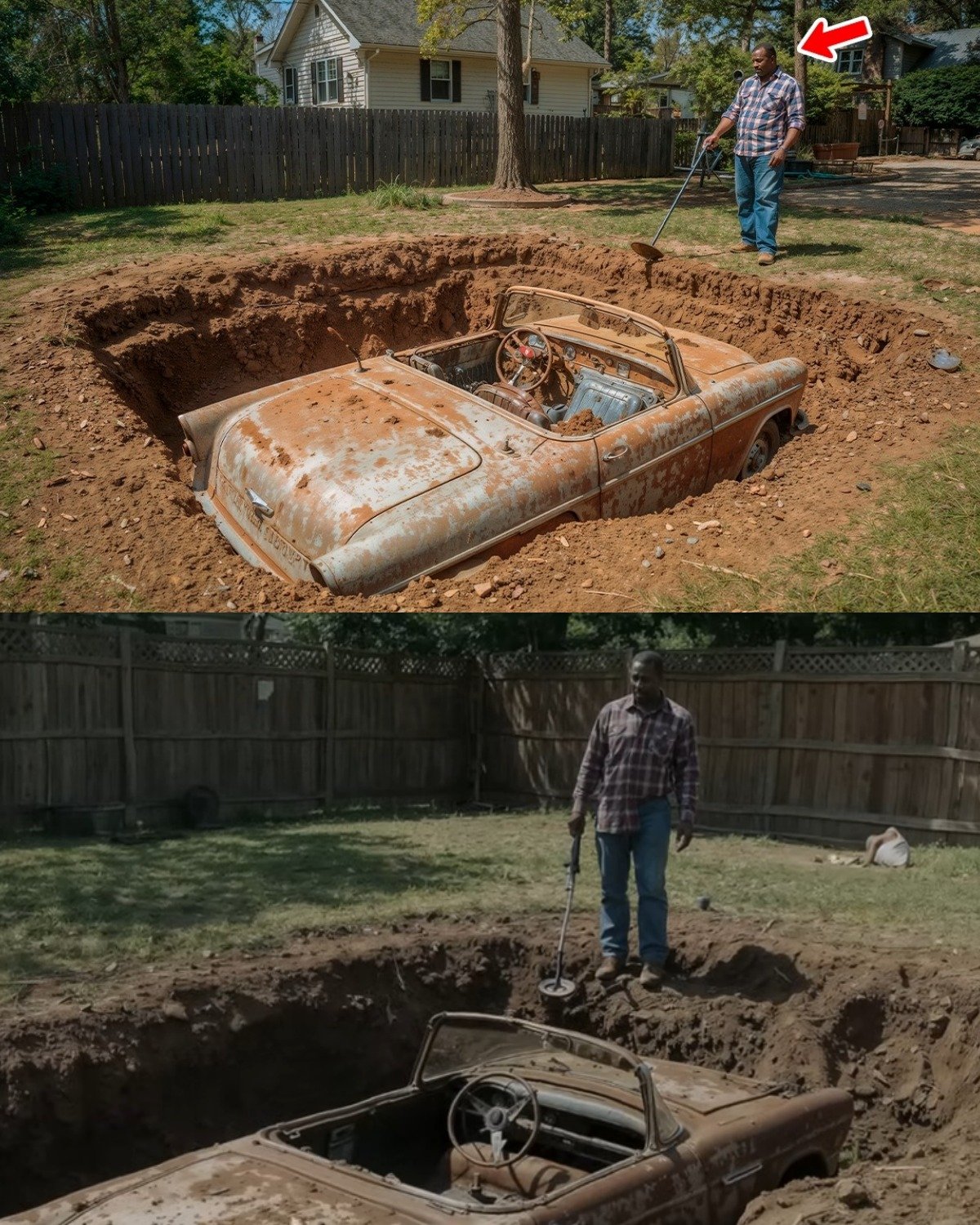
A week before winter, rain softened the soil. Michael took the detector out again. Near the depression in the yard, the signal deepened—steady, strong, unmistakable. He marked the spot and dug. Less than a foot down, his shovel struck something solid.
Red metal emerged beneath the clay. Smooth. Curved. With a strip of chrome.
He stopped digging, realizing he wasn’t uncovering debris. He was unearthing a car
By morning, the rain had stopped. The red metal still gleamed beneath the mud. Michael tried to tell himself it was nothing, but curiosity had already taken root. He dug for hours, uncovering a roofline, a windshield frame, shattered glass fused with soil.
Ray Patterson arrived and saw the exposed metal. His expression changed immediately. He warned Michael that some things stayed buried for a reason. He spoke of a man who once ran the Silver Lounge, always driving a red convertible. One night, the man disappeared. Ray suggested Michael call the county and walk away.
Michael didn’t stop.
As the car emerged further, the unease grew. The doors weren’t just closed. They were welded shut. Thick, uneven seams ran along the frames. The trunk bore the same treatment. The vehicle had been sealed like a coffin.
Using rented equipment, Michael excavated the rest of the car. It was a 1950s Cadillac convertible. Elegant, intact, and deliberately entombed. Ray returned and identified it as likely belonging to Richard Wallace, the Silver Lounge owner who vanished in 1961. Ray warned Michael again. If the trunk opened, he might not like what he found.
That night, Michael barely slept.
The next morning, he cut through the welded trunk with a gas torch. The metal resisted. When it finally opened, stagnant air spilled out. Inside lay human remains—bones tangled with decayed clothing. Beside them was a leather suitcase filled with rotted documents, personal effects, and a briefcase containing ledgers of bank transfers, deeds, and names tied to corruption.
The initials on the cufflinks were RW.
Michael called the sheriff.
Police arrived quickly. The remains were confirmed as Richard Wallace. Detectives documented the car, the bones, and the documents. Wallace had been under federal investigation tied to organized crime and political corruption. He had intended to testify. Instead, he vanished.
The documents detailed bribery, protection rackets, and money laundering involving officials whose families still held power. Some of the papers later went missing after being transferred to state archives.
Michael became the center of unwanted attention. Reporters arrived. Letters followed. One warned him plainly: You should have left it buried.
Ray Patterson left town. Detectives cautioned Michael to stay alert. The case was officially closed as a historical investigation, unresolved in its full scope.
Eventually, the car was removed. The pit filled with rainwater. Michael built a bench over the spot and planted a maple tree beside it. Life slowly resumed its rhythm, quieter but heavier than before.
The town moved on. Michael stayed.
The ground settled. Grass returned, thinner near the bench. The tree grew. Michael tended the yard and learned to live with what he had uncovered. The past, once exposed, had retreated again, not erased, but folded back into the soil.
He remained, listening to the silence—not empty now, but whole.
Website Disclaimer
The information provided on this website is for general informational and educational purposes only. While we strive to ensure that all content is accurate and up to date, we make no guarantees regarding the completeness, reliability, or accuracy of any information published.
The views and opinions expressed in articles belong to their respective authors and do not necessarily reflect the views of this website. Any action you take based on the information found on this website is strictly at your own risk. We will not be liable for any losses, damages, or inconveniences arising from the use of our content.
Some articles may contain opinions, third-party information, or external links. We do not endorse or guarantee the accuracy of content on external websites and are not responsible for their practices or policies.
All content on this website is provided in good faith and is intended for informational purposes only. Readers are encouraged to verify information independently and seek professional advice where appropriate.