I stepped forward. Slowly. Calmly.
My boots echoed against the marble floor, and something about the sound made people turn their heads. Conversations died down one by one. Music kept playing, but no one was listening anymore.
“Excuse me,” I said, my voice steady but cold. “Whose house is this?”
My son turned toward me, irritated.
“And who are you supposed to be?” he asked, looking me up and down. “This is a private event.”
I didn’t answer him. I walked straight to my sister and knelt beside her. I touched her shoulder gently.
“Emily,” I whispered.
She opened her eyes slowly. Confusion, then fear, then recognition.
“Sarah?” she breathed. “Is it really you?”
I helped her sit up. Her hands were rough. Her face thinner than I remembered. She looked like someone who had been shrinking for years.
“Yes,” I said. “It’s me. I’m home.”
A murmur spread through the room.
My son laughed nervously. “Mom, what is this? Why are you waking her up?”
I stood up.
“Your mother?” I repeated quietly.
Silence fell like a hammer.
I turned to the guests. “Welcome, everyone. I’m Sarah Miller. I bought this house twenty-three years ago. I paid for every brick with money earned cleaning offices, washing dishes, and working double shifts in New York.”
Faces stiffened.
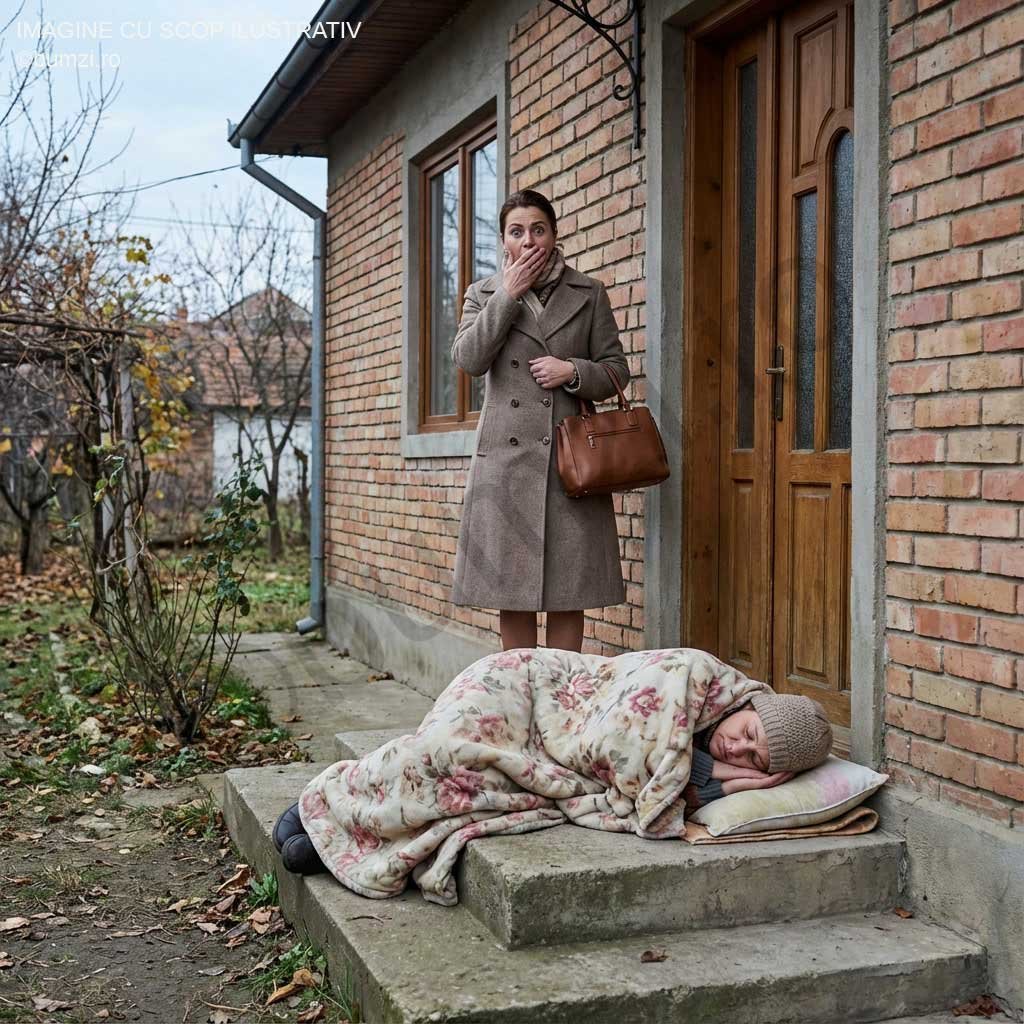
“I gave this house to my sister so she would never struggle,” I continued. “Not so she would sleep on a doormat like a stray.”
My son’s face turned pale.
“That’s not true,” he snapped. “She’s unstable. She insisted on sleeping there.”
Emily flinched.
I raised my hand. “Enough.”
I reached into my bag and pulled out a folder. Deeds. Bank transfers. Legal documents.
“I never transferred ownership,” I said calmly. “I allowed her to live here. And I allowed you to manage it while I was gone.”
People began shifting uncomfortably. Someone set their glass down.
“You turned my generosity into cruelty,” I said. “You threw parties while forcing her to scrub floors. You called her crazy while using her like a servant.”
My son tried to speak, but no sound came out.
“I watched from afar,” I continued. “I sent money. I asked questions. And every time, I was told everything was fine.”
I looked at him. “You lied to me.”
I turned to the guests again. “This party is over.”
No one argued.
One by one, they grabbed their coats and left, eyes down, embarrassed. Within minutes, the house was quiet.
I walked to the door and locked it.
Then I turned back to my son.
“You have one hour to pack,” I said. “You’re leaving.”
“You can’t do this,” he shouted. “I’m your son!”
“I am your mother,” I replied. “And that’s exactly why I won’t allow this anymore.”
He left that night.
I took Emily upstairs, ran her a warm bath, made her soup. She cried as she ate, apologizing over and over.
“You never had to suffer,” I told her. “Not for me. Not for anyone.”
The next morning, I called a lawyer.
Within a week, everything changed.
The house was legally secured. My sister’s name was added properly. My son was cut off financially. No drama. No shouting. Just consequences.
Months passed.
Emily smiled again. She planted flowers in the yard. She slept in a real bed.
And me?
I finally came home.
Not to take revenge.
But to restore dignity.
Because sometimes, the strongest lesson isn’t anger.
It’s justice.
Website Disclaimer
The information provided on this website is for general informational and educational purposes only. While we strive to ensure that all content is accurate and up to date, we make no guarantees regarding the completeness, reliability, or accuracy of any information published.
The views and opinions expressed in articles belong to their respective authors and do not necessarily reflect the views of this website. Any action you take based on the information found on this website is strictly at your own risk. We will not be liable for any losses, damages, or inconveniences arising from the use of our content.
Some articles may contain opinions, third-party information, or external links. We do not endorse or guarantee the accuracy of content on external websites and are not responsible for their practices or policies.
All content on this website is provided in good faith and is intended for informational purposes only. Readers are encouraged to verify information independently and seek professional advice where appropriate.