The turkey weighed almost as much as my regret. It sat in the center of the marble counter like a trophy no one had asked me to win, its skin lacquered with a glaze that had taken hours to perfect, brown sugar melted into bourbon, citrus oils clinging to the air like forced cheer. The kitchen smelled like celebration, yet my body felt like it was being slowly dismantled piece by piece.
By the time the oven timer rang, my ankles were swollen beyond recognition and my lower back pulsed with a deep, relentless ache that made it hard to breathe evenly. I was well into my third trimester, and the child inside me had been restless all morning, reacting to every sharp movement and every wave of stress I failed to suppress. I had been awake since before dawn, moving from stove to sink to counter in a rhythm that felt less like preparation and more like punishment.
“Rebecca.” The voice came sharp and high, slicing through the room from the dining area. “Why is the table still missing the relish. Aaron cannot eat dry meat.”
Judith Blake did not call out so much as announce her displeasure to the walls themselves. I dried my hands on the apron I had already ruined and answered quietly that I was bringing it now, even though my knees trembled as I walked.
The dining room looked like a photograph staged by someone who had never cooked a meal in their life. Polished silver caught the firelight. Crystal glasses stood untouched. At the head of the table sat my husband, Aaron, relaxed and confident in his tailored navy jacket, smiling as he listened to his coworker Paul talk about a case that meant nothing to me.
Aaron looked successful. He looked satisfied. He looked nothing like the man who had once promised that I would never have to prove my worth to anyone.
He did not look up when I set the bowl down.
Judith examined the turkey with open disdain and shook her head. “You rushed it,” she said, spearing the meat with her fork. “I told you to baste it properly. This is what happens when you do not listen.”
“I followed your instructions,” I replied, my voice thin from exhaustion. “Every half hour.”
“Well then you must have done it wrong,” she said dismissively. “Fetch the gravy. Perhaps it can rescue this disaster.”
I turned toward my husband, hoping for something I had stopped expecting. “Aaron,” I said softly. “I need to sit down. My back is hurting badly, and the baby has been kicking nonstop.”
His smile faded into irritation. “Rebecca, please. Paul is in the middle of a story. Do not interrupt.”
“I am not trying to interrupt,” I said, swallowing hard. “I just need a moment.”
He waved his hand without looking at me. “Just grab the gravy. You know pregnancy makes you overreact. Paul understands.”
Paul laughed awkwardly and nodded as if this were all harmless. “Yeah. Totally normal.”
Something inside my chest tightened, and I turned back toward the kitchen before the tears could spill. I reminded myself of where I had come from, of the home filled with books and debate and quiet authority. I had grown up among people who wrote policy and argued before courts that shaped the nation. But I had hidden all of that when I met Aaron because I wanted love without expectation, affection without calculation.
What I had found instead was a man who thrived on imbalance and a household that mistook obedience for virtue.
When I returned with the gravy, my legs nearly gave out. I noticed the empty chair beside my husband and moved toward it without thinking. The sound of the chair scraping the floor stopped every conversation.
Judith stood so fast her napkin fell. “What do you think you are doing.”
“I need to sit,” I said, gripping the chair. “Just for a moment. I need to eat.”
Her face twisted with something ugly and triumphant. “You do not sit here. You eat later. You eat in the kitchen. That is how it works in my home.”
“I am your son’s wife,” I said, my voice breaking despite my effort. “I am carrying your grandchild.”
She leaned closer. “You are a guest who forgets her place.”
I looked at Aaron, silently pleading. He took a slow sip of wine and stared past me.
“Do what my mother says,” he replied calmly. “Do not embarrass us.”
A sharp pain cut through my abdomen, stealing my breath. I pressed my hand to my stomach and gasped. “Something is wrong. It hurts badly.”
Judith pointed toward the kitchen. “Move.”
I turned, dizzy and unsteady. The pain worsened with each step until I had to grab the counter to stay upright.
Behind me I heard footsteps and then her voice again, louder and closer. “I told you to move.”
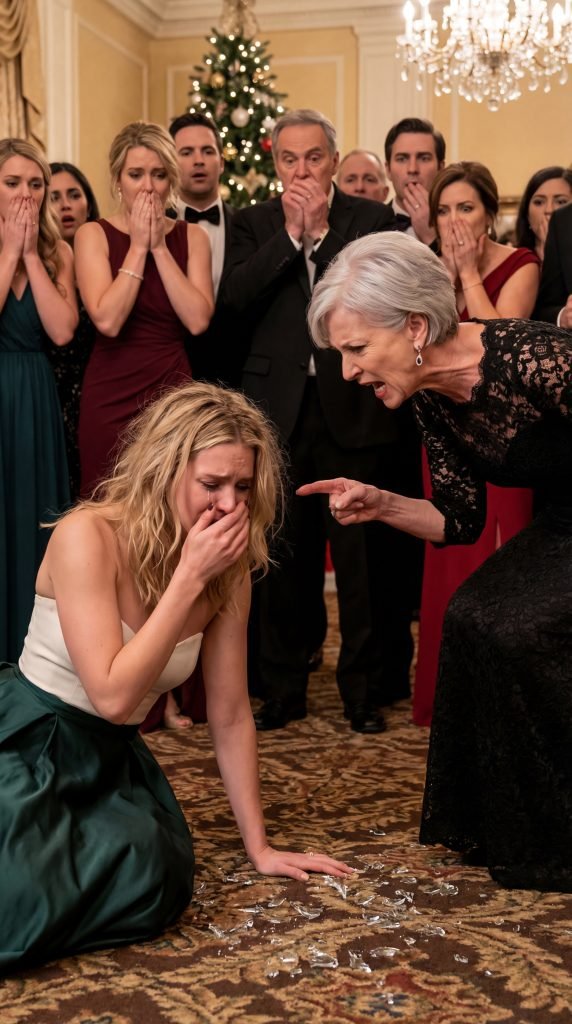
She shoved me with both hands, hard enough to knock the air from my lungs. My feet slipped on the tile and my body fell backward into the island. The impact sent a shock through my spine that exploded into white heat.
I hit the floor, my head bouncing against the tile. For a moment I could not process anything beyond the pain, and then I felt warmth spreading beneath me, soaking through fabric, unstoppable and terrifying.
Aaron rushed in with Paul trailing behind him.
“She slipped,” Judith said instantly. “Always clumsy.”
Aaron frowned at the blood as if it were an inconvenience. “Rebecca, what is this. Paul is here.”
Paul looked pale. “This looks serious. We should call emergency services.”
“No,” Aaron snapped. “Do you want the neighbors watching ambulances. Get up. Clean this. Then we will go somewhere discreet.”
“I am losing the baby,” I cried. “Please call for help.”
He grabbed my arm and pulled. Another wave of pain tore through me and I screamed.
When I reached for my phone, he ripped it from my hand and hurled it against the wall where it shattered.
“You will not ruin my career,” he said quietly. “You will apologize and stay quiet.”
Something in me went cold.
I stopped crying and looked at him carefully, seeing him clearly for the first time. “You should call my father,” I said.
He laughed. “The retired nobody you made up. Fine. What is his number.”
When the voice on the other end answered without preamble, the room changed. The man demanded identification, and when Aaron gave his name, confusion turned to fear.
When I spoke, my father recognized my voice instantly, and when I told him what had happened, the silence that followed felt heavier than the blood beneath me.
“This is Justice Raymond Stone,” my father said at last, his voice stripped of warmth. “You will not touch my daughter again.”
“This is Justice Raymond Stone,” my father said at last, his voice stripped of warmth. “You will not touch my daughter again.”
Aaron dropped the phone.
It was not a dramatic gesture. There was no flourish or apology. His fingers simply released it, as if the weight of the object had suddenly become too much to bear. The device hit the floor with a hollow crack, skidded once through the blood, and went silent.
For a heartbeat no one moved.
Judith’s mouth opened and closed without sound. The authority she had worn like perfume evaporated, replaced by something small and frantic. Paul took a step back, already reaching for his own phone, his eyes darting between Aaron and me as if he were calculating how quickly distance could absolve him.
Aaron knelt beside me, not to help, but to whisper. “You did this,” he said, his voice shaking. “You have no idea what you have done.”
I looked at him from the floor, my vision blurring at the edges. “No,” I said quietly. “You did.”
Sirens cut through the night minutes later, loud and unavoidable. Red and blue light splashed across the pristine walls Judith had polished that morning. The neighbors came out anyway, despite Aaron’s fears, drawn by the spectacle he could not control.
The paramedics moved fast and gently, their hands sure, their voices calm. One of them squeezed my shoulder and told me to breathe with her. Another asked questions I answered between waves of pain. Someone placed a blanket over me, shielding me from the stares, and for the first time that day I felt treated like a human being instead of an inconvenience.
Police followed close behind.
Aaron tried to assert himself then. He talked about misunderstandings, about his reputation, about how things would look. One officer listened politely and then asked him to step aside. Another asked Judith to sit down and stop interfering. When she protested, her voice broke into shrill disbelief, the sound of someone discovering that power is not permanent.
I was lifted onto a stretcher and rolled past the dining room table. The turkey sat untouched now, congealing under the lights, its glossy skin dull and split. The photograph-perfect setting had collapsed into chaos, silverware scattered, wine spilled, the illusion ruined beyond repair.
As the ambulance doors closed, I saw Aaron one last time that night. He stood in the driveway, hands in his hair, shouting into the cold air about lawyers and connections. No one was listening.
The hospital was a blur of white walls and clipped voices. I remember the doctor’s eyes when she spoke to me, careful and kind. I remember the weight in my chest when I understood her words. I remember my mother’s arms around me hours later, and my father’s hand steady on mine, grounding me in the world when everything else felt like it was slipping away.
Grief came in waves. Some days it was sharp and immediate. Other days it was a low ache that settled into my bones. Healing did not follow a straight line. It looped and doubled back and surprised me when I thought I had moved on.
The investigation moved faster than my recovery.
Once my father’s name entered the record, doors opened that had been closed for years. Financial documents were reexamined. Old complaints resurfaced. People who had been dismissed or silenced found themselves suddenly believed. What began as an assault case unfolded into something far larger, a pattern of entitlement and coercion that had thrived because no one had forced the light onto it before.
Aaron stopped calling after his attorney advised him to. Judith wrote one letter, furious and incoherent, blaming me for everything she had lost. I never responded.
Months later, the sentencing was reported in clean, impersonal language. Years attached to crimes described in paragraphs. I read it in a quiet garden, sunlight warming my face, the sound of leaves moving gently above me. I felt no triumph, only a sober sense of closure.
My body healed slowly. My heart healed unevenly.
But something inside me had hardened into clarity.
When I mailed my application to law school, my hands did not shake. I was no longer interested in shrinking myself to survive someone else’s comfort. I understood now that silence protects the cruel, and that endurance without agency is not virtue. It is erosion.
I had spent too long mistaking patience for strength.
I was done waiting to be allowed a seat at the table.
I was ready to build my own.
Website Disclaimer
The information provided on this website is for general informational and educational purposes only. While we strive to ensure that all content is accurate and up to date, we make no guarantees regarding the completeness, reliability, or accuracy of any information published.
The views and opinions expressed in articles belong to their respective authors and do not necessarily reflect the views of this website. Any action you take based on the information found on this website is strictly at your own risk. We will not be liable for any losses, damages, or inconveniences arising from the use of our content.
Some articles may contain opinions, third-party information, or external links. We do not endorse or guarantee the accuracy of content on external websites and are not responsible for their practices or policies.
All content on this website is provided in good faith and is intended for informational purposes only. Readers are encouraged to verify information independently and seek professional advice where appropriate.