The first thing I noticed was how steady her voice was.
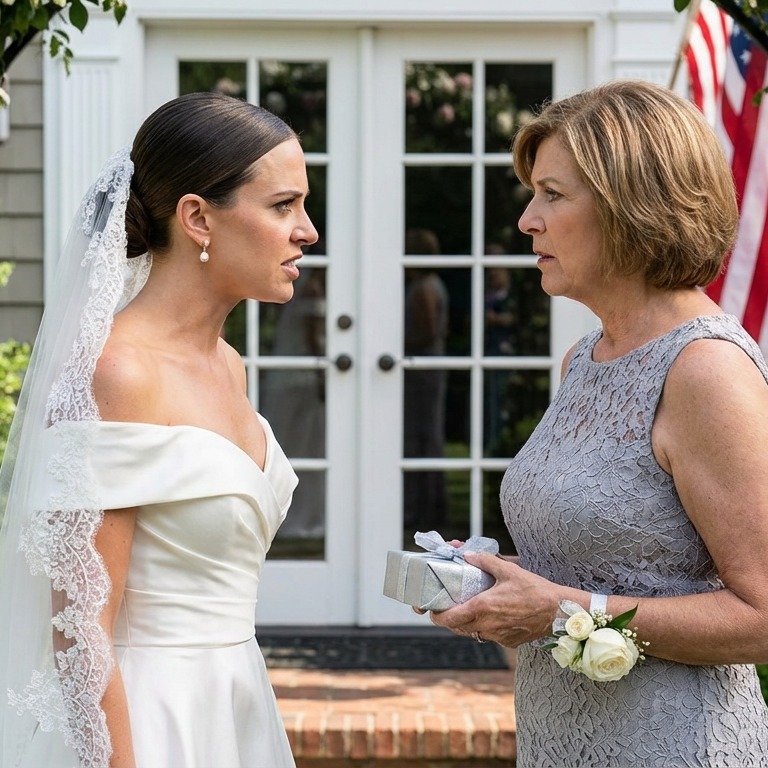
Not a tremor, not a stutter. Just my daughter standing under a whitewashed entry arch at a country venue outside Columbus, Ohio, hair pinned up in soft curls, makeup perfect, bouquet at her side, looking at me like I was someone who had wandered into the wrong conference room.
“Mom. Dad. You’re… not invited.”
That was it. No lead‑up. No excuse about limited seating or a mix‑up with the list. Just those four words delivered like a hotel clerk telling a stranger their reservation didn’t exist.
My hands tightened around the silver‑wrapped box I’d been cradling since we left the house. Tom’s shoulder brushed mine, his suit still sharp from the dry cleaner, his corsage pinned just right. I could smell the faint starch from his shirt, the lingering hint of my perfume. Behind Emily, laughter drifted from the patio where servers carried trays of champagne we’d paid for.
“We’re… what?” Tom asked quietly.
She didn’t flinch. “You’re not invited. This is my day. Please leave before it becomes a scene.”
The words hit with a temperature, not a volume. Ice cold.
Guests turned, curious. A bridesmaid with a spray tan and a too‑bright smile leaned in to whisper to Emily, then looked at us with the detached boredom of someone watching a stranger get asked to step out of line at airport security. Somewhere, the DJ tested the speakers and a pop song thumped faintly through the walls.
My throat went sand‑dry. All I could think was, Don’t drop the box. It held my mother’s necklace, the one she’d worn at her wedding in 1962, the one I’d worn at mine. Emily had spun in front of my full‑length mirror with that necklace around her little neck when she was seven, saying, “I want this when I get married, Mommy.”
She didn’t even glance at it.
“Emily,” I managed, “can we please talk someplace private?”
She shook her head, veil rustling slightly. “There’s nothing to talk about. You insisted on paying for everything, and you’ve been stressing me out for months. I need peace today. You two bring drama. I’m not doing this. Please leave.”
She said it like she was closing a customer service ticket.
Tom’s jaw locked. I saw his right hand flex, the way it did when he was working too hard not to show pain. “We came here to watch you get married,” he said. “We’re your parents.”
Her face didn’t change. Not anger, not guilt. Just a flat blankness that made my stomach twist. “You raised me,” she replied. “That doesn’t mean you own my wedding. Go home.”
She turned away before I could respond, before I could say the words catching in my chest—We paid for this. We paid for all of this—and walked toward the photographer who was already lifting his camera.
Someone laughed behind her. I couldn’t tell if it was her or the bridesmaid. Either way, it sliced straight through me.
My own child had just uninvited me from the day I’d signed every check for.
—
I used to tell myself Emily was just “independent.”
That was the word I pulled out whenever she forgot to say thank you or rolled her eyes at Christmas gifts that weren’t expensive enough. Independent. Strong‑willed. A go‑getter. The kind of traits people brag about when they talk about their daughters.
When she was sixteen, we scraped together enough to buy her a used Honda Civic from a guy Tom knew at work. Clean, safe, low miles. We surprised her with it in the driveway, a red bow from Target looped around the hood.
She had stared at it for three seconds and said, “Everyone else is getting new cars. This looks like a teacher’s car.”
Tom laughed it off. “Teachers are the backbone of America,” he joked, tossing her the keys. “You’ll be lucky if you end up driving like one.”
She took the keys and drove straight to a friend’s house without posing for a single picture.
In college, we co‑signed her loans and paid her rent the first year. We shipped care packages to her dorm in Indiana: homemade cookies, socks, a Costco‑sized carton of ramen. She called when she needed something—textbooks, money for a formal dress, a transfer when the utilities were due and she’d overspent—but rarely just to talk.
“It’s just how kids are now,” my sister used to say. “They’re busy. They love you, they’re just… busy.”
I believed her because it was kinder than the other explanation.
When Emily graduated and moved to Columbus for her first job at a marketing firm, we rented a U‑Haul, hauled boxes up three flights of stairs, built IKEA furniture until midnight. We left her fridge full, her pantry stocked, her Wi‑Fi set up, her trash bags in place.
She stood in the doorway as we left and said, “Thanks,” like she was signing for a package.
I told myself she’d appreciate it later.
Later didn’t come.
—
The wedding planning started like a fresh chance.
She called in January, voice oddly bright. “So, David proposed,” she said. “We’re thinking fall. The venues book up fast, so… can you guys help? It’s a lot.”
I heard the unspoken part: We make less than you. Weddings are expensive. I want a nice one.
“We’ll do what we can,” I said. “We’ll help.”
Somehow, between that sentence and the end of the call, “help” became “pay for practically everything.”
It happened in small increments. We toured a venue thirty minutes outside the city, a converted barn with Edison bulb strings and a view of cornfields rolling out behind it. She loved it, of course. The coordinator mentioned the price for Saturday evening, and Emily’s smile faltered for half a second.
Tom slid his hand over mine. “We can cover the deposit,” he said. “You two just focus on planning the day you want.”
The coordinator took down our information. The contract went into our names. The first payment came out of Tom’s retirement account.
Then the florist called. “I have an estimate for Emily’s order. She said you’d be the one handling payment?”
Sure, I said. Because I wanted roses for her down the aisle, and because that’s what mothers do. I readjusted some things in our budget. I used the credit card with the better points.
The DJ. The photographer. The catering company that required half down now and half the week of the wedding. Each one had my email on file and my name in the “billing contact” line.
Emily forwarded me PDFs with short notes: Can you just send this directly to them? It’s easier with your card. I’m so busy.
I told myself I was lucky to be included.
Until we weren’t.
The first sign should have been the dress fitting.
“Mom, the boutique is tiny and it’s going to be chaos,” she said over FaceTime, angle tilted so I could only see her forehead and ceiling fan. “I’ll send you photos, okay? I just want to enjoy it without a lot of opinions.”
“I wasn’t going to give a lot of opinions,” I replied. “I just wanted to see you try things on.”
“I know, I know, but it’s… it’s a vibe thing. Please don’t be offended. I’ll send pictures.”
The pictures never came.
Then came the centerpieces. I emailed the planner asking about mock‑ups, thinking I could at least peek. Emily texted back within minutes.
“Mom, don’t stress me,” she wrote. “I just want to enjoy this. We’ll figure it out.”
The phrase stung more than I expected. Don’t stress me. As if a question about flowers was an attack.
I should have heard the warning in that sentence.
—
At the venue on her wedding day, all those small warnings lined up like little flags I’d peeled off and thrown away.
The parking lot was full when we pulled in, the late‑September sky that dull Midwestern blue before the sun sinks. I watched people in suits and chiffon filing toward the barn doors, heard the murmur of conversation, smelled barbecue smoke from the caterer prepping in the back.
Tom parked the car and rested his hands on the steering wheel for a moment. “You okay?” he asked.
“I will be,” I said. I smoothed the skirt of my navy dress, touched the corsage at my wrist, made sure the silver box with the necklace was nestled safely in my lap. “It’s her wedding day. That’s all that matters.”
I believed that for exactly eight more minutes.
We hadn’t even made it to the guest table before Emily intercepted us like security.
The word “Mom” sounded strange coming from her mouth in that moment. Neutral. Transactional.
She blocked our path and lowered her voice, but not enough. People near the welcome sign started to turn.
“You’re not supposed to be here,” she said. “I thought I made that clear last week.”
“What are you talking about?” I whispered. “We never got any message.”
She exhaled sharply. “I told you on the phone that this day was for me and David. That I didn’t want stress or drama or guilt. Every time we’ve talked lately, you make it about money or how tired you are or how much you’ve done. I’m done with that. I need peace. So I’m asking you to leave.”
“We are literally holding a gift,” I said, the words coming out flatter than I expected.
“You can mail it,” she replied.
Behind her, David hovered like an extra in his own wedding. He didn’t step in. Didn’t say, “Of course they’re staying, Em, they’re your parents.” He stared at the gravel as if it was suddenly fascinating.
My cheeks burned. I was aware of every pair of eyes, of a woman I didn’t recognize giving me a look that said, Why are you making your daughter upset on her big day?
“We’re not making a scene,” Tom said quietly. “You are.”
“Then don’t,” she said. “Please leave. I’m not repeating myself.”
She pivoted toward the photographer. “Okay, let’s get the bridal party over here,” she called, her voice suddenly bright again.
Just like that, we were dismissed.
We walked back to the car under the floral arch we’d debated over in a showroom catalogue, past the rows of white folding chairs I’d counted on the invoice, past the open bar stocked with the mid‑shelf whiskey Tom had insisted on upgrading for her guests.
“Get in,” he said once we reached the car.
I slid into the passenger seat carefully, the box still in my hands. The cushions sank under me in a way that felt like a collapse.
“She threw us away,” I whispered.
Tom stared straight ahead, fingers white‑knuckled on the steering wheel. “We raised a princess,” he said, voice low. “We got an ice queen.”
A bitter little laugh escaped me before I could stop it. It hurt my own ears.
For the first time, the thought formed in a complete sentence.
We did this to ourselves.
We didn’t make it far down the highway before I heard myself say, “Pull over.”
Tom glanced at me. “You okay?”
“No,” I said. “But I will be. I need Wi‑Fi.”
He blinked. “Now?”
“Now.”
He took the next exit and pulled into a roadside diner with a faded sign and an American flag drooping on a crooked pole. The kind of place that serves bottomless coffee and pancakes the size of a plate.
Inside, the air smelled like syrup and fry oil. A teenager in a polo with the Denny’s logo led us to a sticky two‑top near an outlet. She set down laminated menus and asked what we wanted to drink.
“Coffee,” I said. “Please.”
Tom added, “Same.”
She left. I set the silver box on the table between us like a third person and pulled out my phone.
The lock screen was still a photo of Emily at five years old in a pink tutu, frosting smeared on her face. It stared back at me as I opened my email.
“Marianne,” Tom said carefully, “what are you doing?”
I scrolled to the folder marked WEDDING – EMILY. Contracts. Invoices. Confirmation emails. All with our names in the “payer” line.
“I’m doing what she asked,” I said. “She told us we weren’t invited. So we’re leaving. But our money can leave too.”
One by one, I called.
“Hi, this is Marianne Holloway. Yes, I’m the billing contact for tonight’s event at Maple Ridge Barn. I need to cancel the remainder of our agreement effective immediately.”
Polite confusion on the other end. “Ma’am, the event has already started.”
“I understand. Please process it as a same‑day cancellation. We’ll pay any fees written into the contract. But there will be no further payments authorized by me.”
The florist. “We’re mid‑setup,” she said. “Half the centerpieces are on the tables.”
“Stop where you are,” I replied. “Invoice me for what you’ve already done. Do not deliver anything else.”
The DJ. The photographer’s office. The caterer. The rentals company that had dropped off linens that morning.
Each call was a small knife slicing through a cord I hadn’t realized was wrapped around my throat.
Tom watched me for a few minutes, then pulled out his own phone and started dialing the venue manager, his voice low but firm. “This is Thomas Holloway. The person whose routing number is on your file. We’re withdrawing financial authorization. You’ll want to get a card from someone else if the event is continuing.”
Our waitress returned and set down two mugs of coffee, steam curling up between us. Her nametag said HAILEY. “Everything okay?” she asked politely.
“Not even a little,” I said. “But the coffee smells great.”
She gave a sympathetic little smile and drifted away.
By the time I finished my last call, my inbox was already filling with automated confirmations.
Payment authorization revoked.
Contract adjusted.
Balance due from client.
I opened my messages. My phone lit up with incoming notifications.
Emily – 7 missed calls.
Emily – 12 missed calls.
Unknown – voicemail.
By the time I set the phone face‑down next to the silver box, the count had climbed.
Thirty‑two missed calls.
Love had turned into line items.
—
The drive home to our subdivision in Westerville felt longer than the twenty‑five miles on the map.
Tom kept the radio off. The only sounds were the hum of the tires on the interstate and the little rattly noise our dashboard made over bumps that we’d always meant to fix.
Outside, the sky had turned that flat Ohio gray that makes everything look like it’s been washed in cold water. Inside, my thoughts stacked on top of one another until they felt heavier than my body.
I thought of eight‑year‑old Emily asking for a pony party because Lily from down the street was having one. We couldn’t afford the full setup, so Tom built a little wooden “barn” backdrop in the backyard and we hired one pony for an hour. She cried when the pony left.
I thought of the night she broke her arm in middle school. I sat upright in a plastic ER chair for twelve hours while they ran X‑rays and set the bone, then slept on the floor next to her bed for two nights when we brought her home.
I thought of her first apartment, when I spent two days cleaning out the previous tenant’s grime so she would never see it.
Each memory pressed against the one in front of it like cars in a traffic jam.
“We taught her that we would fix anything,” I said quietly.
Tom’s fingers tightened around the wheel. “We did,” he agreed. “And now she thinks ‘fix anything’ includes erasing us.”
When we pulled into our driveway, our front porch looked exactly the same as it had that morning. The mums in the planters. The little wooden sign that said WELCOME that I suddenly wanted to rip down.
I carried the silver box inside and set it in the middle of the kitchen table. The necklace inside felt heavier than gold.
Tom disappeared into his office and came back with a file box labeled EMILY – WEDDING.
He spread the papers out between us. Contracts, receipts, a printed email where she’d written, “If you guys could just handle this part, it would be a huge help.”
“We were so proud to do this,” I said. “We told everyone at church how excited we were. We never once told her no.”
“And she told us no when it counted most,” he replied.
I looked at the papers, at the box, at my husband.
“We can’t keep living like this,” I said.
That sentence felt like a door creaking open.
—
Emily’s first text came while we were washing dishes, as if doing normal chores might glue the day back together.
What is going on????
I wiped my hands and stared at the glowing screen.
Tom read it over my shoulder. “She’s not asking why she said what she said,” he muttered. “She’s asking why the party is falling apart.”
A second bubble appeared.
Mom, they just told us the caterer won’t serve dinner without another card. The DJ said his payment bounced. Did you cancel stuff? That’s insane. This is my wedding.
The word my jumped off the screen.
I typed slowly.
You told us we weren’t invited, I wrote. So we left. And we withdrew our money. That’s all.
I hovered for a second, then hit send.
Three dots flashed, vanished, flashed again.
That is so cruel, she shot back. How could you ruin the most important day of my life because your feelings were hurt? You always make everything about you.
Tom put his hand on the counter to steady himself.
“We paid for a day she decided didn’t include us,” he said. “I think that qualifies us for at least one feeling.”
The phone buzzed again and again. The missed call count ticked up. Twenty, twenty‑seven, thirty‑two.
I let it ring.
For the first time in thirty‑two years of motherhood, I chose not to answer.
—
The thing about silence is that people rush to fill it.
By morning, my phone looked like it had been in a group chat explosion. Messages from numbers I didn’t recognize. A voicemail from David’s mother asking “what exactly happened last night,” her tone sharp and offended.
Emily had apparently found another card to keep the event limping along. Someone else’s parents, maybe. Or maybe she convinced the vendors to trust her word.
Either way, the damage was done.
Not just to the wedding.
To the story she’d always told about us.
We were no longer the invisible background providers. For once, we had stepped out of frame.
Tom went to work late that day. He sat at the kitchen table with a legal pad, adding up numbers. Retirements. Savings. The check he’d written from his 401(k) for the venue deposit.
“We need professional advice,” I said. “Not just about this. About all of it. We still have her as the sole beneficiary on everything.”
He paused, pen hovering. “You’re serious.”
“I am. I don’t want decisions this big based on guilt anymore.”
Two days later, we sat in a beige office on the tenth floor of a downtown building, across from a woman in a navy suit who introduced herself as Karen Patel, estate planning attorney.
“So,” she said, clicking her pen, “tell me what brings you in.”
I took a breath. “We paid for a wedding we were asked not to attend,” I said. “We realized our daughter has come to see us as an unlimited resource instead of actual people. We’d like to make sure our assets are protected, and that no one can guilt or manipulate us into choices that harm us.”
Karen didn’t raise an eyebrow. “You’re not the first parents to sit in that chair with that story,” she said calmly. “You won’t be the last. Let’s look at what you have.”
We went through accounts, property, the modest house we still owed a little on, Tom’s pension from the county, my 401(k) from thirty years at the library.
“And your daughter is currently listed as sole heir?” she asked.
“Yes,” I said. The word tasted bitter.
“Do you want that to remain the case?”
I thought of Emily’s face in that entryway. Of her saying You bring drama like we were party crashers.
“No,” I said. “I want any inheritance to be contingent on behavior. Not blood.”
Karen nodded. “We can absolutely structure things that way. And you don’t have to justify it to anyone. You owe your child love and support. You do not owe her your retirement if she is actively harming you.”
Her matter‑of‑fact tone steadied me.
By the time we left, we had a thick folder of draft documents—new wills, a trust with strict conditions, instructions for freezing accounts in case of undue pressure.
That night, while I folded laundry, a memory surfaced so sharply I dropped a towel.
I was nineteen again, standing on the porch of my father’s new house in Dayton a few months after he’d remarried. I’d taken the Greyhound down without warning, thinking it would be a happy surprise.
His new wife had opened the door, her perfume hitting me like a wall. He stood behind her, hand on her shoulder.
“You should have called first,” he’d said. “This is our space now. Tonight isn’t a good time.”
I’d stood there on the stoop with a backpack and a cheap sweater, the weight of being uninvited from my own father’s life landing squarely in my chest.
Decades later, my daughter had looked at me with the same patient cruelty.
This is my day. You’re not invited.
The pattern had just repeated with a prettier dress.
Realizing that hurt in a different way.
—
If I thought getting our legal paperwork in order would quiet the storm, I was wrong.
The emails and calls came in waves.
From Emily: You did WHAT??? You rewrote everything without even talking to me? After everything I’ve been through, you’re just cutting me out because of one bad day? You’re unbelievable.
From David: This feels punitive and vindictive. You’re causing irreparable damage to this relationship. Don’t think there won’t be consequences.
From my older cousin in Florida: I heard what happened. She was emotional. Weddings are intense. Aren’t you taking this too far? Be the bigger person.
And then, the one that made my stomach flip.
From Emily again: You’ve always been selfish. This just proves it.
I stared at that word until the letters blurred.
Selfish.
After covering rent when she blew her budget. After paying medical bills when she needed therapy in grad school. After sending Zelle transfers at midnight because her checking account had dipped below zero. After writing tuition checks and making peanut butter sandwiches and sitting in ERs.
Selfish.
A sound came out of me that was part laugh, part sob.
Tom looked up from his recliner. “You okay?”
“She called me selfish,” I said.
He snorted. “That’s rich.”
Unsure of what to do with the feeling, I opened my laptop instead of my mouth.
I found a small, private forum for parents of adult children, the kind you have to request to join. I typed out a post under my first name only, no identifying details, just the bare bones: We paid for a wedding we were told to leave, then pulled our money and restructured our estate. Now we’re being called cruel.
I ended it with a question.
At what point are parents allowed to stop paying for their own erasure?
I didn’t expect much.
By the next morning, there were over a hundred comments.
Strangers from all over the country—Oregon, Texas, New York, Iowa—telling versions of the same story. Adult children treating them like ATMs, like Uber drivers, like emotional punching bags. Parents quietly taking it because “that’s what parents do.”
One comment from a woman in North Carolina stuck out.
You’re not selfish, she wrote. You’re late to self‑preservation. But late is still better than never.
I read that line over and over.
Late is still better than never.
—
Emily did not like being late to anything.
When she realized she was not going to talk us into reversing the legal changes, her strategy shifted.
First came the social media post.
A photo of her and David at some trendy restaurant downtown, wineglasses clinking. The caption read, “Sometimes the family you build chooses you when the family you were born into walks away. Grateful for resilient love.”
Comments poured in.
“So sorry you’re going through this.”
“You deserve better.”
“Some parents don’t know how lucky they are.”
My younger sister forwarded me a screenshot with no comment attached.
I sat at our kitchen island, phone in one hand, mug of Earl Grey in the other, and felt my pulse spike. Not just from the lies, but from the skill. Emily wasn’t just rewriting the story; she was publishing a polished edition.
My phone buzzed again. A text from a former neighbor: Saw Emily’s post… everything okay? Sending love.
Everything was not okay.
For once, I chose not to respond.
Instead, I walked out to the backyard. The rosebushes I’d planted along the fence line last spring were in full bloom, red and unapologetic, thorns and all.
I touched one gently and realized something.
You can be beautiful and still have boundaries.
—
A week after the post, a certified letter arrived.
Tom set it on the table as if it might explode. “From a law office,” he said.
My stomach tightened. I slit it open with the dullest butter knife in our drawer.
It was from an attorney representing Emily—a request for mediation regarding “recent unilateral changes to previously agreed‑upon financial arrangements,” specifically a small education fund we’d opened in her name years ago and never formally closed.
“She’s lawyered up,” Tom said.
I read the letter twice, my eyes catching on the phrases good faith and reasonable expectation.
Reasonable expectation.
We’d taught her to reasonably expect that if she wanted, we would provide.
I drove to the bank the next morning with the letter in my purse. The branch manager recognized me; we’d been coming there for twenty years.
“I’d like to close this account,” I said, sliding the paperwork across the desk.
He looked at the balance. “Are you sure?”
“Yes,” I said. “I’m sure.”
He clicked a few keys. “Done,” he said. “The funds will transfer to your primary account by end of day.”
I walked out feeling ten pounds lighter.
That afternoon, I sat in my therapist’s office for the second time in my life. The first time had been after my father’s remarriage.
“How are you?” she asked.
“Angry,” I said, surprising myself. “But also… lighter?”
We talked about patterns. About how children learn what to expect by what their parents allow. About how I had made a hobby of disappearing into everyone else’s needs.
She asked me a question that landed like a small earthquake.
“What would your life have looked like if you hadn’t made everything about providing for your daughter?”
I stared at the patterned rug.
“I don’t know,” I said quietly. “I never thought that way.”
“Maybe it’s time you start,” she replied.
—
The reconciliation attempt came wrapped in cream‑colored cardstock.
A week later, there was a knock at the door. No car in the driveway that I recognized. Just an envelope on the welcome mat when I opened it.
Inside was a reservation confirmation for four at an upscale restaurant downtown—one we used to go to for anniversaries when we were younger and money stretched further—a note in Emily’s handwriting clipped to the corner.
Let’s fix this. Friday at seven. Please come. Love, Em.
The familiar curve of her E did something funny to my chest.
I sat down on the couch and stared at the paper.
Tom walked in from the garage, wiping his hands on a rag. “What’s that?”
“An invitation to dinner,” I said. “To fix this.”
He raised an eyebrow. “Did she apologize?”
“No.”
“Did she acknowledge what she did?”
“No.”
“Then what exactly are we fixing?”
The question hung in the air.
I pictured us sitting across from her at a white‑tablecloth table, listening to her explain how weddings are stressful, how social media blew this out of proportion, how we were being dramatic. I pictured myself nodding, absorbing, apologizing for reacting at all.
My chest tightened at the thought.
I folded the reservation back into the envelope and walked to the hall closet.
Inside, on the top shelf, sat a plain black binder where we kept important papers. Wills. House deed. Insurance policies.
I slid the envelope into the binder behind the new trust documents.
It wasn’t a keepsake.
It was a record.
Friday at seven came and went. Tom grilled chicken on the patio. We ate on the back deck, listening to the cicadas, the air warm and heavy.
My phone sat on the table face‑down next to the silver box, untouched.
At eight fifteen, it buzzed.
When I flipped it over, the screen lit up.
Emily – 32 missed calls.
The number no longer made my stomach drop.
It was just a number.
—
The next morning, at the grocery store, a woman in the cereal aisle paused beside me. I didn’t recognize her at first—brown hair in a messy bun, Ohio State sweatshirt, a toddler tugging at her sleeve.
“Excuse me,” she said. “Are you Emily Holloway’s mom?”
My heart skipped. “Yes,” I said cautiously.
She smiled, but it was sad around the edges. “I thought so. I knew you looked familiar. I’m in that parents’ forum you posted in. I recognized your story when Emily started posting about her ‘toxic parents’ on Instagram.”
Heat flushed my cheeks. “Oh,” I said.
“I just wanted to say… thank you,” she said. “Your post made me rethink letting my son walk all over me just because I feel guilty. I’m sorry you’re going through this. But I’m grateful you shared.”
My throat tightened. “Thank you,” I managed.
After she walked away, I stood there between the Cheerios and the Frosted Flakes and realized something strange.
I didn’t feel ashamed.
I felt… seen.
—
By the following week, the noise started to fade.
The calls slowed. The texts from extended family tapered off. A few friends quietly sent messages that said things like, I don’t know everything that happened, but I trust you.
I still kept the silver box on the kitchen table for a while. It felt wrong to shove it in a drawer. Some mornings I’d sit with my coffee and run my finger along the edge of the paper, thinking of my mother fastening that necklace around my neck on my wedding day, her hands trembling a little.
“You know you can say no,” she’d whispered as she clasped it. “Even now. You can always say no if something doesn’t feel right.”
I’d laughed it off. “Mom, the church is full. The cake is paid for. I can’t say no now.”
She’d looked at me with a knowing sadness I hadn’t understood.
Decades later, the words floated back.
You can always say no.
One afternoon, I opened the box and lifted the necklace out. The light caught on the tiny diamonds, throwing flecks across the ceiling.
For a long moment, I just held it.
Then I walked to the hallway mirror, fastened it around my own neck, and studied my reflection.
The necklace didn’t belong to a day, or to a daughter, or to a script where parents empty their accounts and smile through humiliation.
It belonged to me.
I wore it that night when Tom and I went out for burgers at a little place off Route 3. No occasion. No reservation. Just two people eating dinner because they felt like it.
“Nice necklace,” the waitress said, setting down our plates.
“Thanks,” I replied. “It’s a family thing.”
Tom caught my eye and smiled.
—
On a quiet Sunday evening, I pulled out the black binder again and spread everything on the dining room table.
The reservation. The lawyer letters. The printed screenshots of her posts. The original wedding invoices with our names in heavy type.
In a separate manila folder, I put something new.
A letter I’d written to myself.
In it, I’d listed every major moment where I’d chosen Emily’s comfort over my own sanity and called it love. Every time I’d said yes when my whole body was screaming no. Every time I’d stayed silent to keep the peace.
I ended the letter with one line.
I love my daughter, but I love myself now, too.
I slid the letter into the folder and labeled it in neat black ink.
WHAT WE LET GO.
The label made my chest ache and expand at the same time.
When I closed the binder and put it back in the closet, the house was quiet. Not the brittle, waiting silence of the days when I jumped at every buzz of my phone.
A different kind of quiet.
The kind you get when a storm finally passes and you can hear your own breathing again.
I walked out onto the porch with a cup of tea. The sky over our little slice of Ohio was streaked pink and gold. A kid rode a bike down the cul‑de‑sac, his father jogging behind him, laughing.
My phone buzzed once on the table beside me.
A notification from the parents’ forum—someone had commented on my post.
I didn’t open it right away.
I sat there, felt the weight of the necklace against my collarbone, watched the light fade, and realized something simple and huge at the same time.
I didn’t need Emily’s apology to start healing.
She might never understand what she did. She might always tell the story in a way that makes her look like the wounded one and us like villains.
But I knew the truth.
And for the first time in my life as a mother, that felt like enough.
If you’ve ever stood on the edge of someone else’s celebration and felt yourself being escorted out of your own life, I want you to hear this from a stranger on a quiet Ohio porch.
You’re allowed to say no.
You’re allowed to step back.
You’re allowed to let your silence speak where your explanations never landed.
And when you do, when you finally put down the weight of being everything for everyone, you just might find there’s a version of you still standing there, waiting.
Not the fixer. Not the bank. Not the background character.
Just you.
Breathing.
Enough.
But life doesn’t freeze just because you finally decide you’ve had enough.
What surprised me in the weeks after that quiet porch moment wasn’t how much I thought about Emily. It was how often I didn’t. Whole mornings slipped by where my brain focused on things like what to make for dinner, whether the furnace needed a tune‑up before winter, a book someone at church had recommended. Ordinary thoughts. Not emergency ones.
I hadn’t realized how long my mind had been on call.
One Tuesday, I caught myself humming while I wiped down the kitchen counters. Nothing special, just an old hymn my mother used to hum. Halfway through the second verse, I froze, sponge in mid‑air.
I was humming.
Not because I was waiting for a text, or because I was planning how to phrase something so Emily wouldn’t get upset. Just because the house was quiet and the late‑afternoon light looked pretty on the tile.
I set the sponge down and leaned on the counter.
“I think I’m getting pieces of myself back,” I said when Tom came home that night.
He loosened his tie and kissed my cheek. “Good,” he replied. “I’d like to get to know that woman.”
His joke landed gently instead of like a jab.
Have you ever looked around your own life and realized you didn’t really see yourself anywhere in it anymore?
—
November rolled into Ohio on a gray wind.
The maple in our front yard turned the exact shade of the mums on our porch before dropping its leaves in one soggy week. Stores swapped out pumpkins for artificial garlands. The grocery aisles filled with boxed stuffing and cans of cranberry sauce.
Thanksgiving used to mean Emily.
For years, we’d driven down to whatever apartment she was renting at the time with a cooler in the trunk, hauling in turkey and sides because she “didn’t have enough oven space.” We squeezed around small tables, took photos she never posted, washed dishes while she and whatever boyfriend she had at the time scrolled through their phones on the couch.
Last year, she’d announced, “We’re doing Thanksgiving with David’s family in Cincinnati. It’s just easier.” We’d smiled and said we understood, then made a turkey for two and watched football with the sound low.
This year, she didn’t call at all.
Instead, a picture popped up in my feed—Emily and David around a long table with friends, a caption about “friends who become family” and “choosing your own tribe.” I saw my sister tagged in the comments, not in the photo.
Tom saw it over my shoulder.
“Well,” he said, “looks like we’re off the hook for bringing the green bean casserole.”
I let out a breath I hadn’t realized I was holding. “What do you want to do?” I asked.
“Whatever you want,” he replied. “We could stay home. Or we could make a reservation somewhere and let someone else do the cooking for once.”
We ended up at a small restaurant near downtown, one of those places that did a special prix fixe Thanksgiving menu. No dishes, no Costco runs, no hauling leftovers. Just us at a two‑top by the window, watching snow flurries start to drift past the streetlights.
Halfway through the pumpkin pie, Tom looked at me over his coffee.
“On a scale from one to ten,” he asked, “how guilty do you feel right now?”
I thought about it honestly. “Maybe… a three?”
“Progress,” he said.
“For you?” I asked.
He smiled. “Two.”
For the first time in decades, the holiday felt like ours.
—
Guilt doesn’t evaporate in one season.
Some mornings I still woke up with my phone in my hand, thumb hovering as if on autopilot over Emily’s name. The habit of checking her social media, of reading comments for clues, had sunk into my muscles.
I tried something new.
I put her accounts on mute.
Not blocked—the thought of that felt too final—but quiet. No more automatic updates. No more pictures shoved under my nose by an algorithm that didn’t care if my heart sped up.
Instead, I filled the space.
I joined a water aerobics class at the community center. All women around my age, some older, a few younger. We splashed in the warm pool three mornings a week while an instructor with a Bluetooth speaker shouted encouragement.
“You’re allowed to take up space,” she’d call. “Reach! Stretch!”
I hadn’t heard those words directed at my body in years. My body had been a tool—something that lifted boxes, drove miles, stood in ER hallways, carried platters.
Now it was moving for me.
One Thursday, after class, I sat in the locker room blow‑drying my hair when a woman with silver streaks through her dark ponytail sat beside me.
“You’re Marianne, right?” she asked.
“Yes,” I said, startled.
She smiled. “I recognized you from your post on that parents’ forum. I’m Lisa. My son’s twenty‑nine and still thinks I’m his personal bailout plan.”
We talked while we laced our sneakers. About boundaries. About late‑night calls. About what it felt like to say no. We exchanged numbers before we left.
On the drive home, I realized I’d just made a friend who knew me as a person first, not as Emily’s mom.
That felt like another small miracle.
—
The first “emergency” text from Emily arrived two days before Christmas.
My phone buzzed while I was standing in the laundry room, folding towels still warm from the dryer. I wiped my hands and glanced at the screen.
EMILY: Hey. I need to ask you something.
I stared at the words for a long second.
Hey.
No how are you. No I’ve been thinking about you. Just a direct line to whatever came next.
I typed back: I’m here. What’s going on?
The reply came fast.
My car died on 270 this morning and the mechanic says the engine is basically shot. It’ll be like six grand to fix and we don’t have that right now with the wedding bills and everything. Can you help? Just a loan until our taxes come back.
The old me would have already been mentally sorting through accounts.
Instead, I sat down on the closed lid of the washing machine and took a breath.
“What’s wrong?” Tom called from the living room.
“Emily’s car,” I replied. “She wants a loan.”
He appeared in the doorway, dish towel still in his hand. “Of course she does.”
“She’s stranded,” I said. Part of me bristled at how automatic his tone sounded, even though I knew where it came from.
“She’s also an adult,” he said gently. “We talked about this, Mare.”
We had. In Karen’s office. In therapy. On long walks around the neighborhood when I couldn’t sleep.
We’d promised each other that money would no longer be the default answer to discomfort.
I looked back at my phone.
Six thousand dollars.
Six thousand reasons to either repeat the past or try something new.
What would you do if your child only ever showed up in your inbox when there was a crisis and a bill attached?
My thumbs hovered over the keyboard.
Then I typed: I’m sorry your car broke down. That’s stressful. We aren’t in a position to loan money right now. I know you and David will find a way to handle it.
I reread it four times before I hit send.
Within seconds, the typing bubbles appeared.
Wow, okay, she wrote. Must be nice to suddenly have boundaries when it’s convenient for you. You had NO problem spending thousands on a wedding just to yank it all back.
I didn’t answer that.
Tom put his hand on my shoulder. “You did fine,” he said. “Better than fine.”
My heart pounded, but underneath the adrenaline was something steadier.
We hadn’t fixed it for her.
We had survived the first test.
—
The real test came in January.
Not from Emily.
From Tom’s heart.
We were watching the late news one night, the kind with more commercials than content, when he pressed a hand to his chest and frowned.
“You okay?” I asked.
“Yeah,” he said. “Just indigestion, I think. That pot roast was heavier than I thought.”
He stood to put his glass in the sink and staggered, catching himself on the back of the couch.
“That’s not indigestion,” I said, already reaching for my phone.
By the time the EMTs wheeled him out of the house, his color had gone from pink to gray. I rode in the front of the ambulance, clutching my purse, listening to the medic behind me call out numbers, terms I didn’t understand.
At the ER in downtown Columbus, they whisked him into a bay, hooked him up to monitors, drew blood. The doctor, a woman about Emily’s age, spoke calmly.
“We’re going to run some tests,” she said. “Right now, it doesn’t look like a full heart attack, but we want to be sure. You did the right thing calling 911.”
I nodded, arms wrapped around myself.
The next three hours stretched like taffy.
I called my sister. She promised to drive in the next morning. I texted our pastor. I updated a couple of close friends.
I did not text Emily.
That choice sat heavy in my stomach.
Was I punishing her? Protecting myself? Protecting Tom from a hallway scene if she showed up angry?
When they finally moved him up to a room for overnight observation, he looked tired but stable.
“Minor cardiac event,” the doctor said. “Some blockage we’ll need to address with meds and lifestyle. No permanent damage we can see. You got here in time.”
I sat beside his bed and held his hand.
“We’re not dying yet,” he said with a weak smile.
“Don’t you dare,” I replied.
He squeezed my fingers. “You know Emily will be furious I didn’t flatline dramatically enough for her story.”
“Tom,” I said, even as a reluctant laugh escaped.
He wasn’t entirely wrong.
The next morning, while a nurse was checking his vitals, my phone buzzed.
LISA: Just saw your post on the forum. Are you okay??
I frowned and opened the app.
There it was. A new thread in the same parents’ group, not from me.
From a username I didn’t recognize but with a writing style I knew too well.
Some people would rather let their own child find out about a parent’s heart attack through a cousin’s Facebook post than admit they were wrong, it read. Toxic forgiveness is still toxicity.
My lungs went cold.
Some cousin of mine, trying to be kind, must have posted a prayer request on Facebook. Emily had clearly seen it.
She hadn’t called me.
She’d gone straight to an audience.
“Of course,” Tom said when I showed him. “She found a way to make my clogged artery about her.”
An hour later, she did call.
I stepped into the hallway to answer, heart thudding.
“Hi, Mom,” she said. Her voice was tight, controlled. “Is it true?”
“Yes,” I said. “Dad had a minor cardiac event. He’s stable. They’re keeping him overnight.”
“And you didn’t think to tell me?”
I looked through the small window at Tom, watching a daytime game show with the sound off.
“I thought about it,” I said. “And then I thought about standing in this hallway while you yelled at me about the wedding or the will or how selfish we are while your father was hooked up to monitors. I decided he deserved peace.”
“So you punished me instead,” she snapped.
“This isn’t about punishment,” I said quietly. “It’s about patterns. You’ve made it clear that you see us as sources of stress, not support. I wasn’t going to bring that into a hospital room.”
She inhaled sharply. “You’re unbelievable.”
“No,” I said. “I’m finally very believable. This is who I am when I’m not bending myself into a shape that makes you comfortable.”
Silence crackled between us.
“I’m coming up there,” she said finally.
“No,” I replied.
“What do you mean, no?”
“I mean, your father is exhausted. The last thing he needs is a confrontation. If you want to drop off a card at the nurses’ station or send a text, that’s fine. But no visits today.”
“You can’t keep me from my own father,” she hissed.
“I can protect him from more stress,” I said. “And I will.”
I heard something slam on her end of the line.
“This isn’t over,” she said, and hung up.
I leaned against the beige hospital wall and let my head thump back gently.
We were done performing as grateful villains in her story.
—
Tom came home with a pharmacy’s worth of new prescriptions and a stack of pamphlets about heart‑healthy diets.
“Looks like we’re really those people now,” he said, poking a fork at his grilled chicken instead of the burgers he would have preferred.
“Those people who get more years,” I countered. “I’ll take it.”
Emily didn’t call again.
She texted once—Hope you’re okay—three days later.
Tom replied with a simple: I am. Thank you for checking.
That was it.
The distance between what I wanted—a daughter who rushed to our side because she loved us—and what I had—a daughter who rushed to her followers because she needed sympathy—felt like a canyon some days.
Other days, it felt like a moat I’d finally stopped trying to cross.
Have you ever found yourself standing at the edge of a gap like that, realizing you were the only one building bridges while the other person kept lighting matches?
—
Spring came on slow feet.
The roses along the fence fattened into buds. The community center posted a flyer about a gardening workshop. I signed up without thinking of how it would look on anyone’s social media.
Life shrank and expanded at the same time.
I started going to a book club at the library where I used to work. One evening, a woman in her thirties mentioned casually, “My mom drives me crazy, but she’s always there when I need her.”
I felt a familiar pang, then noticed what came next.
She rolled her eyes. “I guess I take advantage,” she said. “I just assume she’ll babysit, or send money if we’re short. I should probably stop doing that.”
Another woman nodded. “You’ll miss that when it’s gone.”
They all laughed lightly, the way you do when you’re talking about something true and uncomfortable.
I went home and wrote in my journal for the first time in years.
Not about Emily.
About me.
I wrote that I loved the smell of tomato plants. That I liked hearing the high‑school marching band practice down the hill on Friday nights. That I wanted to take a trip with Tom to somewhere we’d never been—maybe Asheville, or the Smoky Mountains.
I realized I’d been answering the question Who am I? with I’m Emily’s mother for so long that I’d forgotten there were other answers.
—
On the one‑year anniversary of the wedding we didn’t attend, I woke up before the alarm.
The date flashed on my phone.
Tom rolled over and squinted at me.
“You okay?” he mumbled.
“I am,” I said, surprised to find it was mostly true.
We made coffee and sat at the kitchen table. The silver box was no longer there; the necklace hung in my jewelry organizer, ready whenever I wanted to wear it.
“Do you ever think about how that day could have gone?” I asked.
“Every now and then,” he said. “Then I remind myself it would have been the same story with better lighting.”
He wasn’t wrong.
My phone buzzed.
A notification from the parents’ forum.
Someone had replied to the original post I’d written months ago.
Just wanted to update, the commenter wrote. I finally told my daughter no when she demanded I cosign on a condo I couldn’t afford. She didn’t talk to me for three weeks. Then she figured it out on her own. I’m proud of both of us.
I smiled.
Then, on impulse, I wrote a follow‑up of my own.
It’s been a year since we walked away from a wedding we paid for but weren’t allowed to attend, I typed. In that time, we’ve set up legal protections, closed old accounts, survived a heart scare, and learned how to have holidays without our daughter at the center. She’s still angry. She may always be. But I’m less afraid of her anger now than I was afraid of disappearing.
I ended with this:
If you’re where I was a year ago, here’s what I wish someone had told me—loving your child and letting them live with the consequences of their choices are not opposites. Sometimes they’re the same thing.
I hit post.
—
Emily didn’t call that day.
She did, however, post an anniversary picture—her in the wedding dress I realized now wasn’t the one we’d paid for, David in his suit, a simple arch behind them. The caption read, “One year of choosing us, no matter who walked away.”
The comments were exactly what you’d expect.
“So proud of you.”
“Some people don’t deserve to be in your life.”
“You’ve come so far.”
I read them, felt the familiar twist, then closed the app.
Tom came in from the yard, dirt on his knees.
“Want to go to that farmers market in Clintonville?” he asked. “I heard they’ve got homemade pierogies.”
I thought about sitting at home refreshing a screen versus wandering through booths of produce and local honey.
“Yeah,” I said. “Let’s go.”
We spent the afternoon sampling things, talking to strangers about tomato varieties and rain barrels. No one there knew who Emily was. No one cared.
They just saw us.
—
Months later, on a random Tuesday, an email landed in my inbox.
Subject line: A long overdue explanation.
My chest tightened as I clicked.
It was from Emily.
She’d written paragraphs about how overwhelmed she’d been planning the wedding, about how David’s parents had complained that we were too involved, about how every conversation with us “felt like pressure.” She wrote about feeling like she owed us a perfect performance and how telling us to leave was “the only way she knew” to take control.
She mentioned therapy. How her counselor had gently suggested she might have handled things differently. She admitted she’d been cruel. She also spent two paragraphs insisting we’d “pushed her into that corner” with our expectations.
It was an apology and a defense braided together.
At the end, she wrote:
I don’t know how to fix what I broke, but I don’t want to pretend it didn’t happen anymore. I also don’t want money or inheritance or anything else from you. I just… don’t want us to be enemies.
I sat there, staring at the screen, feeling more tired than angry.
Tom read it over my shoulder.
“Well,” he said, “that’s… something.”
“It is,” I agreed.
“Do you want to respond?”
I thought about it for a long time.
Finally, I typed back.
Thank you for writing this, I began. I’m glad you have someone to talk to. I agree that what happened at the wedding can’t be undone. I also agree that we can’t pretend it didn’t happen.
I laid out, in simple sentences, what we’d done to protect ourselves. That the legal changes weren’t about punishing her, but about making sure we didn’t keep giving beyond what we could survive. I told her I was open to a relationship that didn’t revolve around money or guilt.
I ended with this:
If we’re going to have any kind of relationship going forward, it has to be one where we both see each other as people, not as villains or resources. That starts with smaller conversations, not big performances. If you ever want to try that, we can talk.
I hit send.
Days passed.
No reply.
Then, one evening as Tom and I were closing up the house for the night, my phone buzzed.
Okay, Emily wrote. Smaller conversations. I can try.
It wasn’t forgiveness.
It wasn’t a fairy‑tale reunion.
It was a beginning on different terms.
—
We met for coffee in a busy shop near campus, neutral ground.
I wore the necklace that day, not as bait, not as a test, just because it made me feel grounded.
Emily came in wearing a coat I’d never seen, her hair longer, a little messier. She looked older than her thirty‑two years and younger at the same time.
“Hi,” she said, standing awkwardly beside the table.
“Hi,” I replied.
She glanced at the necklace, then away.
“I’m not going to rehash the whole wedding,” she said once we’d ordered. “My therapist says that’s not helpful unless we both want to. I just… wanted to see you.”
“That’s a start,” I said.
There were long pauses. We talked about little things first—her job, the new project she was on, the potholes on High Street, the price of eggs.
At one point she sighed.
“Dad’s okay?” she asked.
“Yes,” I said. “He’s walking more. Switched to decaf half the time. Complains about it daily.”
A corner of her mouth tugged up.
“That sounds right,” she said.
We didn’t solve anything monumental at that table.
We did, however, leave without a scene.
As we stood to go, she hesitated.
“Mom?” she said.
“Yes?”
“If I ever get married again—” She stopped herself, shook her head. “That’s not what I meant. I just… if there’s ever another big thing in my life, I want to do it differently with you. I don’t know how yet. I just know I don’t want a repeat.”
“Neither do I,” I said.
We walked out into the Ohio wind, both of us squinting against the cold.
I didn’t know what would come next.
But for the first time, I wasn’t tempted to offer money or fixes as a shortcut.
I was content to see if she could walk the distance on her own two feet.
—
If you’ve read this far, maybe some part of my story brushed up against yours.
Maybe it was the moment under the floral arch when my own child told me I wasn’t invited to the day I’d helped build.
Maybe it was the coffee at the roadside diner, contracts pulled up on my phone while thirty‑two missed calls lit the screen.
Maybe it was the chair in the lawyer’s office, hearing the words, “You don’t have to justify protecting yourselves,” and realizing you’d been waiting your whole life for that permission.
Maybe it was the hospital hallway, or the silver necklace in the mirror, or the simple act of saying no to a six‑thousand‑dollar “loan” that would have gutted your savings and your soul.
Which moment hit you the hardest?
If we were sitting across from each other right now in some quiet corner of a coffee shop in Ohio, I’d also want to ask you this:
What was the first boundary you ever set with your own family, the first time you chose your peace over their expectations?
Did it come in a shout, or in a quiet sentence, or in the simple decision not to pick up the phone?
Whatever it looked like, I hope you know this now in a way I wish I’d known sooner.
You are allowed to love people and still step back.
You are allowed to be generous without being an endless well.
You are allowed to be someone other than the hero or the villain in someone else’s story.
You are allowed, simply, to be.
Breathing.
Enough.
Website Disclaimer
The information provided on this website is for general informational and educational purposes only. While we strive to ensure that all content is accurate and up to date, we make no guarantees regarding the completeness, reliability, or accuracy of any information published.
The views and opinions expressed in articles belong to their respective authors and do not necessarily reflect the views of this website. Any action you take based on the information found on this website is strictly at your own risk. We will not be liable for any losses, damages, or inconveniences arising from the use of our content.
Some articles may contain opinions, third-party information, or external links. We do not endorse or guarantee the accuracy of content on external websites and are not responsible for their practices or policies.
All content on this website is provided in good faith and is intended for informational purposes only. Readers are encouraged to verify information independently and seek professional advice where appropriate.