The conference room had gone completely silent.
Twelve pairs of eyes stared at me as my phone vibrated for the third time in thirty seconds. I tried to ignore it, continuing my presentation on quarterly financial projections, but the buzzing felt like a drill against my hip. My manager, Richard, gave me a pointed look. I was two slides away from finishing when my phone rang out loud this time, the ringtone echoing off the glass walls.
“I’m so sorry,” I said, my cheeks burning as I pulled the phone from my blue blazer pocket.
Preston’s name flashed across the screen.
My husband never called during work hours. Never. We had an understanding about that.
Something must be wrong.
“Excuse me for just one moment,” I said, stepping into the hallway.
My heart hammered in my chest as I answered.
“Preston, is everything okay? Are you hurt?”
“Camila?” His voice was different. Unfamiliar. “I need you to listen very carefully.”
“What’s wrong? What happened?”
“Nothing’s wrong. Everything is finally right.”
He laughed, but it wasn’t the warm sound I’d known for eight years. This laugh had edges to it—sharp and cruel.
“My grandmother passed away two weeks ago.”
“Oh, honey, I’m so sorry. Why didn’t you tell me? We should have gone to the funeral together.”
“I didn’t want you there. But here’s the important part, so pay attention.” He didn’t even pause. “She left me everything. Millions, Camila. Seven point three million to be exact. Can you believe that? All those years she lived in that modest little house and she was sitting on a fortune.”
I pressed my back against the wall, trying to process his words.
“That’s incredible, Preston. I know how much you loved her. This must be bittersweet for you.”
“Bittersweet?” He sounded almost offended. “Oh, this is the best thing that’s ever happened to me.”
He paused, and I could hear a woman’s voice in the background, followed by his muffled laughter.
“Now, here’s what you need to do. When you get home today, I want you to pack your things. Your clothes, your shoes, whatever personal items you need. You have two hours.”
The floor seemed to tilt beneath my feet.
“What are you talking about, Preston? This isn’t funny.”
“I’m not joking. Get out of my house. It’s my house, Camila. I bought it before we got married. Remember? My name is on the deed. You have no claim to it. Pack your stuff and get out.”
“Are you having some kind of breakdown? Did something happen? Let me come home and we can talk about this.”
“There’s nothing to talk about. I’ve spent eight years tied to you and I’m done. I’m finally free. I can have the life I actually want now.”
“The papers will be on the kitchen table when you get home. Sign them. My lawyer says this should be quick since we kept our finances separate.”
My throat closed up. I couldn’t breathe.
“Preston, we’re married. We took vows. For better or worse, remember? I know this is a lot of money and maybe you’re feeling overwhelmed, but we need to discuss this like adults.”
“I’m discussing it right now. You’re out. Sign the papers. Don’t make this difficult.”
That woman’s voice again, closer now, whispering something I couldn’t make out.
“I have to go. Two hours, Camila. Don’t test me on this.”
The line went dead.
I stood in that hallway for what felt like hours, but was probably only minutes. My presentation materials were still in the conference room. My laptop was still connected to the projector. Twelve colleagues were still waiting for me.
But all I could think about was Preston’s voice—so cold and final, like I was a stranger. Like eight years of marriage meant nothing.
“Camila?” Richard appeared in the doorway. “Is everything all right?”
“I need to go,” I heard myself say. “It’s a family emergency. I’m sorry about the presentation.”
“Don’t worry about it. Take care of whatever you need to take care of.”
I gathered my things in a daze, barely registering the concerned looks from my co-workers.
The drive home took twenty minutes, but I don’t remember any of it. My hands gripped the steering wheel so tight they ached. My mind kept replaying Preston’s words.
Get out of my house. Sign the papers. I’m finally free.
Our house looked exactly the same as it had when I left that morning. The white fence I’d painted last summer. The garden I’d spent every weekend tending. The porch swing where we’d sat together drinking coffee on lazy Sunday mornings.
All of it looked perfect and normal, like my world wasn’t crumbling into dust.
I walked through the front door with my key, half expecting to find Preston waiting with an apology, telling me it was all a terrible joke.
Instead, I found silence.
The living room was emptier than it should be. His gaming console was gone. The photo of us from our honeymoon in Hawaii had been removed from the mantle. The bookshelf held gaps where his favorite novels used to sit.
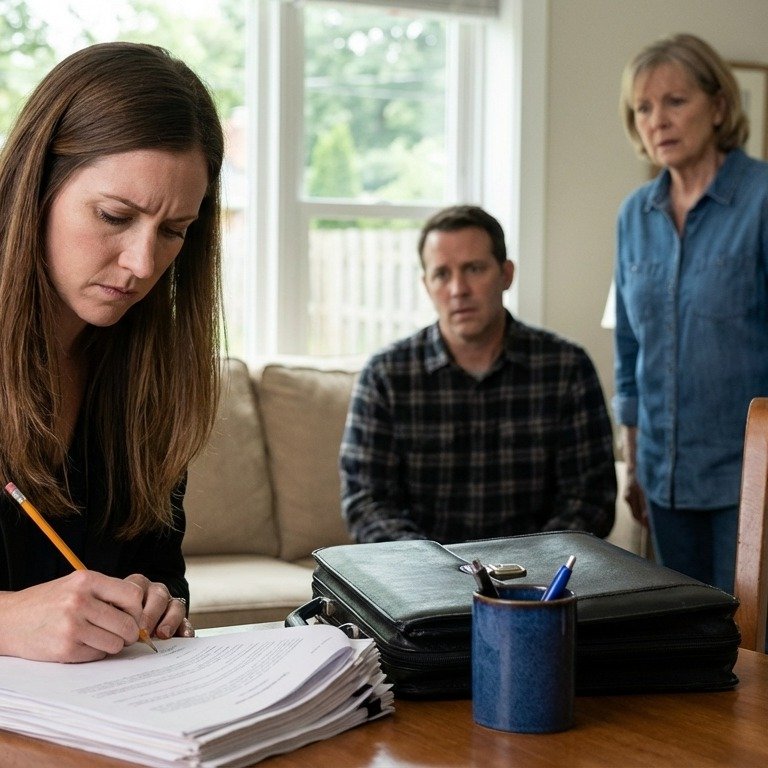
On the kitchen table, exactly where he’d said they’d be, sat the divorce papers.
I picked them up with shaking hands and read through them. The language was cold and legal, reducing eight years of marriage to a list of assets and divisions.
He was keeping the house. The cars were split. Our savings account—which wasn’t much—would be divided fifty-fifty. There was no mention of his inheritance.
A sticky note was attached to the signature page in Preston’s handwriting.
Sign here.
Lawyer says we can be done in 60 days if you don’t fight it.
I sat down hard in one of the kitchen chairs.
This was really happening.
My husband of eight years was throwing me away like garbage because he’d come into money.
I thought about our wedding day, how he’d cried when I walked down the aisle. I thought about the thousands of small moments that made up a marriage—making breakfast together, folding laundry while watching television, holding hands during scary movies, fighting about whose turn it was to take out the trash.
All of it apparently meaningless.
The woman’s voice I’d heard in the background—that was the piece that made this all make sense. Preston wasn’t just leaving me for money.
He was leaving me for someone else.
Someone he could now afford to impress with his newfound wealth.
I don’t know how long I sat there. The sun moved across the kitchen floor. Shadows lengthened. My phone rang twice, but I ignored it.
Eventually, I stood up and walked through the house one more time.
In the bedroom, I found more evidence. The closet on Preston’s side was completely empty. The bathroom counter where his shaving kit used to sit was bare.
He’d already moved out.
This wasn’t a sudden decision made in the heat of emotion. He’d been planning this.
In the back of the closet, shoved behind my winter coats, I found a shoebox. Inside were receipts from restaurants I’d never been to, hotel rooms in the city, jewelry purchases from stores I’d never shopped at.
The dates went back six months.
Six months of lies.
Six months of him building another life while I came home every day thinking everything was fine.
My phone rang again.
This time, I answered.
“Camila, finally.” Relle’s voice was worried. “I’ve been trying to reach you for hours. Are you okay?”
“Preston wants a divorce,” I said flatly. “He inherited millions from his grandmother and now he wants me gone.”
Relle was silent for a beat.
Then: “I’m coming over right now. Don’t move. Don’t do anything. I’ll be there in fifteen minutes.”
But I couldn’t wait. I couldn’t sit in this house surrounded by the ghost of my marriage for another second.
I grabbed a pen from the drawer and walked back to the kitchen table. The divorce papers sat there waiting. My hand hovered over the signature line.
I thought about fighting. I thought about calling a lawyer, making demands, making Preston pay for this betrayal.
Then I thought about dignity—about not clinging to someone who clearly didn’t want me. About not giving him the satisfaction of seeing me beg or cry or fight for scraps.
I signed my name in clear, steady letters.
Camila Rivers.
Then I wrote a note on the back of his sticky note.
Good luck. You’ll need it.
I packed two suitcases with clothes, grabbed my laptop and important documents, and walked out of that house without looking back.
Relle met me in the driveway, her face stricken when she saw the suitcases.
“You signed them?” she asked quietly.
“I signed them,” I confirmed.
“Camila, you should talk to a lawyer first. There might be things you’re entitled to.”
“Let him have it all,” I said, loading my suitcases into my car. “Let him have the house and his millions and whatever woman he’s been sneaking around with. I don’t want any of it.”
Relle grabbed my arm.
“Where are you going to go?”
“I don’t know. A hotel tonight, I guess. Then I’ll figure it out.”
“No. You’re coming to stay with me. My guest room is yours for as long as you need it.”
I wanted to argue—to maintain my independence, to not be a burden.
But the truth was, I had nowhere else to go.
So I followed Relle’s car across town to her apartment, carrying the shattered pieces of my life in two suitcases and wondering how everything had fallen apart so completely in the space of a single phone call.
Relle’s guest room was small but clean, with pale green walls and white curtains that let in the morning sun.
I woke up on that first day disoriented, reaching for Preston before remembering he wasn’t there.
Would never be there again.
The realization hit me fresh like a physical blow to the chest.
I stayed in bed for hours. Relle checked on me twice, bringing coffee and toast that I couldn’t eat.
My phone buzzed constantly. Text messages from Preston’s lawyer confirming receipt of the signed papers. An automated message from our bank about account changes. Three calls from my mother that I let go to voicemail.
I couldn’t explain this to her yet. Couldn’t say the words out loud.
By afternoon, Relle had had enough of my wallowing.
“Get up,” she said, walking into the room and opening the curtains wider. “I’m not letting you rot in this bed.”
“I’m not rotting. I’m processing.”
“You’re hiding. There’s a difference.” She sat on the edge of the bed, her expression softening. “Look, I know this is terrible. I know Preston is a complete piece of trash for what he did, but you’re Camila Rivers. You’re the woman who graduated top of her class, who built a career from nothing, who runs five miles every morning before work. Where is that woman?”
“She got thrown away like garbage by her husband.”
“No. She got freed from a man who didn’t deserve her.” Relle stood up. “Get in the shower. We’re going out.”
“I don’t want to go out.”
“I don’t care what you want. You need groceries for this room. You need to move your body. You need to remember that there’s a whole world outside of Preston and his betrayal.”
I wanted to argue, but Relle had that look on her face that meant she wouldn’t budge.
So I dragged myself into the shower and stood under water so hot it turned my skin pink. I scrubbed at my body like I could wash away the humiliation, the hurt, the feeling of being unwanted.
When I emerged, Relle had laid out clothes on the bed—a red sweater and jeans.
“Nothing black,” she said firmly. “You’re not in mourning. You’re in transition.”
We went to the grocery store, then to Target for basic supplies I’d need. Walking through the aisles felt surreal. Life was continuing like normal for everyone else. People bought cereal and laundry detergent and argued about which brand of coffee was better.
Meanwhile, my entire existence had been upended.
In the checkout line, I saw them.
Preston and her.
They were three lanes over, laughing together as they loaded expensive steaks and wine onto the conveyor belt.
The woman was younger than me, maybe late twenties, with long auburn hair and designer clothes. She had her hand on Preston’s arm, leaning into him the way I used to—the way a woman does when she’s comfortable with someone, when she has history with them.
Natalie Brooks.
I knew her name because I’d found it on those receipts.
Jewelry purchased for Natalie. Hotel room for two under Preston and Natalie. Dinner reservations for Mr. Preston Rivers and guest.
Preston looked different—happier.
He wore a new leather jacket that probably cost more than my monthly salary. His hair was styled differently, shorter, and more trendy. He was laughing at something Natalie said, his whole face lit up in a way I hadn’t seen in months.
“Don’t look at them,” Relle said quietly, stepping in front of me to block my view. “They’re not worth your energy.”
But I couldn’t look away.
I watched Preston pull out his credit card—the one linked to his new fortune—and pay for their groceries without even checking the total.
I watched Natalie kiss his cheek.
I watched him put his arm around her waist as they walked toward the exit.
Then Preston’s eyes met mine.
For a second, something flickered in his expression—guilt, maybe, or surprise.
But then Natalie said something and he looked away, dismissing me like I was a stranger.
Like we hadn’t spent eight years building a life together.
“Camila, breathe,” Relle said, because apparently I’d stopped.
“I’m fine,” I managed.
“You’re not fine. You’re shaking.”
She was right. My hands were trembling as I loaded my items onto the belt.
The cashier, an older woman with kind eyes, seemed to sense something was wrong. She worked slowly, giving me time to collect myself.
“First time grocery shopping after a breakup?” she asked gently.
“How did you know?”
“Seen that look before. My daughter had it after her divorce.” She handed me my receipt. “It gets better. Not today, maybe not tomorrow, but it does get better.”
Back at Relle’s apartment, I finally let myself cry.
Real, ugly crying that came from somewhere deep in my chest.
Relle held me and didn’t say anything. Just let me get it all out.
“Six months,” I said when I could finally speak. “He was with her for at least six months. Maybe longer.”
“How did I not know? How did I miss all the signs?”
“Because you trusted him. Because you’re not the kind of person who goes through their partner’s phone or questions every late night at work.” She brushed my hair back. “That’s not a flaw, Camila. That’s you being a good person.”
“Being a good person got me divorced and homeless.”
“You’re not homeless. You’re staying with your best friend who loves you.” Relle grabbed her laptop. “Now, let’s start looking at apartments. You need your own space.”
We spent the evening scrolling through rental listings. Everything in my budget was either too far from work or in questionable neighborhoods.
I’d been so focused on saving money—putting everything into our joint savings account that was now being split. Joint savings that was maybe ten thousand total because Preston had always said we needed to be careful with money.
Meanwhile, he’d been spending on hotels and jewelry for Natalie.
My phone rang.
Preston’s name appeared on the screen.
“Don’t answer it,” Relle said immediately.
But I was curious. I answered and put it on speaker.
“Camila.” Preston’s voice was clipped. “My lawyer says you signed the papers. Good. That makes this easier.”
“I signed them.”
“I need you to drop off your house keys. You can leave them in the mailbox.”
“Hello to you too, Preston.”
“I don’t have time for small talk. Do you still have your keys or not?”
“I have them.”
“Great. Mailbox. Tomorrow. Don’t come to the door. Natalie will be there and I don’t want any drama.”
Something inside me snapped.
“Drama. You throw me out of our home after eight years of marriage and you’re worried about drama.”
“Former home,” he corrected, like that word mattered. “And yes, I’d like to keep this civil. You signed the papers without fighting, which I appreciate. Let’s just finish this cleanly.”
“Who is she, Preston? How long has this been going on?”
He sighed like I was being tedious.
“Does it matter?”
“Yes, it matters. I deserve to know how long you’ve been lying to me.”
“Natalie and I met about a year ago. She works at my office. We connected. These things happen, Camila. People grow apart.”
“A year.”
An entire year of lies.
An entire year of coming home to me while building a life with someone else.
“You could have been honest. You could have asked for a divorce before all of this. Why wait until now?”
“Because now I can afford to.” His voice held no shame. “Look, I’m not trying to be cruel, but let’s be real. Our marriage was fine, but it wasn’t great. We were comfortable. That’s not the same as being happy. Now I have the money to start over—to have the life I actually want.”
“You should be happy for me.”
“Happy for you.”
“This is better for both of us. You’ll see that eventually. You’ll meet someone else. Someone more suited to you.”
He paused.
“Natalie is pregnant.”
The world stopped.
“What?”
“She’s pregnant. Three months. We’re getting married next month.”
“That’s another reason I needed this divorce to go through quickly. So just drop off the keys and let’s both move on with our lives.”
He hung up.
I sat there holding the phone, unable to process what I’d just heard.
Pregnant. Getting married next month.
Preston was replacing me in every possible way.
And he’d done it so quickly, so completely—like our eight years together were nothing more than a practice run for his real life.
“That absolute piece of garbage,” Relle said.
“Camila, I’m so sorry.”
“He moved on before he even left,” I whispered. “He had a whole other life ready and waiting. I was just an obstacle to get rid of.”
“No. You were his wife. He’s the one who broke those vows. He’s the one who lied and cheated and acted like a coward. None of this is your fault.”
But it felt like my fault.
It felt like I should have been better somehow—more interesting, more exciting, enough to make him want to stay.
I spent that night lying awake, replaying every moment of our marriage, looking for the point where I’d lost him, looking for the moment everything went wrong.
Three days later, I was still staying with Relle and still looking for an affordable apartment. I’d gone back to work, moving through my days like a robot—smile at colleagues, review financial reports, attend meetings, ignore the pitying looks from people who’d somehow heard about my divorce.
Relle insisted I talk to a lawyer before finalizing everything.
“Just to make sure Preston isn’t screwing you over,” she said. “Get a second opinion.”
I resisted because I didn’t want to fight, didn’t want to drag this out.
But Relle made an appointment anyway with her college friend Jerome, who worked at a family law practice downtown.
Jerome’s office was on the tenth floor of a glass building that overlooked the city. The reception area was decorated in cool blues and grays—professional, but not cold.
Jerome himself was tall and broad-shouldered with closely cropped hair and an easy smile that put me at ease immediately.
“Camila, it’s good to finally meet you. Relle talks about you all the time.” He shook my hand and gestured to a chair. “Though I wish it was under better circumstances.”
“Me too.”
He sat across from me, pulling out a legal pad.
“Why don’t you walk me through what happened? Start from the beginning.”
I told him everything. The phone call at work. Coming home to find divorce papers ready. Preston’s inheritance. Natalie. The pregnancy. Signing the papers without thinking because I just wanted it to be over.
Jerome took notes, his expression growing more serious as I talked.
When I finished, he was quiet for a long moment.
“Did Preston tell you anything about this inheritance before he filed for divorce?” he asked.
“No. I didn’t even know his grandmother had passed away until he called me that day.”
“And you said the inheritance was seven point three million.”
“That’s what he told me.”
Jerome pulled up something on his computer, typing quickly.
“What was his grandmother’s name?”
“Eleanor Rivers. She lived in Virginia. Preston visited her a few times a year, but I only met her once at our wedding.”
More typing. Jerome’s frown deepened.
“When did she pass away?”
“Preston said two weeks before he called me. So about three weeks ago.”
Jerome stared at the screen like it offended him.
“Okay,” he said slowly. “Now tell me—did Preston say anything like, ‘You’re not entitled to anything’ or ‘We were barely even married anymore’ when he threw you out?”
“Yes,” I said, voice flat. “He said I wasn’t entitled to anything. That we were just going through the motions. That I should move on.”
Jerome’s jaw tightened.
“And he said this after he told you about the inheritance.”
“Yes.”
He leaned back.
“Camila… I want to see the will.”
Two weeks later, we sat in his office again as he walked me through the contents.
“Here’s the relevant section,” he said, pointing to a paragraph highlighted in yellow. “It reads: ‘Should my grandson Preston Rivers be married at the time of my death, I direct that fifty percent of my estate be transferred to a trust for the benefit of his spouse, in recognition of the partnership of marriage and the support a spouse provides.’”
“Fifty percent?” My voice barely worked.
He nodded.
“That’s three point six five million.”
She really wanted me to have half.
I didn’t even realize I was whispering until Relle’s hand found my shoulder.
“More than that,” Jerome said quietly. “She set it up as a trust, which means it would be protected. Preston couldn’t touch it or control it. It would be yours to manage.”
Jerome flipped to another page.
“There’s more. Eleanor included a letter with the will written to whoever would execute the estate. Want to hear it?”
I nodded.
Jerome cleared his throat and read.
“To whom it may concern. I am writing this letter to clarify my intentions regarding my estate. My grandson Preston is a good man, but he can be thoughtless with money and relationships. I have watched him over the years and I worry about his tendency to prioritize his own desires above the needs of others.”
“When Preston told me he was marrying Camila, I was skeptical. But when I met her at their wedding, I saw something genuine in her. She is steady, hardworking, and kind. The kind of person who will stand by Preston even when he doesn’t deserve it.”
“If Preston is still married to Camila when I pass, it will be because she has put in the work to maintain that marriage. She deserves to be compensated for that labor and loyalty. I am therefore directing that half my estate go to Camila directly in trust so that she will always have security regardless of what Preston chooses to do with his half.”
“I do this not to punish Preston, but to honor Camila’s contribution to his life. She has earned this.”
The letter was signed and dated two years ago.
I couldn’t speak.
Tears ran down my face as Jerome pushed a box of tissues across the desk.
“Eleanor saw you, Camila,” he said gently. “She understood what you were giving to that marriage. And she wanted to make sure you were protected.”
“Preston knew about this letter. His lawyer definitely knew. Whether they told Preston the full truth or whether Preston chose to ignore it, I can’t say. But this letter makes your case ironclad. Eleanor’s intentions were crystal clear.”
“What happens now?” My voice sounded like it belonged to someone else.
“Now we present this to the judge. We show that Preston acted in bad faith by concealing this information and rushing you into a settlement that violated his grandmother’s explicit wishes.”
“The judge will almost certainly rule in your favor.”
“Preston is going to be furious.”
“Let him be furious. He brought this on himself.” Jerome closed the file. “Camila, I need to prepare you for what’s coming.”
“Preston’s lawyers are going to try to make you look bad. They’ll say you’re a gold digger who only wants money. They might dig into your personal life, try to find anything they can use against you.”
“It’s going to get ugly.”
“I don’t care,” I said, and I meant it.
“Eleanor wanted me to have this. I’m not backing down.”
Over the next month, Preston’s legal team did exactly what Jerome predicted.
They filed motions claiming I’d been a bad wife, that I’d neglected Preston, that our marriage had been failing long before the inheritance. They produced statements from Preston’s friends saying I was cold and distant.
Jerome countered with bank statements showing I’d paid for household expenses Preston couldn’t cover. He presented emails from Preston’s own family members talking about how much they liked me. He gathered character witnesses who testified to my work ethic and integrity.
The legal battle consumed my life.
I spent evenings reviewing documents with Jerome, weekends preparing for depositions, lunch breaks on the phone with the estate attorney who was managing Eleanor’s will.
It was exhausting and stressful, but it was also clarifying.
I’d spent the first two weeks after Preston left feeling like a failure, like I’d somehow caused the divorce by not being enough.
But the more I dug into the inheritance and Eleanor’s wishes, the more I realized Preston’s leaving had nothing to do with me.
It had everything to do with his own selfishness and greed.
Relle watched me transform from a distance.
“You’re different,” she observed one night over dinner. “Stronger.”
“I’m angrier,” I corrected.
“Anger isn’t always bad. Sometimes it’s the fuel you need to fight for yourself.”
She was right.
The anger kept me going when I wanted to quit. When the legal fees piled up, when Preston sent nasty text messages calling me every name he could think of.
The anger reminded me that I deserved better.
Jerome managed to schedule a hearing for two months out.
In the meantime, I found a small apartment within my budget. It was a one-bedroom with old carpets and a kitchen that hadn’t been updated since the ’90s, but it was mine.
Relle helped me move in and we celebrated with cheap wine and pizza on my living room floor.
“To new beginnings,” Relle toasted, raising her plastic cup.
“To fighting for what’s mine,” I countered.
We clinked our cups together, and for the first time in months, I felt like maybe I was going to be okay.
More than okay.
I was going to win.
The funny thing about fighting for yourself is that it forces you to remember who you are.
I’d lost myself somewhere in those eight years with Preston. I’d become smaller, quieter, more accommodating. Always putting his needs first—his career, his comfort.
I’d convinced myself that’s what marriage meant.
Now living alone in my small apartment and preparing for court, I started to rediscover the person I’d been before Preston—the person who’d graduated at the top of her class, who’d landed a competitive job through sheer determination.
I started running again. Not the obligatory jogs I’d done with Preston, where he’d complain about the heat or the distance.
Real running.
Five miles became seven, then ten. I ran along the river trail at dawn, watching the sun come up over the water, feeling strong and capable.
Work noticed the change, too.
Richard called me into his office six weeks after the divorce papers were signed.
“Camila, I want to talk to you about something,” he said, gesturing for me to sit. “I know you’ve been dealing with personal issues lately. You’ve handled it with incredible professionalism.”
“Thank you. I’m trying my best.”
“It shows. Which is why I want to offer you a promotion. Senior financial analyst position just opened up. Comes with a salary increase and your own team. I think you’re ready for it.”
I stared at him, momentarily speechless.
“I’m ready for it.”
“You’ve been ready for it for a while. To be honest, I should have promoted you a year ago, but you seemed content where you were, so I didn’t push.” He leaned back in his chair. “Something’s changed in you recently. You’re more assertive, more confident. Whatever you’re dealing with in your personal life, it’s making you a better professional.”
The irony wasn’t lost on me. Preston leaving had devastated me, but it had also freed me to be more of myself.
“I’d love the promotion,” I said. “Thank you for seeing my potential.”
“You’re the one doing the work, Camila. I’m just recognizing it.”
The raise would help with legal fees, which were adding up faster than I’d anticipated. Jerome was good about keeping costs down, but divorce litigation was expensive.
Still, the promotion felt like validation—like proof that I was capable and valuable, regardless of what Preston thought.
I celebrated by buying a new blue dress for court. Something professional and put together that made me feel powerful.
When I tried it on in the dressing room, I barely recognized myself. The woman in the mirror looked confident, strong, nothing like the crying mess who’d signed divorce papers in a day.
I ran into Preston and Natalie again, this time at a restaurant where Relle had taken me for a congratulatory dinner.
They were across the dining room, seated at a table covered in expensive dishes and wine. Natalie’s pregnancy was starting to show. She wore a flowing green dress that highlighted her condition. Preston had his hand on her belly, smiling in a way that used to be reserved for me.
“Don’t look,” Relle said, noticing where my attention had gone.
“I’m okay,” I said, and surprisingly, I was.
Seeing them didn’t hurt the way it had in the grocery store. Instead, I felt something closer to pity. Preston had thrown away eight years for this—for a woman he barely knew and a baby he’d convinced himself was fate.
Preston noticed me looking. Our eyes met across the restaurant.
He said something to Natalie, who turned to stare at me with undisguised hostility.
Then Preston stood and walked over to our table.
“Camila,” he said, his tone cold. “I heard about your little court filing. You’re really going through with this?”
“Hello, Preston. Yes, I’m going through with it. Your grandmother wanted me to have part of the inheritance. I’m simply claiming what’s rightfully mine.”
“She was my grandmother. The money should be mine.”
“Then you should have honored her wishes instead of trying to hide them from me.”
His jaw clenched.
“You’re being vindictive. This is about hurting me because you can’t handle that I moved on.”
“This has nothing to do with Natalie,” I said, bitter and sharp. “This is about you lying and cheating. Not just on me, but about the inheritance. You knew what your grandmother wanted, and you ignored it.”
“I’m not giving you a single cent beyond what we already agreed to.”
“Then I’ll see you in court.”
I didn’t even realize my hands had started shaking until Relle reached across the table and laced her fingers through mine under the cloth.
“Good luck with that,” I said calmly. “Now, if you’ll excuse us, Relle and I are trying to enjoy our dinner.”
Preston stood there for another moment, clearly expecting more of a reaction. When I just turned my attention back to my food, he stalked back to his table.
I could feel him watching me for the rest of the meal, but I didn’t look over again.
“That was impressive,” Relle said. “You didn’t even flinch.”
“He doesn’t have power over me anymore,” I realized as I said it. “He’s just a guy I used to know.”
“Look at you all evolved and mature.”
“I’m still angry,” I corrected. “But I’m not hurt anymore. There’s a difference.”
The court date was set for three weeks away.
Jerome prepped me thoroughly, running through potential questions Preston’s lawyer might ask, teaching me how to stay calm under pressure, reminding me to stick to facts and not let emotion take over.
“They’re going to try to rattle you,” he warned. “They’ll ask about your marriage. Try to make it seem like you were a bad wife. They’ll suggest you’re only after money.”
“Don’t take the bait. Just answer the questions honestly and calmly.”
I practiced my testimony with Relle, who played the role of hostile lawyer. She was brutal, asking cutting questions about my marriage and my motivations. The first few run-throughs, I got defensive. By the tenth practice session, I could answer anything without flinching.
“You’re ready,” Jerome said after our final prep meeting. “Just remember, Eleanor wanted you to have this money. You’re not stealing anything. You’re not being greedy. You’re simply accepting a gift she tried to give you.”
The night before court, I couldn’t sleep. I lay in bed staring at the ceiling, running through every possible scenario.
What if the judge didn’t believe me?
What if Preston’s lawyers found some loophole?
What if I walked away with nothing?
Then I remembered Eleanor’s letter.
She has earned this.
I’d earned it through eight years of loyalty to a man who didn’t deserve it. Through shouldering bills and responsibilities while Preston coasted. Through being thoughtful and steady and kind even when it wasn’t reciprocated.
I’d earned it.
And tomorrow, I was going to claim it.
The courthouse was imposing, all granite columns and marble floors that echoed with every footstep.
I wore my new blue dress with simple jewelry and minimal makeup. Jerome had advised looking professional but not flashy, approachable but not desperate.
I felt like I was wearing a costume—playing the role of someone much more confident than I actually was.
Preston arrived with his lawyers fifteen minutes after us. He wore an expensive charcoal suit I’d never seen before, probably bought with his inheritance money. Natalie wasn’t with him, which surprised me until I overheard one of his lawyers mention that pregnant girlfriends didn’t play well in court when you were trying to prove your marriage had been dead for years.
We sat on opposite sides of the courtroom, carefully not looking at each other.
The judge, a woman in her sixties named Patricia Patterson, entered promptly at nine. She had steel-gray hair and sharp eyes that missed nothing.
“This is a hearing to determine the validity of the divorce settlement between Preston and Camila Rivers,” she began. “I’ve reviewed the filed motions and supporting documents. I want to hear from both parties about the circumstances surrounding this divorce and the inheritance in question.”
Preston’s lawyer went first.
His name was Richard Sterling, and he was everything I’d expected—slick, confident, and aggressive.
He painted a picture of a marriage that had been failing for years, of a wife who’d been distant and unsupportive, of a client who’d simply wanted to end things amicably until said wife got greedy.
“My client inherited money from his grandmother, as is his right,” Sterling argued. “He offered his soon-to-be ex-wife a fair settlement. She accepted and signed without coercion. Now, weeks later, she’s claiming she deserves half the inheritance. This is clearly a case of buyer’s remorse combined with financial opportunism.”
He called Preston to the stand first.
Preston took the oath and sat down looking earnest and wounded.
“Mr. Rivers, can you describe the state of your marriage in the months before you filed for divorce?” Sterling asked.
“It wasn’t good,” Preston said, his voice heavy with false regret. “Camila and I had grown apart. We barely talked anymore. She was always focused on work, and I felt like I wasn’t a priority in her life. I tried to make it work, but eventually I realized we were both just going through the motions.”
“When did you learn about your grandmother’s passing?”
“About a week before I called Camila. I was devastated. My grandmother raised me after my parents divorced. She was the most important person in my life.”
“And when did you learn about the inheritance?”
“Right after the funeral. The lawyer read the will and I found out she’d left me everything. I was shocked. I had no idea she had that kind of money.”
“What was your first thought upon learning about the inheritance?”
Preston glanced at me.
“I thought about how I could finally afford to make a fresh start. I’d been unhappy in my marriage for a long time and suddenly I had the financial freedom to do something about it.”
“Did you tell your wife about the inheritance immediately?”
“I told her a few days later. I wanted to be honest with her about where I was at emotionally and financially. I offered her a fair settlement. We’d kept our finances separate throughout our marriage, so I figured splitting our joint savings was appropriate.”
“Did you coerce her into signing the divorce papers?”
“Absolutely not. I gave her the papers and told her to take her time reading them. She signed them of her own free will.”
It was all lies. Smooth, practiced lies delivered with just the right amount of emotion.
I watched the judge’s face, trying to gauge her reaction, but she remained impassive.
Jerome’s turn came next. He stood and approached Preston with Eleanor’s will in hand.
“Mr. Rivers, you testified that you learned about the inheritance right after your grandmother’s funeral. Is that correct?”
“Yes.”
“And when was the funeral?”
“About five weeks ago.”
“So you learned about the inheritance five weeks ago, but you didn’t tell your wife until three weeks ago?”
Preston hesitated.
“I needed time to process everything.”
“Two weeks to process?” Jerome’s tone stayed calm. “That seems like a long time, doesn’t it?”
“I was grieving. I wasn’t thinking clearly.”
Jerome pulled out a document.
“This is the estate filing from your grandmother’s lawyer. It shows that you were notified of the inheritance seven weeks ago, not five. In fact, you attended a meeting with the estate lawyer to discuss the terms of the will six weeks ago.”
“Does that refresh your memory?”
Preston’s face tightened.
“I may have mixed up the timeline. It was an emotional time.”
“Or perhaps you were deliberately delaying telling your wife so you could file for divorce first.” Jerome didn’t wait for an answer. “Mr. Rivers, did you read your grandmother’s full will?”
“My lawyer read it to me.”
“So you knew about the provision regarding your spouse?”
“There was no such provision.”
Jerome held up the will.
“I have the document right here. It clearly states that fifty percent of the estate should go to your spouse in trust. Did your lawyer tell you about this?”
“My lawyer said the money was all mine.”
“Then either your lawyer lied to you or you’re lying to this court. Which is it?”
Sterling stood. “Objection. Counsel is badgering the witness.”
“Sustained,” Judge Patterson said. “Mr. Jerome, rephrase.”
“Mr. Rivers, are you aware that your grandmother left a letter explaining her wishes regarding the inheritance?”
“No.”
“You’ve never seen this letter?”
Jerome held up Eleanor’s letter.
“No.”
“Then let me read it to you now.”
Jerome read Eleanor’s letter aloud, his voice clear and steady.
When he reached the part about me being steady and hardworking, Preston’s face flushed red.
When he finished, Jerome looked directly at Preston.
“Your grandmother wanted Camila to have half the inheritance. You knew this and you concealed it from her. Isn’t that true?”
“I didn’t know about any letter—”
“But you knew about the provision in the will. Your lawyer had to have told you.”
“My lawyer said it was just standard language that didn’t apply because I was filing for divorce.”
“Before or after you received the inheritance?”
Preston faltered.
“What did your lawyer tell you? The provision didn’t apply before you received the inheritance or after? Because the timing matters. If you receive the inheritance while still married, the provision absolutely applies.”
“I don’t remember exactly what my lawyer said.”
“How convenient.”
Jerome returned to our table.
“No further questions.”
The judge called for a recess.
I followed Jerome out into the hallway, my heart pounding.
“How did I do?” he asked.
“You destroyed him,” Relle said before I could speak. “He was completely caught off guard by that timeline question.”
“Because he was lying,” Jerome said, “and now it’s on record.” He checked his watch. “Next up is you. Are you ready?”
“As ready as I’ll ever be.”
When court resumed, I took the stand.
Sterling approached me like a shark circling prey.
“Mrs. Rivers, you signed the divorce papers without reading them carefully. Correct?”
“Yes.”
“Why would you do that?”
“Because I was in shock. My husband had just called me at work to tell me he wanted a divorce. When I came home, the papers were waiting. He gave me two hours to pack and leave. I wasn’t in a state of mind to carefully review legal documents.”
“But you’re an intelligent woman. You work as a financial analyst. Surely you understand the importance of reading contracts before signing them.”
“Under normal circumstances, yes. But these weren’t normal circumstances.”
“You weren’t coerced, though, were you? Your husband didn’t threaten you or force you to sign.”
“He told me I had two hours to pack my things and leave his house. He said if I didn’t fight the divorce, it would be quick and easy. That felt like coercion to me.”
“Or perhaps that was just your husband being straightforward about his wishes.” Sterling’s voice sharpened. “You could have said no. You could have consulted a lawyer before signing. You chose not to.”
“I chose to trust that my husband of eight years would be fair with me. I was wrong.”
Sterling paced in front of the stand.
“You claim you didn’t know about the inheritance provisions in Eleanor Rivers’s will. But isn’t it true that you’re just having regrets about signing the papers? That you realized you gave up too much and now you want a second bite at the apple?”
“No. I didn’t know Eleanor had left provisions for me until my lawyer discovered them. If Preston had been honest about what his grandmother wanted, we could have settled this fairly from the beginning.”
“Or perhaps you saw an opportunity to get money you don’t deserve.” Sterling’s eyes narrowed. “You were married for eight years. That’s not a lifetime. What makes you think you’re entitled to millions of dollars?”
I took a breath, remembering Jerome’s coaching.
Stay calm. Stick to facts.
“I think I’m entitled to what Eleanor wanted me to have. She made her wishes clear in her will. I’m simply honoring those wishes.”
“How noble,” Sterling said, sarcastic. “Tell me, Mrs. Rivers, did you love your husband?”
The question caught me off guard.
“Yes,” I said. “I loved him very much.”
“And yet your marriage was failing. Multiple witnesses have testified that you and Preston barely spoke in the months before the divorce, that you were cold and distant, that you prioritized work over your relationship. Does that sound like love to you?”
I took another breath.
“I worked hard because I was paying our bills. Preston was between jobs for seven months last year. I covered the mortgage, the utilities, the property taxes. I did that because I loved him and wanted to support him.”
“If that came across as being distant, I apologize, but I was doing what needed to be done to keep our household running.”
Sterling’s confident expression faltered slightly.
“You claim you paid for household expenses. Do you have proof of this?”
“Yes. Bank statements, credit card records, receipts. My lawyer has compiled all of it.”
“We’ll review those documents,” Sterling said stiffly. “No further questions.”
Jerome’s cross-examination was gentler.
He asked me about my relationship with Eleanor, about the one time I’d met her at the wedding. I described her pulling me aside, telling me I was good for Preston. I talked about receiving Christmas cards from her every year with handwritten notes saying how glad she was.
“Did you know Eleanor was wealthy?” Jerome asked.
“No. Preston told me she lived modestly. I had no idea about any inheritance.”
“If you’d known, would it have changed your behavior toward Preston or your marriage?”
“No. I married Preston because I loved him, not because of what he might inherit someday.”
“Do you believe Eleanor wanted you to have half the inheritance?”
“Yes. She made that clear in her letter and her will. I believe she saw me contributing to Preston’s life and wanted to make sure I was taken care of.”
“Do you think you deserve that money?”
I looked directly at the judge.
“I think I deserve what Eleanor intended me to have. Whether that’s fifty dollars or fifty million, it doesn’t matter. What matters is honoring her wishes.”
“She trusted me. She believed in me. The least I can do is fight for what she wanted me to receive.”
Jerome nodded.
“Thank you, Camila. No further questions.”
The judge called for another recess to review documents.
Jerome and I sat in the hallway while Sterling and Preston huddled together, their conversation clearly heated.
“You did great,” Jerome said. “You were honest and direct. The judge could see that.”
“Do you think we’ll win?”
“I think we have a strong case. Eleanor’s letter is compelling. Preston’s timeline inconsistencies hurt his credibility, and your financial records prove you were contributing significantly to the household.”
“Yes, I think we’ll win.”
But it wasn’t about winning anymore.
It was about justice.
It was about making sure Eleanor’s final wishes were respected. It was about proving that I had value, that I’d contributed something meaningful, that I deserved to be treated with dignity.
When court resumed, Judge Patterson looked at both parties with an expression I couldn’t read.
“I’ve reviewed all the evidence and testimony,” she said. “I’m ready to make my ruling.”
Judge Patterson adjusted her glasses and looked down at the papers before her.
The courtroom was silent except for the hum of the air conditioning and the occasional cough from someone in the gallery.
“This case presents several issues that need to be addressed,” she began. “First, the validity of the divorce settlement signed by Mrs. Rivers. Second, the question of whether Mr. Rivers acted in good faith during the divorce proceedings. And third, the matter of Eleanor Rivers’s clearly stated wishes regarding her estate.”
Preston shifted in his seat, his hands clenched on the table in front of him.
“I find that Mrs. Rivers signed the divorce papers under duress,” Judge Patterson continued. “While Mr. Rivers did not physically threaten his wife, he created an environment of emotional pressure by demanding she vacate their home within two hours and presenting her with papers during an extremely vulnerable moment.”
“Mrs. Rivers had just learned her marriage was ending, had no opportunity to consult legal counsel, and was given an ultimatum regarding her living situation. That constitutes duress.”
Sterling stood.
“Your honor, with respect, my client simply wanted to move forward with the divorce. He offered a settlement that Mrs. Rivers accepted. There was no force involved.”
“Sit down, Mr. Sterling,” the judge said sharply. “I’m not finished.”
“Your client created a situation designed to pressure his wife into signing quickly without proper review. That’s not good faith negotiation. That’s manipulation.”
I felt Jerome squeeze my hand under the table.
“Second,” Judge Patterson continued, “I find that Mr. Rivers was not forthright about the timeline of his grandmother’s death and the inheritance. The evidence clearly shows he knew about the inheritance at least two weeks before he told his wife.”
“This timing is significant because it suggests Mr. Rivers was strategizing about how to keep the entire inheritance for himself rather than dealing honestly with his spouse.”
“Your honor, my client was grieving,” Sterling protested. “The timeline confusion was an honest mistake.”
“An honest mistake that happened to benefit your client financially.” Judge Patterson’s voice stayed steady. “I find that hard to believe, Mr. Sterling. The evidence suggests deliberate concealment.”
Preston’s face had gone pale.
“Third, and most importantly,” she said, “we have Eleanor Rivers’s will and accompanying letter. The language could not be more clear. Eleanor wanted half her estate to go to her grandson’s spouse in recognition of the support and partnership marriage provides.”
“She specifically mentioned Camila by name in her letter. She praised her character and contributions. She wanted Camila to be financially secure regardless of Preston’s choices.”
Judge Patterson looked directly at Preston.
“Mr. Rivers, your grandmother left explicit instructions about how her money should be distributed. You chose to ignore those instructions in pursuit of keeping everything for yourself.”
“That’s not just unethical. It’s a violation of your grandmother’s trust and a disservice to her memory.”
Preston opened his mouth to respond, but Sterling grabbed his arm, stopping him.
“Therefore,” the judge said, “I am setting aside the original divorce settlement as invalid due to duress and lack of full disclosure.”
“I am ordering that Eleanor Rivers’s will be executed as written, with fifty percent of her estate transferred to a trust for the benefit of Camila Rivers. The exact amount will be determined by the estate attorney, but it should equal approximately three point six five million.”
I couldn’t breathe.
Jerome was smiling, writing notes, but I just sat there stunned.
“Additionally,” Judge Patterson continued, “I am awarding Mrs. Rivers repayment for the eleven thousand she invested in Mr. Rivers’s property—the new roof and property taxes. That money will be deducted from Mr. Rivers’s remaining inheritance before distribution.”
“Your honor, this is outrageous,” Sterling said, standing again. “You’re essentially rewarding Mrs. Rivers for a failed marriage.”
“No, Mr. Sterling. I’m ensuring a deceased woman’s clearly stated wishes are honored.”
“Eleanor Rivers wanted Camila to have this money. The fact that her grandson tried to prevent that from happening is reprehensible.”
“If you have issues with my ruling, you’re welcome to appeal, but based on the evidence presented, I’m confident this decision will stand.”
She banged her gavel.
“This hearing is concluded. I’ll have the written order ready within a week.”
The courtroom erupted.
Preston was on his feet, shouting something at his lawyer. People in the gallery were talking over each other.
Jerome hugged me, laughing.
“We won,” he said. “Camila, we actually won.”
“I can’t believe it,” I whispered.
“Believe it. Eleanor’s wishes are going to be honored. You’re getting what you deserve.”
Preston stormed past our table on his way out, his face twisted with rage.
“This isn’t over,” he hissed at me. “I’m going to appeal. I’m going to fight this until there’s nothing left.”
“Mr. Rivers, I strongly advise you not to threaten opposing counsel’s client,” Jerome said calmly. “Especially not in front of witnesses.”
Preston looked like he wanted to say more, but Sterling pulled him away, ushering him out of the courtroom before he could make things worse.
I sat there for a long moment trying to process what had just happened.
Three point six five million, plus the eleven thousand Preston owed me, plus the validation that Eleanor had truly valued me—had truly wanted me to be taken care of.
“What happens next?” I asked Jerome.
“We wait for the written order. Once that’s filed, the estate attorney will begin the process of setting up your trust and transferring the funds. It’ll take a few weeks, maybe a month or two.”
“Preston might try to appeal, but honestly, I don’t think he has grounds. The judge was very clear about Eleanor’s intentions.”
We gathered our papers and left the courtroom.
In the hallway, Relle was waiting, having taken the afternoon off work to be there for the verdict.
“Well?” she asked anxiously.
“We won,” I said, and suddenly I was crying. Not sad tears—release. Relief. Joy.
All the emotions I’d been holding back came flooding out.
Relle hugged me tight.
“I knew you would. I knew it.”
We went to dinner that night to celebrate. A nicer restaurant than I’d been able to afford in months. Jerome joined us and we toasted to Eleanor’s memory and justice being served.
“What are you going to do with the money?” Relle asked.
“I don’t know,” I admitted. “It doesn’t feel real yet. I keep thinking I’m going to wake up and find out this was all a dream.”
“It’s real,” Jerome assured me. “And you should think carefully about how to handle it. That’s a life-changing amount of money.”
“You’ll want to hire a financial adviser, set up proper investment accounts, think about your long-term goals.”
“I will. But first, I think I want to take a vacation somewhere Eleanor would have appreciated. She loved the beach.”
“Maybe I’ll rent a house on the coast for a week and just breathe.”
“You’ve earned it,” Relle said. “You’ve earned all of it.”
That night, lying in bed in my small apartment, I thought about the past two months—the devastation of Preston’s phone call, the humiliation of being thrown out, the anger when I discovered his lies, the determination to fight back, and now finally vindication.
Eleanor had seen me, had valued me, had wanted to make sure I was taken care of even after she was gone.
That meant more than the money.
It meant someone had recognized my worth when my own husband hadn’t.
I wished I could thank her, tell her how much her letter had meant to me, how much her belief in me had given me strength.
But all I could do was honor her memory by using her gift wisely—by being the person she’d believed me to be.
My phone buzzed.
A text from an unknown number.
You stole my money. You’re a thief and a liar. I hope you choke on every dollar. —Preston
I deleted the text without responding and blocked the new number.
He couldn’t touch me anymore, couldn’t hurt me, couldn’t make me doubt myself.
I’d won—not just in court, but in reclaiming my sense of self-worth.
Preston had tried to destroy me, and instead I’d emerged stronger than ever.
The written court order arrived a week later, exactly as Judge Patterson had promised. Seeing it in official legal language made it feel even more real.
The court hereby orders that 50% of the estate of Eleanor Rivers totaling approximately $3,650,000 be transferred to a trust for the benefit of Camila Rivers.
Jerome helped me select a financial adviser, a woman named Patricia Chin, who specialized in managing sudden wealth.
She met with me in her downtown office, all glass and steel with a view of the city.
“The first thing we need to do is set up the trust properly,” Patricia explained. “Judge Patterson was smart to structure it this way. The money will be protected from creditors, from future lawsuits, even from a future spouse.”
“If you remarry, it’s yours and yours alone.”
“I don’t plan on remarrying anytime soon,” I said.
Patricia smiled.
“You’d be surprised how often people say that and then meet someone six months later, but that’s beside the point. We want to protect your assets regardless.”
“Now, have you thought about your goals for this money?”
“Not really. It still feels surreal.”
“Let me ask you this. Do you want to keep working?”
The question surprised me.
“I just got promoted. I love my job.”
“Good. Then we’re not looking at retirement planning. We’re looking at wealth building.”
She laid out options—diversified investments, conservative strategies, long-term security. By the end, I had a clear plan.
The money would be invested conservatively, generating enough income that I could continue working because I wanted to, not because I had to.
I set aside a small amount for immediate expenses—replacing my aging car, updating my apartment, taking that beach vacation I’d promised myself.
“One more thing,” Patricia said as we wrapped up. “You’re going to have people coming out of the woodwork now.”
“Family members you haven’t heard from in years, friends who suddenly need help with their business idea, even strangers who think they deserve a piece of your good fortune.”
“You need to be prepared for that.”
She was right.
Within days of the court order becoming public record, I started getting calls. A cousin I hadn’t spoken to in a decade wanted to tell me about an investment opportunity. An old college roommate reached out to say how happy she was for me— and oh, by the way, she was starting a nonprofit and needed funding.
Even my hairdresser mentioned how nice it would be if someone helped her expand her salon.
I said no to all of them politely but firmly.
This was Eleanor’s gift to me, and I wasn’t going to squander it on guilt or obligation.
The one person I did hear from, surprisingly, was Preston’s mother.
She called me on a Tuesday evening, her voice tentative.
“Camila, it’s Barbara. Preston’s mom. I hope it’s okay that I’m calling.”
“Of course, Barbara. How are you?”
“I’m all right.” She hesitated. “I wanted to reach out because I heard about the court ruling… about what Eleanor did.”
“I want you to know I think my mother-in-law did the right thing. Preston has been acting like a fool and someone needed to look out for you.”
“That’s kind of you to say.”
“It’s the truth. I never liked how he handled your divorce. Calling you at work like that, throwing you out of the house. That’s not how I raised him.”
She sighed.
“I also wanted you to know that Eleanor talked about you often. She genuinely cared about you. She told me more than once that you were the best thing that ever happened to Preston.”
Tears prickled my eyes.
“I wish I’d gotten to know her better.”
“She would have liked that. She was a good woman—practical and kind. The money she left you, that wasn’t just about fairness. It was about making sure you’d be okay.”
“She worried Preston would do something stupid if he came into money suddenly.”
“How is he doing?” I asked, not because I cared deeply, but because it seemed like the polite thing to say.
“Not well,” Barbara admitted. “He’s furious about the court decision. He and that girlfriend of his are fighting constantly. Natalie wants him to appeal, to keep fighting. She seems very interested in his financial situation.”
“I’m sure that’s difficult.”
“Camila… I want to apologize for my son’s behavior. The way he treated you was inexcusable. You deserved so much better.”
“Thank you, Barbara. That means a lot.”
After we hung up, I felt a strange sense of closure.
Preston’s own mother recognized his mistakes. Eleanor’s family was on my side.
I wasn’t the villain in this story.
Preston was.
The trust funding went through six weeks after the court order.
One morning, I woke up, checked my bank account, and found $3.65 million sitting there waiting to be transferred to investment accounts.
I stared at the number for a long time, barely able to process it.
I called Relle immediately.
“It’s there,” I whispered. “The money is actually there.”
“Congratulations,” she said softly. “How does it feel?”
“Terrifying. Exciting. Weird. All of the above.”
“You deserve every penny, Camila. Don’t forget that.”
I met with Patricia again to execute our investment strategy. By the end of the day, the money was divided across various accounts, already starting to work for me.
Patricia projected that with conservative estimates, I’d earn about $200,000 a year from investment returns.
Two hundred thousand a year without having to work for it.
The number was staggering. Life-changing.
But also responsibility.
This was Eleanor’s legacy, and I had to be a good steward of it.
I ran into Preston one more time before everything was finalized.
I was leaving Patricia’s office building when I saw him in the lobby, presumably there to meet with his own financial adviser.
We both stopped, the space between us charged with history and hostility.
“Camila,” he said, his voice cold.
“Preston.”
“I hope you’re happy. You took half of what was rightfully mine.”
“I took what Eleanor wanted me to have. There’s a difference.”
“She was my grandmother. That money should have been mine.”
“Then maybe you should have honored her wishes instead of trying to cut me out.”
I adjusted my purse on my shoulder.
“You know what’s funny, Preston? You thought the money would make you happy. You thought it would solve all your problems.”
“But from what I hear, you’re more miserable now than you were when we were married.”
His jaw clenched.
“You don’t know anything about my life.”
“I know you threw away eight years for money and a woman who’s only with you for your bank account. I know your own mother is disappointed in you.”
“I know you’re exactly the kind of person Eleanor worried you’d become when you had money.”
I stepped past him toward the exit.
“Good luck with all that.”
“Wait.”
I turned back.
“I’m sorry,” he said quietly. “For how I handled things. For the phone call. For rushing the divorce.”
“You didn’t deserve that.”
For a moment, I saw a flash of the man I’d married—the one who’d been capable of kindness and vulnerability.
Then his expression hardened again.
“But I’m not sorry about leaving. We weren’t right for each other. You have to admit that.”
“What I’ll admit is that you’re a coward who waited until you had money before you had the courage to end our marriage.”
“That tells me everything I need to know about your character.”
I pushed through the door into the bright afternoon sunshine.
“Goodbye, Preston.”
I didn’t look back.
Three months after the court ruling, I started to hear things through mutual acquaintances.
Preston’s life was unraveling in slow motion.
The first crack appeared when Relle showed me a social media post from one of Preston’s friends. A photo of Preston and Natalie at a restaurant, the caption reading: Supporting my boy through tough times.
In the photo, Preston looked haggard. His expensive clothes couldn’t hide the stress in his face.
“What tough times?” I asked.
“Word is Natalie’s spending his money like it’s water,” Relle said. “Designer everything. Luxury cars. A house way out of their budget. And with the baby coming, expenses are adding up fast.”
“He still has over three million. That should last a while, even with excessive spending.”
“You’d think,” Relle said. “But apparently Preston got some bad investment advice. Put a huge chunk of money into some cryptocurrency scheme that tanked. Lost close to a million dollars.”
I winced, despite myself.
“That’s terrible.”
“He also bought Natalie a car. A brand new Range Rover. Sixty grand for someone he’s known less than a year.”
“Oh,” Relle said, and pulled up another post, “about that. The wedding got postponed. Natalie claims it’s because of the pregnancy—she wants to fit into her dream dress—but people are saying they’re fighting constantly.”
I felt nothing looking at the photos. No satisfaction, no vindictive pleasure. Just a distant sort of pity.
“How did you hear all this?” I asked.
“Barbara called me. Preston’s mom. She’s worried about him and wanted someone to know what’s going on. She thinks you still care.”
“I don’t,” I said. “Not the way she thinks.”
“I know. But she’s a mother.”
The baby was born in late spring, a boy they named Preston Jr. I saw the announcement online—Natalie holding a tiny bundle while Preston stood beside her looking exhausted.
The caption was all about new beginnings and blessed family, but the photo told a different story. These were two people who looked overwhelmed and unprepared.
Barbara called me directly this time.
“I know I shouldn’t be bothering you with this,” she said, “but I don’t have anyone else to talk to. Preston won’t listen to me. His father passed away years ago. I’m at my wits’ end.”
“What’s wrong, Barbara?”
“Everything. Preston quit his job right after the inheritance came through. He said he didn’t need to work anymore, but now he’s burned through a million dollars in less than six months. The house he bought for Natalie has a mortgage he can barely afford.”
“She’s constantly buying things they don’t need. And with the baby, they’re drowning in expenses.”
“I’m sorry to hear that,” I said, “but I’m not sure what you want me to do.”
“Nothing. I just needed to tell someone. My son threw away a good woman for money, and now the money’s destroying him. Eleanor would be heartbroken.”
After we hung up, I thought about Eleanor—about her warning in that letter that Preston could be thoughtless with money and relationships.
She’d tried to protect him by ensuring I’d be taken care of, by making sure at least half her estate would be managed responsibly.
She’d known her grandson’s weaknesses.
Meanwhile, I was thriving.
The promotion at work led to another promotion. I was now managing a team of five analysts, making strategic decisions, earning respect.
The money from Eleanor’s trust gave me a safety net that allowed me to take risks in my career, to speak up in meetings, to negotiate for what I deserved.
I’d also started dating, though nothing serious. A few dinner dates here and there with men I met through work or friends. It felt good to be pursued, to be valued, to remember that I was desirable.
But I wasn’t in a rush.
For the first time in my adult life, I was content being alone.
Six months after the trust was funded, I took that beach vacation I’d promised myself.
I rented a house in North Carolina for two weeks right on the ocean. Every morning, I woke up to the sound of waves and spent my days reading, walking the beach, swimming.
No schedule. No obligations.
Just peace.
One evening as I sat on the deck watching the sunset, my phone rang.
Preston’s number.
I almost didn’t answer, but curiosity won out.
“Camila.” His voice was different. Smaller somehow. “I need to talk to you.”
“What about?”
“I made some mistakes. Big ones. I need help.”
“Preston, I can’t help you. We’re divorced. Whatever problems you’re having are yours to solve.”
“Please just hear me out. Natalie left me. She took the baby and moved back to her parents’ house. She said I’m not the man she thought I was. That all I have is money.”
“And now that the money’s running low, she’s not interested.”
Despite everything, I felt a twinge of sadness for him.
“I’m sorry that happened.”
“I’ve lost almost everything. The house is in foreclosure because I can’t keep up with the payments. I made bad investments. I spent money like an idiot.”
“You were right about everything.”
“Why are you calling me?”
“Because you were always the smart one. You always knew how to handle money, how to plan. I need advice. I need help figuring out how to salvage what’s left.”
“Preston, I’m not your financial adviser. I’m not even your friend anymore.”
“You need to hire a professional to help you.”
“I can’t afford one. Not a good one. Please, Camila. I know I don’t deserve your help after how I treated you, but I’m desperate.”
“You could have had a partner to help you through all of this. You could have had someone who cared about you and wanted to build a life together.”
“Instead, you threw that away for money and a woman you barely knew.”
“These are the consequences of your choices, Preston. I’m not going to rescue you from them.”
“I was wrong. I know that now. I should have stayed with you. We could have shared the inheritance, figured things out together.”
“I was selfish and stupid.”
“Yes, you were. But knowing that doesn’t change anything.”
“I’ve moved on, Preston. I have a good life now. A life I built without you. I’m not going backward.”
“So you’re just going to let me crash and burn?”
“I’m going to let you learn from your mistakes. That’s what adults do. They deal with the consequences of their actions.”
There was a long silence.
Then Preston said quietly, “Eleanor was right about you. You are steady and kind. But you’re also stronger than I ever gave you credit for.”
“Goodbye, Preston.”
I hung up and blocked his number.
Then I sat there watching the ocean, feeling surprisingly calm.
Preston’s life falling apart didn’t make me happy, but it didn’t make me sad either. He’d made his choices. Now he had to live with them.
The next morning, I went for a long run on the beach. The sun bright overhead, the sand firm under my feet.
I felt powerful and alive and grateful.
Not grateful to Preston for leaving.
Grateful to Eleanor for seeing me.
Grateful to myself for fighting back.
Grateful for the life I was building, one deliberate choice at a time.
Two years after the divorce was finalized, I stood in the office of my new financial consulting firm, looking out at the city skyline.
The space was small but professional, with room for three desks, a conference area, and a reception area.
My name was on the door.
Rivers Financial Consulting.
I’d used part of Eleanor’s inheritance to start the business, hiring two junior analysts fresh out of college and slowly building a client base.
We specialized in helping women navigate financial transitions—divorce, widowhood, sudden wealth.
I understood the emotional aspects of money in a way most financial advisers didn’t.
“Camila, your three o’clock is here,” my assistant called through the intercom.
I smoothed down my green dress and walked out to greet my client—a woman in her fifties who’d recently lost her husband and inherited his business. She looked overwhelmed and scared, the same way I’d felt two years ago, sitting in Jerome’s office.
“Thank you for seeing me,” she said as we settled in the conference room. “I don’t know where to start.”
“Let’s start with where you are right now,” I said gently. “Tell me about your situation.”
As we talked, I saw myself reflected in her uncertainty.
But I also saw her strength. Her resilience. Her determination to figure things out.
By the end of our meeting, we had a plan—not just a financial plan, but a roadmap for her entire future.
After she left, I updated her file and checked my schedule.
Dinner with Relle tonight. A networking event tomorrow. A weekend trip to see my mother.
My life was full and satisfying.
My phone buzzed with a text from Barbara.
Preston asked me to tell you he’s back in school getting his teaching certificate. He wanted you to know he’s trying to do better.
I typed back:
That’s good to hear. I hope it works out for him.
And I meant it.
I didn’t wish Preston harm. I just didn’t wish him anything at all.
He was a chapter of my life that had closed—important for what it taught me, but not something I dwelled on.
The door chimed, and Jerome walked in, carrying coffee from our favorite shop.
“Thought you might need this?” he said, handing me a cup. “Big day tomorrow with that corporate client pitch.”
“Don’t remind me. I’m nervous.”
“You’ll be great. You always are.”
Jerome had become more than my lawyer. He was a friend, a mentor, and recently… something that might become more.
We’d been having coffee weekly for months, conversations that stretched longer and became more personal. Last week, he’d asked me to dinner at a nice restaurant—not as colleagues, but as something else.
I’d said yes.
“Are we still on for tomorrow night?” he asked, and there was something vulnerable in his expression that made my heart squeeze.
“We are. I’m looking forward to it.”
“Good. Me too.” He checked his watch. “I should get back to the office. Just wanted to drop off the coffee and see your face.”
After he left, I sat at my desk smiling.
Life had become something I’d never expected.
Not perfect—because perfect didn’t exist—but good. Solid.
That evening, Relle and I met for dinner at a rooftop restaurant. The city spread out below us in a carpet of lights.
“You look happy,” she observed, sipping her wine.
“I am happy.”
“Because of Jerome?”
“Partially,” I said. “But mostly because of me. Because I like who I’ve become.”
Relle’s eyes softened.
“You were always amazing, Camila. You just needed to remember that.”
“Preston made me forget. Every day I was with him, I became smaller. Less sure of myself. Less confident.”
“I thought that’s what marriage meant. Sacrificing pieces of yourself for the partnership.”
“That’s not what marriage means.” Relle’s voice sharpened. “That’s what bad marriage means.”
“I know that now.”
I raised my glass.
“To Eleanor— for giving me a second chance.”
“And to never settling for less than I deserve again.”
We clinked glasses as the city sparkled around us.
A few weeks later, I received a letter forwarded through Jerome’s office.
It was from Natalie.
Dear Camila,
I know we’ve never met and you have no reason to care about what I have to say, but I wanted you to know I’m sorry. I was young and stupid and thought Preston’s money meant he was a good catch. I didn’t think about the wife he was leaving or how cruel the whole situation was. I just saw dollar signs and excitement. Now I’m a single mother working two jobs to support my son because Preston’s money is almost gone and he can barely support himself. I learned a hard lesson about character versus money. I hope you’re doing well. You deserve better than both of us.
—Natalie
I read the letter twice, then filed it away.
I appreciated the apology, but I didn’t need it.
Natalie hadn’t destroyed my marriage. Preston had done that all on his own.
She’d just been the excuse he used.
My business grew steadily. Within a year, I had to hire two more consultants to keep up with demand. Women came to me because they’d heard I understood—that I’d been where they were, that I could help them navigate the financial and emotional complexities of major life transitions.
I invested some of Eleanor’s money into a scholarship fund for women studying finance and business—the Eleanor Rivers Memorial Scholarship. It felt right, honoring her memory by helping other women achieve security and independence.
Jerome and I dated for six months before having the conversation about whether this was going somewhere.
We were sitting on his couch, my head on his shoulder, comfortable and easy.
“I care about you,” he said. “I want you to know that. But I also want you to know there’s no pressure. You’ve been through a lot. If you need more time, or if you decide this isn’t what you want, I’ll understand.”
“I care about you, too,” I said. “And I’m not scared anymore. I’m not worried about losing myself again because I know who I am now.”
“I know what I will and won’t accept. You’re not Preston. You see me and value me. That makes all the difference.”
“So we’re doing this,” he said, almost asking. “Really doing this?”
“We’re doing this.”
He kissed me—sweet and gentle and full of promise.
Six months after that, Jerome proposed.
Nothing flashy—just him getting down on one knee in my office after hours, asking if I’d build a life with him.
I said yes without hesitation.
We got married in a small ceremony with close friends and family. Barbara came, crying through the whole thing, telling me she was glad I’d found someone who deserved me.
My mother walked me down the aisle in a beautiful maroon dress, beaming with pride.
Relle was my maid of honor, of course, making a toast about how she’d always known I was too good for Preston.
Preston wasn’t there. I’d heard through Barbara that he was doing better—teaching high school math and slowly rebuilding his life. He’d written me a letter I never responded to, apologizing again and wishing me well.
That was enough.
I didn’t need him in my life, but I also didn’t need to carry anger toward him.
Standing next to Jerome, promising to love and honor him, I thought about Eleanor, about how her final gift had done so much more than provide financial security.
It had given me the space to rediscover myself, to fight for what I deserved, to build a life based on my own strength and values.
The money was almost irrelevant at this point.
Yes, it provided comfort and options. Yes, it allowed me to start my business and create the scholarship fund.
But the real gift was the message behind it.
You are valued. You are worthy. You deserve to be protected and cared for.
That message changed everything.
After the wedding, Jerome and I honeymooned in Italy. We walked through ancient streets, ate incredible food, let the days unfold without urgency.
One evening, as we watched the sunset from our balcony, Jerome asked softly, “What are you thinking about?”
“How different my life is now,” I said. “How grateful I am.”
“For what specifically?”
“For Eleanor seeing me when I couldn’t see myself. For the divorce forcing me to stand on my own. For finding you.”
I turned to face him.
“For learning that happiness isn’t about having someone else complete you. It’s about being complete on your own and choosing to share that wholeness with someone else.”
“Very philosophical for someone on their honeymoon,” he teased.
I laughed.
“I’m allowed to be philosophical. It’s been a philosophical few years.”
“That it has.” He pulled me close. “I love you, Camila. The strong, independent, fierce version of you. Never forget that.”
“I won’t,” I said. “I can’t afford to.”
When we returned home, I hung a photo in my office.
It was the one from my wedding to Preston—the moment Eleanor had pulled me aside. In the photo, she was smiling at me, her eyes kind and knowing.
Looking at it reminded me of her belief in me, her generosity, her wisdom.
Beneath the photo, I placed a small plaque:
She believed in me when I couldn’t believe in myself.
Eleanor Rivers, forever in my heart.
My life was better than I could have imagined two years ago, standing in that hallway at work taking Preston’s devastating phone call.
I had a successful business, a loving marriage, financial security, and most importantly, unshakable confidence in my own worth.
Preston had tried to break me.
Instead, he’d freed me.
Eleanor had given me the tools.
But I’d done the work.
And I’d never forget that the real fortune wasn’t the millions in my trust fund.
It was the strength I’d found in myself, the knowledge that I could survive anything, the certainty that I would never again settle for less than I deserved.
That was the inheritance that truly changed my life.
The money was just a bonus.
Years later, a young woman would walk into my office, her eyes red from crying, telling me her husband wanted a divorce, and she didn’t know how she’d survive financially.
I’d hand her a tissue, sit across from her, and say with complete conviction:
“You’re going to be more than fine. You’re going to be better than you ever imagined. I know because I’ve been exactly where you are, and I’m here to help you through it.”
Then I’d tell her about Eleanor. About fighting for what’s rightfully yours. About discovering your own strength.
I’d show her that endings could be beginnings, that betrayal could lead to transformation.
I’d help her see that the best revenge wasn’t bitterness or anger.
It was building a life so good, so fulfilling, so authentically yours that the person who left became nothing more than a footnote in your story.
That was Eleanor’s real legacy.
Not just the money she left me, but the example she set.
Take care of yourself. Know your worth. Don’t let anyone diminish you.
I lived by those principles every single day, and I’d spend the rest of my life helping other women do the same.
Website Disclaimer
The information provided on this website is for general informational and educational purposes only. While we strive to ensure that all content is accurate and up to date, we make no guarantees regarding the completeness, reliability, or accuracy of any information published.
The views and opinions expressed in articles belong to their respective authors and do not necessarily reflect the views of this website. Any action you take based on the information found on this website is strictly at your own risk. We will not be liable for any losses, damages, or inconveniences arising from the use of our content.
Some articles may contain opinions, third-party information, or external links. We do not endorse or guarantee the accuracy of content on external websites and are not responsible for their practices or policies.
All content on this website is provided in good faith and is intended for informational purposes only. Readers are encouraged to verify information independently and seek professional advice where appropriate.