The Bank of Steven is Closed
Chapter 1: The Wait
My seven-year-old son came home shaking. He sat in the passenger seat of my car, hands tucked deep into his pockets, staring straight ahead as the streetlights blurred past us.
“Buddy, what happened?” I asked, my voice tight.
He didn’t answer right away. His voice, when it finally came, was small and brittle, like dry leaves.
“I waited outside.”
I glanced at him, confused. “Outside where?”
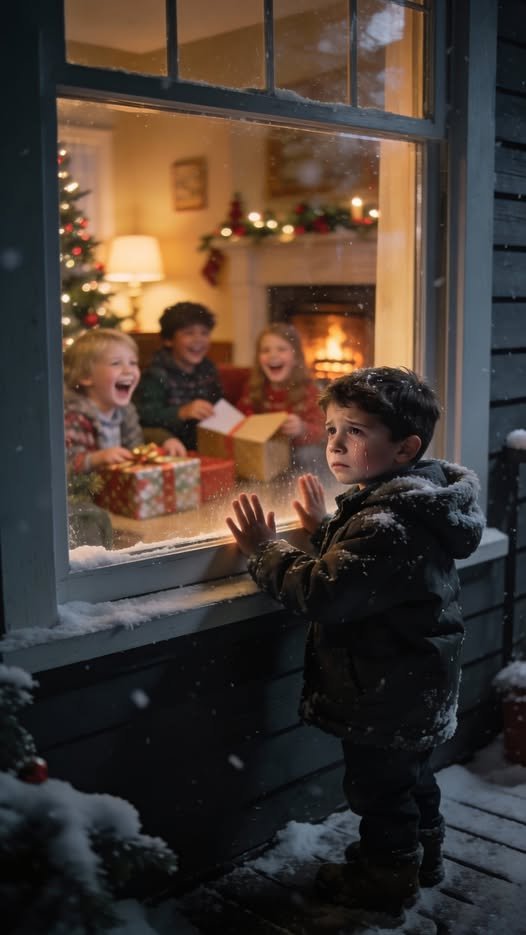
“Outside Auntie Amanda’s house. In the cold.” His breath hitched. “She told me to wait on the porch while they opened gifts. She said, ‘You can come in after. Right now, it’s just for family.’”
The words hit me like a fist to the chest. I pulled the car over to the side of the road, gripping the steering wheel until my knuckles turned white. I turned to look at Ryan. His eyes were red-rimmed, but he wasn’t crying. He was holding it in, the way kids do when they think their pain is an inconvenience.
“She made you wait outside?” My voice came out dangerously calm. “In December?”
He nodded. “For a long time. I could hear them laughing inside. Olivia and Raymond were opening gifts. I saw them through the window. Big boxes with bows.” He swallowed hard. “I knocked once because my fingers were cold. Auntie Amanda opened the door a little and said, ‘Ryan, I told you to wait. We’ll call you when it’s time.’ Then she closed the door again.”
A memory flashed through my mind, sudden and sharp. I was sixteen. It was Amanda’s birthday party. I’d shown up with a card I’d made myself because I didn’t have money for a real gift. She’d opened it, glanced at it, then tossed it onto a table without a word. It’s from Steven. What did you expect?
I looked at Ryan now, shivering in his coat, and something inside me cracked open.
“Did Grandma and Grandpa see you outside?” I asked.
“Yeah. Grandpa walked past the window once. He saw me. But he didn’t open the door.”
My jaw tightened. My parents had been there. They’d seen my son standing outside in the freezing cold, excluded and humiliated, and they’d done nothing.
I pulled back onto the road and drove home in silence. But my mind was screaming.
For seven years, I’ve been the silent engine keeping my sister Amanda’s life running. Not because she asked nicely. Not because anyone acknowledged it. But because that’s what I thought family did.
I covered her mortgage. Every single month, $2,100 wired from my account to hers. I paid her utility bills, her car insurance, her kids’ music lessons. I funded her grocery runs and emergency vet visits. Over seven years, I’d given her more than $180,000.
And the gratitude was zero.
I work as an accountant. My days are predictable. My apartment is small. My life revolves around Ryan. I’ve raised him alone since his mother left when he was two. Amanda, on the other hand, lives in a four-bedroom house with granite countertops and a three-car garage. Her husband, Gregory, works in sales but never brings home enough to match their lifestyle. That gap? I filled it. Quietly. Invisibly.
My parents adored Amanda. She was the golden child. I was the backup plan. Even now, at thirty-four, I played that role. I never told anyone about the money. I thought being dependable meant I was valued.
I thought wrong.
Chapter 2: The Audit
When we got to the apartment, I made Ryan hot chocolate and sat with him until he stopped shaking. He fell asleep on the couch, his head heavy on my shoulder.
It’s just for family.
That’s what Amanda had said. As if Ryan wasn’t family. As if I wasn’t family. As if seven years of mortgage payments meant nothing.
I carried Ryan to his bed, tucked him in, and walked into my home office. I opened my laptop and pulled up seven years of bank statements.
I sat there until 2:00 A.M., scrolling through financial records. The numbers told a story I’d been too blind to see.
Mortgage payments: $2,100/month for 84 months. Total: $176,400.
Utility bills: Averaging $280/month. Total: $23,520.
Car insurance: $190/month. Total: $15,960.
Groceries and “emergencies”: At least $400/month. Total: $33,600.
Grand total: $249,480.
A quarter of a million dollars. Given freely to someone who just made my son stand outside in the cold because he “wasn’t family.”
I leaned back in my chair, eyes burning. My apartment was silent except for the hum of the refrigerator. Ryan was safe. He was warm. But tonight, he’d learned a lesson no seven-year-old should have to learn: That some people don’t care how much you give. They only care what they can take.
I thought about calling Amanda. Demanding an explanation. But I knew what she’d say. She’d gaslight me. She’d tell me I was overreacting. She’d say Ryan misunderstood.
That was her pattern. Deflect. Dismiss.
I looked at my reflection in the dark screen. For seven years, I’d played the role they wanted. The dependable one. The invisible one. I told myself it was noble. But nobility without respect isn’t noble. It’s just slavery with better branding.
I thought about Ryan’s face tonight. The way he’d tried so hard not to cry. My son had more dignity in his silence than my entire family had in their cruelty.
And that was when I made my decision.
I wasn’t going to argue. I wasn’t going to beg for an apology. I was done hoping. I was done asking. I was done being invisible.
I stood up, grabbed my phone, and opened my banking app.
The mortgage payment to Amanda’s account was scheduled to auto-transfer in three days.
I canceled it.
Then I canceled the utility payment. The insurance. The grocery fund. The emergency account.
One by one, I severed every financial tie. And then I sat back down and started building a plan.
Chapter 3: The Collection
It was Saturday morning when I loaded two empty storage bins into the trunk of my car. Ryan was at a friend’s house for a sleepover. I had the entire day.
I drove to Amanda’s house at 10:00 A.M., taking the long route through side streets. I needed the time to think. To prepare.
Amanda’s house sat at the end of a cul-de-sac, the picture of suburban success. A success I had paid for. I thought about the first time I’d sent her money. She’d called in tears, saying it was “just this once.” That was seven years ago.
I pulled into her driveway behind her new SUV—a sleek silver model she’d bought eight months ago after I’d sent her $3,000 for a “car emergency.”
I grabbed the storage bins and walked up to the front door. I didn’t knock. I had a key.
I opened the door and stepped inside. The house smelled like cinnamon candles. The living room was pristine, decorated for Christmas with garlands and a massive tree. I could hear voices coming from the kitchen. Amanda’s laugh. Gregory’s low murmur. My father’s gruff tone.
I walked to the kitchen doorway and stopped.
Amanda was leaning against the counter, phone in hand. Gregory sat at the table. My father stood by the coffee maker.
Amanda looked up, her eyes widening. “Steven? What are you doing here?”
I didn’t answer. I just looked at her.
“We need to talk,” I said, my voice calm and even.
She frowned. “About what?”
“About everything I’ve given you. And everything I’m taking back.”
She set her phone down. “Taking back? Steven, what are you talking about?”
I stepped fully into the kitchen and set one of the bins on the floor with a dull thud.
“I’m talking about the quarter-million dollars I’ve given you over the past seven years,” I said. “The mortgage. The utilities. The insurance. All of it.”
Amanda blinked. “Steven, this isn’t the time—”
“Last night, you made my seven-year-old son stand outside in the cold while your kids opened presents.” My voice stayed level, but there was steel underneath. “You told him he wasn’t family. So I’m here to collect what belongs to someone who isn’t family.”
Gregory stood up. “Whoa, hold on. Ryan said he wanted to wait outside.”
“Don’t,” I cut him off. “Don’t lie to me. Ryan told me exactly what happened. You told him to wait. My father walked past the window and saw him. No one opened the door.”
My father set his mug down, looking uncomfortable. “Steven, you’re overreacting. It was a misunderstanding.”
“Was it?” I looked at him directly. “Because from where I’m standing, it looks pretty clear. Amanda is family. I’m the backup plan. The wallet. Well, the wallet is closed.”
Amanda’s face flushed. “You’re being ridiculous.”
“You heard me.” I bent down, picked up the storage bin, and walked past her into the living room.
The coffee maker I’d bought her two Christmases ago sat on the counter. I unplugged it, wrapped the cord around the base, and placed it in the bin.
“Steven, what the hell are you doing?” Amanda’s voice pitched higher. She followed me.
“I’m taking back what I paid for,” I said calmly.
I walked over to the entertainment center and started unplugging the TV. A 65-inch 4K. I’d sent her $1,800 for it when their old one “died.”
“You can’t just take our stuff!” Amanda cried.
“It’s not your stuff. It’s mine. I bought it. I paid for it. You just borrowed it.”
I lifted the TV, carried it to the front door, and set it down. Then I went back for the soundbar.
Gregory stepped in front of me. “Steven, stop. This is insane.”
I looked at him. Gregory had always been polite, but he’d also been complicit. He’d watched Amanda call me for money every month. And last night, he’d let my son freeze.
“Move,” I said quietly.
He didn’t move.
“You’re upset. I get it. But you can’t just—”
“I can. And I am. Now move.”
Something in my tone must have convinced him. He stepped aside.
I unplugged the soundbar and added it to the pile. The gaming console. The tablet. The smart speaker.
“Dad!” Amanda shouted. “Are you just going to stand there?”
My father stepped out of the kitchen. “Steven, son, let’s talk about this.”
“I’m done talking,” I said, continuing my methodical removal. “I spent seven years talking. Seven years helping. Seven years being invisible. Last night, you proved what I already knew. I’m not family. I’m a wallet. So I’m taking my assets back.”
Chapter 4: The Ledger
I worked systematically, moving through the house like an auditor. The blender. The stainless steel pots and pans. The decorative lamps. In the hallway, the framed artwork I’d bought her.
Every item I touched, I remembered the excuse she’d given to get me to pay for it.
Amanda followed me, her voice climbing higher. “Steven, stop! You can’t do this!”
Gregory tried reasoning. “Look, man. We’ll figure this out. We’ll pay you back.”
“With what money?” I asked, not looking at him. “The money I send you every month? Because that stops today.”
My father finally spoke with authority. “Steven, think about your sister’s kids. Olivia and Raymond. They’re innocent in all this.”
For the first time, my calm cracked.
“I think about kids all the time, Dad,” I said, my voice trembling with rage. “I think about Ryan standing on that porch last night, shaking from the cold while his cousins opened presents. I think about how he tried not to cry because he didn’t want to bother me. I think about how he said, ‘Auntie told me it’s just for family.’ Like he believed it.”
My father’s jaw tightened. “That was a mistake.”
“It wasn’t a mistake. It was a choice. Amanda chose to exclude him. You chose to let it happen. And I’m choosing to walk away.”
I walked to the coffee table and pulled a folded stack of papers from my jacket pocket. I slammed them onto the wood.
“What’s that?” Amanda asked, her voice shaking.
“It’s a ledger,” I said. “Every single payment I’ve made to you over the past seven years. Dates. Amounts. Purposes.”
I unfolded the top sheet. “January 2018: Mortgage, $2,100. February 2018: Mortgage, $2,100. March 2018: Mortgage plus emergency grocery fund, $400.”
“Stop,” Amanda whispered.
“July 2019: Mortgage, $2,100. Car insurance, $190. Utility bill, $310. Kids’ summer camp deposit, $500.”
“I said stop!” Amanda cried. Tears spilled down her cheeks. “Okay! I get it! You helped us! I’m sorry about last night! Ryan can come to every event from now on!”
“I swear this isn’t about events, Amanda.” I folded the papers and put them back in my pocket. “This is about respect. And you’ve never respected me. You’ve tolerated me. You’ve used me.”
Gregory’s face was pale. “We didn’t know you felt this way.”
“You didn’t ask.”
“Steven, please,” Amanda pleaded. “We need that mortgage payment. It’s due in three days. If we miss it… we’ll lose the house.”
I picked up one of the storage bins. “But that’s not my problem anymore.”
My father stepped in. “You’d let your own sister lose her home over a misunderstanding?”
I looked at him. The man who had never once asked how I was doing, even as I bled my savings dry for his golden child.
“It wasn’t a misunderstanding,” I said. “It was cruelty. And I’m done enabling it.”
I walked to the front door carrying the bin. Behind me, I heard Amanda sobbing.
I loaded the bins into my car and went back inside one last time.
Amanda was on the couch, face buried in her hands. Gregory stared out the window. My father stood in the kitchen doorway.
I walked to the coffee table and placed one more document on top of the papers. It was a printed email—a cancellation confirmation for the automatic mortgage transfer. Below it, a notice confirming the utility account closure. Below that, the car insurance cancellation.
Every single financial tie, severed.
Amanda looked up and saw the documents. Her face went white.
“You really did it,” she whispered. “You actually cut us off.”
“I did,” I said. “For seven years, I’ve been your safety net. And the one time I asked you to treat my son with basic decency, you failed. So yes. I cut you off completely.”
“What are we supposed to do?” Gregory asked, his voice strained.
“What everyone else does,” I said. “Figure it out.”
I turned to my father. “You chose her. Every single time. You told me to be patient, to be understanding. And I was. But when she hurt my son, you told me I was overreacting. So you made your choice. And now I’m making mine.”
I walked to the door, paused, and looked back at the house I’d paid for.
“Goodbye, Amanda. Good luck.”
I walked out, closing the door with a soft, final click.
Chapter 5: The Aftermath
Three weeks passed before I heard from Amanda again.
A text message at 11:00 P.M. on a Tuesday.
I’m so sorry. Please. Just one more month. The bank sent a notice. We can’t lose the house.
I read it twice. Then I deleted it without responding.
Ryan looked up from the movie we were watching. “Was that important, Dad?”
“No,” I said, setting my phone aside. “Not anymore.”
I heard through mutual acquaintances what happened. The mortgage payment was late. The utilities were disconnected. Gregory scrambled with credit cards, but the debt was too deep. They put the house on the market within two weeks. It sold at a loss.
Amanda and Gregory moved into a rental. Two bedrooms. No granite countertops. My parents helped with the deposit, complaining bitterly about the cost the whole time.
I felt no satisfaction. Just relief.
The money I saved went into an account for Ryan. College fund. Emergency savings. The future he deserved.
We started new traditions. Saturday morning pancakes. Sunday park visits. Simple things. But they were ours.
One evening, putting Ryan to bed, he asked, “Dad, do you think Auntie Amanda is mad at us?”
I sat on the edge of his bed. “Maybe. But that’s not your responsibility, buddy.”
He thought for a moment. “I’m glad we don’t go there anymore.”
“Yeah? Why is that?”
“Because it always felt like we weren’t really wanted. Like we were just… extra.” He looked at me, his eyes serious. “But here with you, I don’t feel extra. I feel like I’m exactly where I’m supposed to be.”
My throat tightened. I pulled him into a hug. “You are. You’re exactly where you’re supposed to be.”
Later, sitting in the silence of my living room, I realized something.
What I’d given Amanda wasn’t love. It was fear. Fear of being alone. Fear of not being needed. But I wasn’t afraid anymore.
I’d chosen my family. And my family was the seven-year-old boy sleeping down the hall. The one who loved me without conditions.
That was enough.
I leaned back on the couch, closed my eyes, and exhaled. The weight was gone.
The Bank of Steven was closed. And for the first time in a long time, I was free.
Website Disclaimer
The information provided on this website is for general informational and educational purposes only. While we strive to ensure that all content is accurate and up to date, we make no guarantees regarding the completeness, reliability, or accuracy of any information published.
The views and opinions expressed in articles belong to their respective authors and do not necessarily reflect the views of this website. Any action you take based on the information found on this website is strictly at your own risk. We will not be liable for any losses, damages, or inconveniences arising from the use of our content.
Some articles may contain opinions, third-party information, or external links. We do not endorse or guarantee the accuracy of content on external websites and are not responsible for their practices or policies.
All content on this website is provided in good faith and is intended for informational purposes only. Readers are encouraged to verify information independently and seek professional advice where appropriate.