You don’t answer the first call.
You let it buzz until the screen goes dark, because silence is the only luxury you’ve had all week, and you’re not about to hand it back like a borrowed sweater.
You take one slow sip of coffee in your new apartment, the kind of place that smells like fresh paint and freedom. The morning light lands on the floor in clean rectangles, like the sun is drawing boundaries for you.
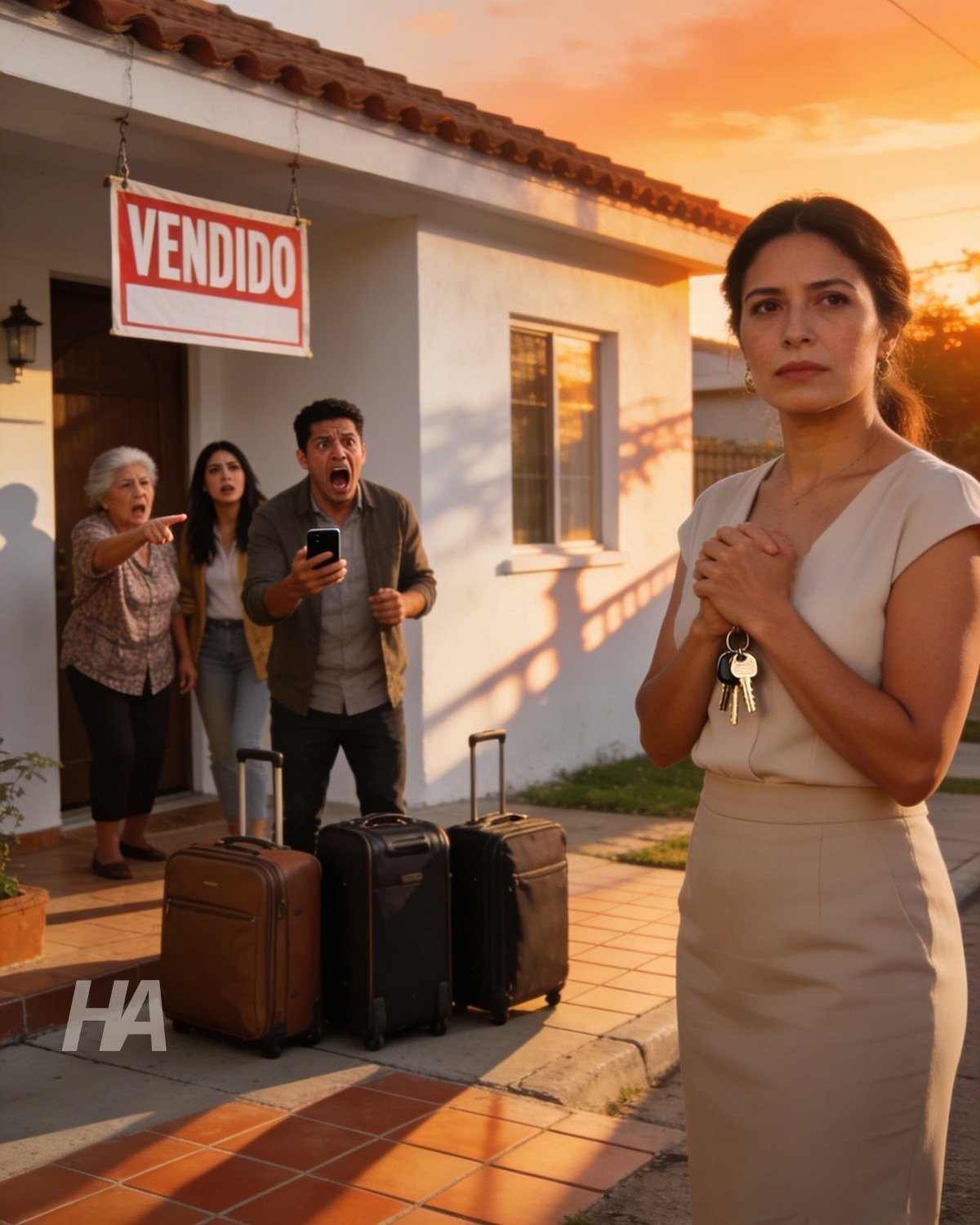
On your phone, the porch camera shows them still frozen in front of the “SOLD” sign, three people suddenly allergic to consequences.
Then Mauricio tries again.
And again.
And then the messages start coming in fast, like panic has its own Wi-Fi.
The first text is rage pretending to be confusion.
Mauricio: “Sofi, this isn’t funny. Open the door.”
You don’t laugh.
You don’t cry.
You just watch him jiggle the key like a man trying to unlock a reality that has changed its locks.
Fernanda hovers nearby with her phone half-raised, trapped between filming and survival, as if her followers might Venmo her dignity. Doña Estela keeps knocking like the door is a stubborn employee who needs a stern speech.
They look so sure the world owes them access.
And you realize: the only reason you ever felt small was because you kept lending them your spine.
You send one more message, short enough to sting.
You: “Don’t contact me directly. Contact my attorney.”
Mauricio’s head snaps up, like he can see you through the lens.
He can’t.
But he knows you’re watching, because your silence now has weight.
He turns to his mother and sister, speaking sharply. Their faces twist into that familiar triangle of blame, the one they always used to trap you in the middle.
Only now there’s no middle.
There’s just distance.
And distance is a locked door.
Doña Estela does what entitled people do when the universe says no.
She escalates.
She steps off the porch and marches to the neighbor’s driveway, pointing at the SOLD sign like it’s a typo someone needs to correct. You see her talking fast, hands slicing the air, the performance of a woman who has always believed volume equals authority.
Then she points at the house again, and you know exactly what she’s saying.
“She’s crazy.”
“She’s dramatic.”
“She stole from us.”
“She’s humiliating her own husband.”
Husband.
The word lands like a rusty nail.
Because you suddenly remember something even more dangerous than selling a house.
You’re still legally tied to a man who thinks your money is “for the family.”
Your attorney calls at noon, right on time, like a metronome made of steel.
He doesn’t waste breath on sympathy, which you appreciate more than kindness.
“They’ll try three things,” he says. “Guilt. Threats. And a story.”
You lean back against your counter and look out at the street below, where strangers live their uncomplicated lives. You try to imagine yourself as one of them.
“What story?” you ask.
“That you knew about the withdrawal,” he replies. “That you gave permission. That you’re retaliating to punish them.”
You exhale slowly.
“They took it from my account.”
“I know,” he says. “But facts don’t matter as much as what can be proven, and what can be sold.”
You close your eyes, and you see the bank notification again, that number slicing your birthday in half.
“I have screenshots,” you say. “I have statements. I have years of deposits.”
“Good,” he replies. “And we need one more thing.”
“What?”
“Intent,” he says. “Proof that they planned it.”
You open your eyes.
Your mind starts moving like a locksmith’s hands.
Because yes, you have proof.
You just haven’t looked for it yet.
That night you don’t scroll through their vacation photos for pain.
You scroll for evidence.
Madrid. Barcelona. Paris.
You watch Fernanda’s stories again, only now you’re not watching her lips, you’re watching the background. You’re watching receipts, wristbands, boarding passes, the corner of a hotel bill that flashes for half a second.
Then you see it.
A clip where Mauricio is bragging in a bar, laughing too loud, and in the background, Doña Estela is holding a document folder.
It’s open.
And for one blink of time, the camera catches the header.
“AUTHORIZED TRANSFER”
…and below it, a signature that looks like your name wearing a cheap disguise.
Your throat goes cold.
Because this isn’t just theft.
This is forgery.
This is a crime they thought you would swallow like you swallowed everything else.
You screen-record the clip.
You take screenshots.
You email them to your attorney with one sentence:
“Here’s intent. And here’s their mistake.”
The next morning, your attorney calls back, and his voice has that calm edge that means someone’s about to regret being arrogant.
“This changes the game,” he says.
You stare at your coffee like it might answer for you.
“What happens now?” you ask.
“We file,” he replies. “We demand the money back. We report the fraud. And we move on your divorce with immediate protective measures.”
Divorce.
The word tastes sharp and clean.
Not bitter.
Not tragic.
More like disinfectant.
You nod even though he can’t see you.
“And what if they try to come here?” you ask.
“They will,” he says. “So we document. We don’t engage. If they show up, you don’t open the door, you call the police.”
You swallow.
Part of you wants to believe they’ll stop.
But you’ve lived with them.
You know they don’t stop until someone makes them.
They come that same afternoon.
Because of course they do.
Your building lobby camera shows Mauricio pacing like a caged animal, Fernanda whispering into her phone with fake tears ready to deploy, and Doña Estela standing stiff as a judge.
They try the intercom.
You don’t answer.
They call again.
You let it ring.
Finally, Mauricio texts.
Mauricio: “We can talk like adults. Stop hiding.”
You almost smile.
Because he still thinks adulthood means he speaks and you obey.
You reply with one line:
You: “You forged my signature.”
There’s a long pause.
Long enough to taste.
Then the messages arrive in a new flavor.
Not rage.
Panic.
Mauricio: “What are you talking about?”
Fernanda: “You’re making things up.”
Doña Estela: “How dare you accuse us after everything we’ve done for you.”
Everything.
You stare at that word like it’s a joke written by a stranger.
Because “everything” is exactly what they did: they took it.
You call the police.
You don’t say “my husband.”
You say “three individuals are harassing me at my residence.”
You keep your voice level.
You don’t decorate the truth.
You don’t beg it to be believed.
The officer arrives within twenty minutes.
You watch from your camera feed as Mauricio gestures wildly, trying to charm, trying to control, trying to perform innocence. Doña Estela tries to talk over the officer. Fernanda keeps filming until the officer turns and looks directly at her phone.
That’s when she lowers it.
Because some uniforms still scare entitled people.
The officer makes them leave.
They don’t go far.
They stand across the street like a threat with luggage.
And you realize: they’re not just angry.
They’re stranded.
They spent your savings, and now they have nowhere to sleep.
And somehow, they still think that’s your problem.
That night, your attorney sends you a draft of the complaint.
You read it slowly.
Not because you enjoy legal language, but because seeing your pain translated into paperwork feels like turning a ghost into something solid.
Fraud. Unauthorized transfer. Forgery.
Your name appears beside words that finally match the way you’ve been treated.
You sign digitally.
Your hand doesn’t shake.
Then you do the next thing: you file for divorce.
You think you’ll feel grief.
You don’t.
You feel air.
Two days later, you get a knock at your door.
Not the loud kind.
Not the entitled pounding you expected.
A gentle knock, like someone who is unsure they deserve your attention.
You check the peephole.
It’s Mauricio.
Alone.
No mother.
No sister.
No audience.
Just him, holding a small paper bag like an offering.
Your stomach tightens, because you know this version of him.
This is the man who shows up after damage, wearing regret like cologne.
You don’t open the door.
You speak through it.
“What?” you ask.
His voice is softer than you’ve heard in years.
“Sofi,” he says. “Please. Just listen.”
You stay silent.
He exhales.
“I didn’t know she would take that much,” he says quickly, like the word she can bleach him clean. “I thought it was… a loan. A temporary thing.”
You lean your forehead against the wood, eyes closed.
The audacity is almost impressive.
“You were in the kitchen,” you say. “Packing your suitcase on my birthday. You knew.”
He pauses.
“Okay,” he admits. “I knew. But you always—”
You cut him off.
“Always what?” you ask. “Always fixed it? Always paid? Always made it feel normal?”
Silence.
Then he tries a different tactic.
“I’m sorry,” he says. “We can work it out. We can buy another house.”
You laugh once, quiet.
Not because it’s funny.
Because it’s insulting.
“With what money?” you ask.
He doesn’t answer.
You can almost hear his pride bleeding out in the hallway.
Then he says the real thing, the one he didn’t want to say first.
“We don’t have anywhere to go,” he whispers.
There it is.
Not remorse.
Need.
You breathe in.
You breathe out.
And you say the sentence that turns you into someone they can’t use anymore.
“Not my problem.”
His voice cracks.
“Are you really going to do this?” he asks, like you’re committing a crime.
You open your eyes, staring at the door like it’s a mirror.
“I’m really going to stop,” you say.
He goes quiet.
Then he says, bitter and small, “You’re punishing my family.”
You answer without emotion.
“No,” you say. “I’m protecting myself.”
Then you add one more line, because the truth deserves to be finished.
“You punished me for years. This is just the first time I didn’t absorb it.”
He doesn’t knock again.
You hear his footsteps retreat.
And you feel something inside you unclench like a fist finally opening.
Fernanda goes to war online.
Because if she can’t control you in private, she’ll try to control your reputation in public.
She posts vague stories about “toxic women” and “ungrateful wives” and “people who abandon family in hard times.” She cries in a video, mascara perfectly placed, saying she “doesn’t want to get into details,” while clearly trying to get into details.
Your phone fills with messages from acquaintances you haven’t spoken to in years.
Some are curious.
Some are judgmental.
Some are the worst kind: “I’m sure they didn’t mean it.”
You don’t respond.
You let your attorney respond.
He sends a cease-and-desist for defamation, with attachments: the forged transfer clip, the bank statements, the timeline.
He doesn’t threaten.
He informs.
Fernanda deletes the video within an hour.
But screenshots exist.
And so does shame, when it can’t be filtered.
Doña Estela tries one final move.
She doesn’t message you.
She shows up at your job.
Because she assumes you’ll fold if she makes it public.
She arrives in the lobby, dressed like a woman attending court, chin lifted, lips tight. She tells the receptionist she’s your “mother,” because a lie is just another tool to her.
You see her on the security camera feed before she reaches your floor.
Your manager asks if you want him to call security.
You nod.
Because you don’t negotiate with people who steal and then demand respect.
Security escorts her out while she hisses your name like it’s a curse.
As she’s leaving, she shouts one last line, loud enough for strangers to hear.
“You think you can survive without us?”
The elevator doors close.
You stand still for a moment, heart pounding.
Then you realize: you already have.
The court process is not cinematic.
It’s paperwork, waiting, signatures, dates.
But slowly, the world starts aligning with the truth.
Your bank opens an investigation.
The transfer is flagged.
Mauricio’s account receives a freeze on certain funds.
Then the first real consequence arrives in the form they fear most:
a letter.
Not from you.
From a financial institution.
From a legal office.
From a system that doesn’t care about their excuses.
Mauricio calls your attorney, frantic, trying to “settle.”
Your attorney tells him the settlement number: your full savings returned, plus legal costs, plus a formal admission.
Mauricio says no at first.
Then the bank’s fraud unit calls him.
Then he says yes.
Because stubbornness is expensive when the law has receipts.
A month after they came back from Europe, you get the money returned.
Every dollar.
It lands in your new account like a heartbeat restored.
You stare at the balance for a long time, not because you’re excited, but because you’re stunned at the sensation of being made whole.
You expected them to win.
You expected the world to shrug.
But the world didn’t shrug this time.
Because you didn’t either.
The divorce finalizes a few months later.
Mauricio tries to negotiate sentimental things.
He asks for “closure.”
He asks for a meeting.
He says he misses you.
You let your attorney handle the logistics, and you keep your life quiet and forward-facing.
The day you sign the last paper, you walk out of the office and the sky looks absurdly blue.
Not poetic.
Just blue.
Like the universe never cared about their drama and was waiting for you to catch up.
You hear through mutual contacts that they’re living in a small rental now.
Doña Estela complains constantly.
Fernanda has pivoted her content to “healing” and “starting over,” as if she didn’t start the fire. Mauricio has grown quieter, the way men do when they realize charm doesn’t work on locked doors.
One evening, you get one last message from him.
No anger.
No manipulation.
Just a sentence that feels like a man finally looking at the wreckage he helped create.
Mauricio: “I didn’t realize I was using you until you stopped letting me.”
You read it.
You don’t reply.
Not because you’re cruel.
Because you’re done teaching lessons to people who only learn when it hurts.
On your next birthday, you wake up before the sun again.
Old habit.
But this time, the morning doesn’t feel like a test.
You make coffee.
You buy yourself a cake from the supermarket on purpose, the kind you used to pretend was “no big deal.”
You light one candle.
You don’t sing.
You don’t wait for someone else to make you feel celebrated.
You sit by the window in your small, bright apartment, and you let the flame tremble in the quiet.
Then you blow it out and make a wish that is not romantic, not dramatic, not dependent on anyone else.
You wish for a life where your peace is non-negotiable.
And the best part is: you already started living it.
THE END
Website Disclaimer
The information provided on this website is for general informational and educational purposes only. While we strive to ensure that all content is accurate and up to date, we make no guarantees regarding the completeness, reliability, or accuracy of any information published.
The views and opinions expressed in articles belong to their respective authors and do not necessarily reflect the views of this website. Any action you take based on the information found on this website is strictly at your own risk. We will not be liable for any losses, damages, or inconveniences arising from the use of our content.
Some articles may contain opinions, third-party information, or external links. We do not endorse or guarantee the accuracy of content on external websites and are not responsible for their practices or policies.
All content on this website is provided in good faith and is intended for informational purposes only. Readers are encouraged to verify information independently and seek professional advice where appropriate.