The ballroom glowed with amber light from crystal chandeliers, casting warm shadows across tables dressed in ivory linens. My cousin Bridget’s wedding reception had been beautiful so far. I sat carefully at table 7, my hands resting on my swollen belly, feeling our daughter shift and kick inside me. At 32 weeks pregnant, every movement required calculation and effort. My husband Daniel had left the venue to take an important work call in his car 20 minutes earlier.
His job as a federal prosecutor often meant interruptions, even during family events. I’d assured him I would be fine eating dinner with his sister and her husband while he handled business. The servers had just placed our entre when I heard the commotion near the entrance. My family arrived in their typical fashion, 40 minutes late and announcing their presence to everyone with an earshot.
My mother’s voice carried across the reception hall as she greeted distant relatives, her laughter sharp and performative. My father followed behind her, nodding tursly at people he barely remembered. Between them walked my younger sister, Olivia, one hand resting delicately on her barely visible baby bump, the other clutching a designer handbag that probably cost more than my monthly rent.
They made their way through the tables, stopping to chat with various guests. Olivia smiled sweetly at everyone, her hand never leaving her stomach, ensuring people noticed her condition. She’d announced her pregnancy just 3 weeks ago at our grandmother’s birthday dinner, choosing that exact moment to reveal she was expecting even though the party was meant to celebrate someone else.
The pattern felt familiar. I focused on my salmon, hoping to avoid drawing attention. Daniel’s sister Monica leaned over and whispered, “They’re heading this way.” I nodded, keeping my eyes on my plate. Maybe they would just pass by with a quick greeting. My mother reached our table first. She wore a burgundy dress with matching heels, the kind with pointed toes and 3-in stilettos that clicked against the floor.
Her makeup was flawless. Her hairstyled in perfect waves. Everything about her appearance screamed control and precision. “Well, there you are,” she said, her tone suggesting I’d been hiding. “We’ve been looking all over for you.” I glanced up, offering a small smile. “Hi, Mom. We’re at our assigned table.
” She ignored my explanation, scanning the empty chairs around us. Daniels parents sat two tables over, and most of the seats at our table remained vacant as guests mingled or danced. “My father approached, his expression stern as always.” Olivia followed, one hand still cradling her stomach protectively. “Your sister needs somewhere to sit,” my mother announced.
“She’s exhausted from the drive. I shifted in my chair, my lower back aching from the weight I carried. There are empty seats right here. I gestured to the vacant chairs surrounding us. She can take any of them. My mother’s eyes narrowed slightly. She needs your seat. It has the best position at the table. The request made no sense.
Every chair at the round table offered the same view and access. But challenging my mother’s logic never ended well. I’d learned that lesson repeatedly throughout my childhood. Mom, I’m 8 months pregnant, I said quietly, hoping to avoid a scene. Getting up and down is really difficult right now. There are plenty of other chairs.
Get up from that chair right now. My mother’s voice dropped to a dangerous whisper. Your sister needs to sit. Monica’s hand found mine under the table, a silent show of support. I squeeze it gratefully before responding. She’s only 2 months pregnant. I’m 8 months. I need to stay seated because the sharp sudden pain in my foot cut off my words.
I gasped, looking down to see my mother’s stiletto heel pressed down hard on top of my shoe, grinding against the delicate bones. The tablecloth hid the assault from most observers, but the pain shot up my leg like lightning. I won’t say it again, she hissed, leaning closer so only I could hear. Her perfectly painted lips barely moved, her smile remaining fixed in place for anyone watching from a distance.
Tears pricked my eyes from the pain, but I refused to move. Something inside me had finally broken free after years of bending to her demands. My pregnancy had awakened a protective instinct that overrode my usual compliance. This baby deserved a mother who stood up for herself, who didn’t crumble under pressure from toxic family members.
No, I said firmly, pulling my foot free from under her heel. I’m staying in my seat. My mother’s face flushed red beneath her makeup. She straightened, her composure slipping for just a moment before she regained control. She glanced at my father, some unspoken communication passing between them. He’d been standing behind my chair, silent as always, letting her take the lead in their manipulations.
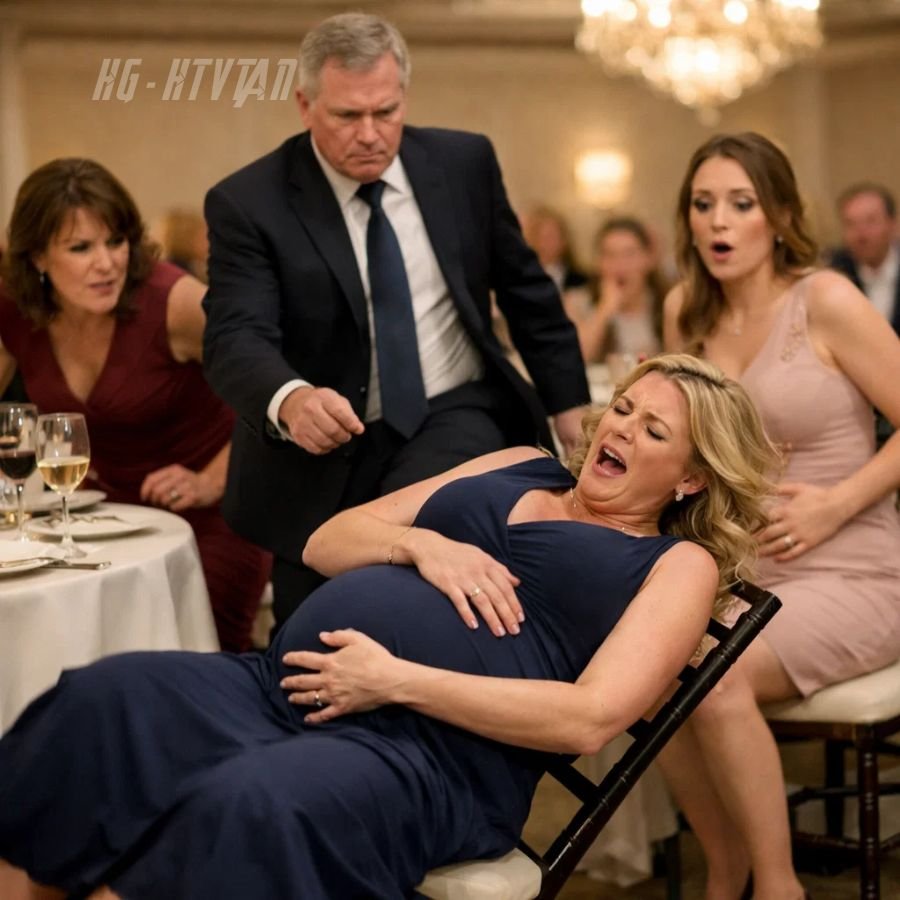
What happened next took only seconds, but seemed to unfold in slow motion. My father stepped closer to my chair. I felt his presence behind me, sensed the shift in energy. Then his foot connected with the back of my chair, a sharp, vicious kick that sent the chair tilting backward. I grabbed for the table edge, but my pregnant belly threw off my balance.
The chair tipped past the point of recovery. Monica screamed. I fell backwards, my arms instinctively wrapping around my stomach as I hit the floor hard on my back, my belly taking some of the impact. The pain was immediate and overwhelming. A warm gush of fluid spread beneath me, soaking through my dress and pooling on the polished floor.
My water had broken. At 32 weeks, 8 weeks too early. Gasps erupted around the room. People pushed back from nearby tables, craning to see what had happened. The music stopped abruptly. I lay there, unable to move, feeling contractions beginning to ripple through my abdomen. Terror gripped me as I tried to assess if the baby was still moving.
She’s fine. My mother’s voice rang out across the now silent ballroom. Everyone keep eating. She just lost her balance. I stared up at the ceiling, my vision blurring with tears. My baby was coming too early because my father had kicked my chair because my mother had demanded I give up my seat.
The absurdity of it mixed with my fear, creating a surreal nightmare I couldn’t wake from. Perfect spot for you, honey. I heard my mother say to Olivia, her voice artificially bright. Through my haze, I saw her guiding my sister into the chair I’d been sitting in moments before. Olivia sat down carefully, her face pale, but saying nothing.
She looked at me on the floor, then quickly looked away. Another contraction hit, stronger this time. I tried to call out for help, but my voice came out as barely a whisper. Monica was already on her knees beside me. her phone pressed to her ear as she called for an ambulance. Her husband had run to find the venue manager.
The crowd began to whisper, ignoring my mother’s directive to continue eating. I heard fragments of their conversations, shock and concern in their voices. Someone brought pillows from the lounge area. A woman I didn’t know held my hand, telling me to breathe. The ballroom doors burst open. Daniel appeared, having just returned from his car where he’d been on his call.
His eyes scanned the room until they found me on the floor. The expression that crossed his face was something I’d never seen before. He worked with criminals and dangerous people everyday, maintaining professional composure through horrific testimony and evidence. But seeing me lying in a puddle of amniotic fluid, clearly injured and in labor, transformed him completely.
He crossed the distance in seconds, dropping to his knees beside me. His hands moved over my face, my arms, checking for injuries while asking me rapid fire questions. What happened? Are you hurt? Is the baby okay? My father kicked my chair. I managed to say between contractions. I fell backwards.
The baby’s coming too early. Daniel’s jaw clenched, his eyes going dark. He looked up at my father, who still stood a few feet away, arms crossed defensively. Then his gaze moved to my mother, who had stepped back from the table, finally seeming to realize the severity of what had occurred. “You did this?” Daniels voice was quiet, controlled, but carrying an edge that made several people nearby step back instinctively.
He slowly stood to his full height, his prosecutor persona sliding into place like armor. “My father cleared his throat. She was being disrespectful to her mother. She needed to learn. You assaulted a pregnant woman. Daniel cut him off, his voice still eerily calm. Your pregnant daughter in front of 200 witnesses. He pulled his phone from his pocket with deliberate precision.
You’re going to want to start thinking very carefully about your next words. My mother moved forward, attempting her usual manipulation tactics. Now, Daniel, let’s not make this into something it’s not. It was an accident. She simply lost her balance. I watched the security footage,” Daniel said, gesturing toward the cameras mounted discreetly around the ballroom.
The venue manager showed me when I came back inside after someone ran out to tell me what happened. I saw everything. The heel on her foot, the kick to her chair, all of it recorded from multiple angles. The color drained from my mother’s face. My father’s defensive posture stiffened further. Monica’s husband returned with paramedics.
They moved quickly, checking my vital signs and preparing to transport me. Daniel knelt again, squeezing my hand. I’m calling this in right now. They’re not walking away from this. The baby, I whispered. Please just make sure the baby is okay. The paramedics are taking care of you both, he assured me, his voice softening when he spoke to me.
You’re going to the hospital and I’m riding with you. But first, I need you to tell these officers exactly what happened. I hadn’t noticed the two police officers who had entered with the paramedics. They stood nearby, taking in the scene. Daniel spoke to them briefly, his credentials as a federal prosecutor adding weight to his words.
They approached my parents, asking them to step aside for questioning. As the paramedics lifted me onto a stretcher, I heard my mother’s voice rising in protest. This is completely unnecessary. She’s fine and we haven’t done anything wrong. One of the officers responded in a professional tone. Ma’am, we have multiple witnesses and video evidence of an assault on a pregnant woman.
You’ll need to come with us to give your statement. The reception guest parted as the paramedics wheeled me toward the exit. I caught glimpses of shocked faces, heard whispered conversations. My cousin Bridget stood near the door with her new husband, her face stricken with concern. She touched my hand as I passed, mouththing, “I’m so sorry.
” The ambulance ride blurred into a series of medical assessments and increasing pain. Daniel held my hand the entire time, his other hand on his phone coordinating with the hospital and making calls I couldn’t quite process. The contractions were coming faster now, my body determined to deliver this baby despite it being too soon.
At the hospital, they rushed me into labor and delivery. A team of neonatal specialists stood ready, preparing for a premature birth. The next hours passed in a haze of pain, fear, and determination. Through it all, Daniel stayed beside me, his presence the only stable thing in a world that had tilted dangerously off axis. The labor progressed faster than the doctors expected for a firsttime mother.
Between contractions, I overheard nurses discussing the case in hush tones outside my room. One mentioned that the police were still at the venue taking statements. Another said she’d never seen anything like this in 15 years of labor and delivery nursing. Their shock mirrored my own. How had a family dinner turned into a criminal case with my parents as defendants? A social worker appeared at some point, introducing herself as Patricia and explaining that hospital protocol required her involvement given the circumstances of
my admission. She asked careful questions about my home situation, my support system, my safety planning for after discharge. Her kindness was almost unbearable in its contrast to what I’d experienced from my own mother just hours earlier. You’ll have resources available, Patricia assured me, handing Daniel a folder of information.
Support groups for trauma survivors, counseling services, legal advocacy if you need it. You don’t have to navigate this alone. The irony struck me that strangers were offering more genuine care than my own parents had provided in three decades. Daniel thanked her and set the folder aside, focusing entirely on helping me through each contraction.
His steady coaching, the way he never left my side despite the hours stretching on, showed me what real partnership looked like. My parents’ marriage had been built on control and compliance. Ours was built on mutual respect and protection. When the pushing stage began, fear overwhelmed me. Clare was so small, so vulnerable, coming into the world under traumatic circumstances.
What if the fall had caused injuries the doctors couldn’t see? What if she struggled to survive outside the womb at this early stage? The whatifs multiplied faster than I could process them. “She’s strong like you,” Daniel kept repeating, his voice cutting through my panic. “She’s a fighter. You both are.
” Our daughter entered the world at 3 lb 14 o 8 weeks early. They whisked her away immediately to the niku and I only caught a glimpse of her tiny body before she disappeared behind a wall of medical equipment and specialists. The doctor assured me she was breathing on her own, a positive sign, but she would need intensive care for several weeks.
Daniel went with her while they finished attending to me. When he returned, his eyes were red, but his voice remained steady. She’s beautiful and strong, fighting like her mother. I wanted to see her desperately, but I was still too weak to move. The doctor said I could visit the niku in a few hours once I’d stabilized. Until then, all I could do was lie in the hospital bed, my body aching, my heart aching more at being separated from my newborn.
“Your parents have been arrested,” Daniel said quietly, pulling a chair close to my bedside. They were taken into custody at the venue after giving their statements to the police. I closed my eyes, processing the information. Part of me felt relief. Another part felt the old familiar guilt that my mother had instilled in me from childhood.
The voice that said I should protect family no matter what they did. Daniel must have seen something in my expression. They assaulted you and endangered our daughter. There’s no scenario where that’s acceptable, and no amount of family loyalty should make you question that. I know, I whispered. I just keep thinking about how this happened at Bridget’s wedding.
I ruined her special day. They ruined it, Daniel corrected firmly. Your parents, with their selfish, abusive behavior. You were sitting at your assigned table eating dinner while pregnant. Nothing about what happened was your fault. A nurse entered to check my vitals, and Daniel stepped out to make more phone calls.
When he returned, he had an update that shifted everything again. “The venue manager sent over the full security footage to the police,” he explained, settling back into the chair. “The cameras captured audio, too. Your mother threatening you, the deliberate nature of both attacks. The district attorney’s office has already reviewed it.
They’re filing charges for secondderee assault and child endangerment. My eyes widened. Child endangerment. Our daughter was viable. Daniel said, “By attacking you at that stage of pregnancy, they put her life at risk. The DA is taking this very seriously, especially given the premeditated nature and the fact that they tried to prevent you from getting help afterward.
” I thought about my mother telling everyone to keep eating, insisting I was fine while I lay on the floor in premature labor. The cruelty of it still didn’t seem real. Over the next few days, as I recovered in the hospital and spent every possible moment in the niku with our daughter, the legal situation developed rapidly.
My parents hired an expensive defense attorney who immediately began crafting a narrative about a misunderstanding blown out of proportion. They claimed I’d been dramatic and attention-seeking, that my father had merely bumped my chair accidentally, that my mother had never threatened me. But the video evidence was irrefutable.
The audio captured every word. The multiple camera angles showed the deliberate violence of both attacks. More importantly, dozens of wedding guests came forward to give statements corroborating what they’d witnessed. Even some of my extended family members who had spent years enabling my parents’ behavior couldn’t defend what they’d seen that night.
Olivia showed up at the hospital on the third day. She stood in the doorway of my room looking uncertain and uncomfortable. We hadn’t spoken since the wedding. Can I come in?” she asked quietly. I nodded, too tired to argue or send her away. She entered slowly, taking in the medical equipment, my pale face, the emptiness where a pregnant belly had been.
I saw her, Olivia said, sitting in the visitors chair. The baby, I asked the Niku nurses if I could look through the window. She’s so tiny. 4 lb 6 o. I said she’s doing well considering breathing on her own, eating from a bottle. Olivia twisted her hands in her lap. I should have said something. At the wedding, when mom demanded your seat, when dad kicked your chair, I just stood there.
Why didn’t you? The question came out without anger, just genuine curiosity. She was quiet for a long moment because it’s always been easier to go along with them, to be the favorite, the one who doesn’t cause problems. I watched them do this to you our whole lives. And I never said anything because I was afraid they’d turn on me next.
And now, now I’m terrified. She admitted, not just of them being angry at me, but of becoming like them. I’m going to have a baby in seven months. What if I treat my child the way mom treated you? What if I can’t break the pattern? I studied my younger sister, seeing fear and genuine remorse in her expression.
She’d been complicit in so much over the years, but she’d also been shaped by the same toxic parents who had damaged me. “Then you’ll need to make different choices,” I said simply. “Starting now. You’ll need to choose to break the cycle instead of perpetuating it.” Olivia nodded, tears streaming down her face. “I gave a statement to the police.
Yesterday, I told them everything I saw, everything I heard. Mom and dad’s lawyer called me this morning, screaming at me for betraying the family. The courage that must have taken surprised me. How did you respond? I hung up, she said. Then I blocked his number and theirs, too. I’m done being there accomplice.
It wasn’t forgiveness, and it didn’t erase years of hurt, but it was a start, a crack in the wall that our parents had built around our family. We talked for another hour carefully and honestly in a way we’d never managed before. When she left, I felt something shift between us, a possibility of a different kind of relationship built on truth rather than their manipulation.
The legal proceedings moved forward with surprising speed. My parents attorney tried various tactics to dismiss the charges or negotiate a plea deal, but the evidence was overwhelming, and the DA’s office was disincined to offer leniency. The case drew media attention after someone leaked the security footage to a local news station.
The video of a pregnant woman being deliberately assaulted by her own parents at a wedding reception struck a nerve with the public. Daniel fielded countless interview requests, declining most but carefully selecting a feud to ensure our side of the story was accurately represented. He framed it not as revenge or vindictiveness, but as a simple matter of justice and protecting our family from further harm.
Our daughter, whom we named Clare, spent five weeks in the NICU before finally coming home. Those weeks were exhausting and stressful, but they also gave me time to heal and to begin processing everything that had happened. Monica and her husband visited regularly, bringing meals and support.
Bridget called often, repeatedly, apologizing for the nightmare her wedding reception had become, though I kept assuring her it wasn’t her fault. Extended family members reached out, their responses split predictably down familiar lines. Some, particularly my mother’s sisters, insisted I was overreacting and destroying the family by pressing charges.
Others, including my father’s brother and several cousins, expressed relief that someone had finally held them accountable for behavior that had gone unchecked for decades. The weeks leading up to the trial brought unexpected revelations. Information Daniel helped gather, working closely with the DA’s investigators, uncovered documentation I’d never known existed.
Hospital records from my childhood showed three separate emergency room visits for injuries my parents had explained away as accidents. A broken wrist at age seven, supposedly from falling off my bike. A concussion at 11, attributed to tripping down the stairs. Bruised ribs at 14, blamed on a mishap during gym class.
The doctor’s notes, however, told a different story. One physician had documented concerns about the pattern of injuries. Another had noted that my explanations seemed rehearsed, my mother’s interjections too quick and defensive. Child protective services had been contacted twice, but both investigations had closed quickly. My parents social standing and my father’s business connections had apparently carried significant weight.
Reading those medical files felt like discovering a hidden room in a house I’d lived in my entire life. I convinced myself that the physical abuse had been rare, isolated incidents that I’d probably exaggerated in my memory. Seeing it documented in clinical language recorded by medical professionals who had been troubled enough to note their concerns validated something I’d spent years questioning.
Daniel also coordinated with investigators to obtain text messages between my mother and several family members from the night of the wedding. One aunt had texted asking if I was all right, mentioning that I’d looked seriously hurt. My mother had responded that I was being dramatic as usual and to ignore her attention seeking.
Another cousin had offered to call an ambulance only to be told that it was completely unnecessary and would ruin Bridget’s special day even more than she already has. The prosecution planned to introduce these messages as evidence of consciousness of guilt, showing that my mother knew I needed medical attention, but actively prevented others from helping me.
Daniel’s colleague in the DA’s office said it significantly strengthened their case, demonstrating clear intent to harm and cover up that harm. Olivia visited one afternoon during this pre-trial period, bringing takeout food and an unexpected confession. She sat at my kitchen table watching Clare play with soft blocks on a mat nearby before finally speaking.
“I need to tell you something about growing up,” she began, her voice hesitant. “You probably don’t remember this, but when I was 5 and you were 12, mom locked you in the basement for an entire day. You’d talked back to her at breakfast, said something about how she was being unfair.
I remember hearing you crying and pounding on the door, begging to be let out. I did remember that day, though I’d pushed it deep down. The darkness, the cold concrete floor, the growing panic as hours passed. When my mother finally opened the door that evening, she’d acted as if nothing had happened, serving dinner and expecting me to do the same.
I asked Dad if we could let you out. Olivia continued, tears in her eyes. He told me that you were learning an important lesson about respect, and if I kept asking questions, I’d learn the same lesson. I was so scared of being locked down there that I never asked again. I just pretended it hadn’t happened.
You were 5 years old, I said quietly. That wasn’t your responsibility. Maybe not then, she acknowledged. But I was older during other incidents. I was 14 when mom destroyed all your college acceptance letters because you’d chosen schools too far away. I was 16 when dad canled your scholarship interview because you’d refused to break up with your boyfriend.
I watched them sabotage you over and over, and I never said anything because staying silent kept me safe. These conversations with Olivia were painful but necessary. We were both excavating years of buried trauma, examining the foundation of our childhood, and finding it rotted through. But speaking these truths out loud, having them witnessed and validated, began a healing process that silence had prevented.
My mother’s sisters attempted an intervention of sorts, showing up at my house unannounced. One morning, they stood on my porch, a united front of disapproval, insisting I drop the charges and let this family heal. Their version of healing, however, required me to forget what had happened, forgive without any accountability, and welcome my parents back into my life as if they hadn’t assaulted me and endangered my child.
I listened to their rehearsed speeches about family loyalty and forgiveness, about how I was tearing apart the family over one incident and being vindictive. When they finished, I asked them a simple question. If someone kicked your pregnant daughter’s chair hard enough to make her fall and go into premature labor, would you call it one incident and expect her to get over it? The silence that followed was telling one not looked away.
Another started to speak, then stopped. The third attempted to explain that it was different because these were my parents, as if parental status granted immunity from consequences for violence. I closed the door on them that day, literally and figuratively. Their visit only reinforced my decision. They weren’t concerned about justice or my well-being.
They were worried about the family’s reputation, about their own comfort being disrupted by the truth of who my parents really were. The trial took place 6 months after that night. Clare was healthy now, meeting all her developmental milestones. Despite her premature arrival, I sat in the courtroom holding Daniels hand, watching my parents at the defense table.
They looked older somehow, diminished. My mother’s perfect composure had cracked, her face drawn and tired. My father stared straight ahead, his expression blank. The prosecution presented their case methodically. The security footage played on screens throughout the courtroom, showing exactly what had occurred.
Multiple witnesses testified about what they’d seen and heard. Medical experts explained the dangers of premature birth and the risks my parents actions had created for both Clare and me. The defense tried to paint me as unstable and vengeful, someone with a history of exaggerating conflicts with my parents. They called character witnesses who described my mother as a devoted parent and my father as a respected businessman.
They suggested I had orchestrated the entire incident to gain attention and sympathy. But then Olivia took the stand. She testified calmly and clearly about growing up in our household, about witnessing years of my mother’s psychological manipulation and my father’s intimidation tactics. She described the specific events of the wedding reception from her perspective, confirming every detail of the prosecution’s account.
When the defense attorney tried to discredit her testimony, suggesting she was lying to avoid her own culpability, she remained composed and resolute. I’m not testifying because I hate my parents, Olivia said clearly. I’m testifying because what they did was wrong and I’m done pretending otherwise. My sister almost lost her baby because of their actions. That baby is my niece.
She deserved better than almost dying because adults couldn’t behave with basic decency. The jury deliberated for less than 3 hours. When they returned with guilty verdicts on all charges, I felt a strange mix of vindication and sadness. These were still my parents despite everything. But they were also people who had deliberately harmed me and endangered my child, then tried to prevent me from receiving medical care.
The judge sentenced them each to 18 months in prison, followed by probation and mandatory counseling. It was more than their attorney had expected, but less than the maximum possible sentence. As they were led away, my mother looked back at me, her expression containing more anger than remorse. My father didn’t look back at all.
Outside the courthouse, reporters crowded around us with cameras and microphones. Daniel gave a brief statement thanking the jury and the prosecutor’s office, emphasizing that this case was about protecting vulnerable people from abuse, regardless of family relationships. I said nothing, just held Clare close and let Daniel guide us to our car.
Life gradually found a new rhythm. Clare continued to thrive, growing stronger everyday. Daniel returned to work, though he’d arranged a more flexible schedule. I stayed home with Clare, cherishing every moment while also beginning to process years of trauma through therapy. Olivia and I met for coffee every few weeks. Our relationship remained complicated, but we were building something authentic, slowly, learning to trust each other outside our parents’ influence.
She distanced herself from them completely, preparing for her own child’s arrival with a determination to do better. The extended family eventually settled into new patterns as well. Some relatives cut off contact with me entirely, viewing me as a traitor who had sent my parents to prison. Others reached out more than ever before, sharing their own stories of my parents’ cruelty over the years, expressing gratitude that someone had finally stopped their behavior.
I didn’t seek revenge. I simply refused to let their violence go unpunished. Refused to protect them from the consequences of their choices. They had attacked me at my most vulnerable, endangered my unborn child, and tried to manipulate everyone around them into accepting their version of events.
The justice system held them accountable when family loyalty and social pressure had failed for decades. Months later, on Clare’s first birthday, we hosted a small celebration at our home. Monica and her family came along with Olivia, now visibly pregnant herself. Bridget drove in from across the state, bringing a beautiful handmade quilt for Clare.
Daniel’s parents stayed the whole afternoon doing on their granddaughter. As I watched Clare smash her birthday cake with pure joy, her chubby hands covered in frosting, her delighted squeals filling our home, I felt profound gratitude. She would grow up in a different environment than I had, surrounded by people who modeled healthy boundaries and genuine love.
She would never doubt that protecting herself was more important than maintaining appearances or keeping toxic people comfortable. My parents were released after serving 13 months. Their sentences reduced for good behavior. I heard about it through Olivia, who had maintained minimal contact despite my mother’s attempts to draw her back into their dysfunction.
They’d sold their house to pay legal fees and moved to a different state, apparently attempting to start over where people didn’t know about their conviction. They sent a letter through their attorney requesting contact with Clare. Daniel and I consulted with our lawyer and a family therapist before responding with a firm refusal.
They demonstrated through both their actions and their complete lack of genuine remorse that they posed a danger to our family. Until they showed real change, verified through long-term counseling and concrete behavioral evidence, they would have no place in our lives. Some people called this harsh or unforgiving.
But forgiveness doesn’t require exposing yourself or your child to ongoing harm. It doesn’t mean pretending abuse never happened or giving abusers continued access to their victims. True forgiveness meant releasing the anger and bitterness without compromising our safety. Moving forward without being controlled by the past while still learning from it.
Clare grew into a curious, confident toddler. She had Daniel’s steady temperament and apparently my stubbornness, though channeled in healthier directions. Watching her navigate her small world with such fearless determination reminded me why that night at the wedding had been worth the painful aftermath.
She deserved parents who would protect her, even when that protection came with a cost. Years passed. My parents made no further attempts at contact after that initial letter. Through occasional updates from distant relatives, I learned they’d settled into a quiet life, keeping mostly to themselves. Whether they genuinely changed or simply learned to hide their behavior better remained unclear.
Either way, they no longer had any power over my life or my family. Olivia gave birth to a healthy son and approached motherhood with impressive intentionally. She questioned her instincts, worked through her own childhood trauma and therapy, and built a support system of people who would call her out if she started repeating our parents’ patterns.
Our relationship deepened as we both navigated parenthood, learning to be the mothers we’d needed instead of the ones we’d had. Sometimes I thought about that night at Bridget’s wedding, lying on the floor, feeling my water break, watching my mother seat my sister in the chair she just violently forced me out of. The surreal cruelty of it still shocked me when I allowed myself to fully remember.
But I’d stopped questioning whether I’d overreacted by pursuing legal action. My parents had made their choices. I’d simply ensured those choices had consequences. Daniel often said that night revealed who people truly were when their masks slipped. My parents showed their capacity for violence and control.
Daniel showed his fierce protectiveness and integrity. The wedding guests showed both the best and worst of human nature, some rushing to help while others looked away. Olivia eventually showed her capacity for growth and courage, though it took time. And I’d shown myself something important, too. After years of bending to my parents’ demands, of prioritizing their comfort over my own well-being, I had finally drawn a line.
Not perfectly, not without fear or doubt, but decisively. That moment of refusing to give up my chair, of staying seated despite my mother’s threats and pain, had been the beginning of reclaiming my life from their control. Clare would grow up hearing age appropriate versions of this story. Eventually, she’d learned that sometimes protecting yourself means disappointing people, that love doesn’t excuse harm, that family members can be wrong and still be held accountable.
She’d understand that her grandmother and grandfather had made terrible choices that prevented them from being part of her life, but that their absence was about their failures, not hers. Standing in my kitchen now, cleaning up after Clare’s afternoon snack, I felt a peace I’d never experienced in my childhood home.
The silence here was comfortable, not tense. When Daniel arrived home from work, he would greet us with genuine warmth, not criticism. Our conflicts would be resolved through honest communication, not manipulation or violence. This was the life I’d fought for that night at the wedding reception, though I hadn’t fully understood it at the time.
My phone buzzed with a text from Olivia, a photo of her son taking his first steps. I smiled and sent back a congratulatory message, then returned to watching Clare build an elaborate tower with her blocks. She knocked it down with a squeal of laughter, then immediately started rebuilding. Perhaps that was the real lesson from everything that had happened. Things fall apart sometimes.
Structures crumble, foundations prove unstable. But you can always choose to rebuild better, stronger, with more intention and wisdom than before. My parents had knocked down more than just my chair that night. They shattered any remaining illusions about who they were and what our relationship could be.
In the rubble of that destruction, I found the materials to build something new. A family defined by respect rather than fear, by boundaries rather than manipulation, by genuine love rather than obligation. It wasn’t the family I’d been born into, but it was the one I’d chosen and created. And watching Clare play in the safety and warmth of that choice, I knew I’d made the right decision in refusing to stand up from that chair, in refusing to accept their abuse one more time.
They’d expected compliance. They’d gotten consequences instead. And in those consequences, my real life had finally begun.
Website Disclaimer
The information provided on this website is for general informational and educational purposes only. While we strive to ensure that all content is accurate and up to date, we make no guarantees regarding the completeness, reliability, or accuracy of any information published.
The views and opinions expressed in articles belong to their respective authors and do not necessarily reflect the views of this website. Any action you take based on the information found on this website is strictly at your own risk. We will not be liable for any losses, damages, or inconveniences arising from the use of our content.
Some articles may contain opinions, third-party information, or external links. We do not endorse or guarantee the accuracy of content on external websites and are not responsible for their practices or policies.
All content on this website is provided in good faith and is intended for informational purposes only. Readers are encouraged to verify information independently and seek professional advice where appropriate.