For 16 years, I thought I knew my husband better than anyone. Then he returned from a weekend away and started acting like he was waiting for something terrible to happen. The night I found him sitting outside our house, I realized his fear was connected to something he wasn’t telling me.
My husband, Mark, had always been the kind of man who took his shoes off the moment he entered our house.
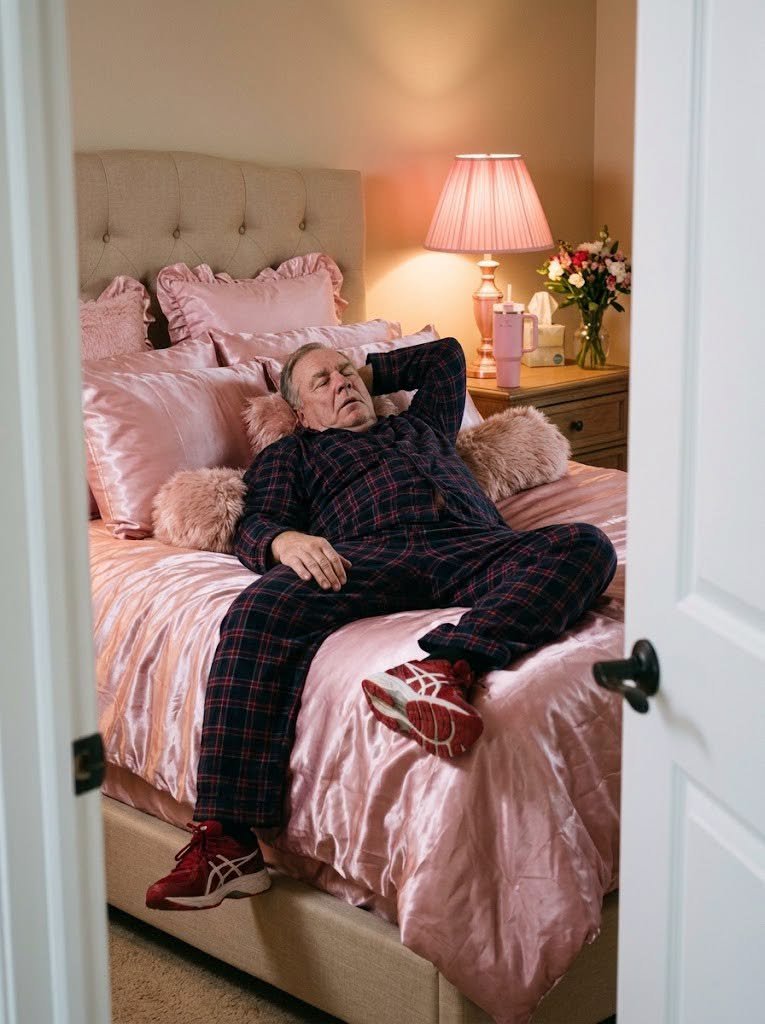
So when he returned from a weekend fishing trip and climbed into bed wearing his sneakers, I thought he was joking.
“Mark, seriously? Your shoes?”
He stared at the ceiling.
“I’m sorry,” he muttered.
I laughed, expecting him to smile and explain himself. But he didn’t.
He simply turned toward the wall and pulled the blanket over his shoulders.
That was the first moment I realized something was wrong.
Mark had never been a particularly mysterious man. For sixteen years, we’d shared everything: bills, family problems, embarrassing childhood stories, and the small frustrations that came with everyday life. He was predictable in the most comforting way possible.
He drank coffee from the same chipped blue mug every morning. He checked the front door twice before bed. And every Friday evening, he called his mother, even when they had nothing new to discuss.
I knew his habits, his moods, and the tiny expressions that crossed his face when he was worried.
But the man who returned from that fishing trip felt like a stranger wearing my husband’s face.
The next morning, I found him standing at the kitchen window, staring at the driveway.
“Did something happen on your trip?” I asked.
“No.”
“Did you have an argument with someone?”
“No, Sarah.”
“Then why are you acting like this?”
He finally turned toward me.
For a second, I thought he might tell me everything. His lips parted, and his eyes filled with something that looked painfully close to panic.
Then he shook his head.
“I’m just tired. I didn’t sleep much out there.”
I wanted to believe him.
I made his favorite breakfast, packed his lunch, and kissed him before he left for work. He kissed me back, but his mind seemed somewhere else.
That evening, he came home earlier than usual.
He checked the locks, walked through the house, and looked inside the garage before sitting down for dinner.
When I asked what he was doing, he said he had heard something outside.
“What kind of something?”
“Probably nothing.”
He barely touched his food.
Over the next few days, his behavior became increasingly unsettling.
He started leaving the hallway light on all night. He kept his phone beside him, even in the shower. Whenever a car slowed near our house, he stopped whatever he was doing and watched through the curtains.
Twice, I woke up in the middle of the night and found him standing at the bedroom window.
The second time, I reached for his arm.
“Mark, you’re frightening me. Please tell me what’s happening.”
He looked at me with exhausted eyes.
“I didn’t mean to bring this into our home.”
My heart began pounding.
“Bring what?”
He immediately looked away.
“Nothing. Forget I said that.”
I sat up in bed.
“No. You don’t get to say something like that and expect me to forget it.”
He sat on the edge of the mattress and rubbed his face.
“I just need a little more time.”
“Time for what?”
He didn’t answer.
I spent the rest of that night staring at the ceiling, wondering whether my husband had gotten himself into trouble, whether someone was threatening him, or whether there was a part of his life I had never known about.
By Thursday, I was barely sleeping.
Mark continued going to work, but he seemed distracted and exhausted. He checked his phone constantly, and whenever it rang, he looked almost relieved when the call ended without him answering.
Then, on Friday evening, I woke to an empty bed.
The clock on my nightstand read 2:17 a.m.
I called his name softly, thinking he might be in the bathroom.
No answer.
I walked downstairs.
The living room was empty. The kitchen was dark. The back door was locked.
Then I noticed the front door wasn’t fully closed.
A cold feeling settled in my stomach.
I stepped onto the porch and looked toward the driveway.
Mark was sitting on the bottom step beside the garage, still wearing his clothes from the day before. His elbows rested on his knees, and his hands were clasped so tightly that his knuckles had turned white.
He was staring at the road.
“Mark?”
He flinched.
I approached slowly.
“What are you doing out here?”
He looked up at me, and I saw tears on his face.
For sixteen years, I had watched this man deal with job losses, family emergencies, and the death of people he loved. I had seen him grieve, struggle, and get back on his feet.
I had never seen him look this afraid.
“Sarah,” he whispered, “if someone comes here tonight, I need you to promise me something.”
My stomach dropped.
“Who is coming here?”
He shook his head.
“Please. Just listen to me.”
I knelt beside him.
“No. I’m your wife. Whatever this is, you don’t have to face it alone.”
He stared at the road again.
Then he finally spoke.
“On the fishing trip, I met someone.”
I waited.
“At first, I thought it was a coincidence. He was staying at the same campground, a few spaces away from me. He knew my name, Sarah. He knew where I worked. He knew the name of this street.”
I felt the blood drain from my face.
“Who was he?”
Mark swallowed hard.
“His name is Daniel. And he told me something about my past that I thought I had buried forever.”
I reached for his hand.
“What past?”
He closed his eyes.
“Before I met you, I made a mistake. A terrible one. I was twenty-three, working at a small construction company, and I was desperate for money. My father was sick, and I had debts I couldn’t pay.”
He paused, struggling to find the words.
“I signed some documents for my employer without reading them properly. I thought they were routine paperwork. Later, I discovered they had been used to cover up financial fraud.”
I stared at him.
“Were you involved?”
“I didn’t know what I was signing at first,” he said quickly. “But when I realized what was happening, I panicked. I was young, and I was afraid of losing everything. I should have reported it immediately. Instead, I quit and walked away.”
He looked down at his hands.
“I told myself that because I hadn’t planned the fraud, I wasn’t responsible for what happened. I never heard from those people again. I started a new job, moved to another city, and eventually met you.”
I tried to absorb what he was saying.
“You’ve never told me any of this.”
“I know.”
“Did you hurt anyone?”
“No. Not deliberately. But people lost money, and I was too frightened to speak up when I should have.”
His voice cracked.
“Daniel told me he knew what I had signed. He said someone had been looking for me for years.”
I felt a chill run through me.
“Did he threaten you?”
“Not directly. He said I needed to meet him again, and he gave me a number to call. When I asked what he wanted, he said I would find out soon enough.”
I looked toward the dark road.
“Why didn’t you call the police?”
Mark rubbed his forehead.
“Because I don’t know whether Daniel is telling the truth about everything. And because I’m ashamed. I spent sixteen years building a life with you, and I was terrified that if you learned about this, you’d see me differently.”
I wanted to be angry. I was angry.
But beneath that anger was something more complicated: the painful realization that my husband had been carrying a secret for years, convinced that hiding it was the same as leaving it behind.
“Mark,” I said quietly, “you don’t protect our marriage by keeping me in the dark.”
He nodded, tears slipping down his cheeks.
“I know that now.”
Before I could say anything else, headlights appeared at the end of our street.
Mark went rigid.
A dark sedan slowed as it approached our house.
It passed our driveway, continued to the corner, and stopped.
Neither of us moved.
After several seconds, the car turned around and drove back toward us.
Mark grabbed my hand.
“Go inside,” he whispered.
“No.”
“Sarah, please.”
“I’m not leaving you out here.”
The sedan stopped across the street.
A man stepped out.
Even in the dim porch light, I could see that he was carrying a large envelope.
He walked toward us, stopped at the edge of our driveway, and called Mark’s name.
Mark stood slowly.
“Daniel?”
The man nodded.
“I’m sorry to come this late. I know you didn’t want to see me.”
I moved closer to my husband.
“Who are you, and why are you frightening him?”
Daniel looked at me, then back at Mark.
“I’m not here to hurt either of you. I’m here because someone else has been searching for him, and I think he deserves to know why.”
He held out the envelope.
Mark didn’t take it.
“What is this?”
“Copies of the documents you signed twenty years ago. And a letter from the man who ordered them.”
Mark’s face went pale.
Daniel continued.
“The company owner died last year. Before he died, he left instructions for these papers to be delivered to you. I’ve spent months trying to find you.”
“Why now?” Mark asked.
“Because the people who lost money are finally reopening the case. They need witnesses, and your signature is on some of the original documents.”
Mark stared at the envelope as though it might explode.
“Am I going to prison?”
Daniel didn’t answer immediately.
“I can’t promise you what will happen. That’s why you need a lawyer. But I can tell you something else. The letter explains that the owner deliberately misled several employees, including you. It doesn’t erase your responsibility, but it may help establish what you knew and when you knew it.”
For the first time that night, Mark seemed to breathe.
I looked at Daniel.
“If you were trying to help him, why didn’t you simply call?”
“I did,” Daniel replied. “Several times. The number I had for Mark was disconnected. When I finally found his address, I wasn’t sure how he’d react. I made a mistake by approaching him at the campground without explaining myself properly.”
He looked genuinely uncomfortable.
“I thought the documents would speak for themselves. Instead, I frightened him.”
Mark lowered his head.
“I thought you were coming to expose me. I thought you wanted revenge.”
Daniel shook his head.
“I don’t know you well enough to want revenge. I just didn’t want you to be blindsided when the investigation moved forward.”
I took the envelope from him.
“Thank you for bringing this. We’ll have a lawyer review everything before Mark speaks to anyone else.”
Daniel nodded.
“That would be wise.”
He gave Mark one last look, then returned to his car and drove away.
We stood on the porch long after his taillights disappeared.
When we finally went inside, Mark sat at the kitchen table and buried his face in his hands.
“I thought my life was over,” he whispered.
I sat opposite him.
“Your life isn’t over. But we can’t pretend this never happened.”
He nodded.
The next morning, we contacted a lawyer and arranged for the documents to be reviewed. We didn’t make assumptions about what they meant or whether Mark would face legal consequences. We decided to deal with the facts one step at a time.
Over the following weeks, the investigation moved forward. Mark answered questions through his lawyer, provided the information he had, and finally acknowledged the part he had played in the events from his twenties.
It wasn’t easy.
There were difficult conversations, uncomfortable discoveries, and moments when I wondered how much of our life together I truly understood.
But something else happened, too.
Mark stopped treating fear as a reason to remain silent.
He began telling me when he was worried, even when he didn’t know how to solve the problem. He stopped pretending that everything was fine simply because he wanted to protect me from the truth.
And I learned that loving someone didn’t mean shielding them from every consequence of their choices.
It meant standing beside them while they faced those consequences honestly.
Months later, when the legal questions were still being resolved, Mark and I sat together on our porch watching the sun set.
He reached for my hand.
“I’m sorry I made you feel like you were living with a stranger.”
I squeezed his fingers.
“You did frighten me. And I wish you’d trusted me enough to tell me sooner.”
“I was afraid you’d stop loving me.”
I looked at him for a long moment.
“I’m still here, Mark. But trust isn’t something we can take for granted just because we’ve been married for sixteen years.”
He nodded.
“I understand.”
That night, he took off his shoes before coming to bed.
It was such a small, ordinary thing that I almost laughed.
But I realized I had missed those familiar routines more than I knew. They reminded me of the man I had married, the life we had built, and the possibility that we could find our way back to one another without pretending the difficult parts had never existed.
I still don’t know whether I’ll ever understand every decision Mark made before we met. Some questions may never have simple answers.
But I know this: the night I found him sitting outside our house, I thought I was watching my marriage fall apart.
Instead, I was watching the first crack appear in a wall he had spent years building around himself.
And through that crack, the truth finally began to come out.
Sometimes, the secret that threatens a relationship isn’t the only thing that matters. What matters just as much is what happens when the secret is finally revealed—whether people choose denial and blame, or honesty and accountability.
After sixteen years, I learned that knowing someone deeply doesn’t mean knowing every part of their past.
It means being willing to face the truth about them, even when that truth is difficult, and deciding what trust must look like from that moment forward.
Because love can survive painful revelations.
But it cannot grow in the dark forever.
Website Disclaimer
The information provided on this website is for general informational and educational purposes only. While we strive to ensure that all content is accurate and up to date, we make no guarantees regarding the completeness, reliability, or accuracy of any information published.
The views and opinions expressed in articles belong to their respective authors and do not necessarily reflect the views of this website. Any action you take based on the information found on this website is strictly at your own risk. We will not be liable for any losses, damages, or inconveniences arising from the use of our content.
Some articles may contain opinions, third-party information, or external links. We do not endorse or guarantee the accuracy of content on external websites and are not responsible for their practices or policies.
All content on this website is provided in good faith and is intended for informational purposes only. Readers are encouraged to verify information independently and seek professional advice where appropriate.