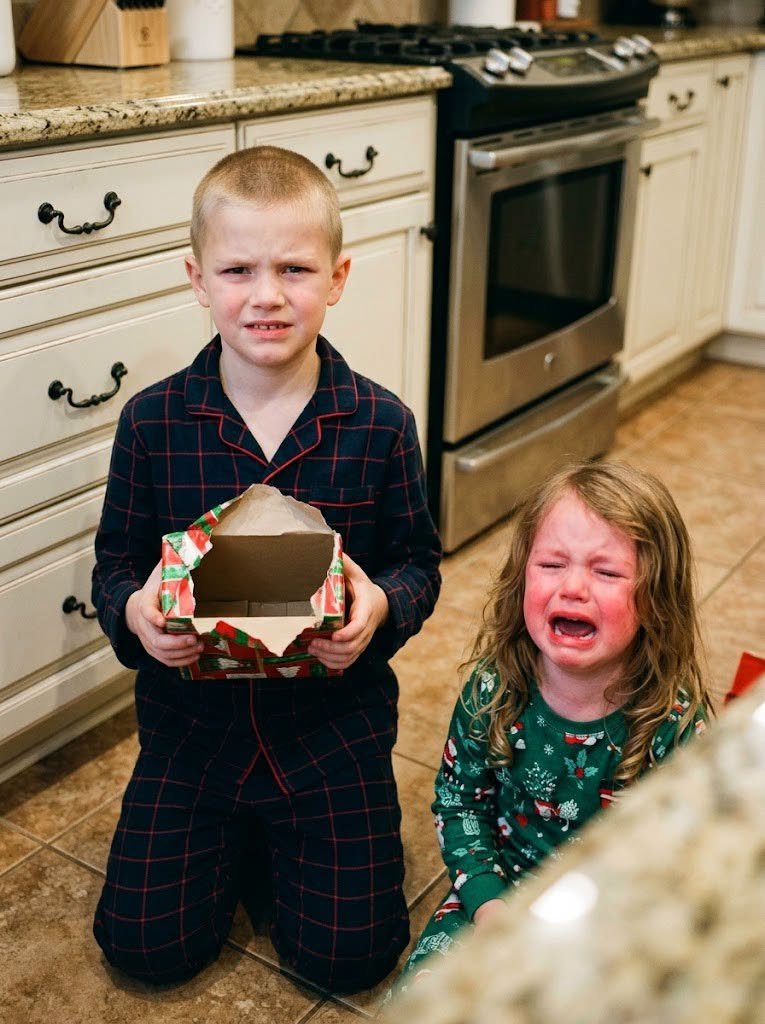
My mother-in-law gave every grandchild a Christmas present except my daughter. She didn’t forget her. She made that painfully clear in front of the entire family. I thought the worst part of Christmas was watching my little girl cry, until an unexpected knock at the door changed everything.
My name is Jenna.
My daughter Mia is six.
She calls my husband “Daddy,” even though he’s not her biological father.
Patrick adopted her the day she turned four.
He was there for her first day of kindergarten, her nightmares, her scraped knees, and every little moment that made her feel safe. He never once treated her as anything less than his own child.
And I loved him for that more than I could ever explain.
Unfortunately, his mother, Margaret, had never shared that feeling.
From the moment Patrick and I got married, she made it clear that Mia was different from the other grandchildren. She never said anything openly cruel when Patrick was around, but her little comments always found their way into our conversations.
“She certainly has her own personality,” Margaret would say whenever Mia behaved like any other six-year-old.
Or, “It’s wonderful that Patrick has been so generous.”
Generous.
As if loving a little girl were some extraordinary charitable act.
Patrick always defended Mia. He reminded his mother that adoption made him her father in every way that mattered. Margaret would smile, change the subject, and pretend the conversation had never happened.
I wanted to believe things would improve with time.
I was wrong.
That Christmas, Patrick’s family gathered at Margaret’s house for their annual holiday celebration. There were twelve of us around the dining table, with roast turkey, mashed potatoes, and enough desserts to feed twice as many people.
Mia had been excited for weeks.
She had made handmade Christmas cards for everyone, carefully writing each name with the help of her teacher. She had even drawn a little picture for Grandma Margaret, complete with a red heart and the words, “I LOVE YOU, GRANDMA.”
The night before, she’d asked me whether Santa would remember to bring her cousins presents, too.
I told her that Christmas was about giving and sharing.
She smiled and went back to coloring.
I had no idea how badly those innocent words would hurt her the following afternoon.
After dinner, Margaret announced that it was time to open the presents.
The children gathered around the tree, their eyes wide with excitement.
One by one, she called their names.
“Lucas, this one’s for you!”
“Emily, Grandma has something special!”
“Jacob, come here, sweetheart!”
Each child received a beautifully wrapped package with a shiny ribbon. There were toy cars, dolls, building sets, and boxes of art supplies.
The room filled with laughter and delighted squeals.
Mia sat cross-legged on the carpet, watching eagerly.
She had been particularly excited about this moment. Earlier that morning, she’d told me she hoped Grandma might get her a book because she was learning to read.
I smiled at her from across the room.
Then Margaret picked up the final present.
It was a large box wrapped in silver paper.
“For my youngest grandson,” she announced.
Everyone clapped as little Noah tore through the wrapping.
Mia looked around the tree.
There were no more presents.
She glanced at the empty space in front of her, then at the pile of gifts surrounding her cousins.
Finally, she turned toward Margaret.
“Grandma?” she asked softly.
Margaret looked at her.
“Yes, dear?”
“Did you forget mine?”
The room went quiet.
I felt Patrick’s hand tighten around mine.
Margaret didn’t look embarrassed. She didn’t look surprised.
Instead, she folded her hands in her lap and said, loud enough for everyone to hear, “No, Mia. I didn’t forget you.”
My daughter blinked.
“Then where’s my present?”
Margaret tilted her head.
“Well, sweetheart, these presents are for my grandchildren.”
Mia’s little face brightened with confusion.
“But I am your grandchild.”
Margaret gave a thin smile.
“You’re Patrick’s adopted daughter. That’s different.”
For a moment, I genuinely couldn’t understand what I had heard.
Then Mia looked at her father.
“Daddy?”
Patrick stood up so quickly that his chair scraped against the floor.
“Mom, what did you just say?”
Margaret sighed as though he were being unreasonable.
“I simply believe in being honest. I bought presents for my grandchildren. I didn’t think it was necessary to buy one for a child who isn’t biologically related to our family.”
My daughter stared at her.
She was six years old.
She didn’t understand family history, inheritance, or the complicated arguments adults used to justify their behavior.
She understood only that every other child in the room had received a present, and she hadn’t.
Her eyes filled with tears.
“Did I do something bad?” she whispered.
That question broke something inside me.
I crossed the room and knelt beside her.
“No, baby. You didn’t do anything wrong. Not a single thing.”
She pressed her face into my shoulder.
“But Grandma doesn’t want me.”
I held her tightly while tears slipped down my own cheeks.
Patrick stood motionless for a second, his jaw clenched. Then he walked over, lifted Mia into his arms, and kissed her forehead.
“You listen to me, sweetheart,” he said. “You are my daughter. You have always been my daughter. Nobody gets to decide otherwise.”
Margaret rolled her eyes.
“Oh, please, Patrick. Don’t make a scene. She’s too young to understand the difference.”
“No,” Patrick replied, his voice shaking with anger. “She’s old enough to understand that you deliberately humiliated her in front of this entire family.”
His sister tried to intervene.
“Patrick, maybe Mom just didn’t think—”
“She thought about it,” he interrupted. “She bought presents for every other child. She knew Mia would be here. She even watched her make that Christmas card.”
Nobody spoke.
I remembered the little card in Mia’s coat pocket, the one she had been so excited to give her grandmother.
Mia was still crying against Patrick’s shoulder.
I stood and gathered our coats.
“We’re leaving,” I said.
Margaret looked almost offended.
“You’re going to ruin Christmas over a present?”
I turned toward her.
“No, Margaret. You ruined this moment when you made a six-year-old child feel that she wasn’t worthy of being loved.”
Patrick carried Mia to the door.
As we stepped outside, his mother called after him.
“If you walk out of this house, don’t expect me to apologize!”
Patrick didn’t turn around.
“An apology wouldn’t mean much if you still believe what you just said.”
The door closed behind us.
In the car, Mia sat quietly in her booster seat, clutching the Christmas card she had never given her grandmother.
After several minutes, she asked, “Daddy, am I really different from the other kids?”
Patrick pulled into a parking lot and turned around to face her.
“Everybody is different, sweetheart. But being adopted doesn’t make you any less my daughter. I chose you, and I will keep choosing you every single day.”
Mia wiped her nose.
“Even when I’m naughty?”
He smiled sadly.
“Especially when you’re naughty. That’s part of being a dad.”
She gave a tiny laugh, then reached forward to hug him.
I thought that was the hardest part of Christmas.
I thought nothing could hurt more than watching my little girl question whether she belonged in the family that was supposed to love her.
But I was wrong.
Because when we arrived home, there was an unexpected knock at the door.
Patrick went to answer it.
I was helping Mia take off her boots when I heard him say, “Dad?”
I froze.
My father-in-law, Robert, stood on the porch holding a large cardboard box. Snow clung to his coat, and his cheeks were red from the cold.
He rarely visited without Margaret. In fact, I couldn’t remember the last time he had come to our house alone.
“Can I come in?” he asked.
Patrick stepped aside.
Robert walked into the living room, carrying the box carefully in both hands. When he saw Mia, his expression softened.
“There she is,” he said. “My girl.”
Mia looked at him uncertainly.
“Grandpa?”
He knelt in front of her.
“I heard what happened at Grandma’s house.”
Patrick’s shoulders stiffened.
“How?”
Robert looked down at the box.
“Because I was there. And because I should have stopped it.”
Silence filled the room.
I hadn’t realized Robert had witnessed the entire exchange and said nothing.
He swallowed hard.
“I’ve spent too many years avoiding arguments with your grandmother, Mia. I told myself that keeping the peace was the same as keeping the family together. Today, I realized I was wrong.”
He placed the box on the coffee table and opened it.
Inside were several smaller presents, each wrapped in colorful paper. On top sat a large teddy bear wearing a red scarf.
Mia’s eyes widened.
“Are those for me?”
Robert nodded.
“Every single one.”
He handed her the teddy bear first.
“I bought these for you weeks ago, sweetheart. I had planned to give them to you at Grandma’s house.”
I looked at Patrick.
He appeared just as confused as I felt.
“Then why didn’t you?” Patrick asked.
Robert lowered his head.
“Because your mother insisted that if I brought Mia a present, she’d accuse me of undermining her. She said it would cause a family argument, and I foolishly agreed to leave the gifts in the car.”
He looked at Mia, his eyes filling with tears.
“I thought I was avoiding a fight. Instead, I let you sit there believing nobody had remembered you.”
Mia hugged the teddy bear.
“That’s okay, Grandpa.”
Those three little words nearly brought him to his knees.
“No, sweetheart,” he whispered. “It isn’t okay. You deserved better from all of us.”
Then he reached into his coat pocket and pulled out a small envelope.
“This one is different,” he told her. “It’s something I’ve wanted you to have for a long time.”
Inside was a photograph.
It showed Patrick holding Mia on the day she was adopted. She was tiny in his arms, smiling at the camera, while Patrick looked down at her with an expression of pure joy.
On the back, Robert had written a sentence in careful handwriting:
Family isn’t only the people you’re born to. It’s the people who choose you, stand beside you, and never make you question whether you belong.
Mia traced the words with her little finger.
“Did you write this, Grandpa?”
“I did.”
“Can I keep it?”
“Forever.”
She hugged him, and Robert closed his eyes as he held her.
I thought the moment would end there, but then he stood and turned toward Patrick.
“There’s something else you need to know.”
Patrick frowned.
“What is it?”
Robert glanced at me, then back at his son.
“Your mother and I have argued about this for years. She believes that because Mia isn’t biologically related to us, she shouldn’t have the same place in the family as the other grandchildren.”
He paused.
“But that’s never been the truth. And I won’t pretend it is anymore.”
He reached into the box and removed a folder.
“I’ve been reviewing my estate plans. I’ve decided to make sure every one of my grandchildren is treated equally, including Mia. I’ve also made arrangements for her future education, just as I have for the others.”
Patrick stared at him.
“Dad, you don’t have to do that.”
“I know,” Robert replied. “That’s why I’m doing it. Because it’s the right thing to do.”
I felt tears gathering in my eyes again.
Not because of the money. Not because of the presents.
But because, for the first time that day, an adult in Patrick’s family had stood up and said plainly what Mia needed to hear.
She belonged.
Robert stayed for dinner. We heated leftovers, made hot chocolate, and let Mia open her presents one by one.
She loved the art set best. She spent nearly an hour drawing a picture of our family: Patrick, me, herself, and Robert standing beneath a giant Christmas tree.
Then she added Margaret.
I noticed and asked gently, “Why did you draw Grandma, sweetheart?”
Mia shrugged.
“Because she’s still Grandma.”
I swallowed the lump in my throat.
Six-year-olds can be remarkably generous with their hearts, even when adults give them reasons not to be.
Later that evening, after Mia had fallen asleep with her new teddy bear tucked beneath her arm, Patrick and I sat together on the couch.
He held my hand.
“I’m sorry,” he whispered. “I should have seen how deeply my mother’s attitude was hurting Mia before today.”
I leaned against him.
“You stood up for her.”
“She’s my daughter,” he said simply. “I should never have to think twice about that.”
The next morning, Margaret called.
Patrick answered on speakerphone while I sat beside him.
“I hear Robert went to your house,” she began.
“Yes,” Patrick replied.
“And I hear he gave Mia a pile of presents.”
“He did.”
A long pause followed.
“He’s making me look like a terrible grandmother.”
Patrick closed his eyes briefly.
“Mom, you did that yourself when you told a six-year-old that she wasn’t your real grandchild.”
“I was trying to make a point.”
“What point? That a child who has done nothing wrong deserves less love than everyone else?”
Margaret sighed.
“I don’t see why everyone is being so dramatic. She’s adopted. That’s a fact.”
“Yes,” Patrick said. “And I’m her father. That’s a fact, too.”
For once, Margaret had no immediate answer.
Patrick continued.
“Mia will never be required to earn her place in this family. She already has one. If you want a relationship with her, you need to understand that she is my daughter in every way that matters. I won’t allow you to make her feel otherwise.”
Margaret muttered something about needing time to think.
Patrick told her to take all the time she needed, then ended the call.
Over the following weeks, things changed.
Robert began visiting regularly. He brought Mia books, helped her build a birdhouse, and attended her school activities whenever he could. He never treated her like a child who needed to be compensated for what had happened. He simply treated her like his granddaughter.
Margaret, however, did not immediately change her mind.
She sent a short message saying she regretted that Mia had been upset, but she didn’t acknowledge the cruelty of what she had done. Patrick told her that an apology would need to come without excuses.
We didn’t force Mia to see her grandmother, and we didn’t ask her to pretend that Christmas hadn’t hurt.
Instead, we focused on making home a place where she never had to question whether she was wanted.
Months later, Margaret finally asked to visit.
Before agreeing, Patrick spoke with her privately. He explained that Mia’s adoption was not a flaw to be overlooked or a reason to treat her differently. If Margaret wanted to be part of Mia’s life, she would have to respect that.
When she arrived, she brought a small present and a handwritten letter.
She knelt in front of Mia and apologized for excluding her at Christmas. She admitted that she had allowed her own prejudices to hurt an innocent child.
Mia listened quietly.
Then she accepted the gift.
I didn’t expect her to run into Margaret’s arms, and she didn’t. Forgiveness wasn’t something we demanded from her. It was something she would decide for herself, in her own time.
But she did allow her grandmother to sit beside her while she colored.
For that day, it was enough.
Looking back, I still remember the moment Mia asked whether she had done something wrong. I remember how small she looked beneath that enormous Christmas tree, surrounded by presents she hadn’t received.
But I also remember the knock at our door.
Robert couldn’t erase what had happened, and his gifts couldn’t undo the hurt. What mattered was that he finally stopped protecting an adult’s pride at the expense of a child’s heart.
That Christmas taught me something I will never forget.
Children don’t measure love by biology, family names, or the promises adults make. They measure it by who shows up, who holds them when they cry, and who makes them feel safe when the world becomes confusing.
Patrick chose Mia. Robert chose to stand beside her. And our little girl learned that one person’s rejection could never determine her worth.
Mia still sleeps with the teddy bear Robert gave her. Sometimes, she takes it to school for show-and-tell and tells her classmates that her grandpa brought it to her house on Christmas night.
She doesn’t talk much about the presents she missed.
But she remembers the people who came through our door afterward.
And so do I.
Because that night, an unexpected knock reminded us that family isn’t defined by who shares your blood.
It’s defined by who refuses to let you stand alone when it matters most.
Website Disclaimer
The information provided on this website is for general informational and educational purposes only. While we strive to ensure that all content is accurate and up to date, we make no guarantees regarding the completeness, reliability, or accuracy of any information published.
The views and opinions expressed in articles belong to their respective authors and do not necessarily reflect the views of this website. Any action you take based on the information found on this website is strictly at your own risk. We will not be liable for any losses, damages, or inconveniences arising from the use of our content.
Some articles may contain opinions, third-party information, or external links. We do not endorse or guarantee the accuracy of content on external websites and are not responsible for their practices or policies.
All content on this website is provided in good faith and is intended for informational purposes only. Readers are encouraged to verify information independently and seek professional advice where appropriate.