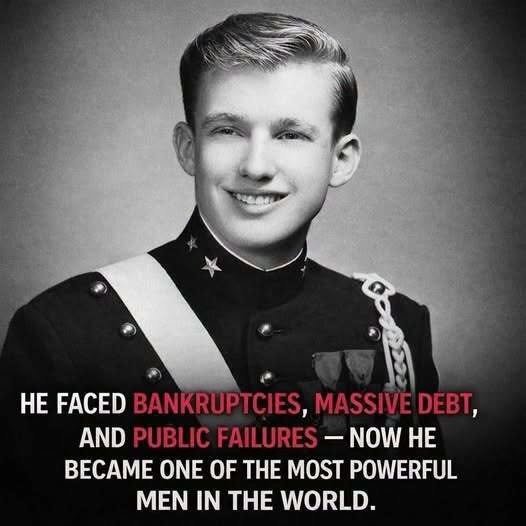
Drowned in debt. Written off by critics. Mocked by the same political and business circles he once worked so hard to impress. Yet every time the world seemed ready to declare Donald Trump irrelevant, he found a way back into the center of attention.
His story is less like a traditional business biography and more like a survival thriller. From an early age, Trump appeared to understand the power of perception. Looking strong could sometimes matter almost as much as being strong. His name became a brand, and that brand often served as a shield during periods when his businesses faced serious difficulties.
Banks, competitors, journalists, and critics repeatedly questioned whether he could recover from financial setbacks and public controversies. But Trump consistently bet on one thing: his ability to remain relevant. Even when individual ventures struggled, his public identity remained recognizable, valuable, and impossible to ignore.
Television transformed that recognition into something even bigger. The Apprentice introduced him to millions of viewers as a decisive, demanding businessman with complete control of the room. The program helped strengthen an image that would later become central to his political appeal.
When Trump entered politics, he brought decades of celebrity, media experience, controversy, and an instinct for commanding attention. He connected with voters who felt ignored or frustrated by traditional political institutions, turning his public persona into a powerful political movement.
Whether people admire him or strongly oppose him, Trump’s rise, defeats, and returns demonstrate something important about modern public life: attention itself can become a form of power. For someone who understands how to control the conversation, disappearing can be far more difficult than critics expect.
His story ultimately raises an uncomfortable question. In an era driven by media, celebrity, and constant public attention, is failure ever truly final for a person who refuses to disappear?
Website Disclaimer
The information provided on this website is for general informational and educational purposes only. While we strive to ensure that all content is accurate and up to date, we make no guarantees regarding the completeness, reliability, or accuracy of any information published.
The views and opinions expressed in articles belong to their respective authors and do not necessarily reflect the views of this website. Any action you take based on the information found on this website is strictly at your own risk. We will not be liable for any losses, damages, or inconveniences arising from the use of our content.
Some articles may contain opinions, third-party information, or external links. We do not endorse or guarantee the accuracy of content on external websites and are not responsible for their practices or policies.
All content on this website is provided in good faith and is intended for informational purposes only. Readers are encouraged to verify information independently and seek professional advice where appropriate.