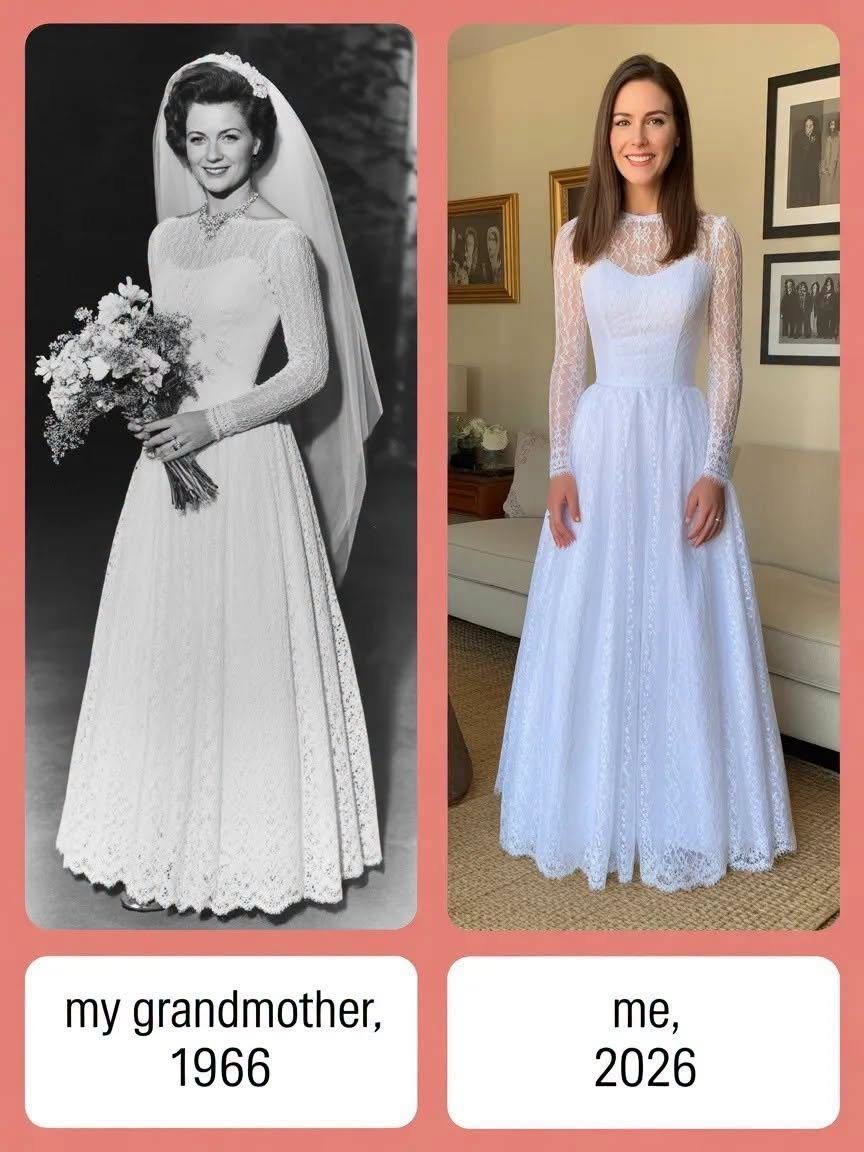
“You’ll wear this someday, darling,” Grandma told me.
I laughed and shook my head. “Grandma, this dress is older than Mom’s favorite stories. And I’m not even thinking about getting married.”
She smiled, but there was something in her eyes I couldn’t quite understand. It was sadness mixed with relief, as if she had been waiting years to say those words.
“Life has a funny way of bringing us back to things we thought we’d never need,” she said.
Then she carefully folded the dress and returned it to its garment bag.
I never asked her what she meant.
For the next twelve years, Grandma Rose was my entire world.
My parents had died when I was too young to remember them clearly. According to the story I grew up with, they had been killed in a car accident when I was just a few months old. Grandma took me in, raised me in her little white house at the end of Maple Street, and never once made me feel like I was a burden.
She taught me how to bake apple pie, how to sew a button, and how to tell when someone was hurting even when they insisted they were fine.
Every night, she read to me until I fell asleep. Every birthday, she made my favorite chocolate cake. When I had nightmares, she sat beside my bed and held my hand until the fear passed.
She was the first person I ran to when I got good grades, the first person I called after my first heartbreak, and the only person who could make me feel better with a cup of tea and three simple words.
“You’ll be all right.”
I believed her because, in my world, Grandma Rose could fix anything.
But there were things she never discussed.
She kept no photographs of my parents in the living room, only one small picture of a young woman with dark hair and a gentle smile tucked inside her bedroom drawer. Whenever I asked about it, Grandma would say, “Some memories are precious enough to keep private.”
If I asked what my mother had been like, she would tell me she was kind, stubborn, and loved wildflowers.
If I asked about my father, she would say he had a wonderful laugh.
And if I asked why I didn’t look much like either of them, she would simply brush my hair away from my face and say, “You look exactly like yourself, sweetheart. That’s enough.”
As a child, I accepted those answers.
As a teenager, I stopped asking.
By the time I turned thirty, I had built a life of my own. I worked as a school librarian, lived in a small apartment across town, and visited Grandma every Sunday.
She was getting older, but she remained sharp-minded and fiercely independent. She still insisted on carrying her own groceries, still corrected my grammar, and still claimed her apple pie was better than anything sold in a bakery.
Then, one cold November morning, she suffered a stroke.
I was at the hospital when the doctor told me there was nothing more they could do. Grandma had been unconscious for hours, her small hand resting in mine, her familiar silver hair spread against the pillow.
I leaned close to her ear.
“Grandma, it’s me. I’m here.”
For a moment, I thought her fingers moved.
Then she opened her eyes just enough to look at me.
“Rose’s girl,” she whispered.
“I love you,” I said through my tears. “You know that, don’t you?”
Her lips trembled.
“Dress,” she breathed.
I leaned closer. “What about your dress?”
But she had already closed her eyes.
Those were the last words she ever spoke to me.
Grandma Rose died that afternoon.
At her funeral, people filled the little church with flowers and stories about her generosity. Neighbors told me how she had quietly paid for groceries when families were struggling. Former students described how she had helped them buy school supplies. Everyone seemed to have a story about a woman who had given pieces of herself to make someone else’s life easier.
I stood beside her casket, trying to understand how someone so essential to my existence could suddenly be gone.
For weeks, I couldn’t bring myself to enter her bedroom.
When I finally did, I found her belongings arranged exactly as she had always kept them. Her slippers sat beside the bed. Her reading glasses rested on the nightstand. A half-finished crossword puzzle lay beside a cup she had forgotten to put away.
And in the back of her closet hung the wedding dress.
The same dress she had shown me when I turned eighteen.
I pulled it from the garment bag and spread it across her bed. The ivory fabric had yellowed slightly with age, but the delicate lace still looked beautiful. Tiny pearl buttons ran down the back, and the sleeves were embroidered with small flowers.
I remembered her standing on the porch, holding it beneath the yellow light.
“You’ll wear this someday, darling.”
For the first time, I wondered whether she had been talking about marriage at all.
I ran my fingers over the lining, remembering how carefully she had handled the dress. That’s when I felt something unusual beneath the fabric near the waist.
A small, uneven ridge.
At first, I thought it was an old repair. But when I turned the dress inside out, I noticed a section of stitching that didn’t match the rest.
Someone had sewn a narrow pocket into the lining.
My hands began to shake.
I fetched a small pair of scissors from Grandma’s sewing basket and carefully loosened the thread. Inside the pocket was a folded envelope, yellow with age, bearing my name in Grandma’s familiar handwriting.
For my darling girl, when she is ready to know the truth.
I sat down on the floor.
For several minutes, I couldn’t open it. Some part of me already understood that whatever was inside would change the way I remembered my entire life.
Finally, I unfolded the letter.
My darling girl,
If you are reading this, then I am no longer there to explain what I should have told you many years ago.
I have loved you every day of your life. Nothing you discover in this letter can change that.
But you deserve to know who you are, and I have been afraid for too long.
I stopped reading. Tears blurred the page.
Then I forced myself to continue.
The story I told you about your parents was not the whole truth. Your mother did die when you were very young, and the accident was real. But the woman whose photograph I kept in my drawer was not your mother.
I stared at the words.
I read them again.
Then a third time.
Your birth mother was my daughter, Margaret.
My breath caught.
I had spent my entire life believing my mother had been someone I barely knew through stories and a handful of imagined memories. But Grandma had just written that the woman I had been taught to identify as my aunt was actually my mother.
Margaret.
The woman in the photograph.
The woman Grandma had never wanted to discuss.
I continued reading.
Margaret was young when she had you. She loved you, but she was frightened. Your biological father, Daniel, was a man she met when she was working in a small town several hours from here. Their relationship ended before you were born, and he never knew you existed.
Margaret came home to me with you in her arms. She was struggling, and she asked me to help her raise you. I promised her I would.
For a little while, we were happy. You were a beautiful baby, and Margaret loved holding you. She sang to you at night and whispered promises about all the things she would teach you when you grew older.
Then, when you were only a few months old, Margaret died in a car accident.
I pressed the letter against my chest.
My mother hadn’t been a distant stranger who had died before I could remember her. She had been Grandma’s daughter, a young woman who had held me, sung to me, and imagined a future she never got to see.
And Grandma had been my grandmother and my mother in every way that mattered.
But why had she hidden the truth?
I looked down at the next paragraph.
After Margaret died, I was terrified that you would grow up feeling abandoned. I worried that knowing your mother had been young, frightened, and imperfect would make you feel unwanted. I told myself I was protecting you.
Then the years passed. Every birthday made the secret harder to reveal. Every time you called me Mom by accident as a little girl, I wanted to tell you everything. Every time you asked about your parents, I nearly did.
But I was afraid that if I told you the truth, you would look at me differently. I was afraid you would wonder whether my love had been enough to replace what you had lost.
And so I waited.
I kept waiting for the perfect moment, until I realized I had spent thirty years waiting for a moment that would never feel perfect.
I cried then, not quietly, but with the kind of grief that seems to come from somewhere deeper than the heart.
I was devastated that Grandma had kept such an enormous secret from me. I was angry that she had decided, on my behalf, what I was allowed to know about my own life.
But beneath that anger was something I couldn’t deny.
She had loved me.
She had loved me enough to sacrifice her own peace, even if the way she had tried to protect me was wrong.
The letter continued.
There is one more thing you need to know.
Margaret left you something before she died. I have kept it safe all these years because I wanted you to have it when you were old enough to understand.
Look inside the small wooden box beneath my bed.
I folded the letter and hurried to Grandma’s bedroom.
Beneath her bed, behind a pair of old slippers, sat a small wooden box I had never seen before. Its brass clasp was tarnished, and a faded ribbon was tied around it.
Inside lay a baby blanket, a tiny silver bracelet, several photographs, and a second envelope.
This one was addressed to me in a handwriting I didn’t recognize.
To my daughter, when she is old enough to read this.
My knees nearly gave way.
I opened it carefully.
My sweet girl,
I don’t know when you will read these words, or whether I will be there to see the woman you become. But I want you to know something before anything else.
You were never a mistake.
When I found out I was going to have you, I was scared. I was young, and I didn’t know how to be the person everyone expected me to be. I made mistakes, and I was afraid of what people would say.
But the first time I held you, I knew I wanted to give you a life full of love.
I wanted to watch you take your first steps. I wanted to hear your first words. I wanted to teach you to ride a bicycle and help you choose your first school dress. I wanted to be there when you fell in love and when you discovered what you wanted to do with your life.
If I cannot be there for those things, please don’t think it means I didn’t want them.
I wanted them more than I can explain.
My mother will raise you. She is the strongest woman I know, and she will love you even on the days when she is tired, frightened, or unsure of herself. Trust her. She will give you everything she can.
And when you are old enough to understand, please forgive me for all the things I won’t be there to teach you.
I love you, my little girl.
I loved you before I ever saw your face.
Your mother,
Margaret.
I held the letter against my heart and sobbed.
For thirty years, I had wondered why I couldn’t remember my mother. I had imagined her as a distant figure, someone who had existed only long enough to leave me behind.
Now I knew she had been a frightened young woman who had loved me fiercely and died before she could fulfill the dreams she had for us.
I also understood why Grandma had kept the photograph.
She hadn’t hidden it because she was ashamed of Margaret.
She had hidden it because every time she looked at it, she remembered the daughter she had lost and the promise she had made to raise her child.
And perhaps she had been afraid that I would love Margaret more if I knew the truth.
But love was not a competition.
Grandma Rose had raised me, and Margaret had given me life. Both women had shaped me, even though I had known only one of them as my mother.
For the first time, my story felt larger than the story I had been told.
A week later, I returned to Grandma’s house and carried the wedding dress into the living room. I laid it carefully across the sofa and examined the tiny stitches in the hidden pocket.
Then I understood something else.
Grandma had not simply hidden a secret inside that dress.
She had placed the truth in the one object she had told me I might someday wear.
Perhaps she had always hoped I would find it. Perhaps she had wanted to tell me herself but couldn’t bear to begin. I would never know for certain.
But I knew what I wanted to do.
I took the dress to a seamstress and asked her to restore it without removing the pocket. I had no plans to get married, and I didn’t know whether I ever would.
I simply wanted to preserve it.
When the dress was ready, I brought it home and placed it in a garment bag beside my own clothes.
Then I framed the two letters and set them beside the photograph of Margaret.
For the first time in my life, my mother had a face I could look at whenever I wanted.
Months passed. I began asking relatives questions I had been too afraid to ask before. I learned that Margaret had loved old movies, hated thunderstorms, and once drove two hours just to bring Grandma a particular kind of pie she couldn’t find in town.
I learned that she had been funny, stubborn, and sometimes impatient.
In other words, she had been human.
And I began to understand that knowing the truth didn’t erase the childhood I had shared with Grandma. It gave that childhood a deeper meaning.
One spring afternoon, I sat on the porch where Grandma had shown me her wedding dress all those years ago. The cicadas hadn’t begun singing yet, but a soft breeze moved through the trees.
I held Margaret’s letter in my hands.
For the first time, I spoke to her aloud.
“I’m thirty years old now,” I whispered. “I wish you could see me.”
Then I looked toward the house.
“And Grandma, I wish you had trusted me with the truth.”
I didn’t know whether either of them could hear me.
But I felt something settle inside my heart—not complete forgiveness, and not the disappearance of grief, but the beginning of peace.
Grandma Rose had kept a secret from me for thirty years. She had made a choice I wished she hadn’t made, believing silence could protect me from pain.
She had been wrong about that.
But she had also been right about something else.
Some truths are easier to carry when you’re grown enough to understand them.
I was finally old enough to know that people can love us deeply and still make mistakes. That a secret can be born from fear rather than cruelty, even when it causes real hurt. And that the truth about where we come from doesn’t have to diminish the love that raised us.
I had spent my whole life believing I had lost both parents before I was old enough to know them.
Now I understood that one had loved me for a short, precious time, and the other had devoted her entire life to making sure I never felt alone.
I couldn’t get back the years I had spent not knowing.
I couldn’t ask Margaret about the future she had imagined for me.
And I couldn’t ask Grandma why she had waited so long.
But I could carry their love forward.
I could remember Margaret as more than a tragedy. I could remember Rose as more than the woman who kept a secret. I could hold both truths at once, even when they hurt.
That evening, I put the letters back into the wooden box and placed it beside the wedding dress.
Before closing the lid, I touched the photograph of my mother.
“I’m here,” I whispered. “I’m all right.”
Then I added, with a small, tearful smile, “Grandma was right about that part.”
Because I was all right.
Not because the truth hadn’t hurt me, but because it had finally given me the chance to understand my own story.
And if there is one thing I know now, it is this:
Family is not only the people who give us life. It is also the people who stay, the people who sacrifice, and the people whose love continues to shape us long after they are gone.
Sometimes the truth arrives late.
Sometimes it changes everything.
But when we finally open our hearts to it, we may discover that the truth doesn’t destroy our story.
It helps us understand why we were loved the way we were.
Website Disclaimer
The information provided on this website is for general informational and educational purposes only. While we strive to ensure that all content is accurate and up to date, we make no guarantees regarding the completeness, reliability, or accuracy of any information published.
The views and opinions expressed in articles belong to their respective authors and do not necessarily reflect the views of this website. Any action you take based on the information found on this website is strictly at your own risk. We will not be liable for any losses, damages, or inconveniences arising from the use of our content.
Some articles may contain opinions, third-party information, or external links. We do not endorse or guarantee the accuracy of content on external websites and are not responsible for their practices or policies.
All content on this website is provided in good faith and is intended for informational purposes only. Readers are encouraged to verify information independently and seek professional advice where appropriate.