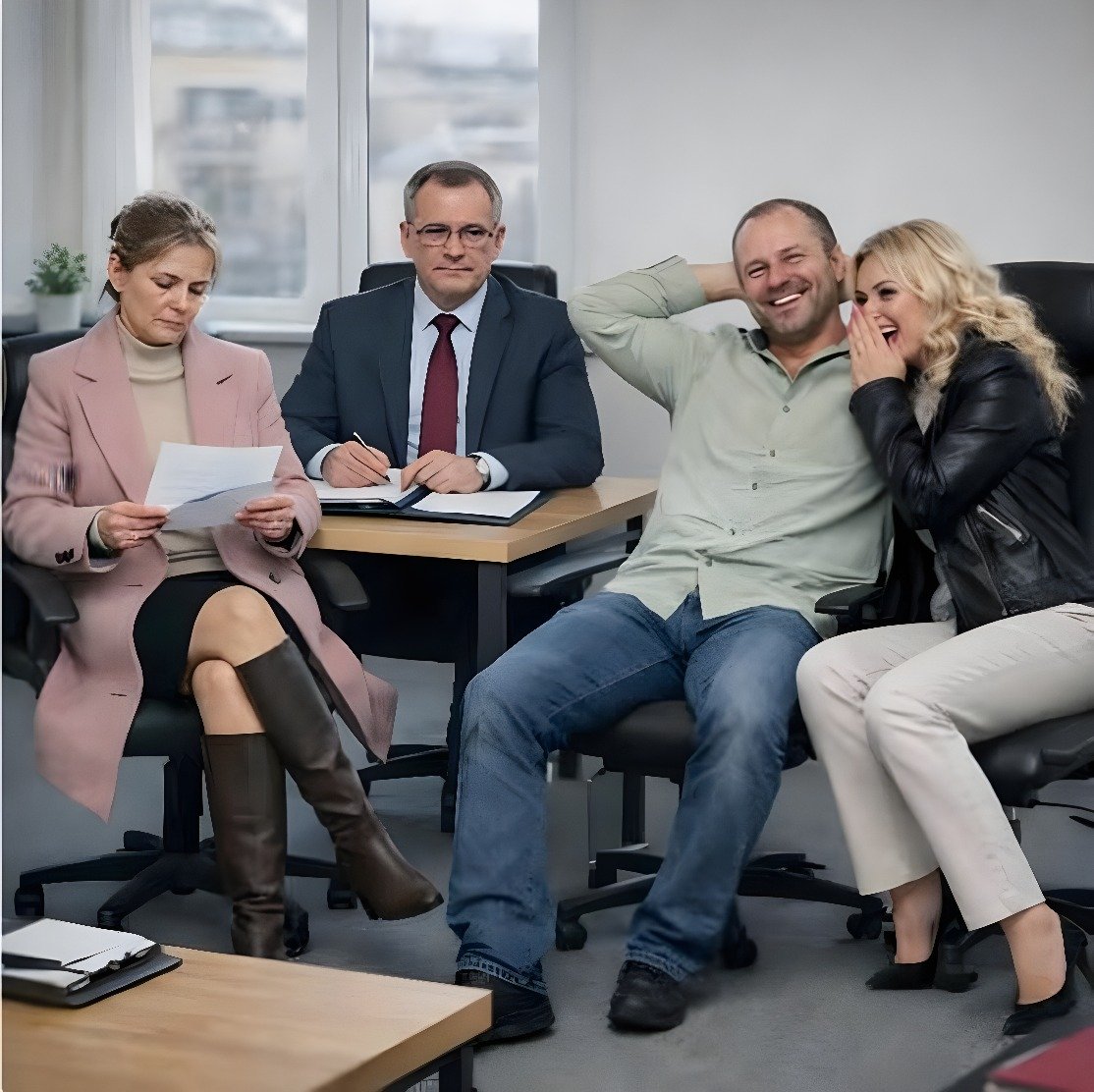
“Well, Marinka, you’re a wealthy heiress now,” Viktor leaned back in his chair and laughed so loudly that the notary grimaced. “You’ve inherited saws and some old planers. You can start a workshop or sell them for scrap if you’re lucky.”
“Vitya, don’t make me laugh,” Angela covered her mouth with her hand, but giggles still slipped through her fingers. “I can just imagine her dragging that trunk around the city. Marina, do you want me to call some movers? Or will you manage your little fortune on your own?”
With bright pink nails, her hair styled in curls, and a cloud of sweet perfume around her, she leaned into Viktor, signaling her closeness to him. Marina sat across from them, dressed in an old gray coat, her hands resting on her knees. She gazed out the window, where the November rain blurred the city into a gray spot, remaining silent.
The notary cleared his throat and returned to his paperwork.
“According to the will, Viktor Pavlovich will receive the house along with a plot of land in a residential area, along with the deceased’s savings account. Marina Fyodorovna is to inherit a wooden trunk filled with tools, a savings book issued in nineteen eighty-seven, and a sealed envelope. The envelope must be opened here, in the presence of all parties involved.”
“What’s that for?” Viktor was already flipping through documents regarding the house, tracing his finger across the lines. “What envelope? Did father lose his mind completely?”
“It was the desire of the deceased,” the notary handed Marina a yellowed envelope with a wax seal through the table.
Angela whispered something to Viktor, and he smirked, nodding. She continued, now raising her voice:
“Vityun, what if we sell the house right away? That should be enough for a central apartment, and there might be money left for a car. Or we could head to Sochi, where property values are rising now.”
Marina tore the wax, unfolded the sheet inside. Her father-in-law’s handwriting was large and uneven, the letters jumping around. The first line hit her like a punch to the gut, and her vision blurred.
“Marinushka, I knew everything. About Angela. About how he left you while I was still alive. About how you spent your last money on my medications while he wined and dined with his new sweetheart.”
For thirty-two years, Marina worked in a bread shop, caring for her father-in-law for the last fifteen. Her husband didn’t visit his father—he claimed he couldn’t bear to see him, that his heart wouldn’t stand it. But his heart endured just fine to go fishing with friends and socializing in cafes.
Marina changed the bedding, turned the old man, read him newspapers when his eyesight failed, counted coins for medicines. Meanwhile, Viktor counted down the days until he would be free.
The father-in-law was quiet, irritable, rarely said thank you. But a month before he passed, he called her over and asked for an old trunk from the storeroom. He rummaged through it for a long time among chisels and planers before pulling out a wrinkled envelope.
“Marin, you’re a good person,” he looked at her, and for the first time in all those years, his gaze was soft. “Not like him. I will take care of everything properly; just don’t say a word to Vitya.”
A week later, the notary visited them. The old man dictated the will, and Marina signed some papers as a witness, not bothering to read them. Three weeks later, her father-in-law was gone.
At the funeral, Viktor didn’t cry; he just nodded at condolences. After the wake, he vanished, claiming he couldn’t breathe in those walls. Marina washed the dishes, cleared the table, and in that empty apartment, the silence was so profound that it rang in her ears. For the first time in fifteen years, she was alone, no obligation to check on the sick, to see if he was breathing.
Two weeks later, Viktor packed his things. Angela waited downstairs in a bright white sheepskin coat, vibrant as a laundry detergent advertisement. Marina stood by the window behind the curtain, watching her husband carry bags to the car. She longed for him to turn around and say something. But he simply got into the driver’s seat and drove away. That night, her pillow was wet, but no one saw it.
“So, the house is mine, the savings are mine,” Viktor flipped through the documents, nodding in satisfaction. “Father was right; he did it all properly, leaving everything for his son. And you, Marina, should not worry; maybe there are a few kopecks left from the Soviet era in your account book—a little for bread.”
“Vityun, who would even need these tools?” Angela snickered, leaning toward him. “Maybe we should just throw them away to avoid cluttering the apartment?”
Marina looked up from the letter, scanning both of them—he relaxed, a victor, and she next to him like a trophy. She dropped her gaze back to the shaky lines written by a dying man.
“Did you think I didn’t hear you crying in the kitchen at night? I listened. I heard everything; the walls are thin. And here’s what I did, Marinushka. The savings book in your name contained my compensation from the work-related injury. It was a substantial payout. I put it in your name back when you became my son’s bride—I wanted to see what kind of person you were. You passed the test, but he didn’t. The money laid there all these years, accruing interest. It’s now worth more than this house—maybe five times over. Perhaps even more.”
Marina raised her head and met the notary’s eyes. He nodded, pulling another document from his folder.
“Marina Fyodorovna, according to the bank statement, the amount in the savings book registered in your name significantly exceeds the value of the property left to Viktor Pavlovich. We are talking about a capital sum sufficient to purchase several properties in the city center.”
The silence fell so abruptly that the sound of rain outside became audible. Viktor froze, holding documents, the smile slowly sliding off his face. Angela stopped giggling, looking first at the notary and then at Marina, her eyes flickering with fear.
“Wait, how much is ‘significantly’?” Viktor straightened up, and the documents slipped from his hands onto the table. “How much exactly? How much is there?”
“I cannot disclose the exact amount without the consent of Marina Fyodorovna, but I can say it’s a considerable sum,” the notary stated evenly, though there was a barely perceptible smirk at the corners of his mouth.
“Vityun, wait, maybe there’s a mistake,” Angela clutched his arm, her voice taking on a thin, squeaky quality. “It’s some Soviet book; it can’t have anything at all, let us clarify it properly…”
Viktor turned pale, then flushed, then paled again. He looked at Marina, and panic showed in his eyes. Marina slowly folded the letter and put it back in the envelope. Her hands no longer trembled.
“Well, Marinka, now you really are a wealthy heiress,” she echoed his words quietly, and each one struck like a blow.
Viktor jumped up, walked around the table, and tried to touch her shoulder. His face twisted into a smile, one that was fake and pitiful.
“Marin, we’re family after all, we’ve been together for so many years, let’s have a calm conversation like adults,” he rattled quickly, panting. “Father probably wanted us to sort this out together, as one family. I’m not a stranger to you, right?
Marina stood up and pushed her chair back. She took the documents regarding the savings book and the letter from the table. Viktor stood nearby, smelling of a familiar cologne that previously had felt like home. Now it just nauseated her.
“Have a calm conversation?” she looked him in the eyes, and he stepped back a pace. “Like when you calmly left two weeks after the funeral? Or when I asked you to help me lift your father, and you calmly walked away to her?”
“Marin, why bring up the past? We are adults; we can sort this out properly,” Viktor tried to smile again, his tone turning conspiratorial, almost sweet. “We need to maintain the house, do repairs; it all costs money. Maybe you can help, and I can assist you as well. We are not enemies.”
Angela jumped up, her white sheepskin coat parting to reveal a short skirt.
“Viktor Pavlovich, are you serious?” she turned to him, her voice rising to a shriek. “You promised me we’d go to Sochi, that we’d buy a car, that you had everything under control! And now, what, this… this ex of yours is going to take everything? What about us?”
“Angela, be quiet, don’t interrupt,” Viktor tried to quiet her, but she didn’t listen, her voice rising higher.
“No, I will not be quiet! I’ve waited six months for you to get divorced, endured your promises, and now it turns out she has more money than you! Maybe you should go back to her?”
Marina fastened the buttons of her coat and tied her scarf. Her movements were slow but precise. She looked at Angela, and the latter shrank away, falling silent mid-sentence.
“You recently laughed at my trunk,” Marina spoke quietly, but every word was like ice. “That trunk is worth more to me than all your life plans. Because it was collected by a man who understood what honor means. And you will never understand that.”
She grabbed her bag, nodded at the notary, and walked toward the door. Behind her, Viktor screamed something about conscience, about years, about justice. Angela was demanding explanations, her voice growing increasingly frantic. Marina exited into the hallway, and the door closed behind her, cutting off their voices. She descended the staircase, and with each step, it became easier to breathe.
Outside, the cold November rain drizzled, but Marina felt warm. She reached the bus stop, sat on a wet bench, and took the envelope from her bag. She read the letter once more, slowly, contemplating each word. At the end, in a small and shaky handwriting, there was a note she hadn’t noticed in the office:
“Live, Marinushka. You’ve earned this life. And make sure to take my trunk—it holds a photograph under the tools at the bottom. Me with your grandmother, when we were young. I wanted you to know—I understood who you are. My Katyusha was just the same. Thank you for everything.”
Marina folded the letter back, placed it in her bag, and tears began to flow down her cheeks unaided. But these were different tears from the ones she had cried silently in the kitchen at night, so no one would hear. This was something else—relief, liberation, acknowledgment. She cried and smiled at the same time, as passersby glanced at her, veering away, yet she felt indifferent.
The bus arrived after ten minutes. Marina sat by the window, watching her reflection in the wet glass. The gray coat, the old scarf, and a weary face. But her eyes were different—they were alive, her own, no longer cowed. She pulled out her phone, checked the screen. Three missed calls from Viktor. With a quick tap, she sent his number to the blacklist. Just a finger’s movement, and it was done.
Outside, gray buildings flowed by, wet streets, sparse streetlights. Marina clutched the bag with documents to her chest, recalling how her father-in-law held her hand just before leaving. How he squeezed her fingers and stayed silent, yet his eyes conveyed something significant. Now she understood. He said everything he needed in his own way, as best as he could.
She got off the bus at her stop, walked through the yard, and ascended to the third floor. The apartment welcomed her with silence, but this silence was no longer empty; it was her own. Marina took off her coat, set the kettle to boil, and sat by the window. Outside, the city continued its life, distant and alien. But here, in this silence, began her own existence. Free from Viktor, free from her father-in-law, no longer pretending that everything was fine.
Tomorrow, she would go to the bank, then pick up that very trunk. And she would find the photograph at the bottom—the one of her young father-in-law with a woman who resembled her. And perhaps then she would understand why he chose her back in eighty-seven. Why he trusted her. Why he stayed silent but remembered.
For now, she simply sat by the window, breathing. Freely. For the first time in fifteen years.
Website Disclaimer
The information provided on this website is for general informational and educational purposes only. While we strive to ensure that all content is accurate and up to date, we make no guarantees regarding the completeness, reliability, or accuracy of any information published.
The views and opinions expressed in articles belong to their respective authors and do not necessarily reflect the views of this website. Any action you take based on the information found on this website is strictly at your own risk. We will not be liable for any losses, damages, or inconveniences arising from the use of our content.
Some articles may contain opinions, third-party information, or external links. We do not endorse or guarantee the accuracy of content on external websites and are not responsible for their practices or policies.
All content on this website is provided in good faith and is intended for informational purposes only. Readers are encouraged to verify information independently and seek professional advice where appropriate.