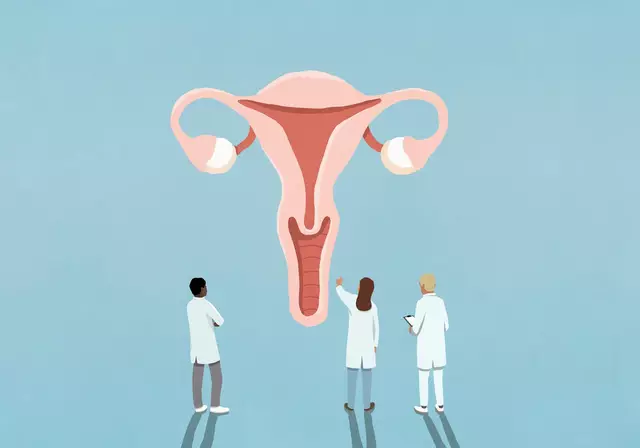
Mayer-Rokitansky-Küster-Hauser syndrome (MRKH) is a rare congenital disorder which affects the female reproductive system
A woman born with Mayer-Rokitansky-Küster-Hauser syndrome (MRKH) has explained how she is able to have sex.
The rare congenital health disorder affects approximately one in every 4,500 to 5,000 female newborns worldwide.
Those affected are born without, or with an underdeveloped or absent uterus and upper vagina, while external function remains normal.
People with MRKH can have typical puberty and hormonal development, but are unable to menstruate or carry a pregnancy without medical assistance.
Women who have the syndrome can still have sex, while for some it is recommended to have treatment like vaginal lengthening to create a functional vagina for intercourse.
Commenting on a Reddit thread, a user claiming to be a 44-year-old female who was diagnosed with MRKH at the age of 16 said she was able to dilate without any surgery.
“I dilated without any surgery and mine remains as is just fine,” the woman explained.
“I started dilating with my then boyfriend at 17, and it took about a year before we had intercourse as you normally would.
“He didn’t have a very large penis, which helped a lot. My later partners had varying sizes of penises and I’ve never had any complaints.
“I think by now if I had intercourse with someone not mentioning it, they wouldn’t be able to tell something is different with me.”
Similarly, Ally Hensley was 16 when she was told about her MRKH diagnosis, which took a mental toll on her growing up.
In an interview with Tyla, the author of Vagina Uncensored: A Memoir of Missing Parts said she underwent dilator therapy by using specially designed smooth cylinder-shaped objects called vaginal dilators.
“They said that when your knuckles turn white, you’re doing it correctly,” she said. “That’s the that’s the force of pressure that you need to do.
“To do that doesn’t ever feel right for anybody, yet you’re you’ve got to equate that with progress, and that’s where I kind of started to associate intimacy with shame and intimacy with pain and pain with progress.
“And all the relationships that I made were unhealthy links.”
Since coming to terms with her diagnosis, she uses her platform to remove the stigma and so nobody goes ‘through what I had gone through’.
“It’s lovely because MRKH is a part of my life, but it’s not my life, it’s not my identity. So I’m in this really wonderful, really great place where I feel quite liberated from it,” Ally said.
“I know my worth. I hold firm boundaries between good and not-so good people. I am eager to see what happens next for me.”
Website Disclaimer
The information provided on this website is for general informational and educational purposes only. While we strive to ensure that all content is accurate and up to date, we make no guarantees regarding the completeness, reliability, or accuracy of any information published.
The views and opinions expressed in articles belong to their respective authors and do not necessarily reflect the views of this website. Any action you take based on the information found on this website is strictly at your own risk. We will not be liable for any losses, damages, or inconveniences arising from the use of our content.
Some articles may contain opinions, third-party information, or external links. We do not endorse or guarantee the accuracy of content on external websites and are not responsible for their practices or policies.
All content on this website is provided in good faith and is intended for informational purposes only. Readers are encouraged to verify information independently and seek professional advice where appropriate.