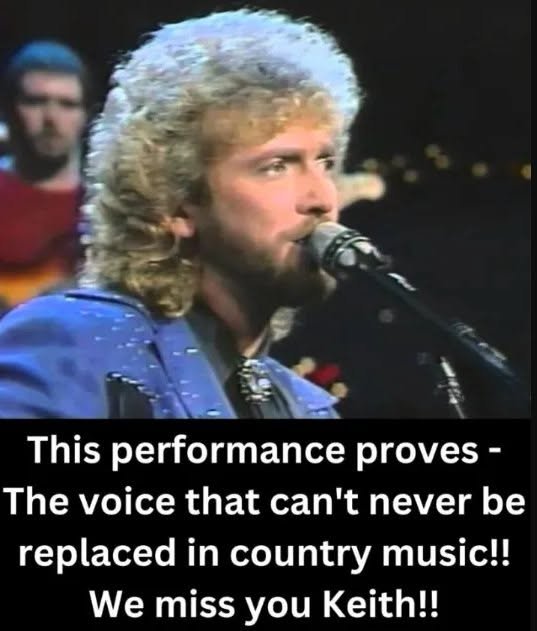
When Keith Whitley released “When You Say Nothing at All” in 1988, it quietly became one of the most emotionally powerful ballads in modern country music. Written by Don Schlitz and Paul Overstreet, the song captured the beauty of silent understanding between lovers—proving that sometimes, feelings are strongest without words. The track quickly reached No. 1 on the Billboard Hot Country Singles chart, but its impact went far beyond commercial success.
It marked a shift in country music, where subtlety and emotional restraint became more powerful than dramatic storytelling. Whitley, born in Kentucky in 1955, was deeply influenced by bluegrass and traditional country. His voice carried a natural sadness and sincerity, making every lyric feel lived-in and real. Unlike many artists of the time, he relied on honesty rather than showmanship.
Produced by Garth Fundis, the song’s arrangement was simple—soft acoustic guitar, gentle steel guitar, and minimal instrumentation. This allowed Whitley’s voice to remain the focus, delivering each line with tenderness and quiet emotion. The song helped elevate Whitley from rising star to one of country music’s most respected voices. It also influenced a generation of artists, encouraging a return to emotional depth and simplicity.
Tragically, Whitley passed away in 1989 at just 34, making the song one of his most lasting legacies. Its message became even more meaningful over time. Decades later, “When You Say Nothing at All” remains a timeless classic. Its quiet strength, emotional honesty, and universal message continue to resonate—proving that sometimes, the most powerful songs are the ones that speak the softest.
Website Disclaimer
The information provided on this website is for general informational and educational purposes only. While we strive to ensure that all content is accurate and up to date, we make no guarantees regarding the completeness, reliability, or accuracy of any information published.
The views and opinions expressed in articles belong to their respective authors and do not necessarily reflect the views of this website. Any action you take based on the information found on this website is strictly at your own risk. We will not be liable for any losses, damages, or inconveniences arising from the use of our content.
Some articles may contain opinions, third-party information, or external links. We do not endorse or guarantee the accuracy of content on external websites and are not responsible for their practices or policies.
All content on this website is provided in good faith and is intended for informational purposes only. Readers are encouraged to verify information independently and seek professional advice where appropriate.