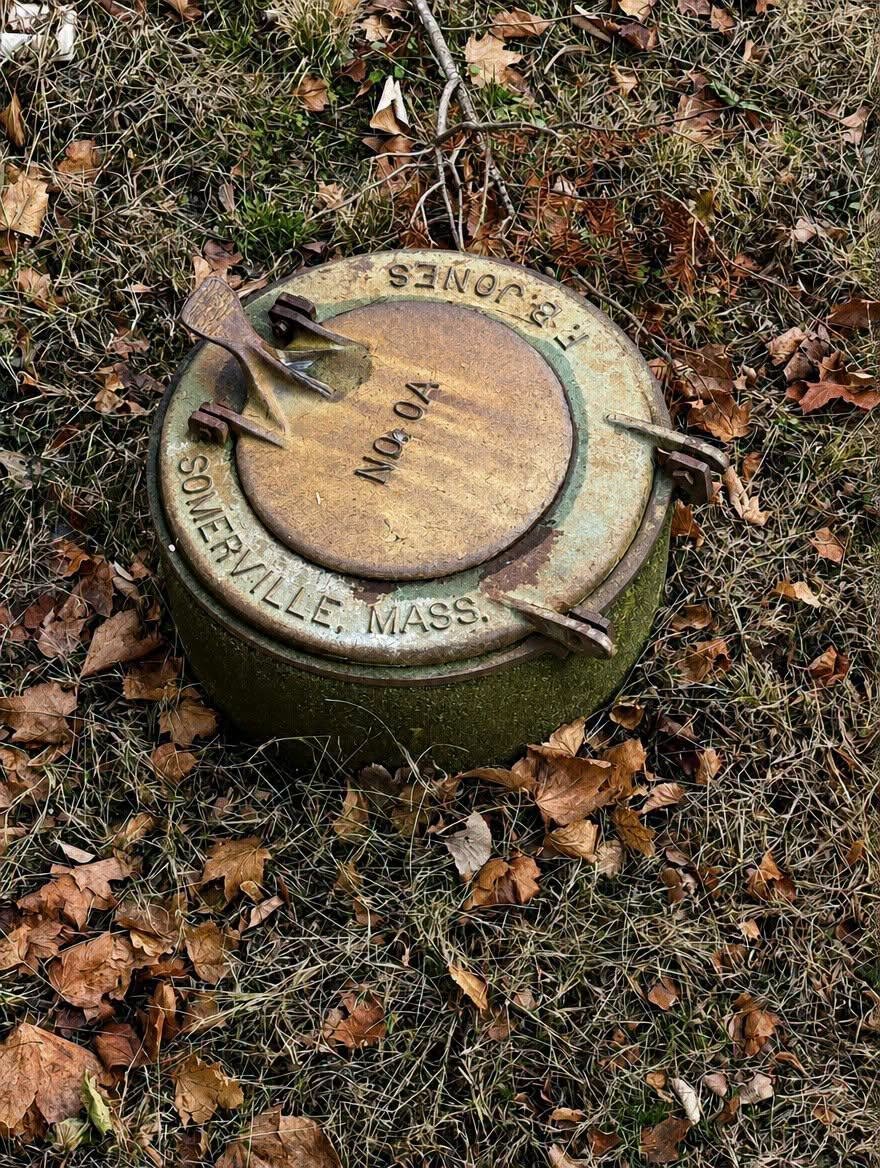
My friend Mike called one day saying he’d found something strange in his backyard—maybe even an old underground bomb shelter. Curious, I went over immediately.
What we discovered wasn’t a shelter at all, but a forgotten underground garbage bin. Beneath fallen leaves was a heavy rusted metal hatch stamped “Somerville, Mass.” At first, we weren’t sure what it was, but research revealed it was once a common mid-century household waste system in New England.
Back before curbside pickup existed, trash disposal was messy and inconvenient. Metal cans attracted animals, rusted quickly, and were difficult to manage in harsh weather. To solve this, some towns installed underground bins—metal containers set in concrete wells with flush lids that kept odors contained and pests out.
These systems worked simply: homeowners dropped waste into the bin, and on collection day workers lifted the inner container, emptied it into trucks, and returned it underground. It was a clever early attempt at cleaner urban sanitation.
However, over time, they became obsolete. Moisture caused rust and structural damage, rainwater collected in the wells, and freezing winters made them unreliable. As cities modernized waste collection, lightweight curbside bins replaced them entirely by the 1970s.
Most underground cans were abandoned, filled in, or paved over, slowly disappearing from everyday awareness. Today, finding one is rare and feels like uncovering a small piece of forgotten infrastructure hidden beneath a normal suburban lawn.
Some homeowners who rediscover them now repurpose the structures creatively—as garden planters, hidden coolers, or decorative yard features—turning old utility relics into something useful again.
These buried cans are quiet reminders that everyday life once relied on very different systems, and that even ordinary backyards can hold traces of how people solved practical problems in the past.
Website Disclaimer
The information provided on this website is for general informational and educational purposes only. While we strive to ensure that all content is accurate and up to date, we make no guarantees regarding the completeness, reliability, or accuracy of any information published.
The views and opinions expressed in articles belong to their respective authors and do not necessarily reflect the views of this website. Any action you take based on the information found on this website is strictly at your own risk. We will not be liable for any losses, damages, or inconveniences arising from the use of our content.
Some articles may contain opinions, third-party information, or external links. We do not endorse or guarantee the accuracy of content on external websites and are not responsible for their practices or policies.
All content on this website is provided in good faith and is intended for informational purposes only. Readers are encouraged to verify information independently and seek professional advice where appropriate.