Why Police Officers Approach Your Car the Way They Do During a Traffic Stop — And What Their Actions Really Mean
Seeing red and blue lights explode in your rearview mirror can feel like a punch to the chest. Your pulse spikes, your mind starts racing, and suddenly every little mistake you might have made behind the wheel comes rushing back.
You check your speedometer. You glance at your license. You wonder whether your taillight is out or whether you accidentally missed a traffic sign.
But what if that frightening moment isn’t simply about catching you doing something wrong? What if the officer’s movements, the position of the patrol car, and even the way the officer approaches your window have practical reasons that most drivers never consider?
Understanding what happens during a traffic stop can make the experience less confusing and help you respond calmly and safely.
Why Does the Officer Park Behind You at an Angle?
When a police officer activates the emergency lights, your first responsibility is to find a safe place to stop.
Once you pull over, you might notice that the patrol car doesn’t stop directly behind yours. Instead, the officer may position the vehicle slightly to one side, leaving a small angle between the two cars.
This positioning can serve several purposes.
It can provide the officer with some protection from passing traffic, improve visibility for approaching drivers, and create room to approach your vehicle. The exact position depends on the road, traffic conditions, and the officer’s training.
On a busy highway, for example, an officer may need to consider vehicles speeding past at close range. On a quiet residential street, the situation may be entirely different.
The angled position isn’t necessarily a sign that the officer suspects you of a serious crime. Often, it’s simply a practical safety measure.
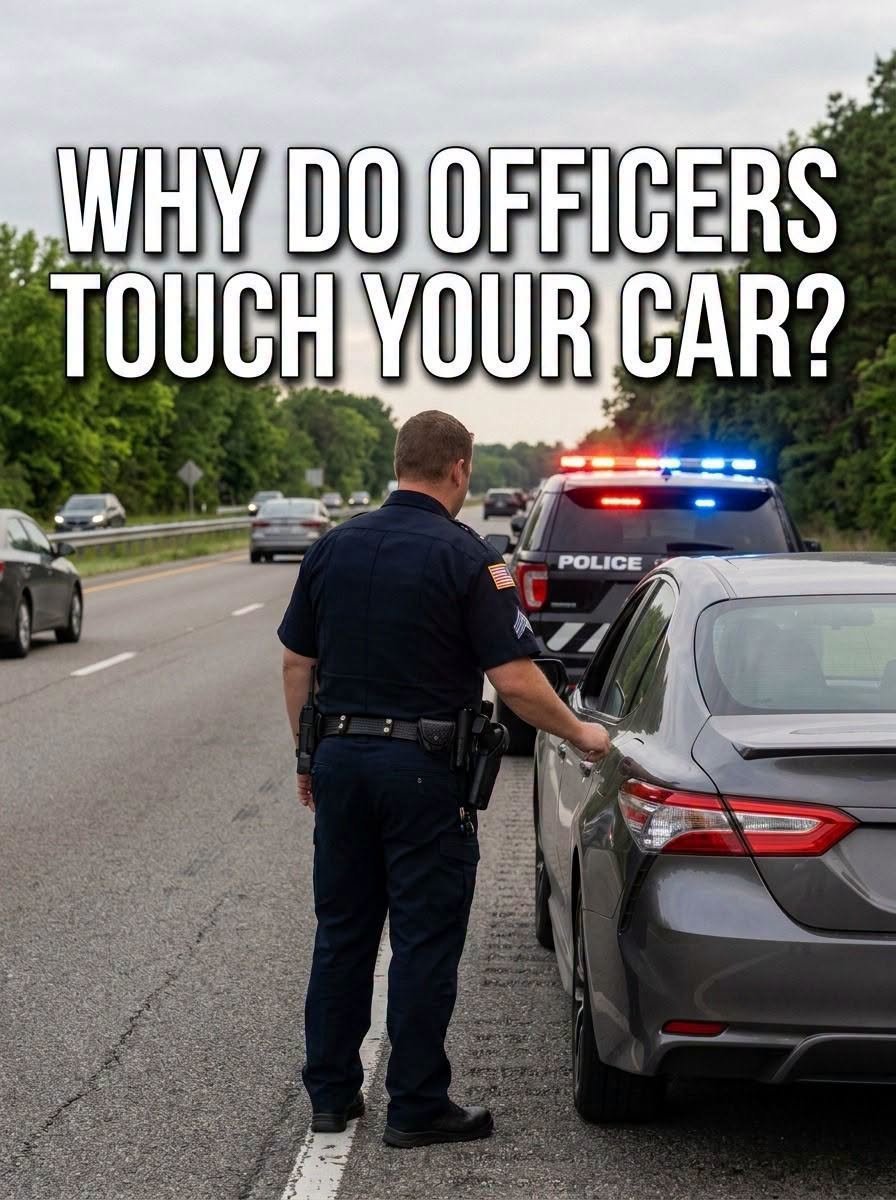
Why Do Officers Touch the Back of a Car?
One of the most frequently discussed aspects of traffic stops is the possibility that an officer might touch the rear of a vehicle while approaching it.
Some people believe this is always done to leave fingerprints on the car in case something happens to the officer.
Although this explanation is widely repeated, it shouldn’t be treated as a universal rule or a guaranteed reason for the action. Police practices vary by department, officer, and circumstance, and there isn’t one explanation that applies to every traffic stop.
An officer might briefly touch a vehicle for a variety of reasons, or might not touch it at all.
The important point is that a driver’s interpretation of a gesture doesn’t necessarily reveal the officer’s intention.
Rather than assuming that every movement has a hidden meaning, it’s more useful to focus on what the officer actually says and asks you to do.
Why Does the Officer Approach Your Window Carefully?
When an officer walks toward your vehicle, you may notice that they observe the surroundings before speaking to you.
They might look inside the car, check the number of occupants, or pay attention to nearby traffic.
These actions are generally connected to situational awareness.
A traffic stop can expose an officer to unpredictable conditions. The officer doesn’t know everything about the driver, the passengers, or the circumstances before approaching the vehicle.
At the same time, drivers may be nervous, confused, or frightened. An officer’s cautious approach doesn’t automatically mean that the driver has done something beyond the original traffic violation.
The encounter may be routine, even if it feels intimidating.
For drivers, the simplest response is usually the safest: remain in the vehicle unless instructed otherwise, keep your hands visible, and avoid sudden movements.
Why Might an Officer Stand Near the Side of Your Car Instead of Directly Behind You?
The officer’s position can depend on several factors, including traffic flow, road conditions, the location of your vehicle, and departmental procedures.
Standing in a particular place may allow the officer to communicate with you while remaining aware of passing traffic and other potential hazards.
There is no single position used in every traffic stop.
If you’re on a narrow shoulder with trucks passing nearby, the officer’s approach may look very different from an encounter in a quiet parking lot.
This is why it’s misleading to interpret one particular stance as proof that the officer suspects you of something.
The circumstances matter.
What Should You Do When the Officer Reaches Your Window?
Although traffic laws and police procedures differ by location, a few general practices can help make a traffic stop safer and less stressful.
1. Pull over somewhere safe.
Signal and move to a suitable stopping place as soon as reasonably possible. If the immediate location is dangerous, slow down, signal, and proceed cautiously to a nearby safe location when appropriate.
2. Keep your hands visible.
Place your hands somewhere clearly visible, such as on the steering wheel. Avoid reaching suddenly into the glove compartment, under a seat, or into a pocket.
3. Stay calm and communicate clearly.
You don’t have to agree with everything an officer says, but arguing aggressively at the roadside can make an already stressful encounter more difficult.
4. Follow lawful instructions.
Requirements concerning identification, vehicle documents, and other requests vary by jurisdiction. You can ask respectful questions if you don’t understand an instruction.
5. Don’t assume that silence or nervousness proves anything.
People react differently to stressful situations. A racing heart, trembling hands, or difficulty finding words doesn’t automatically indicate wrongdoing.
6. Address disagreements through the appropriate process.
If you believe a ticket was issued incorrectly or your rights were violated, document the details when safe and seek advice about the relevant complaint or legal process rather than escalating the confrontation on the roadside.
Does Every Traffic Stop Mean You’re in Serious Trouble?
Absolutely not.
Traffic stops can occur for many reasons, including speeding, broken equipment, expired registration, or other suspected violations. In some circumstances, an officer may simply need to clarify information.
Being stopped doesn’t automatically mean you’ve committed a crime, and the officer’s safety precautions don’t necessarily indicate that the encounter is unusually serious.
The most important thing is to understand the actual reason for the stop rather than trying to decode every movement as a warning.
If you’re given a citation, read it carefully and check the instructions for responding or contesting it. If the encounter raises concerns about your legal rights, those rights depend on the laws of the jurisdiction where the stop occurred.
The Detail Most Drivers Forget
A traffic stop is a stressful interaction between two people who may know very little about each other.
The driver may be worried about a fine, an insurance increase, or the possibility of missing an important appointment. The officer must assess the situation while dealing with traffic, limited visibility, and uncertainty.
Recognizing these pressures doesn’t mean you must surrender your rights or accept inappropriate behavior. It simply means that understanding the situation can help you make better decisions.
The flashing lights may trigger panic, but you don’t have to let that panic control your response.
Find a safe place to stop. Keep your movements predictable. Listen carefully. Ask questions respectfully when necessary, and address disputes through the proper channels.
Because the goal isn’t to guess what every gesture means. It’s to understand the situation, protect your safety, and know how to respond appropriately.
And the next time those red and blue lights appear in your mirror, remember this: a traffic stop may feel personal, but the officer’s positioning and movements often have practical explanations. Stay calm, focus on the facts, and don’t assume that every precaution is an accusation.
Website Disclaimer
The information provided on this website is for general informational and educational purposes only. While we strive to ensure that all content is accurate and up to date, we make no guarantees regarding the completeness, reliability, or accuracy of any information published.
The views and opinions expressed in articles belong to their respective authors and do not necessarily reflect the views of this website. Any action you take based on the information found on this website is strictly at your own risk. We will not be liable for any losses, damages, or inconveniences arising from the use of our content.
Some articles may contain opinions, third-party information, or external links. We do not endorse or guarantee the accuracy of content on external websites and are not responsible for their practices or policies.
All content on this website is provided in good faith and is intended for informational purposes only. Readers are encouraged to verify information independently and seek professional advice where appropriate.