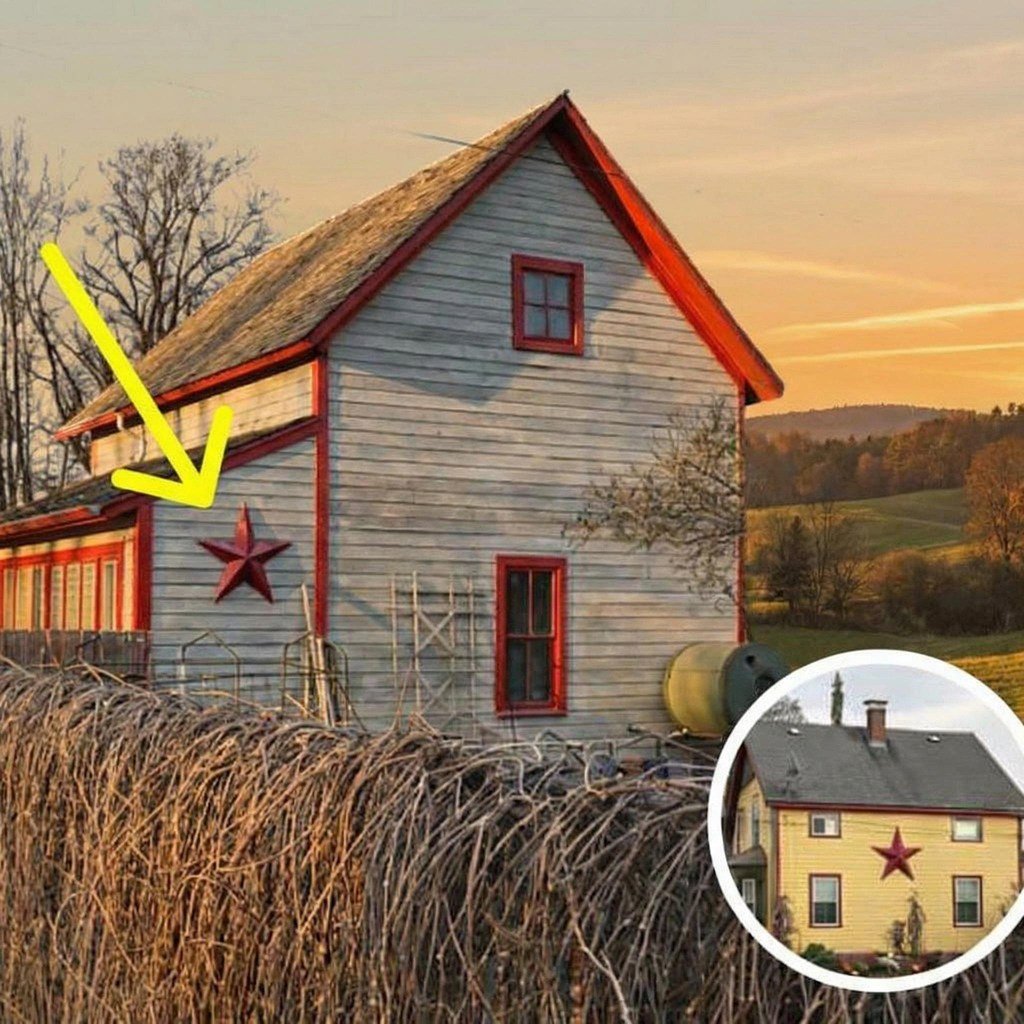
It’s strange how something you’ve seen a hundred times can suddenly feel “suspicious” just because the internet decided it was. In many neighborhoods, a simple five-pointed star mounted on the side of a house has always blended in—just another cozy detail, like a porch swing or a welcome sign. But in recent years, viral posts and screenshots have turned this harmless decoration into a source of confusion. People began sharing dramatic claims about what the star “really means,” and before long, homeowners who’d displayed one for years found themselves wondering if others were judging them. It’s a perfect example of how quickly rumors can attach themselves to ordinary things, transforming familiar symbols into something mysterious—even when nothing about them has actually changed.
In reality, these stars have a long and simple history. Often called barn stars, they’re commonly linked to Pennsylvania Dutch and German-American traditions, passed down through generations. Families placed them on barns and homes as a sign of pride, heritage, protection, and good fortune—less like a secret message, and more like a personal touch that made a property feel cared for. Some people chose certain colors based on family preference, local customs, or folk beliefs, but for most households it wasn’t complicated at all. It was tradition, craftsmanship, and decoration—something meant to be welcoming, not alarming.
So why did the meaning get distorted? The answer isn’t history—it’s modern information. A single misleading post can spread faster than any correction, especially when it’s framed in a dramatic way. Social media rewards attention, and uncertainty travels well because people naturally want to understand what they’re seeing. Once a claim gets repeated enough, it starts to feel “true,” even without proof. That’s how everyday symbols become misunderstood: not because their meaning changed, but because people stopped checking where the symbol actually came from.
Most of the time, a star on a house is exactly what it looks like: a decorative choice, a cultural keepsake, or a simple design that gives a home character. Understanding that matters—not just to clear up confusion, but to respect the families and traditions behind it. It also reminds us of something important: not every viral explanation deserves belief. Sometimes the most accurate answer is also the simplest one—some symbols aren’t coded messages at all. They’re just small, familiar details that make a place feel like home.
Website Disclaimer
The information provided on this website is for general informational and educational purposes only. While we strive to ensure that all content is accurate and up to date, we make no guarantees regarding the completeness, reliability, or accuracy of any information published.
The views and opinions expressed in articles belong to their respective authors and do not necessarily reflect the views of this website. Any action you take based on the information found on this website is strictly at your own risk. We will not be liable for any losses, damages, or inconveniences arising from the use of our content.
Some articles may contain opinions, third-party information, or external links. We do not endorse or guarantee the accuracy of content on external websites and are not responsible for their practices or policies.
All content on this website is provided in good faith and is intended for informational purposes only. Readers are encouraged to verify information independently and seek professional advice where appropriate.