Imagine experiencing the sheer, indescribable joy of welcoming twin babies into the world, only to have your entire universe shatter just three hours later. For Millie Smith and her partner Lewis Cann, this devastating reality became their waking nightmare. After a high-risk pregnancy carrying identical twins Callie and Skye, tragedy struck when Skye passed away mere hours after birth. Left with one surviving baby in the neonatal intensive care unit, Millie faced a storm of grief. But what happened next—and the tiny, ingenious symbol born from her pain—sparked a global movement that is changing how hospitals handle infant loss forever.
A High-Risk Pregnancy and an Unthinkable Diagnosis
Millie Smith and Lewis Cann were thrilled to welcome their first child in November 2015 before expecting a pair of daughters. With a family history filled with twins, Millie carried a strong intuition that she was carrying more than one baby. However, just two weeks after discovering they were expecting twins, their excitement turned to profound dread. During a routine ultrasound, the absolute silence of the medical technician told them everything they needed to know.
Doctors delivered the devastating news that one of the unborn babies suffered from anencephaly, a severe and fatal birth abnormality. According to the Centers for Disease Control and Prevention, approximately one in 4,600 newborns in the United States are affected by this condition, and almost all babies born with it pass away shortly after birth. Despite knowing the tragic outcome, Millie and Lewis courageously chose to move forward with the high-risk pregnancy. They decided to name their daughters Skye and Callie, wanting Skye to have a name that would echo through eternity. Skye symbolized a place they could always look up to—the sky—to remember their precious baby.
A Brief, Precious Encounter and Unbearable Heartbreak
On April 30, at just 30 weeks into the pregnancy, Millie went into labor, requiring an emergency Caesarean section. The hospital provided them with compassionate support, including a bereavement midwife and a “Daisy Room”—a peaceful space designed for families to spend precious moments with their infant before and after death.
To their absolute astonishment, both girls cried when they were born. Medical professionals had warned Millie and Lewis that Skye would neither make a noise nor move, making those cries a monumental moment. For three precious hours, Millie and Lewis held and cuddled Skye before she passed away in their arms. While it was the darkest moment of their lives, Millie felt an immense sense of pride that her tiny daughter fought so fiercely just to spend time with them.
The Breaking Point in the NICU
Following the tragedy, surviving twin Callie remained in the NICU alongside other premature babies recovering from birth complications. While most of the medical staff knew about Skye’s passing, time marched on, and conversations faded. After roughly four weeks, hospital visitors and surrounding families began acting as though nothing had happened, completely unaware of the family’s ongoing grief.
One fateful day, a frazzled mother with healthy newborn twins approached Millie. Out of innocent humor and utter exhaustion, she remarked to Millie that she was “so lucky” not to have the burden of two infants.
The innocent comment nearly broke Millie. She bolted from the room in blinding tears, leaving the other mother entirely confused. Because none of the surrounding parents knew about Skye, the remark cut deep into an unhealed wound. Millie realized instantly that a simple, silent indicator could have prevented that agonizing miscommunication entirely.
The Birth of the Purple Butterfly Initiative
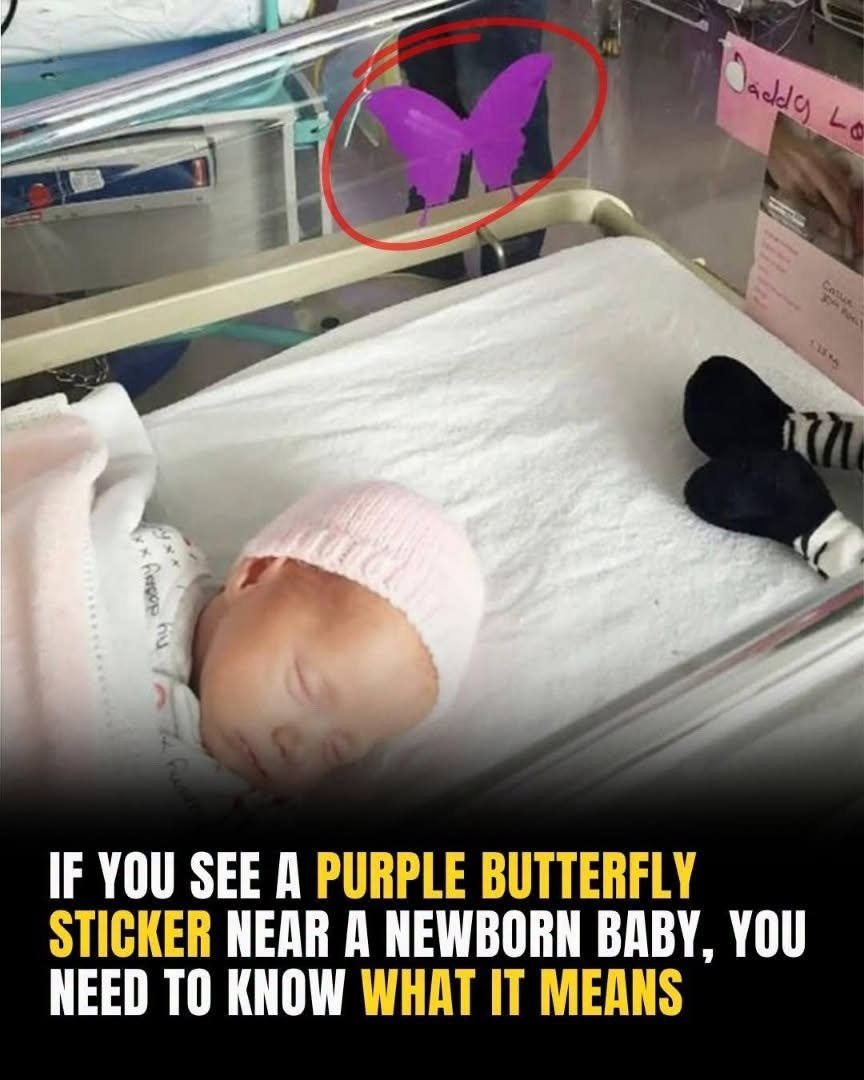
Determined to ensure no other bereaved parent would endure such accidental cruelty, Millie took action. She designed a simple yet powerful poster for neonatal intensive care units to inform hospital staff and visitors that a purple butterfly sticker placed near an incubator indicated the tragic loss of one or more babies in a set of multiples.
Millie chose butterflies because they beautifully represent babies who have “flown away,” and selected the color purple because it remains neutral and suitable for both boys and girls. What started as a mother’s desperate need to honor her child quickly blossomed into an international phenomenon. Today, The Skye High Foundation oversees the purple butterfly initiative, expanding the program to hospitals across numerous nations and offering comfort items, cards, and support networks to grieving families worldwide.
A Living Legacy
Callie, now seven years old, is a vibrant, joyful child who carries forward the memory of her twin sister. Through the tireless efforts of her mother and the growing reach of the foundation, Skye’s legacy continues to educate the public and protect the delicate hearts of parents navigating the unimaginable loss of a child. Millie Smith’s journey stands as a profound reminder of how immense personal pain can be transformed into a beacon of hope, empathy, and everlasting comfort for others.
Website Disclaimer
The information provided on this website is for general informational and educational purposes only. While we strive to ensure that all content is accurate and up to date, we make no guarantees regarding the completeness, reliability, or accuracy of any information published.
The views and opinions expressed in articles belong to their respective authors and do not necessarily reflect the views of this website. Any action you take based on the information found on this website is strictly at your own risk. We will not be liable for any losses, damages, or inconveniences arising from the use of our content.
Some articles may contain opinions, third-party information, or external links. We do not endorse or guarantee the accuracy of content on external websites and are not responsible for their practices or policies.
All content on this website is provided in good faith and is intended for informational purposes only. Readers are encouraged to verify information independently and seek professional advice where appropriate.