Chapter 1
Everyone in the underground knew one rule about Holden Cross’s fortress. Stay away from the eastern courtyard after dark. The massive Cane Corso that prowled those grounds had sent three intruders to the hospital and turned two experienced dog handlers into quivering wrecks who refused to speak about what they’d witnessed. Phantom wasn’t just a guard dog. He was a hundred-and-thirty-pound embodiment of controlled violence, black as midnight, with amber eyes that tracked movement like a predator calculating kill trajectories.
The security team maintaining Cross’s eighteen-acre compound had learned to give the beast a twenty-foot radius at all times. Steel chains meant to restrain him lay in twisted fragments across the courtyard stones, snapped like holiday ribbon during one of his territorial displays. Concrete feeding bowls built to withstand industrial abuse had been shattered by jaws that could generate over seven hundred pounds of pressure per square inch. Even the mansion’s most hardened enforcers, men who’d committed acts that haunted lesser souls, crossed themselves when walking past the courtyard’s iron gates.
Holden Cross had hand-selected Phantom from an Italian breeder specializing in protection animals for high-value clients who operated outside legal boundaries. The dog arrived at six months old, already displaying the territorial aggression and unwavering loyalty that made Cane Corsos legendary. Two years of intensive training by a former military handler had refined Phantom’s instincts into something approaching supernatural awareness. The dog could detect intruders before electronic surveillance picked up their heat signatures. His behavioral responses were calibrated to eliminate threats with mechanical efficiency.
The crime lord controlled operations spanning three states, his influence reaching into city council chambers and federal courtrooms with equal effectiveness. Politicians returned his calls within minutes, and rival organizations had learned through painful experience that crossing Cross meant consequences that extended across generations. Yet for all his power over human affairs, Holden maintained a peculiar respect for Phantom’s dominion. The eastern courtyard belonged entirely to the dog, and even its owner approached with careful deliberation and specific commands.
On this particular winter evening, temperatures dropped toward freezing and security protocols ran on heightened alert due to recent territorial disputes with competing organizations. The delivery entrance on the compound’s southern perimeter had a gap barely wide enough for a grown man’s arm to pass through — a defect scheduled for repair that had been deprioritized amid more pressing security concerns. What slipped through that gap at 7:43 p.m. was something far smaller and infinitely more unexpected.
Security cameras captured the thermal signature first, a small form moving with purpose rather than the erratic patterns of wildlife. The guard monitoring feeds in the second-floor security hub initially dismissed it as a neighborhood cat until the figure emerged into floodlight illumination. What appeared on his screens made him reach for the emergency alert button with hands that suddenly wouldn’t cooperate properly.
A child, no more than seven years old, walked across the frosted lawn with the directional certainty of someone following a map only she could see. Her coat was three sizes too large, held closed with duct tape where buttons should have been. Her shoes left mismatched prints, suggesting they’d been salvaged from different sources. The guard’s spine turned to ice as he registered her trajectory — a straight line toward the eastern courtyard.
Phantom’s growl resonated through the mansion’s stone foundation, a sound that registered below conscious hearing but triggered primal responses in everyone within range. Guards who’d served in combat zones felt their adrenal systems spike, hands moving toward weapons they knew would be useless. The girl showed no awareness of her danger, no hesitation in her steady approach toward gates that separated manicured lawn from the courtyard’s deliberately sparse terrain.
Holden Cross was reviewing financial reports in his second-floor office when his head of security burst through the door without knocking. The man’s face had gone pale beneath his permanent tan, and he was already pulling up security feed on the tablet he thrust toward his employer. Cross took the device, his expression shifting from irritation to sharp focus as he registered what was unfolding in real time on his property.
The crime lord moved with controlled speed that belied his tailored suit and polished appearance, taking stairs two at a time while maintaining predatory grace. His mind raced through scenarios and countermeasures, calculating responses to threats he couldn’t yet define. But when he burst through the mansion’s rear entrance into the frigid evening air, all his strategic planning evaporated.
Phantom stood in the courtyard’s center, every muscle in his powerful frame coiled with aggressive intent, teeth exposed in a display that would have sent wolves retreating. The Cane Corso’s hackles were raised to maximum extension, making his already imposing size appear even more formidable. That low, continuous growl had escalated to something approaching a roar. Four guards flanked Holden, weapons drawn despite knowing bullets would likely reach the child before stopping the dog.
The girl had somehow entered the courtyard proper, though the gate remained closed — a mystery for later investigation if anyone survived to conduct it.
Chapter 2
She stood fifteen feet from Phantom, directly in his kill zone, with no barrier between fragile human flesh and unleashed canine aggression. Her small hands hung at her sides, not raised in surrender or defense. Her face held an expression Holden couldn’t immediately categorize, something beyond fear or foolishness.
For three suspended heartbeats, the tableau held — child and beast locked in a confrontation that physics and common sense dictated could have only one outcome. Guards held their breath, weapons trained but useless. Holden felt something unfamiliar clawing at his chest — genuine helplessness. The evening air seemed to press down with physical weight, winter’s cold forgotten in the heat of absolute focus on those fifteen feet.
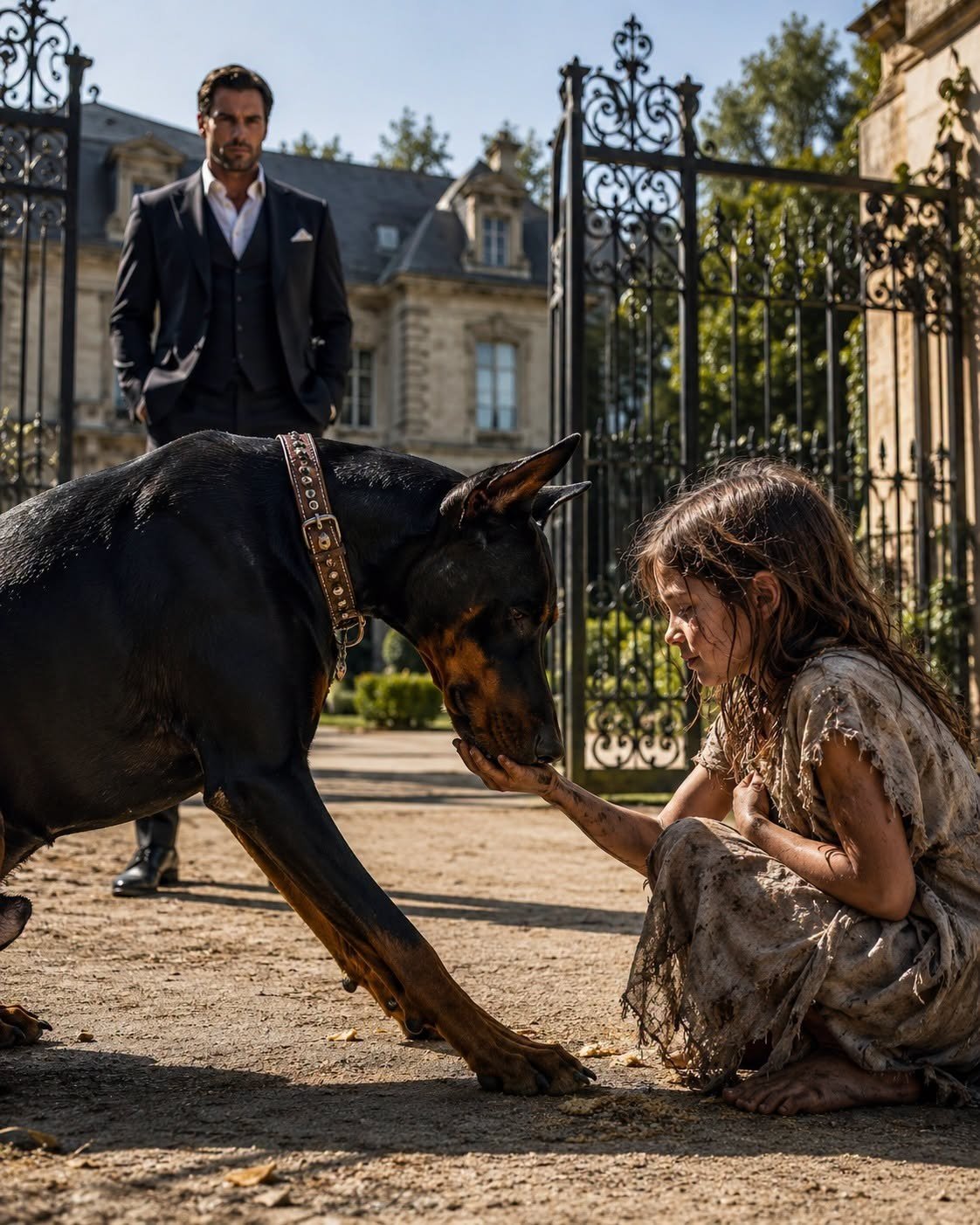
Then the girl’s lips moved, and a single word cut through Phantom’s growling with the precision of a surgical blade through tissue. The word was too soft for observers to distinguish, meant only for the dog’s ears, but its effect was instantaneous and absolute. Phantom’s entire body language transformed as if someone had thrown a switch in his neural wiring. The aggressive stance collapsed, muscles releasing tension. The hundred-and-thirty-pound Cane Corso dropped to his belly with shocking speed, powerful legs folding beneath him as he crawled forward like a supplicant approaching sacred ground.
Holden watched in stunned disbelief as his supposedly untouchable guard dog placed his massive head beneath the child’s tiny hand. Amber eyes closed with something that looked disturbingly like relief, like recognition of someone he’d been waiting for. The girl’s fingers disappeared into Phantom’s black fur. The guards remained frozen, weapons still trained on a threat that had somehow transmuted into impossibility before their eyes.
Holden felt his tactical mind struggling to process what two years of expensive training and carefully cultivated aggression had been undone by a single word.
Chapter 3
The silence that followed Phantom’s transformation was somehow more oppressive than his earlier growling, filled with questions that demanded answers none of them possessed.
Holden approached slowly, each step measured and deliberate, acutely aware that he was entering territory where his authority meant nothing compared to whatever connection had just manifested. Phantom’s eyes opened as his master drew near, but the Cane Corso made no move to leave the child’s side. The dog positioned his bulk as a barrier between her and all others, a protective stance that spoke of instincts deeper than training.
Chapter 5
The girl’s eyes met Holden’s across the remaining distance, and the crime lord found himself cataloging details with the analytical precision he applied to evaluating threats. She couldn’t weigh more than forty pounds soaking wet, malnutrition evident in the hollow spaces beneath her cheekbones. Her wrists appeared too fragile to support even her diminished body weight. But those eyes held something that transcended physical vulnerability — a depth of experience that shouldn’t exist in someone so young. Her lips were chapped and bleeding at the corners.
“His name is Umbra,” the girl said quietly, her voice hoarse from disuse or cold or both. “Not Phantom. Umbra del Passato. My mama named him before she gave him away to keep him safe.” She looked up at Holden with those ancient, weary eyes set in that child’s face. “I promised her I’d find him. I promised I’d make sure he was okay.” Her small hand, buried in the dog’s fur, tightened almost imperceptibly. “Is he okay? Have you truly been good to him?”
Holden Cross, a man who had ordered violence without hesitation for two decades, found himself unable to immediately answer a seven-year-old’s simple question about his own dog’s welfare.
Chapter 4
Celeste Marchand arrived within the hour, summoned by a call Holden made himself rather than routing through his usual channels. The French Canadian veterinarian had treated Phantom since the dog’s arrival from Italy, establishing a professional relationship built on genuine skill rather than the fear most of Holden’s associates inspired in outside professionals. She found the girl still in the courtyard, wrapped now in a blanket one of the guards had brought without being asked, Phantom’s massive body curled protectively around her small frame.
“Her name is Kea,” Holden said, before Celeste could ask. “She says the dog belonged to her mother before he was given away. She says she’s been looking for him.”
Celeste knelt slowly, the way she approached any frightened creature, human or animal, and began her assessment with the same careful attention she applied to Phantom himself. Severe malnutrition. Signs of exposure consistent with weeks, possibly months, spent without adequate shelter. A low-grade fever that suggested infection somewhere, likely respiratory given the harsh rattle in the girl’s breathing when she spoke. Celeste’s professional composure held, but her eyes carried something rawer as she worked, the particular grief of a healer confronting damage that should never have been allowed to accumulate in a body this young.
“She needs a hospital,” Celeste said quietly.
“She needs somewhere the wrong people won’t find her asking questions,” Holden said, and something in his voice made Celeste look up sharply. “I don’t know yet who she is or how she found this dog, but I intend to find out before I hand her over to a system that’s already failed her once. Bring your equipment here. Whatever you need, my people will get it.”
It was an unusual request, even for a man accustomed to unusual requests, but Celeste recognized something in Holden’s face that hadn’t been there in the two years she’d known him — a crack in the careful armor he wore for every professional interaction, the particular helpless urgency of a man who had stumbled into a responsibility he hadn’t chosen and couldn’t now set down.
Over the following days, Celeste worked out of a hastily converted guest suite, treating Kea’s malnutrition and the infection settling into her lungs with the same clinical thoroughness she brought to any critical patient, animal or otherwise. Phantom refused to leave the girl’s side except for brief, urgent trips outside, returning each time to resume his position at the foot of her bed with the vigilance of a creature who understood, in whatever way dogs understand such things, that this particular charge required protection beyond his usual territorial mandate.
It was on the third night, once Kea’s fever had finally broken and she’d slept through six consecutive hours for the first time since her arrival, that Holden found the paperwork that would reshape his understanding of everything that had happened in his courtyard. Reviewing the original transfer documents from the Italian breeder, cross-referencing them against records his security team had pulled at his direction, he discovered a detail he’d never had reason to examine before.
Phantom’s registered name, according to the breeder’s original transfer papers, was not simply Umbra. It was Umbra del Passato — shadow of the past. And the paperwork revealed something Holden had never known in the two years he’d owned the dog. There was a three-month gap in Phantom’s documented history, a period between his initial placement in the breeder’s protection training program and his eventual arrival at Holden’s compound, during which the dog had spent time at an American animal sanctuary that had since closed.
“Get me everything on this sanctuary,” Holden told his investigator the next morning, sliding the relevant documents across his desk. “Ownership records, closure date, everything.”
The investigator’s report arrived within forty-eight hours, and what it contained made Holden’s blood run cold in a way few things had managed across two decades of increasingly hardened experience. The sanctuary had operated illegally out of a converted warehouse in the industrial district, run by a couple who had devoted their entire modest resources to rescuing and rehabilitating animals other people had abandoned or abused. Neighbors had considered them eccentric. They had lived in the warehouse itself, alongside the animals, spending every available cent on veterinary care rather than their own comfort.
The fire had started in the electrical system around three in the morning, six months earlier. Forty-three animals had been evacuated before the structure fully collapsed. The sanctuary’s owners had not been among the survivors.
Chapter 6
“Kea’s parents,” Holden said, once Celeste had returned that evening and he’d laid the full report out for her to review, breaking a silence he’d been sitting inside for most of the afternoon, processing information he’d been turning over since receiving it. “The fire marshal’s report says they found them near the back exit. They’d gone back in for one more animal despite being told the building was about to collapse. They never made it back out.”
Celeste absorbed this with the same careful attention she applied to medical diagnosis, extracting meaning from facts that painted a picture of the girl’s background layer by devastating layer. “So she grew up surrounded by damaged creatures, learning to trust again,” she said slowly. “That explains why she approached Phantom without fear. She’d spent her whole life around animals that others considered dangerous. She saw past the aggression to the pain underneath.”
“There’s more,” Holden said, his voice dropping lower, though Kea slept soundly two rooms away, Phantom’s watchful presence keeping vigil at her door. “Kea was listed as deceased in the official report. Her bedroom was in the section that burned hottest. Investigators assumed she’d been overcome by smoke before she could escape.”
“But she hadn’t been in her bedroom,” Celeste said, following the logical thread to its obvious, devastating conclusion, her voice going quiet with the weight of it. “She was with the animals they’d already evacuated. She watched her parents go back inside and not come out. Then she watched the building collapse with them inside, and she’s been trying to fulfill her mother’s last instruction ever since. Find Umbra. Make sure he’s safe.”
The weight of that realization settled over them both, adding layers of understanding to Kea’s determined approach to the mansion despite obvious danger. She hadn’t been reckless or foolishly brave. She’d been completing a mission that gave purpose to a survival that might otherwise have felt meaningless. Finding Phantom meant honoring her parents’ life work, proving their deaths hadn’t been entirely in vain, because at least one of their rescued animals had found safety.
Chapter 7
The six months between the fire and the courtyard would remain, for the rest of Kea’s childhood, a period she rarely discussed in full, offering fragments only when the telling felt necessary rather than merely cathartic. What Celeste and Holden pieced together, across careful conversations spread over many months of therapy and trust-building, painted a picture of a survival instinct forged far too early in a child who should never have needed to develop one.
Kea had watched the warehouse collapse from a safe distance, the animals she and her parents had already evacuated scattered and frightened around her in the pre-dawn dark, the smoke thick enough that she’d needed to press her sleeve against her face just to keep breathing steadily while she counted, over and over, the animals still crowded close around her legs, making certain none had wandered back toward the burning structure in their own confusion. She had understood, with the particular clear-eyed practicality that trauma sometimes grants children instead of the confusion adults might expect, that returning to the scene meant becoming a problem for well-meaning strangers who would place her in a system she had heard her parents discuss with quiet, worried voices on more than one occasion — a system, they’d said, that separated siblings, moved children between strangers’ homes without warning, and rarely, if ever, kept the promises it made to frightened kids.
So she had not returned. She had gathered what animals would follow her, found homes for most of them across the following days and weeks through instincts her parents had spent her whole short life teaching her — which neighbors kept gentle dogs of their own and might take in a frightened stray, which shop owners left food out for cats and might be persuaded to extend that kindness further. She had kept only Phantom’s location firmly in mind, understanding from her mother’s final instructions, shouted across the burning warehouse in the chaos before she went back inside one last time, that the newest and most valuable of their rescued animals had already been placed with a private buyer weeks earlier, sold reluctantly to fund emergency repairs to the warehouse’s failing roof.
Find Umbra. Make sure he’s safe. The instruction had lodged itself in Kea’s seven-year-old mind with the particular unbreakable weight of a dying parent’s final words, and she had spent six months methodically working toward fulfilling it, sleeping in doorways and beneath overpasses, learning which soup kitchens served meals without demanding paperwork she didn’t have, learning which adults could be trusted with brief, careful interactions and which needed to be avoided entirely.
She had followed the trail of Phantom’s sale through fragments of information gathered from her parents’ old business records, salvaged from a storage unit they’d kept separate from the warehouse specifically for important paperwork, and from careful, patient questions asked of the handful of people in the old sanctuary’s network who remembered enough details to point her, eventually, toward the general direction of Holden Cross’s compound. It had taken six months of a homeless seven-year-old’s patient, methodical detective work to accomplish what Holden’s own trained investigators would later need days to reconstruct with the full resources of his organization behind them.
Chapter 8
“She shouldn’t have survived that,” Celeste said once, reviewing the timeline with Holden, the particular horror of it settling over both of them fresh each time they turned the details over. “Six months alone, a child that young, navigating a city that eats vulnerable people alive without a second thought. The fact that she made it to your courtyard at all is closer to miracle than any reasonable calculation of odds would predict.”
“She had her parents’ training,” Holden said. “Whatever else that sanctuary gave her, it gave her the instinct to read danger accurately, to trust cautiously, to survive on resourcefulness rather than simply on luck. I don’t think it was miracle, exactly. I think it was a child raised by two people who taught her, without meaning to prepare her for exactly this, precisely how to keep herself alive when the adults meant to protect her were suddenly gone.”
It was a sobering thought, and one that settled into both of their understanding of Kea’s resilience with a weight that made her subsequent recovery feel less like simple luck and more like the natural continuation of a strength she had already, tragically, been forced to develop long before she ever needed it applied to anything as gentle as thriving in a stable home.
It was two weeks after Kea’s arrival, once she was strong enough to sit up and eat solid meals without exhausting herself, that Celeste finally told Holden the thing she’d been carrying quietly since the moment she’d first seen the sanctuary’s name in the investigator’s report — a piece of her own history she hadn’t expected would ever intersect with a case this personal to a man she worked for.
“I knew them,” Celeste said, finding Holden alone in his study late one evening, Kea finally asleep upstairs, the mansion quiet around them in the particular way large houses go quiet once every occupant has finally settled for the night. “Kea’s parents. Marguerite and Daniel Foss.” She said the names carefully, as though testing whether they still hurt to speak aloud after six months of silence. “I consulted for their sanctuary twice, years ago, when they had an outbreak of parvo running through their rescued strays and couldn’t afford proper veterinary care on their own. I donated my time. I told myself it was simply professional generosity, the kind any vet extends occasionally to operations too underfunded to pay full rates.”
Holden set down the report he’d been reviewing, giving her his full attention, understanding from the particular careful tone in her voice that whatever came next mattered considerably more than routine business. “You never mentioned this.”
“I didn’t connect it until I saw their names in the fire marshal’s report,” Celeste admitted, her voice carrying the particular strain of someone finally saying aloud a thought she’d rehearsed silently many times before finding the courage to speak it. “It had been years. But once I saw it, I remembered everything — the warehouse, the animals, Marguerite’s exhausted, determined face every time I visited. She used to say the sanctuary would survive another season if she could just find one more source of funding, one more grant, one more donor willing to take a chance on operators as unconventional as they were.” Celeste’s composure, held carefully through the recitation, finally cracked. “I could have done more. I had resources, connections, a client list full of people who could have funded that sanctuary properly if I’d simply asked. I told myself, at the time, that it wasn’t my responsibility to solve their funding problems, that I’d already given what I reasonably could. I’ve thought about that decision every day since I learned how the story ended.”
“You couldn’t have known there’d be a fire,” Holden said gently, understanding, even as he said it, that gentleness rarely resolves guilt of this particular shape, however true the underlying logic might be.
“No,” Celeste agreed. “But I could have known they were vulnerable, underfunded, operating in a way that left them exposed to exactly the kind of neglect that let an electrical fault go unaddressed until it killed two people and nearly killed a third. I chose comfortable distance over real involvement, and I’ve spent six months since telling myself that choice was reasonable, professional, appropriately bounded.” She looked at Holden directly. “Watching you with Kea these past two weeks, watching you choose real involvement over comfortable distance in a situation you had every reason to simply hand off to authorities — I find I can’t keep telling myself my own earlier choice was the right one.”
Holden considered this a long moment, understanding the particular weight of guilt Celeste was carrying, recognizing something of his own reckoning in it. “You’re not responsible for the fire,” he said finally, choosing each word with the same deliberate care he brought to any negotiation where the stakes actually mattered. “Whatever additional funding you might have arranged, an electrical fault in an old warehouse isn’t something donations alone would have necessarily prevented. But I understand the feeling regardless. I’ve spent two weeks turning over every decision that led to this moment, wondering what I might have done differently if I’d known any of this sooner.”
It was that same week that Holden’s investigator, continuing to dig into the sanctuary’s history at Holden’s ongoing instruction, uncovered the detail that transformed the fire from tragedy into something considerably darker. Financial records showed that the warehouse property had been purchased immediately after the fire by a development company connected to one of Holden’s rival organizations. The sanctuary had been occupying valuable real estate in an area undergoing gentrification, and its eccentric operators had refused multiple buyout offers in the months before the blaze. The fire had solved a problem that legal channels hadn’t resolved quickly enough, though proving the connection definitively would require resources and time Holden wasn’t certain he wanted to invest, given what pursuing it would necessarily mean for the fragile peace he was trying to build around Kea’s recovery.
The information changed the entire context around Kea’s survival and her parents’ deaths, transforming what had seemed like random tragedy into something closer to calculated murder that had almost succeeded in eliminating the entire family, a possibility neither Holden nor Celeste had entertained in the first devastating days after the fire marshal’s report first crossed their desk.
Chapter 9
Telling Kea that her parents hadn’t just died, but had been killed, required careful consultation between Holden and Celeste about psychological impact versus a child’s fundamental right to the truth about her own history. They agreed, together, to wait until she was stronger, until the foundation of her recovery was solid enough to withstand additional trauma without collapsing back into the survival mode that had nearly killed her on that frozen winter lawn.
Holden’s business continued during these weeks with the same outward efficiency it always had, but something in him had shifted in ways his organization was learning to adapt to rather than resist. Violence, once his preferred tool for resolving disputes, became a last resort rather than a first response. Negotiations replaced confrontations wherever possible, and he began systematically withdrawing from operations that posed the greatest legal risk, understanding, with a clarity that had arrived slowly across two weeks of watching a seven-year-old rebuild her capacity for trust one careful day at a time, that a man building toward being someone Kea could rely upon needed a life that could withstand scrutiny rather than merely evade it.
“You’re changing,” Celeste observed one evening, watching him review a legitimate shipping contract with the same careful attention he’d once reserved for territorial disputes, red pen marking margins the way he’d once marked targets, though the stakes on the page in front of him now involved nothing more dangerous than shipping timelines and customs fees.
“I’m trying to,” Holden said. “I don’t know yet whether I can fully manage it. Two decades of building an empire on fear doesn’t unmake itself in two weeks, or even in two months, however much I might wish otherwise on the harder days. But I find I want to try, in a way I’ve never wanted to try at anything else in longer than I care to admit, and wanting it that badly has to count for something, even before the results fully catch up.”
Understanding exactly why a single whispered word had unraveled two years of intensive protection training required Holden to track down the former military handler responsible for Phantom’s original conditioning — a taciturn ex-serviceman named Reyes who had built a small, exclusive business training protection animals for clients whose particular needs required discretion rather than publicity.
Reyes met with Holden reluctantly, understanding exactly what kind of client he’d trained for years earlier without ever needing the specifics of his organization explained to him directly, the way certain professionals in the city learned to serve dangerous men without asking dangerous questions. When Holden described what had happened in the courtyard, Reyes was quiet a long moment before responding, turning the account over with the particular professional attention of a man who took genuine pride in his craft and found its apparent failure worth understanding properly.
“I don’t train dogs to forget their earliest bonds,” Reyes said finally, leaning back in his chair. “I train them to prioritize new commands over old instincts, which is a different thing entirely, and one that usually holds under nearly any circumstance except the most extreme conditioning contradictions. Whatever bond that dog had with the girl’s mother, before he ever came to me for training, must have been foundational rather than superficial. The kind of bond formed in early puppyhood, before a dog’s personality has fully solidified, sometimes proves more durable than anything trained into an adult animal afterward, however intensive that later training might be.”
“You’re saying two full years of professional conditioning couldn’t override a bond formed before he was even six months old,” Holden said slowly.
“I’m saying it’s rare, but not impossible, particularly with a breed as intelligent and emotionally attuned as the Cane Corso,” Reyes said. “Most protection dogs, if they’d bonded with an early owner before entering my program, would still recognize that owner’s scent or voice if reintroduced. But recognition alone rarely produces the kind of complete behavioral collapse you’re describing. For that, there’d typically need to be a specific trigger — a particular word, phrase, or gesture the original owner used consistently enough during the bonding period that it became load-bearing in the dog’s earliest neural architecture, something considerably more foundational than a name or a simple command.”
Holden thought of Marguerite Foss, a woman he’d never met, dead six months now in a fire that authorities had called accident and evidence increasingly suggested was murder, who had apparently built something into a puppy’s earliest development so durable that two years and two hundred miles hadn’t been enough to erase it. “What would that trigger have needed to look like,” he asked. “Practically.”
“Something used constantly during feeding, comfort, and bonding in those first critical weeks,” Reyes said. “A specific word paired reliably with safety, with reward, with the presence of someone the puppy trusted completely before he’d learned to trust anyone else. If the girl knew that word — if her mother taught it to her specifically, anticipating exactly this kind of separation — then she wasn’t relying on luck when she walked into your courtyard, Mr. Cross. She was executing a plan her mother had apparently prepared for, understanding, somehow, that the day might come when her daughter would need a way to reach an animal that had been sold away from the family for its own protection.”
The revelation settled over Holden with considerable weight in the weeks that followed. Marguerite Foss, whatever else circumstance had denied her, had apparently understood, with a foresight that bordered on prophetic, that her sanctuary’s precarious existence might someday require exactly this kind of contingency — a bond built deliberately durable enough to survive separation, sale, and years of distance, activated by a single word passed down to a daughter young enough that she might not fully understand its purpose until the moment she desperately needed it.
“She planned for this,” Holden told Celeste, once Reyes’s explanation had fully settled in his understanding. “Not this specific outcome, not my courtyard specifically. But she planned for the possibility that Kea might someday need to find Umbra again, and she built that possibility into the dog himself, in the earliest weeks of his life, long before either of us ever knew either of them existed.”
“That’s not luck,” Celeste said quietly, her voice carrying real conviction. “That’s a mother loving her daughter enough to prepare for tragedies she hoped would never come, and being right to prepare for them regardless.”
It was this understanding, more than any single fact in the investigator’s reports, that finally convinced Holden the debt he owed Kea’s memory of her parents extended considerably beyond simple guardianship. Marguerite Foss had built a bridge across an uncertain future for a daughter she couldn’t protect forever. Holden understood, standing at the far end of that bridge now, that honoring it properly meant becoming exactly the kind of durable, reliable presence in Kea’s life that her mother had trusted a dog’s earliest training to eventually help her find.
Chapter 10
By the end of the first week, Kea was strong enough to leave the bed for short periods, exploring the guest suite with cautious curiosity while Phantom shadowed her every movement. She touched everything with careful reverence, as if the luxury surrounding her existed in a different reality than the one she’d inhabited for six months. Celeste encouraged this exploration, recognizing that reclaiming agency over her environment was a crucial step in psychological recovery.
Holden had his legal team researching custody options and bureaucratic pathways that might allow Kea to remain in his care without triggering system intervention. The challenge was substantial. A single man with a criminal empire seeking to adopt a child officially declared dead, whom he’d effectively kept hidden by not reporting her survival to authorities. His lawyers approached the problem with the same creative interpretation of regulations they applied to his business operations.
Meanwhile, the mansion staff had begun treating Kea’s presence as a permanent fixture rather than a temporary anomaly. The cook prepared child-friendly meals tailored to her recovering digestive system, and the head housekeeper had quietly acquired age-appropriate clothing in Kea’s size. No one had explicitly stated that she was staying, but the infrastructure supporting that assumption built itself through accumulated small actions that acknowledged reality before it had been officially declared.
Celeste watched these developments with mixed feelings she didn’t fully articulate even to herself. Her initial commitment to staying through Kea’s medical crisis had evolved into something more complex — an investment in the girl’s long-term welfare that went beyond professional obligation. She’d begun imagining futures for Kea that included stability, education, the kind of childhood that had been stolen by fire and circumstance. But she also recognized the moral complications of those futures being built inside a crime lord’s fortress.
“What happens when she’s fully recovered?” Celeste asked Holden during one of their late-night conversations that had become routine over the past two weeks. They sat in his study while Kea slept upstairs under Phantom’s vigilant guard, the quiet hours after midnight creating space for discussions too complex for daytime. “You can’t keep her hidden forever. Eventually, someone will notice. A neighbor, a delivery person, someone who will ask questions you can’t answer without exposing the whole situation.”
Holden swirled whiskey in his glass, studying the amber liquid as if it contained answers to questions that had no easy solutions. “My lawyers think they can establish legal guardianship through family court, if we construct the right narrative. Claim I’ve been caring for a distant relative’s child after her parents died. That proper channels were followed but paperwork was delayed. Judges in this city owe me favors. Not an ideal foundation for custody, but better than the alternatives.”
“You’re talking about corrupting the legal system to keep a child,” Celeste said, though her tone carried more weariness than accusation.
“I’m talking about doing whatever is necessary to keep a child safe who has already lost everything a system was supposed to protect,” Holden corrected. “The legal system failed Kea’s parents when it let a gentrification scheme burn down their home with them in it and called it accident. I don’t feel especially bound by its usual channels when the alternative is handing her back to the foster system that would have no idea what she’s actually survived, or worse, into proximity with whoever ordered that fire in the first place, if word ever got out that a witness to the sanctuary’s operations had survived.”
Celeste absorbed this, understanding the practical logic even as she wrestled with the ethical complications it carried. “And if it works? If you get guardianship? What kind of life does she actually have here, Holden? Raised in a mansion by a man who runs three states’ worth of criminal enterprise, however much you’ve started softening the edges of it these past two weeks?”
“I don’t know,” Holden admitted, and the honesty of the admission carried more weight than any confident reassurance could have. “I know I can’t undo who I’ve been for the past twenty years. I know the empire doesn’t dissolve overnight just because a seven-year-old walked into my courtyard and said a word that broke my guard dog’s training. But I also know that for the first time in longer than I can remember, I want to be someone worth being, rather than simply someone worth fearing. I don’t have a clean answer for what that looks like yet. I only know I’m not willing to hand her to strangers and hope for the best when I have the resources to actually protect her properly, if I can just figure out how to do it without becoming exactly the kind of danger I’m trying to shield her from.”
It was a rare moment of complete honesty from a man who had spent two decades cultivating careful ambiguity as his primary tool of survival, and Celeste recognized it as exactly that — a genuine reckoning rather than a calculated performance.
Chapter 11
“Then we do it together,” Celeste said finally. “Whatever it looks like, whatever compromises it requires with a legal system that failed her once already. I’d rather help you build something imperfect but genuinely protective than watch her disappear back into a system that couldn’t even keep her name attached to her own life.”
Holden looked at her, something loosening in his chest that had been coiled tight since the night Kea first appeared on his security feeds. “You’re certain,” he said.
“I’ve been certain for weeks,” Celeste admitted. “I think I’ve simply been waiting for you to ask the question plainly enough that I could answer it just as plainly in return.”
The custody arrangement took three months to finalize, moving through channels Holden’s lawyers had carefully constructed and quietly greased with the accumulated favors of two decades in the city’s shadow economy. The narrative held: a distant family friend, contacted by neighbors after the fire, who had been searching for Kea through private channels while the official investigation declared her dead. It was not a story that would have survived rigorous scrutiny, but rigorous scrutiny, in a city where Holden Cross’s influence reached into judicial chambers as easily as it reached into council meetings, was never seriously applied.
The night the guardianship papers were finally signed, Holden found himself standing outside Kea’s bedroom door well past midnight, unable to sleep, listening through the gap for the particular quiet sounds of a child sleeping peacefully rather than the restless, nightmare-troubled sleep that had marked her first weeks in his home. Celeste found him there, still in his shirtsleeves, tie loosened, looking more uncertain than she had ever seen him in two years of professional acquaintance.
“You should be celebrating,” Celeste said quietly, joining him in the dim hallway. “It’s done. She’s yours, legally, permanently. Whatever complications come later, tonight the paperwork says she’s safe.”
“I keep thinking about the responsibility of it,” Holden admitted, his voice carrying none of its usual controlled authority. “I’ve commanded organizations, negotiated treaties between rival factions, made decisions that affected hundreds of lives without a second thought. And I stand here tonight more frightened of getting this wrong than I’ve ever been of anything in my professional life.”
“That fear is exactly why you’ll get it right,” Celeste said. “Men who never worry about failing children are usually the ones who fail them worst. The worry itself is evidence you understand the stakes properly.”
Holden looked at her in the dim hallway light, something shifting in his expression that had nothing to do with Kea directly. “You’ve been here every day for three months,” he said. “Beyond what any professional obligation required. I don’t think I’ve properly thanked you for that.”
“I didn’t do it for thanks,” Celeste said. “I did it because Marguerite and Daniel Foss deserved someone to finish what I should have started years ago, and because Kea deserved someone in this house who understood her world before all of this — the animals, the particular language of trust that gets built between creatures who’ve learned the world can be cruel.”
“Stay,” Holden said, the word arriving simply, without the careful calculation he usually brought to important requests. “Not as her doctor. As whatever this has actually become between the three of us, whatever we want to call it. I don’t have the right words for it yet. But I know the house feels less like a fortress and more like something worth defending honestly when you’re in it, and I know Kea has started asking, most mornings, whether you’re staying for breakfast before she even asks about anything else.”
Celeste considered this, the particular weight of what he was actually asking settling between them in the quiet hallway. “You understand what you’re offering,” she said carefully. “Not just a housemate. Not just a co-parent for Kea’s sake.”
“I understand exactly what I’m offering,” Holden said. “I’ve had three months to understand it, watching you with her, watching the particular way this house has reorganized itself around the two of you without my needing to order it to. I’m not a good man, Celeste. I’ve done things I won’t fully account for even to myself, let alone to you. But I find I want to try building something honest, for the first time in longer than I can remember, and I’d rather try building it with you than without you, if you’re willing.”
Celeste didn’t answer immediately, but she didn’t step away either, and something in the quiet hallway, in the sound of Kea’s peaceful breathing through the door beside them, seemed to settle the question more completely than words could have managed.
Chapter 12
Six months after that night in the hallway, the mansion had transformed from fortress into something resembling home. Kea thrived under the combined care of Holden and Celeste, attending private school where she excelled academically while maintaining a healthy suspicion of easy friendships that trauma had taught her to question carefully. She made one close friend that first semester, a quiet girl named Priya who shared her fascination with animals and never once asked prying questions about the particular circumstances that had brought Kea to her new school midyear, understanding instinctively, the way children sometimes do better than adults, that some histories are shared only when their owner decides the sharing is worth the vulnerability it costs. Phantom remained her constant companion, the dog’s presence reassuring both her and Holden that the connection that had brought them together, on that impossible winter evening, remained strong, unbroken by the passage of ordinary time and daily routine.
Despite the normalized routines that had replaced the initial crisis, Holden’s business continued with the same underlying efficiency it always had. But his priorities had shifted in ways his organization adapted to rather than resisted. Violence became a last resort rather than a preferred tool. Negotiations replaced confrontations wherever possible, and he had begun systematically withdrawing from operations that posed the greatest legal risk. The transformation wasn’t sudden or complete — some of his oldest lieutenants grumbled privately about the changing direction, though none dared voice that grumbling directly to a man whose reputation for consequences remained intact even as his methods softened — but the direction was clear. He was building toward legitimacy, not because he feared consequences, but because Kea deserved a guardian who could attend school functions without risking arrest.
Celeste had moved permanently into the mansion’s west wing, maintaining her veterinary practice from a newly constructed facility on the grounds while serving as Kea’s primary caregiver whenever Holden’s business required his attention. Their relationship had evolved beyond professional collaboration into a partnership neither had explicitly defined but both understood extended well beyond Kea’s needs alone. They moved around each other with the comfortable familiarity of people building a shared life from accumulated daily choices that created foundations stronger than dramatic declarations ever could.
One evening, Holden found Kea in the eastern courtyard where everything had begun, sitting with Phantom and talking to him in the quiet voice she used for conversations she thought were private. He approached silently, not wanting to interrupt, but curious about what she was saying to the dog who’d been her salvation and her connection to the parents she’d lost.
“I told Mama I’d find you,” Kea was whispering, her small hand stroking Phantom’s head with the gentle rhythm that had become ritual. “I kept my promise, and now we have a family again. Even if it’s different, I think she’d be okay with that. I think she’d like Holden and Celeste. They keep their promises too.”
Holden felt tears threatening for the first time in years, moved by the casual acceptance of the family they’d built from impossible circumstances, and the accumulated choices that had led them all here. He’d entered this situation through accident and obligation, maintaining distance while managing a crisis that had fallen into his lap without invitation. But somewhere along the way, distance had collapsed into genuine connection that transcended strategic benefit or calculated advantage. He’d become the person Kea needed him to be, because she’d believed he could before he’d believed it himself.
He walked forward into the courtyard, the same courtyard where a guard dog’s ferocious training had collapsed at a single whispered word, and knelt beside his daughter and the dog who had waited, patient and loyal, across two lives and one impossible reunion, for exactly this moment to arrive.
“She’d be proud of you,” Holden told Kea quietly. “Prouder than you know.”
“I think you’re proud of me too,” Kea said, looking up at him with those eyes that had once held too much old grief for a child so young, but now, six months into a home that finally kept its promises, held something considerably lighter.
“Every single day,” Holden said, and meant it more completely than he had ever meant anything in the two decades before a small girl in a taped-up coat had walked into his courtyard and taught his entire fortress the difference between the family you’re given and the family you finally choose to become worthy of.
Phantom, sensing the particular emotional weight settling over the two people he’d chosen to guard with equal devotion, rose from where he’d been resting and pressed his massive head against both of them at once, as though physically bridging the space between father and daughter with his own solid, patient presence. Kea laughed, the sound bright and unguarded in a way that would have been unimaginable eight months earlier, when a starving seven-year-old had walked across a frosted lawn toward what should have been certain death, carrying nothing but her mother’s final instruction and a faith in a dog’s memory that no reasonable person would have trusted.
Celeste watched from the courtyard’s edge, having followed Holden out a few minutes behind, understanding without needing to be told that this particular moment belonged first to father and daughter, that her own place in it would come naturally in its own time rather than needing to be claimed. She thought, watching them, about Marguerite Foss, about the particular courage it must have taken to build a contingency plan into a puppy’s earliest weeks, hoping desperately it would never need to be used, and being right, in the end, to prepare for exactly the tragedy that eventually found her family regardless.
The eastern courtyard, once the most feared quarter of Holden Cross’s entire eighteen-acre compound, had become, across eight quiet months, something closer to sacred ground — not because of Phantom’s ferocity, which had gentled considerably in the company of a family finally worth protecting rather than merely territory worth defending, but because of what had happened there on one freezing winter evening when a single whispered word had proven, against every expectation anyone standing in that courtyard carried, that love built early and honestly enough could survive separation, distance, and even death itself, waiting patiently for exactly the right moment to finally bring everyone it had ever protected safely home.
__The end__
Website Disclaimer
The information provided on this website is for general informational and educational purposes only. While we strive to ensure that all content is accurate and up to date, we make no guarantees regarding the completeness, reliability, or accuracy of any information published.
The views and opinions expressed in articles belong to their respective authors and do not necessarily reflect the views of this website. Any action you take based on the information found on this website is strictly at your own risk. We will not be liable for any losses, damages, or inconveniences arising from the use of our content.
Some articles may contain opinions, third-party information, or external links. We do not endorse or guarantee the accuracy of content on external websites and are not responsible for their practices or policies.
All content on this website is provided in good faith and is intended for informational purposes only. Readers are encouraged to verify information independently and seek professional advice where appropriate.