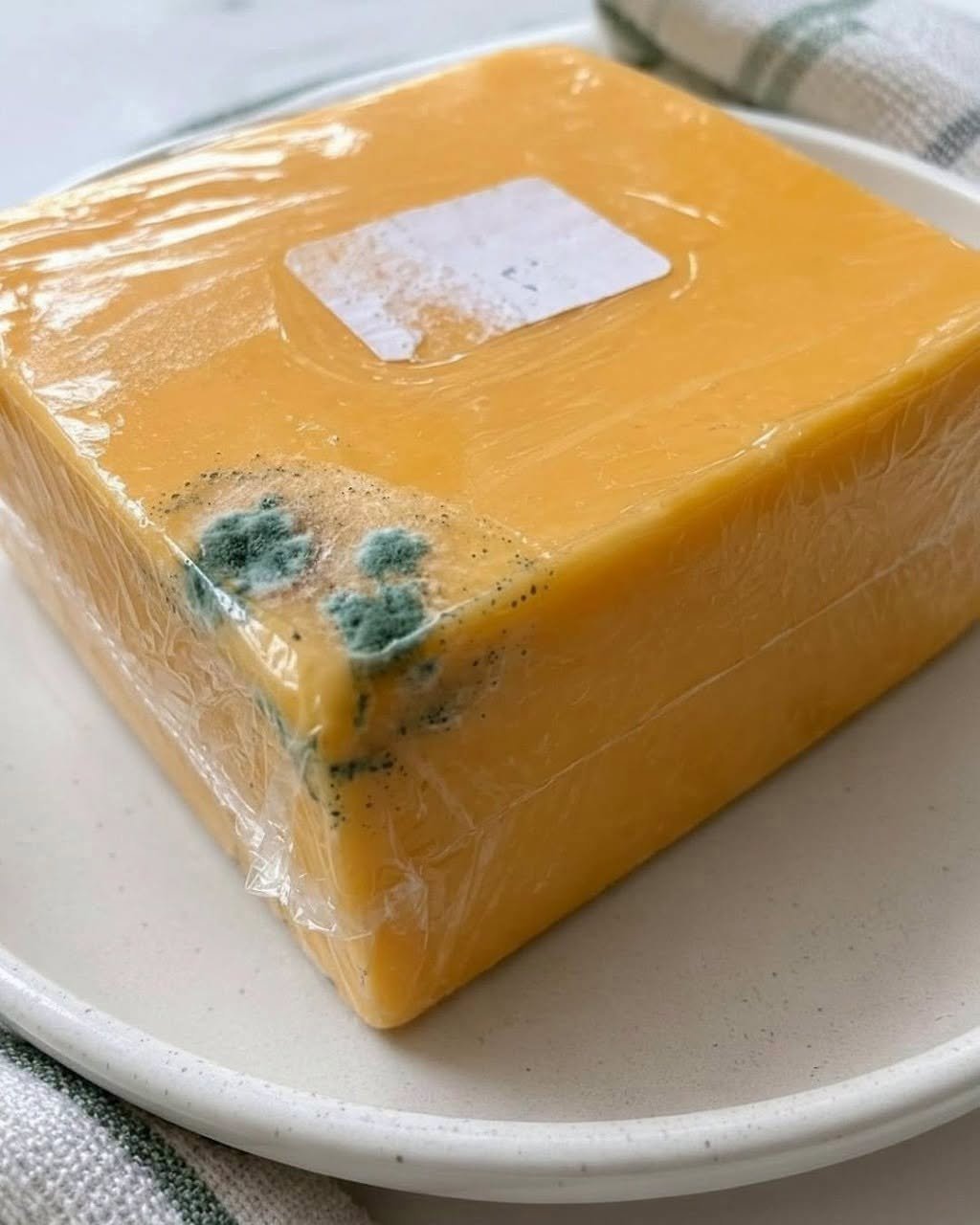
Finding a green or blue mould spot on cheese does not always mean the whole block has to be thrown away. Whether it is safe to cut off the affected area or discard the entire piece depends on the type of cheese — and on how far the mould has spread.
Some cheeses are made with mould on purpose: blue cheese, Roquefort, Stilton and Gorgonzola get their distinctive veining and sharp flavour from specific cultures added during production, and the mould is part of the cheese itself. Hard cheeses such as cheddar, Parmesan, Gouda and Swiss are dense and contain less moisture, so mould is less likely to spread deeply through them — which is why the affected portion can sometimes be removed while the rest stays safe to eat.
Food-safety guidance generally advises cutting at least one inch (2.5 centimetres) around and below the visible mould, then discarding that piece — and keeping the knife from touching the mould, since that can transfer it to the remaining cheese. Soft cheeses are different: cream cheese, ricotta, cottage cheese, Brie, Camembert and fresh mozzarella hold more moisture and have a softer structure, so mould and bacteria spread more easily beneath the surface, and parts that look clean may still be contaminated. The safest recommendation is to discard soft cheese when unexpected mould appears — refrigeration or wrapping will not remove mould that has already spread, and scraping off the visible portion is not enough.
Another concern is mycotoxins, substances produced by certain types of mould; not all moulds make them, but some can cause allergic reactions or other health problems, and cutting away a small visible patch does not guarantee all mould and toxins are gone. Smell and appearance are not reliable guides either — some spoiled cheeses may still look and smell normal. The simplest rule to remember: a small mould spot on hard cheese can often be trimmed away safely, while mould on soft cheese means the whole portion should be discarded.
Website Disclaimer
The information provided on this website is for general informational and educational purposes only. While we strive to ensure that all content is accurate and up to date, we make no guarantees regarding the completeness, reliability, or accuracy of any information published.
The views and opinions expressed in articles belong to their respective authors and do not necessarily reflect the views of this website. Any action you take based on the information found on this website is strictly at your own risk. We will not be liable for any losses, damages, or inconveniences arising from the use of our content.
Some articles may contain opinions, third-party information, or external links. We do not endorse or guarantee the accuracy of content on external websites and are not responsible for their practices or policies.
All content on this website is provided in good faith and is intended for informational purposes only. Readers are encouraged to verify information independently and seek professional advice where appropriate.