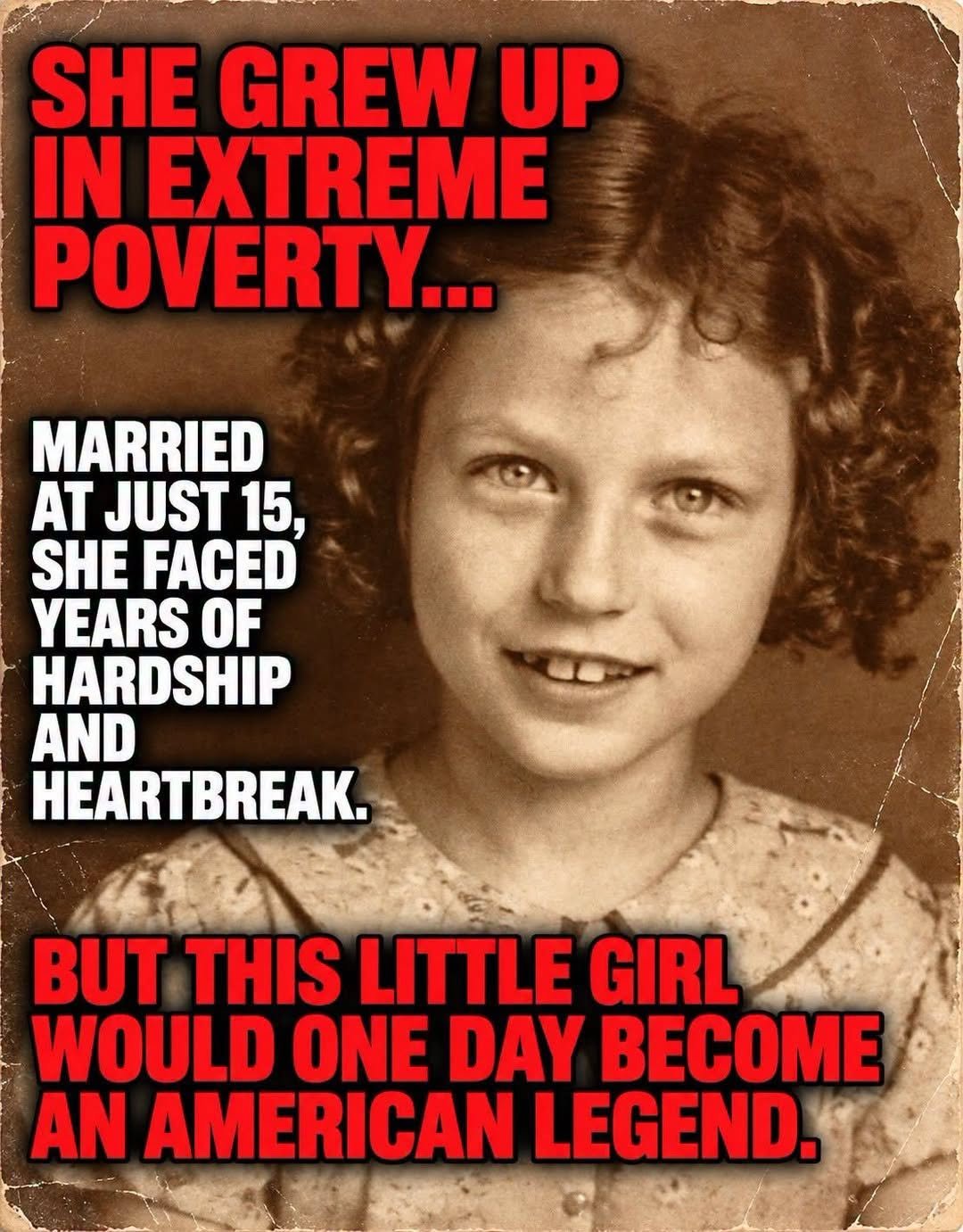
Poverty nearly wrote her future before she had the chance to choose it. Married at fifteen and raising four children before turning twenty-one, Loretta Lynn grew up in a world where survival often came before dreams. Yet the young woman from the hills of Kentucky possessed a voice that would eventually reach millions, carrying the stories of working-class families, heartbreak, love, and resilience into homes across America.
Born Loretta Webb on April 14, 1932, in Butcher Hollow, Kentucky, she was the second of eight children in a poor coal-mining family. Her father, Melvin “Ted” Webb, worked long hours in the mines, while her mother, Clara, raised their growing family with limited resources. Their home was modest, and life was rarely easy, but music was always nearby. Folk songs, hymns, and the sounds of Appalachian life became part of Loretta’s childhood and later shaped the honest storytelling that defined her career.
At fifteen, Loretta married Oliver “Doolittle” Lynn. Soon, she was raising children and managing a household while still little more than a child herself. Their marriage lasted nearly fifty years, but it was complicated by financial hardship, infidelity, drinking, and episodes of violence. Loretta would later speak openly about the difficulties they experienced, refusing to pretend that a long marriage was necessarily an easy one.
Music offered her a way to express what she had lived through. After receiving a guitar reportedly purchased for just seventeen dollars, she began teaching herself to play and writing songs. She performed at local venues while raising her children, gradually discovering that her experiences could become powerful lyrics. Her songs did not come from an imagined world of glamour. They came from kitchens, marriages, family struggles, and the lives of women whose stories were rarely heard on country radio.
In 1960, Loretta released her first single, “I’m a Honky Tonk Girl.” With support from her husband and family, she traveled to promote the record, visiting radio stations and trying to persuade DJs to play her music. It was a demanding beginning, but her determination paid off. Her career gained momentum, and she soon became one of country music’s most distinctive voices.
As her popularity grew, Loretta earned recognition for songs that addressed subjects many performers avoided. She sang about women’s independence, marital troubles, poverty, and the complicated realities of love. Songs such as “Don’t Come Home A-Drinkin’ (With Lovin’ on Your Mind)” and “The Pill” challenged traditional expectations and helped establish her reputation as a fearless songwriter.
Then came the song that would forever connect her name to her beginnings: “Coal Miner’s Daughter.” Released in 1970, it told the story of her childhood in Kentucky, honoring the hardworking parents and modest home that had shaped her life. Rather than hiding her poverty, Loretta turned it into the foundation of her identity as an artist. The song became one of her signature hits and later inspired her bestselling autobiography and the acclaimed 1980 film starring Sissy Spacek, who won an Academy Award for portraying her.
Her success continued through collaborations with Conway Twitty, producing beloved duets including “After the Fire Is Gone” and “Louisiana Woman, Mississippi Man.” Together, they became one of country music’s most celebrated partnerships. Loretta also collected major honors, including Grammy Awards and induction into the Country Music Hall of Fame in 1988. In 2013, she received the Presidential Medal of Freedom, one of the highest civilian honors in the United States.
But fame could not protect her from life’s deepest losses. She experienced the pain of losing loved ones, and in 1996, her eldest daughter, Betty Sue, died at fifty-four from complications associated with emphysema. In 1996, Loretta also lost her husband, Mooney Lynn, after decades of a complicated shared life. Their relationship had included difficult chapters, but it had also been intertwined with the family and career they built together.
Later, Loretta faced health challenges that forced her to step back from some performances. Yet she continued to inspire generations of musicians and fans. Her story was never simply about becoming famous. It was about finding a voice when circumstances offered few choices, then using that voice to tell the truth about life as she had experienced it.
On October 4, 2022, Loretta Lynn died at her home in Hurricane Mills, Tennessee, at the age of ninety. Her passing marked the end of an extraordinary life, but her music continued to speak to listeners who recognized their own struggles and hopes in her words.
Loretta Lynn began as a poor coal miner’s daughter, a teenage bride, and a young mother trying to build a future with very little. She became a country music legend not because her life was perfect, but because she dared to sing about its imperfections.
Her greatest achievement was not merely the records she sold or the awards she received. It was the way she transformed personal hardship into songs that made ordinary people feel seen.
Loretta Lynn proved that where you begin does not have to determine where you end—and that sometimes, the most powerful voice is the one that tells the truth.
Website Disclaimer
The information provided on this website is for general informational and educational purposes only. While we strive to ensure that all content is accurate and up to date, we make no guarantees regarding the completeness, reliability, or accuracy of any information published.
The views and opinions expressed in articles belong to their respective authors and do not necessarily reflect the views of this website. Any action you take based on the information found on this website is strictly at your own risk. We will not be liable for any losses, damages, or inconveniences arising from the use of our content.
Some articles may contain opinions, third-party information, or external links. We do not endorse or guarantee the accuracy of content on external websites and are not responsible for their practices or policies.
All content on this website is provided in good faith and is intended for informational purposes only. Readers are encouraged to verify information independently and seek professional advice where appropriate.