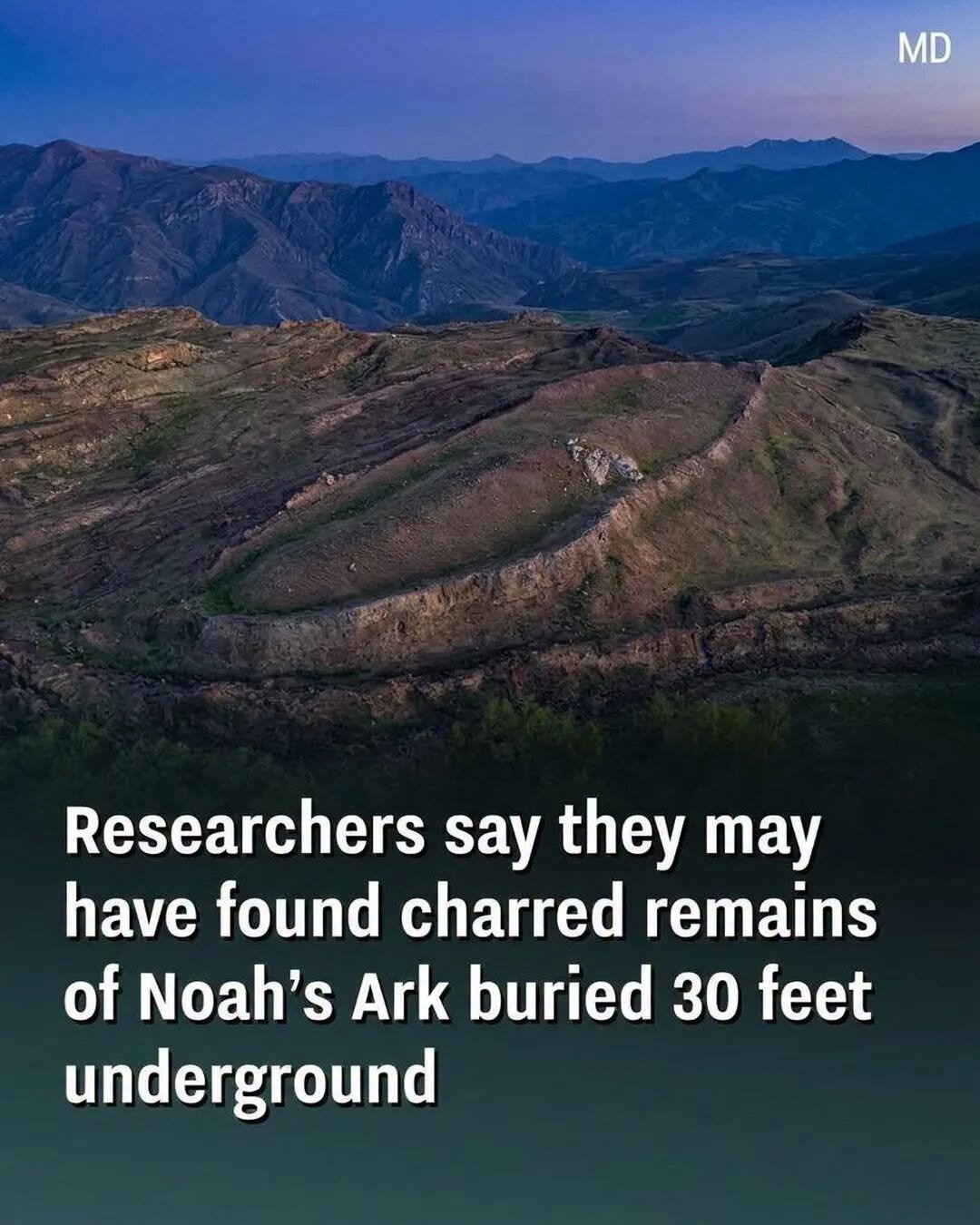
Deep beneath a mysterious boat-shaped formation in eastern Türkiye, researchers have uncovered something that could reignite one of history’s most fascinating mysteries. Nearly 30 feet below the surface, drilling equipment reportedly recovered pieces of burned and unburned wood, raising fresh questions about a site that has puzzled investigators for decades. The discovery was announced in October 2026, following an extensive investigation near Mount Ararat, a region traditionally associated with the biblical story of Noah’s Ark, and the unusual formation measures approximately 515 feet long — remarkably close to one interpretation of the vessel’s dimensions described in the Book of Genesis. For generations, explorers have searched for physical evidence of the legendary ship believed to have sheltered Noah’s family and animals during a catastrophic flood, and investigators now believe their latest findings deserve a much closer examination.
The location, known as the Durupınar formation, first attracted international attention in 1959 because of its striking resemblance to a massive boat, and researchers recently returned with modern ground-penetrating radar technology, drilling equipment and advanced mapping systems to examine what might lie beneath its surface. Their scans revealed unusual underground patterns, including possible cavities and layered structures that some investigators believe resemble features of a constructed vessel, and a specialized mapping company also helped produce a three-dimensional representation of the formation. The discovery of wood samples has introduced an entirely new possibility, though investigators suggest burning could have helped preserve some material underground while acknowledging that the fragments might have originated from a much later campfire.
The research team, working with university specialists, has sent the recovered material for laboratory examination, including carbon-14 dating and identification of the wood species, because the age and origin of the fragments remain unknown. Yet the researchers face considerable skepticism: many geologists maintain that the formation is a natural geological feature shaped by landslides, erosion and surrounding rock formations, previous scientific studies have supported that explanation, and no independently verified evidence has established the presence of an ancient ship. Project representative Andrew Jones has argued that the radar patterns suggest something more complicated than an ordinary rock formation, but the researchers acknowledge that further testing and independent scientific review are necessary before any extraordinary conclusions can be reached.
For now, the discovery remains an intriguing possibility rather than confirmation of an ancient biblical vessel. Scientists must determine whether the recovered wood is ancient, whether it shows evidence of human activity, and how it became buried so deeply beneath the ground — and even if the fragments prove exceptionally old, that alone would not establish a connection to Noah’s Ark. The research continues at a location approximately 18 miles south of Mount Ararat, where investigators hope future examinations will provide clearer answers, under the project Noah’s Ark Scans. Whether the site eventually reveals evidence of human construction or confirms a remarkable natural formation, its latest findings have renewed interest in a mystery that has fascinated generations.
Website Disclaimer
The information provided on this website is for general informational and educational purposes only. While we strive to ensure that all content is accurate and up to date, we make no guarantees regarding the completeness, reliability, or accuracy of any information published.
The views and opinions expressed in articles belong to their respective authors and do not necessarily reflect the views of this website. Any action you take based on the information found on this website is strictly at your own risk. We will not be liable for any losses, damages, or inconveniences arising from the use of our content.
Some articles may contain opinions, third-party information, or external links. We do not endorse or guarantee the accuracy of content on external websites and are not responsible for their practices or policies.
All content on this website is provided in good faith and is intended for informational purposes only. Readers are encouraged to verify information independently and seek professional advice where appropriate.