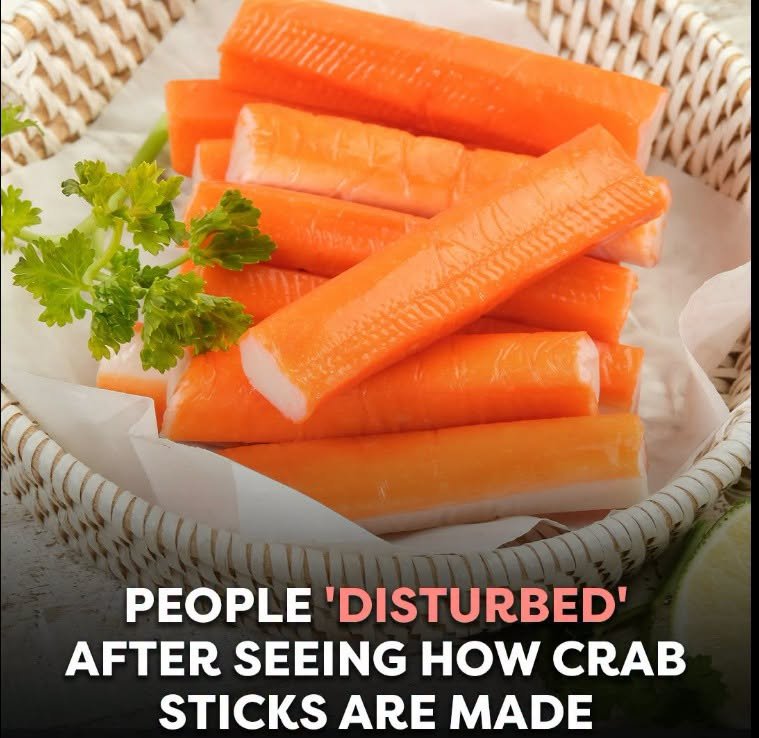
People have been left disturbed after finding out how crab sticks are made — and many are now vowing never to eat them again. Crab sticks are a favourite seafood treat, but loyal buyers have stumbled upon the startling truth behind their production, and it has all got a little fishy.
What many people do not realise is that crab sticks are actually a product known as “surimi” — a Japanese invention that dates back hundreds of years. Surimi is made by washing minced white fish repeatedly until only pure protein remains, before it is flavoured, coloured and shaped to resemble crab meat. While the modern Western version is far more processed than the original Japanese product, the method is still used worldwide as a low-cost seafood substitute.
A clip posted on Reddit goes into lengthy detail. The process usually begins with white fish such as Alaskan pollock being minced into a paste and washed multiple times to remove fat, odour and colour, leaving behind a sticky protein known as surimi. The mixture is then blended with starch, sugar, egg whites, salt, artificial crab flavouring and colouring agents. The paste is heated, shaped into sticks and layered with red dye on the outside to mimic the appearance of real crab meat. For many viewers, seeing the pale fish paste pumped through machines was enough to completely turn their stomachs.
Much of the backlash appears to stem from the belief that crab sticks contain real crab meat. In reality, many supermarket versions contain little to no crab at all, relying instead on flavouring and colouring to create the illusion. For some shoppers, the issue is not the ingredients themselves, but the feeling that the branding has misled them for years. Reactions online ranged from “Watching processed food being made really puts you off” to a simple “Grim.” — and for some, it is business as usual, while for others, it is the end of a once-loved snack. One thing should be said plainly: no one in the article is named, and the only source is an unnamed Reddit post — no subreddit, username or link is given — so the reactions are anonymous comments, not verified reports.
Website Disclaimer
The information provided on this website is for general informational and educational purposes only. While we strive to ensure that all content is accurate and up to date, we make no guarantees regarding the completeness, reliability, or accuracy of any information published.
The views and opinions expressed in articles belong to their respective authors and do not necessarily reflect the views of this website. Any action you take based on the information found on this website is strictly at your own risk. We will not be liable for any losses, damages, or inconveniences arising from the use of our content.
Some articles may contain opinions, third-party information, or external links. We do not endorse or guarantee the accuracy of content on external websites and are not responsible for their practices or policies.
All content on this website is provided in good faith and is intended for informational purposes only. Readers are encouraged to verify information independently and seek professional advice where appropriate.