PART 2
For several seconds, nobody moved.
The hospital room seemed to shrink around the four of us, drawing every sound into sharp focus: the steady beeping of the monitor beside my bed, the soft hiss of air through the wall vent, the squeak of Claire’s shoe against the polished floor outside the glass partition.
Evelyn Shaw stood at the foot of my bed with Grandma’s leather folder held close to her chest. She had always been a small woman, neat and composed, with silver hair pinned at the nape of her neck and glasses that made her eyes look larger than they were. But in that moment, she seemed immovable.
Dad’s attorney, a tired-looking man named Leonard Pike, stared at the deed as if it were a trap waiting to close.
Claire found her voice first.
“That’s not possible,” she said.
Evelyn looked at her calmly. “It is not only possible. It is recorded.”
“She was sick,” Claire snapped. “Grandma was confused near the end.”
“She was examined by two physicians the same week she signed the transfer,” Evelyn replied. “Both certified that she was fully competent.”
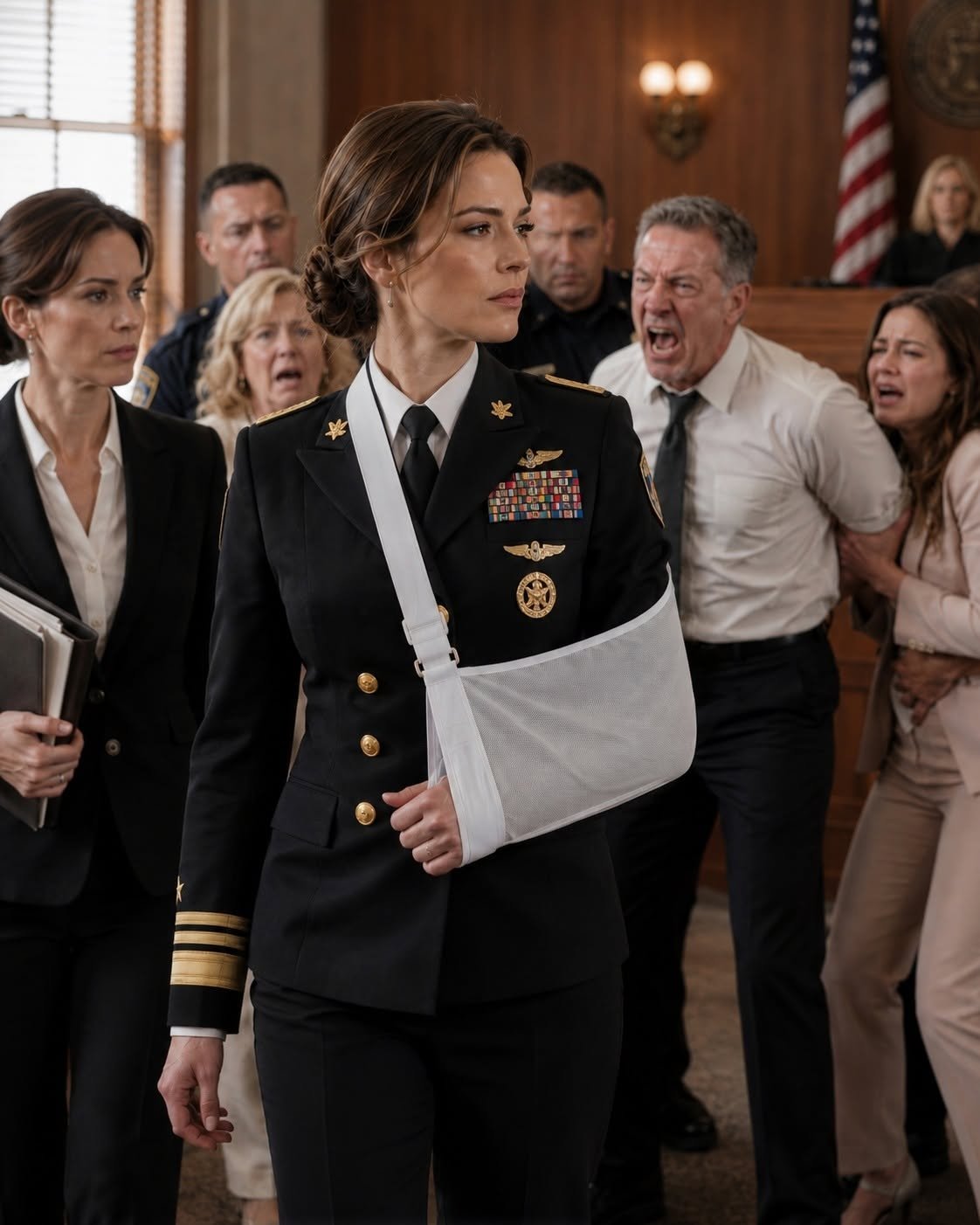
My mother stood near the door, one hand still wrapped around the brass key she had hidden for six years. She looked older than she had that afternoon, as if the day had carved new lines into her face. Her eyes kept moving between Claire and me, full of fear and something dangerously close to guilt.
I tried to sit up, but pain flashed through my ribs. Evelyn immediately stepped closer.
“Captain Hart,” she said softly, “please don’t strain yourself.”
Claire’s eyes narrowed at the title. It bothered her. Not because she respected it, but because it proved there had been a whole life of mine she had never bothered to imagine.
Leonard cleared his throat. “Ms. Shaw, perhaps we can discuss this privately.”
“We are discussing it privately,” Evelyn said. “In front of the rightful owner of the property.”
Claire gave a brittle laugh. “Rightful owner? She abandoned this family.”
I looked at my sister through the glass. Her face was pale, but her chin was raised the same way it had been when we were children and she had broken something, then convinced Dad I had done it.
“I left,” I said carefully, each word costing me breath. “There’s a difference.”
“You left Grandma too.”
That one landed harder than I wanted it to.
Because I had left Grandma.
Not completely. Not in my heart. Not in the quiet phone calls from shipboard offices, not in the birthday cards, not in the money I mailed whenever she pretended she didn’t need it. But I had not been there for the slow ordinary things: tea on rainy afternoons, doctor appointments, loose porch steps, lonely winter evenings.
Before I could answer, Evelyn unzipped a small pocket inside the leather folder and removed the flash drive.
“Your grandmother anticipated this exact accusation,” she said.
Mom shut her eyes.
Claire noticed.
“What did you do?” Claire demanded.
Mom whispered, “Claire, stop.”
But Claire had spent years mistaking volume for strength. “No. I want to know what’s on that thing.”
Evelyn turned to me. “Aria, do you consent to viewing the recording now?”
Hearing my first name from her, after so many hours of being Captain Hart to everyone else, almost undid me.
“Yes,” I said.
A nurse helped dim the lights. Evelyn borrowed a hospital tablet from the charging station at the nurses’ desk and inserted the flash drive with an adapter she had already brought. That detail told me this had not been an emergency errand. Grandma had prepared a trail, and Evelyn had memorized every step.
The video opened on Grandma’s living room.
My chest tightened at the sight.
The old green sofa was there, faded along the arms. The braided rug beneath the coffee table was the same one I had fallen on that afternoon. Sunlight spilled through lace curtains, turning dust motes into gold. Grandma sat in her wingback chair, wrapped in her blue cardigan, her white hair brushed smooth.
She looked thinner than I remembered, but her eyes were steady.
“Evelyn,” she said in the recording, “is it working?”
A younger version of Evelyn’s voice answered from off camera. “It’s working, Miriam.”
Grandma folded her hands in her lap.
“My name is Miriam Elaine Hart,” she began. “Today is April twelfth. I am making this statement of my own free will.”
Claire shifted outside the room. Leonard’s face went blank in the professional way lawyers use when they realize silence is their safest option.
Grandma looked directly into the camera.
“If you are watching this, Aria, then I am gone, and someone has tried to make you believe you do not belong in my house.”
My throat closed.
“You do belong,” Grandma continued. “You always did. Not because you stayed, and not because you left, but because you loved this place for what it was, not for what it could be sold for.”
Claire’s mouth opened, but no sound came out.
Grandma drew a slow breath.
“I transferred the house to you because I discovered certain things after your grandfather died. Things I should have faced sooner. Harold had been borrowing against family trust accounts that were never his to touch. Claire knew more than she admitted. Your mother knew enough to be afraid.”
Mom covered her face.
I stared at her, stunned.
Grandma’s voice softened.
“Linda, if you are there, I hope you finally tell the truth. Fear may explain silence, but it does not repair what silence breaks.”
My mother made a small sound, not quite a sob.
The recording continued.
“There is a locked cabinet in the back pantry. Aria, the brass key opens it. Inside, you will find ledgers, letters, and copies of documents. Evelyn has originals in safekeeping. I did not leave these things to punish anyone. I left them because truth has a way of rotting when it is hidden too long.”
I could feel Claire watching me now, not with anger, but calculation.
Grandma leaned forward slightly.
“One more thing. Do not sell quickly. No matter what they say. No matter what debt they claim is urgent. Wait until you understand why Harold wanted the house emptied before probate was complete.”
The video ended.
No one spoke.
Even the hospital machinery seemed suddenly too loud.
Evelyn removed the flash drive and placed it back inside the folder.
Claire stepped away from the glass, then returned almost immediately. “That proves nothing.”
“It proves intent,” Evelyn said. “It also tells us where to look.”
Leonard touched Claire’s arm. “We should leave.”
She jerked away from him. “I am not leaving.”
A sheriff’s deputy appeared at the end of the corridor, summoned either by the nurse or by the noise. Claire saw him and lowered her voice.
“This family is going to fall apart because of you,” she said to me.
I looked at my mother, who was crying silently into both hands.
“No,” I said. “It already did.”
By morning, the pain medication made everything feel soft around the edges. The deputy assigned to the case came by with more questions. Evelyn stayed through sunrise, sleeping upright in a chair for less than an hour before waking with her glasses crooked and her legal pad already in her lap.
My father was still in custody. Claire had not been charged yet, but the deputy made it clear that the recording from the neighbor’s camera had changed the conversation. There was no version of the story where everyone simply pretended I had fallen.
At ten, Mom returned alone.
She stood in the doorway holding a paper cup of coffee she never drank.
“May I come in?” she asked.
I wanted to say no. I wanted to ask where that courtesy had been when Dad raised the bat. Instead, I nodded.
She sat in the visitor chair, leaving a careful distance between us.
For a long while, she stared at the cup in her hands.
“Your grandmother gave me the key after your grandfather’s funeral,” she said at last. “She told me not to give it to Harold. She said if anything happened to her, I was to take it to Evelyn.”
“But you hid it.”
Her face crumpled. “Yes.”
“Why?”
Mom looked toward the window. Morning light washed the parking lot in pale gray. “Because your father found the pantry cabinet once. He didn’t open it, but he knew there was something inside. After that, he watched me. He watched her. I thought if I kept the key hidden, no one could use it.”
“That doesn’t make sense.”
“I know.”
Her honesty surprised me more than any excuse would have.
“I told myself I was protecting everyone,” she whispered. “Really, I was postponing the moment when I would have to choose.”
“And yesterday?”
Her lips trembled. “Yesterday I chose too late.”
I looked away.
Part of me wanted to comfort her. That instinct embarrassed me. Even after everything, my first response to her pain was still to make room for it. Daughterhood, I realized, was not something you outgrew simply because it had hurt you.
“Mom,” I said, “what is in that house?”
She shook her head. “I never saw everything.”
“What did you see?”
She swallowed. “Bank letters. Your grandfather’s name. Claire’s signature on something when she was barely twenty. And a photograph.”
A coldness moved through me.
“What photograph?”
Mom pressed her fingers to her mouth. “Your grandmother standing on the porch with a little boy.”
I waited.
“What little boy?”
“I don’t know,” she said. “But on the back, in your grandmother’s handwriting, it said: For Aria, when the house is safe.”
Evelyn looked up sharply from her legal pad.
That was the first time I saw her composure crack.
“You didn’t tell me about a photograph,” she said.
Mom’s shoulders folded inward. “I forgot.”
“No,” Evelyn said quietly. “People forget grocery lists. Not that.”
Mom began to cry again, but this time I did not look away.
Two days later, I was discharged with a rib brace, a bottle of medication, and strict instructions not to lift anything heavier than a kettle. Evelyn drove me to a small guest cottage behind her own house, insisting I stay there until the locks at Grandma’s place were changed and the deputy finished documenting the scene.
I should have slept.
Instead, I lay awake beneath a quilt that smelled faintly of lavender, listening to wind move through the trees outside Evelyn’s window. Every time I closed my eyes, I saw Grandma on the recording.
Wait until you understand why Harold wanted the house emptied.
By late afternoon, Evelyn came to the cottage carrying soup and a stack of documents.
“I made copies,” she said, setting the papers on the table beside me. “You don’t have to read them tonight.”
Of course I read them.
The first file contained the deed transfer. The second held medical competency letters. The third was a timeline in Grandma’s careful handwriting.
She had written my father’s name again and again.
Harold asked about refinancing.
Harold angry when I refused.
Claire visited with developer brochure.
Linda afraid.
Then, near the bottom of the page, one line had been underlined twice.
The house is not what they are after.
I read it three times.
Evelyn watched me over the rim of her tea.
“She never told you what that meant?” I asked.
“No,” Evelyn said. “Miriam believed the fewer people who knew, the safer the information would be.”
“Information?”
“That was the word she used.”
The next morning, we went to the house.
A deputy met us outside. Yellow leaves skittered across the porch steps, gathering in the corners where Grandma used to sweep every Saturday. The front door had been repaired with temporary hardware, and the living room smelled of sawdust and cold ashes.
I paused just inside.
The room looked smaller than it had in memory. Or perhaps I had grown too accustomed to wide decks, gray water, and horizons without fences.
Evelyn touched my elbow. “We can come back another day.”
“No,” I said. “I need to know.”
We found the pantry at the back of the kitchen. Its shelves were lined with jars of peaches, pickled beans, and dusty tins of tea. Behind a curtain of old aprons stood a narrow cabinet built into the wall. It was so ordinary I might have missed it entirely.
Mom’s brass key slid in with a reluctant click.
Inside were three shelves.
The top shelf held ledgers wrapped in cloth. The middle held envelopes labeled by year. The bottom contained a small metal box, a bundle of photographs, and a child’s blue mitten.
I reached for the photographs first.
My hands trembled as I turned them over.
Grandma on the porch.
Grandpa beside a truck.
My father as a young man, unsmiling.
Then the photograph Mom had mentioned.
Grandma stood in front of the house, one hand resting on the shoulder of a boy about six years old. He had dark hair, serious eyes, and a crooked front tooth. He was not anyone I recognized.
On the back, Grandma had written: For Aria, when the house is safe.
Below that, in smaller writing, were three words.
Find Samuel Hart.
Evelyn inhaled.
I looked at her. “Who is Samuel Hart?”
She did not answer right away.
That frightened me.
“Evelyn.”
“I heard the name once,” she said. “Only once. Your grandmother mentioned a Samuel in connection with your grandfather’s estate, then told me she had spoken out of turn.”
“Was he family?”
“I don’t know.”
But she was lying. Not fully, perhaps, but enough.
The deputy stepped into the kitchen. “Captain Hart?”
I tucked the photograph carefully into the folder. “Yes?”
“We found something in the garage.”
The garage had always been Grandpa’s kingdom. Even years after his death, it smelled of oil, cedar shavings, and old rope. Tools hung in perfect rows along pegboard walls. A tarp covered the workbench where he once taught me to sand birdhouses.
The deputy led us to a row of storage cabinets near the back.
“One was recently emptied,” he said. “No dust on the shelf. Scrape marks on the floor. Looks like something heavy was dragged out.”
Evelyn bent to examine the concrete. “How recently?”
“Hard to say. Weeks, maybe less.”
I thought of Claire’s text.
YOU HAVE NO IDEA WHAT’S IN THAT HOUSE.
“What was here?” I asked.
Nobody answered.
Then I noticed a square of paper wedged behind the cabinet leg. I pointed, and the deputy pulled on gloves before retrieving it.
It was a shipping receipt.
Most of the ink had faded, but one line remained clear.
Destination: Bellweather Storage, Unit 19.
The name hit Evelyn like a physical blow.
“Do you know that place?” I asked.
She folded her arms tightly. “It closed years ago.”
The deputy checked his phone. “Actually, it reopened under new ownership.”
That afternoon, Evelyn and I sat in her car outside Bellweather Storage while the deputy went in to speak with the manager. The place sat at the edge of town near the railroad tracks, a line of dull orange doors beneath a faded sign. Rain began to fall, tapping lightly on the windshield.
“You knew Samuel’s name,” I said.
Evelyn kept both hands on the steering wheel though the car was parked.
“I knew your grandmother was protecting someone,” she admitted. “I did not know whether that person was alive.”
“Was Samuel my uncle?”
“I cannot say.”
“Cannot or will not?”
Her eyes softened. “Aria, there are truths that change once they are spoken. I want evidence before I hand you a possibility that may hurt you.”
I gave a tired laugh. “I’m already hurt.”
“I know.”
The deputy returned with a ring of keys and the manager, a nervous young man who kept glancing at my uniform jacket folded across the back seat. Unit 19 was near the end of the property. Its lock was newer than the others.
Inside, the air was stale and cool.
There were only five items.
A cedar chest.
A banker’s box.
A rolled-up rug.
An old suitcase.
And a framed portrait wrapped in brown paper.
The deputy photographed everything before allowing us closer. Evelyn opened the banker’s box first. Inside were copies of adoption records, property maps, and letters written in Grandma’s hand but never mailed.
The first letter began, Dear Samuel, I should have fought harder.
My heartbeat changed.
I sat carefully on the edge of the cedar chest while Evelyn read in silence. Her face grew paler with every page.
Finally, she handed me a document.
It was a birth certificate.
The father’s name was my grandfather.
The mother’s name was not my grandmother.
The child’s name was Samuel David Hart.
I stared at it until the letters blurred.
Grandpa had another son.
My father had a half-brother.
Claire and I had an uncle no one had ever mentioned.
Evelyn opened the old suitcase. Inside were children’s clothes, school drawings, and a small wooden boat with the initials S.H. burned into the side.
Beneath everything lay a sealed envelope addressed to me.
My name, in Grandma’s handwriting.
I opened it slowly.
Aria,
If you are reading this, then you have found Samuel. Or at least the beginning of him.
Your grandfather made mistakes before I married him. Samuel was one of the people hurt by those mistakes, though a child is never a mistake. When Samuel’s mother died, your grandfather wanted to bring him home. Harold was sixteen then. Angry, proud, and terrified of losing what he believed belonged to him. There was a terrible argument. Samuel disappeared from our lives soon afterward.
For years, I was told the boy had been placed with distant relatives. I believed it because believing was easier than asking. After your grandfather died, I found proof that money meant for Samuel had been redirected. Not once. Many times.
I do not know if Samuel is alive.
But I know this: the house sits on land that was partly purchased with funds intended for him. If he or his heirs can be found, they may have a claim. Harold knows this. Claire suspects enough. That is why they wanted the house sold quickly, the records scattered, and you pressured into silence.
You were the only one I trusted to look for the truth without first asking what it was worth.
Forgive me for leaving you a burden. I pray it becomes a bridge.
Grandma
By the time I finished, rain was drumming against the metal roof of the storage unit.
I did not cry. Not then.
The feeling was too large for tears.
I thought of my father standing in Grandma’s living room, desperate not merely for money, but for erasure. I thought of Claire pushing papers at a hospital bed because speed was her only protection. I thought of my mother hiding a key because fear had taught her that delay felt safer than truth.
And I thought of Samuel, a little boy with a crooked tooth, vanished from every family story as if love could be edited out of blood.
Evelyn rested a hand over mine.
“We will find out what happened,” she said.
The deputy’s phone rang before I could answer.
He stepped outside, spoke briefly, then returned with his expression tightened.
“That was the station,” he said. “Claire Hart was picked up trying to access your grandmother’s bank deposit box.”
Evelyn closed her eyes. “Of course she was.”
“There’s more,” he said, looking at me. “She wasn’t alone.”
My stomach dropped. “Who was with her?”
He hesitated.
“Your mother.”
For one suspended second, the rain seemed to stop.
I heard my own pulse in my ears.
“No,” I said, though I did not know whether I meant it as denial or plea.
The deputy’s voice softened. “They’re being brought in for questioning. Your mother asked for you.”
Evelyn immediately shook her head. “Aria is injured and under no obligation—”
“I’ll go,” I said.
“Aria.”
“I’ll go.”
Because some doors, once opened, did not close again simply because you were tired.
At the sheriff’s station, Mom sat alone in an interview room with a paper cup of water untouched before her. She looked smaller through the glass. Claire was in another room down the hall, speaking rapidly to Leonard Pike, her hands moving like birds trapped indoors.
Mom saw me and stood too quickly.
“I didn’t help her,” she said before I sat down. “Not the way it looks.”
I eased myself into the chair. “Then tell me how it looks.”
She twisted a tissue between her fingers. “Claire said the deposit box had Grandma’s medical papers. She said if police found them first, they would twist everything. I knew she was lying, but she said something else.”
“What?”
Mom looked at the camera in the corner, then back at me.
“She said Samuel isn’t dead.”
The room tilted.
“She knows where he is?” I asked.
Mom shook her head. “She said Dad has been paying someone for years. Not Samuel. Someone connected to him.”
“Who?”
“I don’t know.”
I believed her, and I hated that I believed her.
The door opened behind me. The deputy stepped in holding a clear evidence bag. Inside was a small notebook taken from Claire’s purse.
“She had this,” he said.
On the open page, written in Claire’s sharp handwriting, was a list of names. Most were crossed out.
At the bottom, circled twice, was one I recognized.
Not because I had seen it in Grandma’s papers.
Because I had served with him.
Lieutenant Commander Daniel Ross.
My former executive officer.
A man who had once saved my career by testifying on my behalf after a shipboard investigation. A man who knew my emergency contacts, my service record, and more about my life than most of my relatives ever had.
Beside his name, Claire had written one sentence.
He knows what Aria is.
I looked up slowly.
Evelyn’s face had gone still.
“What does that mean?” I asked.
No one answered.
Then my phone buzzed.
A new message appeared from an unknown number.
Captain Hart, your grandmother asked me to wait until you found Samuel. You are closer than you think. Do not trust the photograph.
Attached beneath the message was an image.
The same porch.
The same blue cardigan.
The same little boy.
But this time, standing in the shadow behind Grandma, half-hidden by the screen door, was another child.
A girl.
Me.
Website Disclaimer
The information provided on this website is for general informational and educational purposes only. While we strive to ensure that all content is accurate and up to date, we make no guarantees regarding the completeness, reliability, or accuracy of any information published.
The views and opinions expressed in articles belong to their respective authors and do not necessarily reflect the views of this website. Any action you take based on the information found on this website is strictly at your own risk. We will not be liable for any losses, damages, or inconveniences arising from the use of our content.
Some articles may contain opinions, third-party information, or external links. We do not endorse or guarantee the accuracy of content on external websites and are not responsible for their practices or policies.
All content on this website is provided in good faith and is intended for informational purposes only. Readers are encouraged to verify information independently and seek professional advice where appropriate.