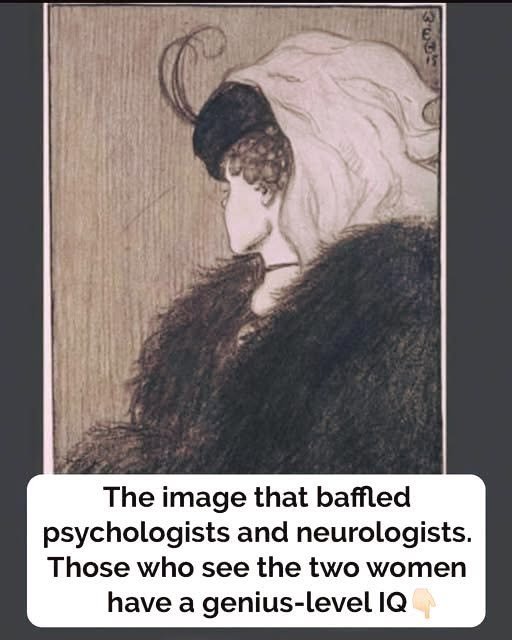
Optical illusions have always fascinated people because they challenge the way the human brain interprets visual information. At first glance, an image may seem simple and straightforward, but upon closer inspection, it often reveals hidden patterns, shapes, or entirely different interpretations.
This is what makes optical illusions both entertaining and intellectually stimulating for people of all ages. Over the years, such images have spread widely across books, magazines, and now the internet, where millions of users continue to test their perception and share what they see. One of the most well-known optical illusions in history is the famous “Young Girl / Old Woman” drawing. This illustration has circulated for more than a century and remains one of the most discussed visual puzzles ever created.
The image is believed to have originated in the late 19th century, with versions appearing around 1888. During that time, printed postcards and illustrations were a popular form of communication and entertainment. Many of these images were shared widely without explanation, allowing viewers to discover hidden details on their own.
To put the time period into context, the late 1800s was an era of rapid technological development. Communication systems were evolving, early transportation industries were expanding, and printed artwork played a major role in public life. Within this environment, visual puzzles like optical illusions became a source of curiosity and discussion.
The Origin and Artist Behind the Illusion
The most widely recognized version of this illusion is often associated with a British cartoonist named W.E. Hill. He created illustrations that played with perception and visual interpretation, often embedding multiple meanings within a single drawing.

One of his most famous works is the dual-image portrait commonly known as “My Wife and My Mother-in-Law,” which is closely related to the “Young Girl / Old Woman” illusion. This artwork demonstrates how a single set of lines can be interpreted in two completely different ways depending on what the viewer focuses on.
In the image, some people see a young woman looking away, while others immediately recognize an older woman facing downward. Both interpretations are correct, yet they cannot be seen clearly at the same time, which makes the illusion so powerful.
How the Illusion Works
This optical illusion is a classic example of a bistable image, meaning it contains two valid interpretations that the brain alternates between. The human brain tries to make sense of visual input by matching patterns to familiar shapes, such as faces, profiles, and objects.
In this particular drawing, subtle lines form different facial features depending on how they are interpreted. For example, what appears to be the chin of a young woman can also be seen as the nose of an older woman. Similarly, hair and clothing shapes shift depending on perception.
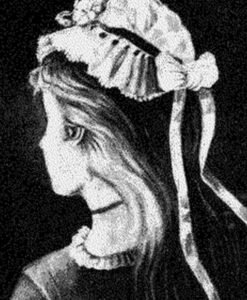
Because of this dual interpretation, viewers often experience a “switching effect,” where their perception changes after someone points out the alternative image.
Why People Struggle to See Both Images
Many people initially see only one version of the illusion and find it difficult to identify the second. This is completely normal and relates to how the brain prioritizes certain visual cues over others.
Once the brain locks onto one interpretation, it tends to ignore conflicting information. This is known in psychology as perceptual bias, where the mind prefers a familiar or dominant pattern rather than switching to an alternative view.
However, with time or guidance, most people are eventually able to see both images. This often creates a sense of surprise or amusement, as the hidden picture suddenly becomes clear.
The Role of Optical Illusions in Psychology
Optical illusions like this one are not just entertainment; they are also used in psychology and neuroscience to study perception. Researchers use such images to better understand how the brain processes visual information and constructs reality.
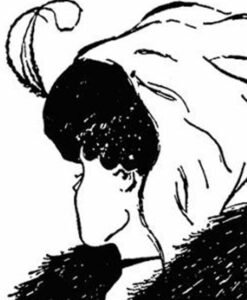
These illusions demonstrate that human perception is not a perfect reflection of the external world. Instead, it is an interpretation shaped by experience, attention, and cognitive shortcuts.
Because of this, optical illusions help scientists explore how people perceive depth, faces, movement, and ambiguous shapes.
The Popularity of the “Young Girl / Old Woman” Image Online
In the modern digital age, this classic illusion has gained new popularity through social media platforms, educational websites, and viral posts. Millions of users have encountered the image online and shared their interpretations in comments and discussions.
What makes this illusion especially engaging is its simplicity combined with depth. There are no complex colors or patterns—just a black-and-white drawing that holds two distinct meanings.
People often challenge friends and family to see both images, turning it into a fun visual test that spreads quickly across platforms.
Why Optical Illusions Remain Timeless
Despite being created more than a century ago, illusions like this continue to attract attention today. Their timeless appeal comes from the universal nature of human perception. Everyone sees the world slightly differently, and optical illusions highlight that fact in a clear and visual way.
They also provide a reminder that reality is not always as straightforward as it appears. What we see depends heavily on how our brain interprets signals, not just what is physically present in front of us.
Because of this, optical illusions remain a popular subject in education, art, psychology, and online entertainment.
The “Young Girl / Old Woman” illusion is more than just a drawing—it is a demonstration of how flexible and complex human perception can be. A single image can hold two completely different realities, both valid yet impossible to see at the same time.
Its long history and continued popularity show how deeply people are fascinated by the mysteries of the mind. Even today, millions of viewers continue to experience the surprise of discovering the hidden image for the first time.
Optical illusions like this remind us that seeing is not always believing, and that sometimes, reality depends entirely on perspective.
Website Disclaimer
The information provided on this website is for general informational and educational purposes only. While we strive to ensure that all content is accurate and up to date, we make no guarantees regarding the completeness, reliability, or accuracy of any information published.
The views and opinions expressed in articles belong to their respective authors and do not necessarily reflect the views of this website. Any action you take based on the information found on this website is strictly at your own risk. We will not be liable for any losses, damages, or inconveniences arising from the use of our content.
Some articles may contain opinions, third-party information, or external links. We do not endorse or guarantee the accuracy of content on external websites and are not responsible for their practices or policies.
All content on this website is provided in good faith and is intended for informational purposes only. Readers are encouraged to verify information independently and seek professional advice where appropriate.