The balance on the screen read $12.43, and for several seconds I waited for the missing numbers to appear. Behind me, rice boiled over on the stove while my seven-year-old daughter, June, decorated the cracks in her old sneakers with a purple marker. My ten-year-old son, Emmett, worked beneath a kitchen light that flickered every time the refrigerator started. Then the family tablet buzzed, displaying messages from my husband, Vaughn, to a woman named Brielle. She thanked him for the luxury apartment, joked that my night shifts were paying her rent, and asked whether he had hidden the documents after withdrawing money from our children’s savings. Vaughn replied that I would never notice because I did not check anything without asking him first. My phone began ringing for the twenty-third time, but instead of answering, I photographed every message before he could make them disappear.
Three weeks earlier, Vaughn had placed $80 on our kitchen table and announced that it was the grocery budget for our family of four. He claimed his delivery business was struggling and said the rest of his income had gone toward fuel, insurance, and bills that I “wouldn’t understand.” I worked from 10 p.m. until 6 a.m. cleaning offices inside a downtown law firm, then came home to prepare lunches, walk the children to school, and sleep between loads of laundry. I stretched the money with rice, beans, pasta, coupons, and discounted chicken legs while June wore split sneakers and Emmett waited for new basketball shoes. Meanwhile, Vaughn had paid an $8,500 security deposit on an apartment at Lakecrest Towers, where monthly rent was $3,200, and purchased Brielle a pair of gold earrings for $1,260. The money had come from an account I had spent nearly twelve years building with birthday checks, tax refunds, and $50 deposits from extra cleaning shifts. That account was supposed to help our children with college, emergencies, and the future Vaughn had promised to protect.
When I finally answered his call, Vaughn demanded that I bring him a spare car key, but a new message from Brielle revealed that she was waiting for him at the leasing office. I asked whether I should meet him at Lakecrest Towers, and the silence on the other end told me more than any confession could have. His voice dropped into the controlled, quiet tone he used whenever he wanted me frightened, and he warned me not to do anything that might “destroy the family.” I reminded him that the apartment lease was in my name because his credit had been too poor to qualify, then activated the phone’s recording feature as he told me I was nothing without him. After ending the call, I discovered that the blue folder containing our birth certificates, tax records, and savings agreements was missing from the cabinet above the refrigerator. Emmett admitted that Vaughn had asked where I kept it and had questioned him about how often I reviewed the children’s account. Then the tablet buzzed once more with a message from Vaughn saying he was coming home—and this time, he ordered me not to touch any of his belongings.
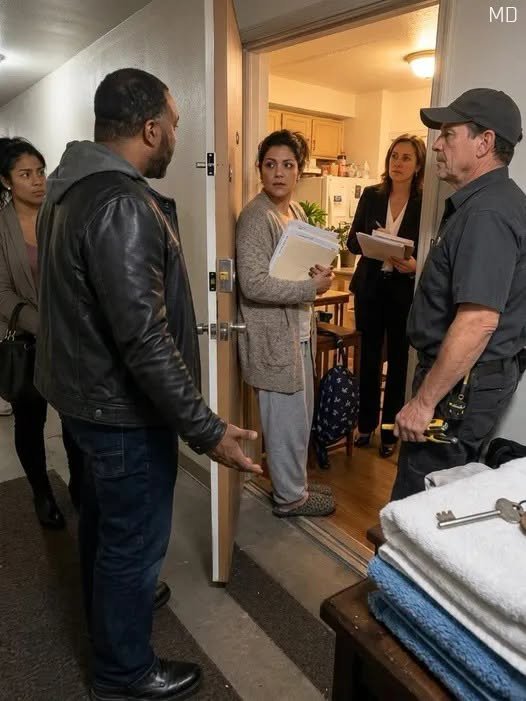
I called our downstairs neighbor, Mrs. Weaver, whose niece Denise Holloway was a family-law attorney, and within an hour the building manager had changed the lock while Denise reviewed the messages and bank records at my kitchen table. A receipt hidden inside Vaughn’s coat confirmed that the Lakecrest deposit had been charged directly to the children’s account, even though withdrawals above $5,000 required both parents’ signatures. The credit union later produced an authorization form bearing a forged version of my name, turning what Vaughn called a marital disagreement into suspected financial fraud. Denise helped me preserve the digital evidence, contact the bank’s fraud department, review our insurance documents, protect the apartment lease, and separate every account connected to my wages. Because the home was rented solely in my name, there was no shared mortgage or estate claim Vaughn could use to force his way back inside. Court proceedings revealed that he had taken $18,700, using the children’s savings as an investment in a secret life he could not afford on his own. He eventually accepted a reduced charge, a restitution order of approximately $11,000, supervised visitation, and restrictions preventing him from accessing our accounts, while Brielle abandoned the apartment as soon as she learned the money was gone.
Not every dollar returned, and I stopped pretending that a court order could restore everything Vaughn had taken from us. What returned instead was control: my passwords, my paychecks, my home, and the right to make decisions without being told I was too foolish to understand them. A partner at the law firm helped me move into a better-paying supervisory position that included health insurance, predictable hours, and a modest retirement contribution. I reopened Emmett’s college fund under my name alone and began rebuilding it one deposit at a time, while June received a new pair of white sneakers she proudly wore until the soles turned gray. About a year later, I sat at the same kitchen table where I had once stared at a balance of $12.43 and listened to my children argue cheerfully over a science project. Vaughn had said I was nothing more than a woman who cleaned other people’s offices, but those same tired hands had gathered evidence, hired an attorney, changed a lock, protected two children, and rebuilt what he tried to steal. I finished my coffee, packed their lunches, and walked out with them into an ordinary morning that finally belonged to us.
Website Disclaimer
The information provided on this website is for general informational and educational purposes only. While we strive to ensure that all content is accurate and up to date, we make no guarantees regarding the completeness, reliability, or accuracy of any information published.
The views and opinions expressed in articles belong to their respective authors and do not necessarily reflect the views of this website. Any action you take based on the information found on this website is strictly at your own risk. We will not be liable for any losses, damages, or inconveniences arising from the use of our content.
Some articles may contain opinions, third-party information, or external links. We do not endorse or guarantee the accuracy of content on external websites and are not responsible for their practices or policies.
All content on this website is provided in good faith and is intended for informational purposes only. Readers are encouraged to verify information independently and seek professional advice where appropriate.