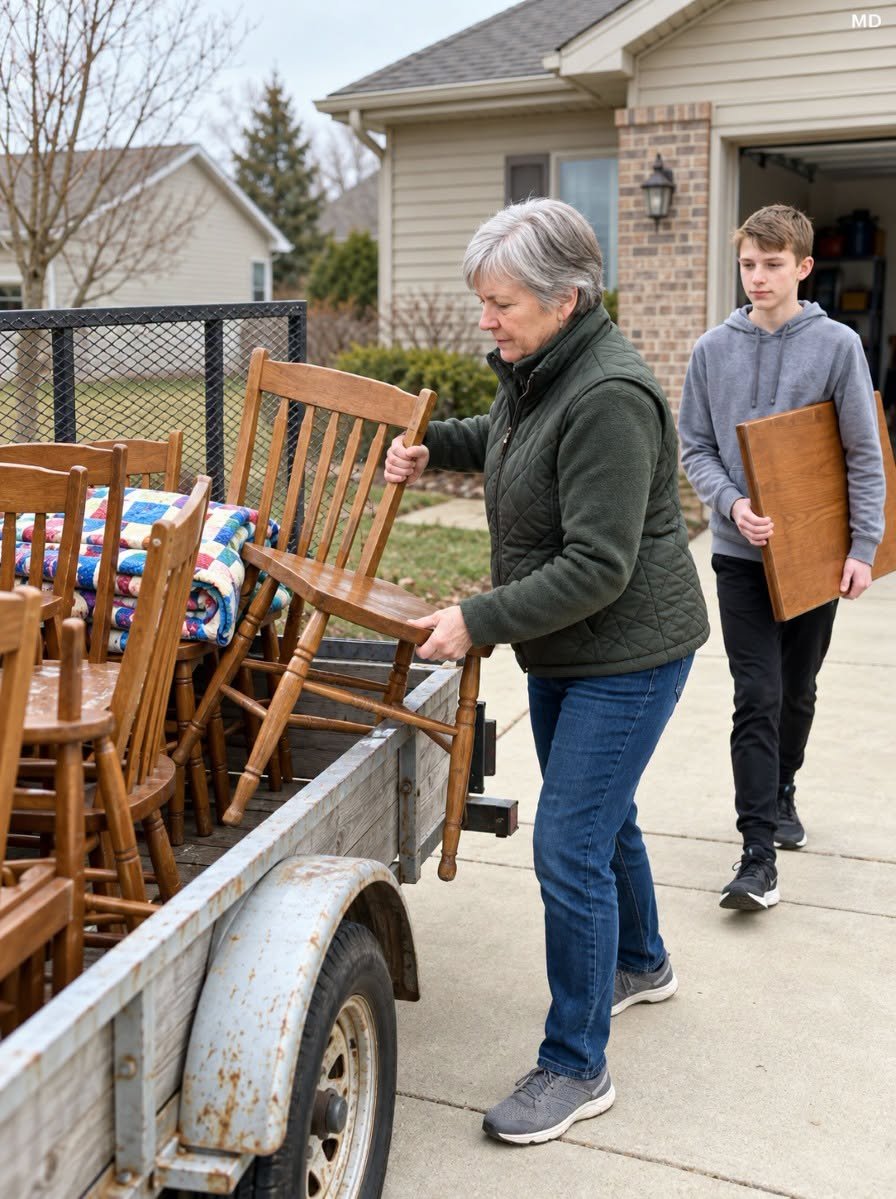
chairs had come from my own home. I had given them to Stephanie and her husband, Mark, when they bought their house three years earlier. I remembered the afternoon we carried the table through their front door, laughing as Mark struggled to keep one end from bumping against the wall. Stephanie had hugged me afterward and said, “Mom, this table will be where our family makes memories for years.”
Now, apparently, there was no room for me at it.
I set the bread knife down and stared at the bowl on my counter. I was seventy years old, a widow for six years, and Thanksgiving had always been my favorite holiday. After my husband, Robert, passed away, I continued preparing the same dishes he had loved: homemade dressing, mashed potatoes, green bean casserole, and pumpkin pie with a crust I made from scratch. My children had grown up with those smells filling our house every November.
I had never expected gratitude for cooking. I simply believed that feeding people was one of the ways a family showed love.
“Stephanie,” I said carefully, “are you telling me you don’t want me at Thanksgiving?”
There was a pause on the other end of the phone.
“It’s not like that, Mom. It’s just complicated this year. Arlene has a lot of relatives coming, and she wants everyone together. We don’t have enough room for everybody.”
I glanced toward the dining room, where an old photograph of Robert and me hung above the sideboard.
“Your table seats twelve,” I reminded her.
“I know, but there are already twelve people coming.”
“And I suppose I’m not one of them?”
“Please don’t make this into something it’s not,” she replied, her voice tightening. “We can have dinner together another day.”
Another day.
I looked at the ingredients scattered across my kitchen. I had already bought the turkey, ordered fresh cranberries, and picked up the special rolls Stephanie’s children loved. I had planned to bring the dressing and two pies to her house, just as I had done every Thanksgiving since she became a mother herself.
For a moment, I wanted to remind her of everything I had done for her. I wanted to tell her about the nights I stayed awake when she was sick, the extra shifts I worked to pay for her college textbooks, and the years I helped with childcare whenever she needed me.
But I didn’t.
Instead, I said, “All right, sweetheart. I understand.”
I ended the call before she could hear my voice break.
That night, I sat alone at my kitchen table with Robert’s old coffee mug beside me. The house was quiet, and for the first time in decades, I had no idea what Thanksgiving would look like.
I wasn’t angry because I expected my daughter to repay me for raising her. I was hurt because she had made room for everyone else and treated my presence as the easiest thing to remove.
The next morning, I put the turkey back in the refrigerator and called my friend Margaret.
When I told her what had happened, she was silent for a moment.
“Are you still planning to cook all that food?” she finally asked.
“I don’t know.”
“Well, I do,” she said. “Bring it to my house. My son is working overseas, my daughter is spending Thanksgiving with her in-laws, and I was planning to eat a sandwich in front of the television. Between the two of us, we can make a proper holiday.”
I laughed for the first time since Sunday evening.
By Tuesday, we had a plan. Margaret invited two neighbors who would otherwise be alone, and I began preparing the dishes I loved making. Instead of cooking out of obligation, I cooked because I wanted to. I baked pies while Margaret set her dining table, and we spent the afternoon remembering our husbands and laughing about the Thanksgiving disasters we’d survived over the years.
Still, a small part of me hoped Stephanie would call.
She didn’t.
On Thursday morning, I woke early and began preparing the turkey. The house smelled of butter, sage, and roasting onions. I arranged the food carefully in covered dishes, packed everything into my car, and drove to Margaret’s home.
Her little dining room was filled with warmth and conversation. There were only six of us, but every chair was occupied by someone who genuinely wanted to be there.
We held hands before dinner, and Margaret asked everyone to share something they were thankful for.
When it was my turn, I looked around the table.
“I’m thankful that family isn’t always defined by whose name appears on a family tree,” I said. “Sometimes, family is simply the people who make room for you.”
My voice trembled, but I finished the sentence.
Everyone raised their glasses, and we began eating.
For the first time in years, I enjoyed Thanksgiving without worrying whether everyone liked the food or whether I had done enough. I sat back, listened to the stories, and allowed other people to refill my plate and pour my coffee.
It was a small thing, but I had forgotten what it felt like to be cared for rather than simply needed.
Later that afternoon, while we were clearing the dishes, my phone rang.
It was Stephanie.
“Mom, what are you doing?” she asked.
“Having Thanksgiving dinner with Margaret and some friends.”
There was a pause.
“You didn’t come over?”
I almost laughed at the question.
“Stephanie, you asked me not to come.”
“I know, but I thought you might still stop by afterward.”
I looked out the window at Margaret’s garden, where the late-autumn sunlight fell across the bare branches.
“You told me there wasn’t room for me at your table,” I replied. “So I found another table.”
She went quiet.
Then she said, “Mom, I didn’t mean to hurt you.”
“I believe you didn’t intend to hurt me,” I said. “But you did. And I need you to understand something. I’m your mother, not an extra guest you can remove when someone else wants my seat.”
I heard her take a shaky breath.
“Arlene said it would be easier if we kept the gathering to her side of the family this year,” Stephanie admitted. “She wanted to introduce everyone properly, and I didn’t know how to tell her no.”
“So you told me no instead.”
She didn’t answer.
I could picture her standing in her kitchen, perhaps looking at the very table I had given her. For years, I had tried to make life easier for my children. I had learned to say yes before they finished asking, and I had swallowed my disappointment whenever their schedules left little room for me.
Perhaps Stephanie had grown accustomed to believing that I would always understand, always forgive, and always be available whenever it suited her.
But love should not require a person to make herself invisible.
“I love you,” I told her. “I always will. But I won’t keep pretending something doesn’t hurt just because you’re uncomfortable talking about it.”
“Can I come see you tomorrow?” she asked quietly.
“You can,” I said. “But let’s not pretend this never happened.”
We ended the call without solving everything.
The following afternoon, Stephanie arrived at my house carrying a small bouquet of yellow roses. She looked tired, and for the first time in a long while, she seemed uncertain about what to say.
“I owe you an apology,” she began. “I should have stood up for you. I kept telling myself that you would understand because you’ve always been so accommodating. I didn’t stop to think about what it would feel like to be told your own family didn’t have room for you.”
I listened without interrupting.
She explained that Arlene had wanted to host a Thanksgiving gathering centered on her relatives, and Stephanie had been anxious about creating tension with her husband’s family. She had chosen the easiest solution without considering the message it sent to me.
“I made you feel like you didn’t belong,” she said, wiping her eyes. “And that wasn’t fair.”
“No, it wasn’t,” I replied gently.
I didn’t rush to comfort her or tell her it was all right. An apology mattered, but so did the willingness to learn from what had happened.
After a while, I showed her the photographs Margaret had taken of our Thanksgiving dinner. Stephanie studied the picture of everyone gathered around the table, smiling and passing dishes.
“You look happy,” she said.
“I was.”
She looked down.
“I’m glad,” she whispered. “And I’m sorry I wasn’t there.”
We talked for another hour. I told her that I didn’t expect to be invited to every gathering or that her husband’s family should matter less than mine. I simply expected to be treated with consideration and honesty.
If there wasn’t room for me at a particular event, she could tell me kindly. But she couldn’t expect me to keep giving my time, cooking, and love while treating my feelings as an inconvenience.
Before she left, Stephanie hugged me tightly.
“Next Thanksgiving,” she said, “I want you there. Not because you cooked the turkey or brought the dressing. Because you’re my mom.”
I held her for a moment.
“Then remember that when next Thanksgiving comes,” I replied.
Over the following months, our relationship slowly improved. Stephanie began calling more often, not only when she needed advice or help with the children. She asked about my days, invited me to ordinary family dinners, and made a greater effort to include me in plans.
Our relationship wasn’t suddenly perfect. We still had difficult conversations, and there were moments when old habits returned. But I had learned to speak honestly instead of quietly accepting every disappointment.
I also discovered that my life could be full without revolving entirely around my children. Margaret and I began hosting monthly dinners, and I joined a local community group where I met people who appreciated my company as much as my cooking.
The following Thanksgiving, I arrived at Stephanie’s house with a pumpkin pie in my hands. The oak table stood in the dining room, its two extension leaves in place, surrounded by twelve chairs.
Stephanie met me at the door and took the pie from my hands.
“Mom, I’m so glad you’re here,” she said.
I believed her because, this time, she had made sure there was a place for me.
As we sat down to eat, I looked at the old oak table. It had witnessed years of laughter, family arguments, birthdays, and holiday meals. Its value had never been in the wood or the number of people it could seat. Its value came from the love shared around it.
And I finally understood something I wished I had learned years earlier.
You can love your family with your whole heart without teaching them that your feelings don’t matter.
Being a mother doesn’t mean accepting every slight in silence. Being a grandmother doesn’t mean you must always be available. And being loving doesn’t mean you have to earn your place at a table by cooking the meal.
Sometimes, the kindest thing you can do for yourself is stop begging for a seat where your presence is treated as a burden.
Because the people who truly love you won’t simply make room for what you can give them.
They will make room for you.
Website Disclaimer
The information provided on this website is for general informational and educational purposes only. While we strive to ensure that all content is accurate and up to date, we make no guarantees regarding the completeness, reliability, or accuracy of any information published.
The views and opinions expressed in articles belong to their respective authors and do not necessarily reflect the views of this website. Any action you take based on the information found on this website is strictly at your own risk. We will not be liable for any losses, damages, or inconveniences arising from the use of our content.
Some articles may contain opinions, third-party information, or external links. We do not endorse or guarantee the accuracy of content on external websites and are not responsible for their practices or policies.
All content on this website is provided in good faith and is intended for informational purposes only. Readers are encouraged to verify information independently and seek professional advice where appropriate.