Michael Landon became one of the most familiar faces in American television, but behind his enormously successful career was a large family whose members experienced him not as a television icon but as a husband and father. Among his children was Christopher Landon, who would eventually develop a successful entertainment career of his own. Christopher’s journey, however, was shaped by a devastating event that happened while he was still a teenager.
Michael died from pancreatic cancer on July 1, 1991, at only 54 years old. Christopher was 16, an age when many important conversations between parents and children have not yet happened. For television audiences, Michael’s death meant losing an entertainer who had been present in popular culture for decades. For Christopher, the loss was far more personal. He was still navigating adolescence and had not yet begun the adult life that would eventually include filmmaking, relationships, parenthood and a clearer understanding of his own identity.
Losing his father at that stage meant Michael would never personally witness many of the milestones his son eventually reached. It also meant Christopher had to carry forward memories of a relationship that had ended before he was old enough to discuss certain subjects with his father as one adult speaking to another. Michael’s television career was already legendary by the time Christopher was born in Los Angeles on February 27, 1975. Years earlier, Michael had achieved widespread recognition playing Little Joe Cartwright on Bonanza, one of the longest-running and best-known Western series in American television history. He later became deeply associated with Little House on the Prairie, where his work extended beyond acting into writing, directing and producing. During the 1980s, Highway to Heaven provided another major chapter in his television career. Together, those programs made Michael Landon’s name familiar to several generations of viewers.
That degree of fame inevitably affected his family. Christopher did not grow up with an anonymous father who could move through everyday life without being recognized. Michael’s work had made him a public figure whose professional accomplishments were discussed nationally. Christopher therefore inherited a surname that already carried strong associations with television history long before he decided what kind of work he wanted to pursue. Yet the career he eventually created would look remarkably different from his father’s.
Christopher was the son of Michael Landon and Lynn Noe. His parents divorced when he was young, and biographical accounts indicate that Christopher later lived with his father until Michael’s death. By the time Christopher reached his teenage years, Michael was approaching the final period of an extraordinary career. Then, in 1991, the family received devastating news when Michael was diagnosed with pancreatic cancer.
Michael spoke publicly about his illness rather than completely withdrawing from public life. His diagnosis came only months before his death, leaving very little time between the discovery of the disease and the family’s loss. Pancreatic cancer had already progressed significantly by the time it was identified. Michael died at his home in Malibu on July 1, 1991, with his wife beside him. His death at 54 shocked audiences who had watched him portray resilient, often optimistic characters for decades.
Christopher’s experience was necessarily different from that of those viewers. He was not mourning the star of Bonanza or Little House on the Prairie. He was mourning his father. At 16, Christopher was still years away from becoming an established screenwriter and filmmaker, and many aspects of his future life had not yet taken shape. His father’s absence therefore extended far beyond the immediate grief surrounding 1991. Michael would not be present for Christopher’s professional breakthroughs, his later personal milestones or the family Christopher eventually created.
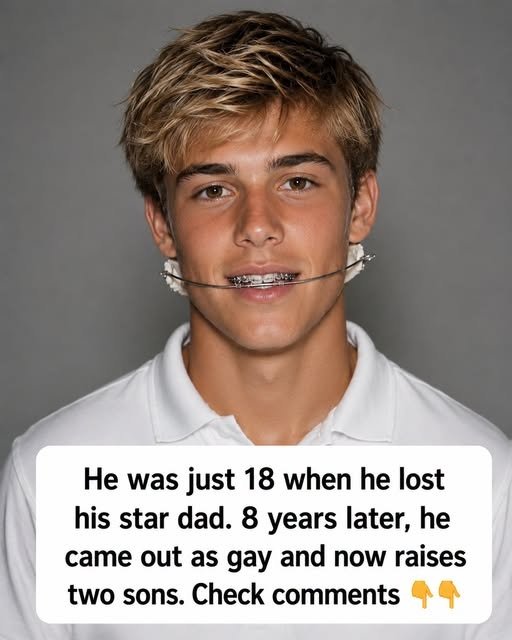
The loss also left behind conversations that could never take place. One of those subjects concerned Christopher’s sexuality. Christopher publicly came out as gay in 1999, eight years after Michael’s death. Contemporary accounts of his coming out describe a young screenwriter who understood that being open about his sexuality could potentially affect his opportunities in Hollywood but chose not to hide that part of himself. His public decision came during a period when openly gay professionals in mainstream entertainment still frequently faced significant prejudice.
Christopher’s decision was therefore both personal and professionally significant. He had already begun working in the film industry and could not know exactly how others might react. Yet he made clear that he did not want fear about his career to determine whether he could live openly. That decision became an important part of his own story, but his father’s death meant one central conversation could never occur directly. Christopher could never sit across from Michael as an adult and personally tell him.
Years later, however, Christopher received information that changed the way he could think about that missing conversation. His stepmother, Cindy Landon, reportedly told him that she and Michael had suspected that Christopher was gay. According to biographical accounts drawing on Christopher’s comments, Cindy’s words suggested that Michael may have understood more about his son than Christopher had realized while his father was alive.
That distinction matters. There is no way to reconstruct exactly how a conversation between Michael and Christopher would have unfolded, and it would be inappropriate to invent words or reactions Michael never had an opportunity to express. What can be said is that Christopher later reported learning through Cindy that his father may already have suspected this part of his identity. The information gave him another way to interpret a conversation that death had prevented them from having.
For anyone who loses a parent young, unanswered questions can remain for decades. Adolescents are still discovering themselves, and many topics that feel impossible to discuss at 15 or 16 become easier once adulthood brings greater confidence and perspective. Christopher never had that additional time with Michael. There were no later conversations in his twenties or thirties, no opportunity to revisit childhood from an adult perspective and no chance to ask his father what he remembered or understood.
Cindy’s account could not replace that missing experience. It could not tell Christopher exactly what Michael would have said. But the possibility that his father had already recognized an important part of him could offer a different emotional perspective. Instead of imagining that Michael had known nothing about the person his son was becoming, Christopher could consider the possibility that his father had noticed more than they openly discussed.
Christopher’s adult life eventually developed in directions very different from Michael’s. He entered filmmaking, but he did not attempt to reproduce the television career that had made his father famous. Instead, he gravitated toward screenwriting, thrillers, horror and horror-comedy. The difference became one of the defining aspects of his professional identity.
Christopher studied screenwriting at Loyola Marymount University before leaving school to pursue opportunities in the film industry. His early work included co-writing Another Day in Paradise, directed by Larry Clark. He later developed credits across an increasingly broad range of projects, gradually establishing a reputation independent of the Landon surname.
A significant step arrived with Disturbia, the 2007 thriller starring Shia LaBeouf. Christopher received a screenwriting credit on the film, which became a commercial success and helped strengthen his position as a Hollywood writer. The project was far removed in style from the family-centered television dramas associated with Michael Landon. That distinction would become even clearer as Christopher’s career developed.
Christopher subsequently became deeply involved with the Paranormal Activity franchise. He wrote Paranormal Activity 2, Paranormal Activity 3 and Paranormal Activity 4, helping develop one of the most recognizable horror franchises of its period. Eventually, he moved from screenwriting into directing within the series.
In 2014, Christopher wrote and directed Paranormal Activity: The Marked Ones. The film expanded the mythology of the franchise while allowing him to take greater creative responsibility behind the camera. His involvement demonstrated that he was no longer simply a writer working within established productions. He had developed into a filmmaker capable of overseeing an entire feature.
The following year brought Scouts Guide to the Zombie Apocalypse, another film Christopher directed and co-wrote. Its combination of horror and comedy hinted at the particular creative territory in which he would later achieve some of his most recognizable work. Rather than approaching horror exclusively through darkness and fear, Christopher frequently combined genre conventions with humor, character development and unusual storytelling structures.
That approach became especially visible with Happy Death Day in 2017. Christopher directed the film, which follows a college student repeatedly experiencing the same day while trying to identify her killer. The premise combined the structure of a time-loop story with slasher-film conventions and comedy. The film became one of the titles most closely associated with Christopher’s career and further established his ability to blend different genres.
He returned for Happy Death Day 2U in 2019, serving as director and screenwriter. The sequel expanded the concept while incorporating additional science-fiction elements. Christopher’s work on the two films helped give him a recognizable filmmaking identity that was entirely separate from his father’s television reputation.
In 2020, he directed and co-wrote Freaky, starring Vince Vaughn and Kathryn Newton. The movie used a body-swapping premise within a horror-comedy framework, once again demonstrating Christopher’s interest in taking familiar genre ideas and combining them in unexpected ways. Freaky received strong critical attention compared with many mainstream slasher films and became another notable entry in his filmography.
Christopher continued broadening his work afterward. He wrote and directed Netflix’s We Have a Ghost, released in 2023, another project blending supernatural material with comedy and family-oriented themes. He also wrote Paranormal Activity: Next of Kin and remained involved in a variety of other productions as writer, director and producer.
More recently, Christopher directed the 2025 thriller Drop, starring Meghann Fahy. The film added another major directing credit to a career that had already moved well beyond the early period when he was primarily identified through his famous father. By this stage, Christopher had accumulated decades of professional work and was recognized within Hollywood for a filmmaking style and body of work that were distinctly his own.
The contrast between father and son is striking. Michael’s career became inseparable from traditional American network television, particularly Westerns, period family drama and emotionally driven storytelling. Christopher built his reputation primarily through theatrical and streaming films involving suspense, supernatural ideas, horror and comedy. Their creative worlds often looked very different.
Yet there is also a common thread. Both men became storytellers. Michael did far more than act, taking significant roles as a writer, director and producer on his television projects. Christopher likewise developed into someone who writes, directs and produces. The genres changed, as did the era and the technology surrounding their work, but both built careers around creating stories rather than simply appearing in them.
That connection became especially interesting in 2021 when Christopher was involved in a new television movie adaptation of Highway to Heaven. He was credited as a writer and executive producer. The project revisited a title deeply associated with his father while giving Christopher the opportunity to approach it from a later generation’s perspective.
At the same time, Christopher has never been professionally limited to preserving Michael’s legacy. Most of his career has moved in a very different direction. That independence matters because children of famous entertainers often face assumptions that their careers exist primarily because of their family connections. A recognizable surname can provide visibility, but it can also create constant comparisons.
Christopher’s filmography eventually gave audiences plenty of material through which to evaluate him independently. From Disturbia and the Paranormal Activity films to Happy Death Day, Freaky, We Have a Ghost and Drop, he accumulated credits spanning multiple decades. His work became especially associated with finding humor or emotional material inside genres traditionally centered around fear and suspense.
His personal life also continued evolving. Christopher built a family with Cody Morris. Current reporting describes Morris as Christopher’s husband, and the couple have two sons. A 2025 Vanity Fair profile reported that their sons were five and eight at the time. Christopher therefore eventually entered the same fundamental role Michael once occupied in his life: fatherhood.
That generational transition adds another dimension to his story. Christopher was only 16 when he lost his own father, but he eventually grew into adulthood and became responsible for raising children himself. Parenthood inevitably creates experiences his father never lived long enough to see. Michael could not watch Christopher build his family, just as he could not see the professional career his son eventually established.
It would be speculative to claim exactly how losing Michael influenced every decision Christopher later made as a parent or filmmaker. Christopher’s life should not be reduced to a single childhood tragedy. Still, the chronology is significant. His father’s death happened before many of the defining events of Christopher’s adult life, leaving Michael’s absence as an unavoidable part of those later milestones.
Michael’s death also occurred long before cultural attitudes toward LGBTQ+ people evolved to their current position. Christopher publicly came out in 1999, at a time when Hollywood offered fewer openly gay filmmakers as visible examples. Reports from that period indicate that Christopher understood being open could have professional consequences, yet he chose not to conceal himself simply to protect his career.
That context makes his eventual success particularly notable. Christopher continued writing, directing and producing rather than allowing uncertainty surrounding his identity or his family name to dictate his professional future. His later body of work demonstrated that an openly gay filmmaker could build a sustained career within mainstream genre filmmaking.
His story is therefore not simply about inheriting Michael Landon’s Hollywood legacy. It is about navigating that inheritance while creating something different. Christopher carried a famous surname, but the movies audiences now associate with him could hardly be more stylistically distinct from Little House on the Prairie.
Michael remains remembered for characters such as Little Joe Cartwright and Charles Ingalls, as well as for his work on Highway to Heaven. Christopher is recognized for masked killers, supernatural threats, time loops, body swaps and suspense stories. Each found a different corner of popular entertainment in which to build a career.
Michael’s impact on American television remains significant decades after his death. Bonanza continues to represent an important period in television Westerns, while Little House on the Prairie remains familiar to viewers through reruns and streaming. Highway to Heaven also continues to be associated with Michael’s later career. His body of work ensured that his name remained visible long after 1991.
For Christopher, however, Michael’s legacy was never merely cultural history. It belonged to his childhood. Behind the famous performances was the father whose life ended while Christopher was still a teenager. That difference helps explain why discussions about the two men can involve both professional comparisons and deeply personal questions.
One of those questions will always remain impossible to answer completely: what might Michael have said if Christopher had been able to come out to him directly? Because Michael died eight years before Christopher publicly came out, no verified adult conversation between them exists. Any attempt to provide Michael with imagined words or beliefs would go beyond the available evidence.
What Christopher did receive was Cindy’s recollection that Michael apparently suspected he was gay. That does not allow anyone to speak on Michael’s behalf, but it gave Christopher information about what his father may have understood.
For Christopher, such knowledge could change the emotional framework surrounding the silence. A conversation remained missing, but perhaps his identity had not been completely invisible to his father. The distinction is subtle but meaningful.
Christopher’s life afterward demonstrated that he was able to build an identity that accommodated several different realities at once. He could be Michael Landon’s son without trying to become Michael Landon. He could participate in Hollywood without hiding his sexuality. He could remember the father he lost while becoming a father himself.
Those aspects of his life do not form a simple inspirational narrative in which every difficulty disappears. Losing a parent at 16 cannot be undone by later professional success. Nor can information passed along years afterward completely replace conversations that never occurred. But a person can continue developing around those absences.
Christopher’s professional evolution illustrates that process in a visible way. His earliest screenwriting work appeared during the 1990s, but major recognition developed gradually. There were periods of uncertainty before his career eventually expanded into repeated writing and directing opportunities.
By the 2010s, his connection to the Paranormal Activity franchise had made him an established figure in contemporary horror filmmaking. Happy Death Day then demonstrated that he could create a commercially accessible concept with a strong individual identity. Freaky strengthened that reputation, and later projects allowed him to continue exploring different variations of suspense, horror, supernatural storytelling and comedy.
His directing career also shows that Christopher did not follow a single rigid formula. Although horror is strongly associated with his work, individual projects differ considerably. The Marked Ones used found-footage supernatural horror. Happy Death Day incorporated a time loop. Freaky used a body-switching premise. We Have a Ghost leaned more heavily toward supernatural comedy and family material. Drop moved into a contained modern thriller.
That range has helped Christopher establish credibility as a filmmaker rather than as someone simply benefiting from a recognizable family name. His professional identity is now connected to a substantial filmography spanning writing, directing and producing.
Michael, meanwhile, remains an unavoidable part of the larger story. Few television stars have been associated with as many long-running programs as he was. He moved from Bonanza into Little House on the Prairie and later Highway to Heaven, maintaining a level of television visibility that stretched across decades.
His death came with painful speed. Diagnosed with advanced pancreatic cancer in 1991, Michael was gone within months. The illness ended not only a major television career but also a family life that included children of very different ages. Some were adults; others were still young.
Christopher belonged to the latter group. At 16, he was close enough to adulthood to understand the seriousness of the loss but still young enough to have enormous parts of his identity and future unresolved.
More than three decades later, Christopher’s life illustrates just how much Michael did not get to see. His son became a screenwriter. Then a director. Then a producer. He publicly came out. He built a long-term relationship and family. He became a father.
Those milestones cannot retroactively change what happened in 1991, but they reveal how much life Christopher created after an enormous loss.
They also show why his story deserves to be understood separately from Michael’s fame. Christopher’s career exists within a Hollywood family history, but it is not merely an extension of his father’s career.
He chose different genres.
He told different kinds of stories.
He worked in a different entertainment era.
And he did so while gradually becoming more publicly comfortable with his personal identity.
As of 2026, Christopher has more than two decades of significant professional credits behind him. His recent work includes directing Drop and participating in other projects as writer and producer, continuing a career that has repeatedly evolved.
The Landon surname will probably always create a connection between father and son. Michael’s television legacy is simply too prominent to disappear, and Christopher has never denied where he came from.
But inheritance does not require imitation.
Michael Landon found his place through some of the most recognizable television dramas of the twentieth century. Christopher Landon found his through modern movies that frequently combine horror, suspense, comedy and inventive genre concepts.
Their careers are different enough to stand independently while still sharing an underlying commitment to storytelling.
Christopher’s personal journey followed a similar pattern. He lost his father before adulthood, but he did not remain permanently defined by being the teenager Michael left behind.
He became an adult with his own work, relationships, responsibilities and children.
The question of what Michael might have said about every aspect of Christopher’s adult life can never be answered with certainty. Responsible accounts should resist filling that silence with imagined conversations.
What is documented is enough to tell a meaningful story.
Michael died on July 1, 1991, when Christopher was 16.
Christopher publicly came out as gay in 1999.
Cindy later told him that she and Michael had suspected he was gay.
Christopher went on to build a substantial filmmaking career and a family of his own.
Those facts reveal two lives connected by family but separated too soon.
Michael’s story remains deeply rooted in classic American television.
Christopher’s story continued long beyond his father’s death, taking him through filmmaking, personal acceptance and parenthood.
The teenager who lost one of television’s most famous fathers eventually became a recognized filmmaker in his own right.
He did not recreate Michael Landon’s career.
He created Christopher Landon’s.
And perhaps that is the clearest way to understand the relationship between their two legacies: one father left behind an enormous cultural footprint, while his son grew up, carried the memories with him and found an entirely different path through the same storytelling world.
Website Disclaimer
The information provided on this website is for general informational and educational purposes only. While we strive to ensure that all content is accurate and up to date, we make no guarantees regarding the completeness, reliability, or accuracy of any information published.
The views and opinions expressed in articles belong to their respective authors and do not necessarily reflect the views of this website. Any action you take based on the information found on this website is strictly at your own risk. We will not be liable for any losses, damages, or inconveniences arising from the use of our content.
Some articles may contain opinions, third-party information, or external links. We do not endorse or guarantee the accuracy of content on external websites and are not responsible for their practices or policies.
All content on this website is provided in good faith and is intended for informational purposes only. Readers are encouraged to verify information independently and seek professional advice where appropriate.