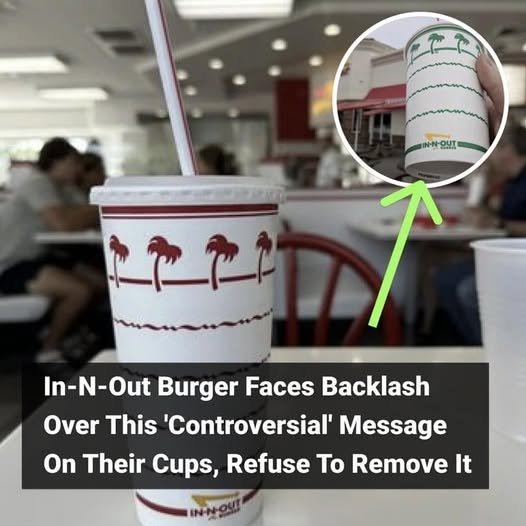
Fast-food chains are known for their quirks, branding tricks, and carefully curated identities. Some hide clever symbols inside their logos. Others create cult followings around secret menu items or limited-time offerings. But one of the most talked-about — and enduring — traditions in American fast food isn’t flashy at all. It’s four tiny Bible verses, discreetly printed on cups, wrappers, and packaging at In-N-Out Burger.
For decades, customers have noticed the scripture references while sipping soda or unwrapping a Double-Double. And while the practice has sparked curiosity, debate, and even controversy over the years, In-N-Out leadership says the reason behind it has never changed.

According to CEO Lynsi Snyder, the verses are not a marketing stunt or a recent cultural statement. They are a deeply personal family tradition rooted in the company’s history.
In-N-Out has remained family-owned since it was founded in 1948, a rarity in modern fast food. Snyder, the granddaughter of the company’s founders, has repeatedly emphasized that maintaining the brand’s original values matters just as much as protecting food quality and customer service. That mindset extends beyond burgers and fries — it includes honoring the faith that shaped the family behind the business.

The idea to print Bible verses on packaging began in 1987, when Rich Snyder, Lynsi’s uncle and then-president of the company, quietly introduced the practice. For him, faith wasn’t something to advertise loudly, but something to live by consistently. Adding scripture references was his way of acknowledging that belief without forcing it on customers.
After Rich Snyder’s death, the tradition continued. Lynsi Snyder has said preserving the verses is a way to honor both his memory and the spiritual foundation laid by earlier generations. Rather than reinvent the company, she has focused on protecting what made it successful in the first place — high standards, simplicity, and staying true to core principles.

“My grandparents set the bar high,” Snyder has explained in past interviews, noting that her responsibility is to build on that foundation without lowering expectations. She has also made clear that In-N-Out’s standards — whether ethical or operational — are non-negotiable.
For those curious about the specific verses, each item points to a different passage. Soda cups reference John 3:16, one of the most widely recognized verses in Christianity, centered on God’s love and salvation. Milkshake cups display Proverbs 3:5, a passage about trusting God rather than relying solely on human understanding.
Burger wrappers carry Revelation 3:20, a verse about invitation and fellowship, while the iconic Double-Double packaging includes Nahum 1:7, which speaks to strength and refuge during difficult times. Over the years, additional verses such as Proverbs 24:16 and Luke 6:35 have also appeared.

Importantly, the verses are printed as references only — not full quotations — making them easy to overlook for customers who aren’t looking for them. In-N-Out has never required acknowledgment or agreement from its patrons, and the company serves millions of people from all backgrounds without distinction.
In an era when brands are often pressured to take loud political or cultural stances, In-N-Out’s approach stands out for its quiet consistency. The verses aren’t new, reactionary, or promotional. They’re simply part of the company’s DNA — a reminder that for one of America’s most beloved burger chains, faith and family still matter just as much as fresh ingredients and made-to-order meals.
Website Disclaimer
The information provided on this website is for general informational and educational purposes only. While we strive to ensure that all content is accurate and up to date, we make no guarantees regarding the completeness, reliability, or accuracy of any information published.
The views and opinions expressed in articles belong to their respective authors and do not necessarily reflect the views of this website. Any action you take based on the information found on this website is strictly at your own risk. We will not be liable for any losses, damages, or inconveniences arising from the use of our content.
Some articles may contain opinions, third-party information, or external links. We do not endorse or guarantee the accuracy of content on external websites and are not responsible for their practices or policies.
All content on this website is provided in good faith and is intended for informational purposes only. Readers are encouraged to verify information independently and seek professional advice where appropriate.