I was sixteen the first winter I slept behind Miller’s Feed & Seed, wrapped in a horse blanket that smelled like hay, diesel, and old rain.
The town of Briar Glen, Kentucky, had three churches, two stoplights, one diner, and a thousand opinions about everybody’s business. People knew I was homeless before I admitted it to myself. They saw me washing up in the gas station bathroom before school. They saw me eating crackers from the discount shelf and pretending I wasn’t hungry. They saw my backpack stuffed so full it looked like I was running away every morning, which, in a way, I was.
My name was Caleb Walker, and by then I had learned that pity was just another kind of weather. It came, it soaked you, and then it moved on.
My mother had left when I was nine. My father drank himself mean and then drank himself gone. After he died, the house we rented went back to the landlord, our furniture went to the curb, and I went wherever the night would let me.
The only person who had ever made me feel like I belonged anywhere was my grandpa, Amos Walker.
Grandpa Amos had died three years earlier, but I still heard his voice when I was scared.
“Land remembers, Caleb,” he used to tell me, tapping his cane against the red Kentucky dirt. “People lie. Paper burns. But land remembers.”
He had owned land once—forty acres east of Briar Glen, past the old county road, where the hills dropped into a thick hollow nobody wanted. Folks called it Dead Man’s Bottom because nothing decent grew there. The soil was sour. The creek flooded. There were sinkholes, copperheads, briars taller than a man, and an abandoned stone well everyone claimed was bottomless.
When Grandpa lost that land to unpaid taxes, people said it was no loss.
“Worthless ground,” they called it.
But Grandpa never said that.
He called it “the last honest thing we got.”
The spring after my sixteenth birthday, Briar Glen posted a list of county tax auction properties on the courthouse bulletin board. I only stopped to read it because it was raining hard, and the courthouse porch had a roof.
Lot 17 caught my eye.
Forty acres. Walker Hollow. Minimum bid: $312.
I stood there with rain dripping from my sleeves and my heart punching my ribs.
Walker Hollow.
Grandpa’s land.
No one else seemed to care. A man in a John Deere cap laughed when he saw me staring.
“You thinking of buying that snake pit, boy?”
I said nothing.
“Better off buying a bucket of mud. At least you can carry that away.”
He walked off laughing, but I stayed.
I had $427 hidden in three places: $190 rolled inside a sock in my backpack, $86 taped under a loose board behind the feed store, and the rest in a coffee can buried near the baseball field fence. I had earned it unloading hay, washing dishes at Dot’s Diner, cleaning kennels, and fixing anything small enough for people to trust a kid with.
I knew a sixteen-year-old couldn’t just walk into a courthouse and buy land like a grown man. But I also knew the county clerk, Mrs. Lillian Price, had been my grandpa’s neighbor once. She had blue hair, sharp glasses, and a soft spot she tried hard to hide.
Two days before the auction, I waited until her lunch break and found her smoking behind the courthouse.
“Mrs. Price,” I said, “I need to buy Walker Hollow.”
She looked at me like I’d said I needed to buy the moon.
“Caleb, you need supper. Not forty acres of trouble.”
“I have the money.”
“That land is a mess.”
“It was my grandpa’s.”
Her face changed then. Not much, but enough.
She took one last drag, crushed the cigarette under her shoe, and said, “Come inside.”
That afternoon, she explained things I barely understood. Because I was underage, I couldn’t hold the deed outright without a guardian arrangement. But Grandpa had once signed papers naming Mrs. Price as a temporary trustee for me if anything ever happened to my father. No one had used those papers because no one had cared enough to look.
Mrs. Price looked.
Three days later, I stood in the county meeting room wearing my only clean shirt while farmers, land speculators, and bored old men bid on parcels.
When Lot 17 came up, the auctioneer barely lifted his voice.
“Forty acres, Walker Hollow. Minimum three hundred twelve dollars. Do I hear three twelve?”
Silence.
Someone coughed.
A man muttered, “Pay me three twelve and I still wouldn’t take it.”
I raised my hand.
The room turned.
The auctioneer blinked. “Three hundred twelve from Caleb Walker.”
Laughter rolled through the room.
My face burned, but I kept my hand up.
“Any advance?”
No one spoke.
“Going once. Going twice. Sold.”
Just like that, I bought forty acres no one wanted.
People laughed as I signed the papers.
But Mrs. Price didn’t laugh. She slid the deed copy toward me and placed one wrinkled hand over mine.
“Your grandfather always said that hollow had more under it than above it,” she whispered. “I never knew what he meant.”
Neither did I.
Not then.
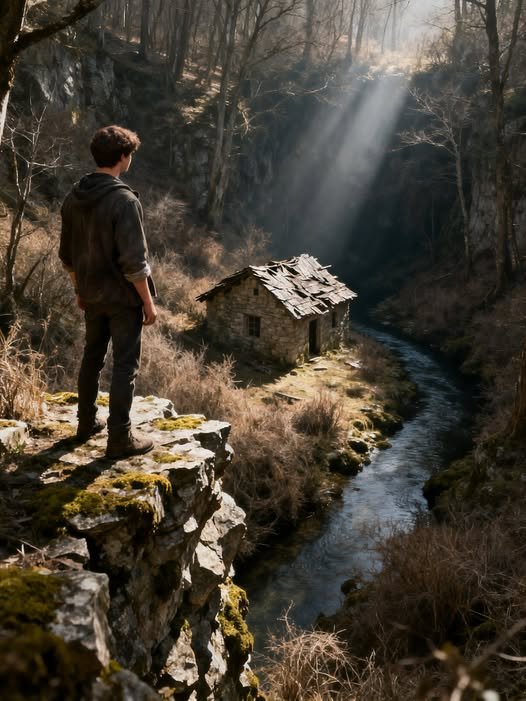
The first night I slept on my own land, I built a fire inside the stone shell of Grandpa’s old cabin. The roof had collapsed, the windows were gone, and poison ivy crawled up one wall like it owned the place. But the chimney still stood, blackened and stubborn.
I sat near the fire and listened to the hollow breathe.
At night, Walker Hollow was not quiet. Frogs screamed from the creek bed. Owls called from the ridge. Something heavy moved in the brush and snapped twigs like bones. The air smelled like wet leaves and iron.
I should have been afraid.
Instead, for the first time in years, I slept without wondering who would chase me away.
By summer, I had cleared enough brush to pitch a secondhand canvas tent near the cabin. I hauled water from a spring half a mile downhill. I bathed in the creek. I cooked beans in a dented pot and worked at Dot’s Diner until midnight. Every dollar I earned went into roofing tin, nails, canned food, or gasoline for the old chainsaw Mr. Harlan at the feed store let me borrow.
The town kept laughing.
At school, boys called me “Swamp King.” A girl named Madison asked if I was building a castle out of mud. Teachers looked at me with careful sadness, like I was a cracked plate they were afraid to touch.
Only one person my age didn’t treat me like a joke.
Her name was Grace Bell. She had dark curly hair, a quick mouth, and a father who ran the only towing service in town. Grace worked the diner register on weekends and slipped me extra biscuits when Dot wasn’t looking.
“You really living out there?” she asked one evening while wiping down the counter.
“Yeah.”
“Alone?”
“Mostly.”
“That place is cursed.”
“It’s taxed, not cursed.”
She laughed. “Same thing in Kentucky.”
I smiled because it was easier than admitting she was the first person in months who had made me feel human.
By August, I had patched half the cabin roof. By September, I had fixed the stone hearth. By October, I had built a door from salvaged barn boards.
Then the first warning came.
I found a dead crow nailed to my new door with a railroad spike.
Under it was a note written in black marker.
LEAVE WHAT’S BURIED ALONE.
I stood there in the cold morning, staring at the bird’s black wings spread against the wood. My first thought was that some boys from school had done it.
My second thought was that the railroad spike was old. Rusted deep. The kind that came from the abandoned spur line that used to run through Walker Hollow before I was born.
I took the crow down and buried it near the tree line.
I kept the note.
That night, I slept with Grandpa’s old hatchet beside my bedroll.
A week later, someone cut the rope on my food cache and scattered my canned goods down the slope. Two days after that, I came back from work and found muddy boot prints inside the cabin.
Nothing was stolen.
But something had been moved.
Grandpa’s old trunk.
I had found it under fallen rafters when I first cleared the cabin. It was mostly full of ruined clothes, moldy books, and yellowed newspapers. I had gone through it twice and found nothing useful except a photograph of Grandpa Amos standing beside a young woman I guessed was my grandmother.
But now the trunk sat at an angle, dragged six inches from the wall.
Someone had wanted inside it.
That night, I emptied it again by lantern light.
At the bottom, beneath a cracked leather Bible, I found a strip of cloth tucked into a split seam. It was oilcloth, folded tight and sealed with wax.
My hands shook as I opened it.
Inside was a small piece of paper, browned with age.
Grandpa’s handwriting.
When the black water runs backward, go below where the sun never reaches. Count thirteen from Mercy. Trust the stone that sounds hollow.
I read it ten times.
It made no sense.
Black water. Mercy. Hollow stone.
But the note proved one thing.
Grandpa had hidden something.
And someone else knew it.
The next morning, I skipped school and walked every foot of the creek.
Walker Creek wasn’t much in dry weather, just a dark ribbon sliding between mossy stones. But after rain it swelled fast, carrying leaves, mud, and sometimes dead branches big enough to knock a man down.
Black water runs backward.
At noon, I found a place where the creek disappeared under a limestone shelf and came out twenty yards lower. Near the shelf, the current swirled in a strange circle. In heavy flood, I guessed the water might push back on itself.
Above the shelf stood a stone marker half buried in vines.
It wasn’t a grave exactly. More like a carved block. The letters were worn, but I could still read one word.
MERCY
My mouth went dry.
Count thirteen from Mercy.
Thirteen what?
Steps? Stones? Trees?
I started with steps.
On the thirteenth step from the Mercy stone, I found nothing but weeds. Thirteen paces brought me to a cluster of rocks below the slope. Thirteen yards took me near the old well, which leaned in the earth like a black eye.
I spent three days digging, counting, measuring, and cursing.
Nothing.
On the fourth day, Grace came out to the hollow with a backpack full of sandwiches and a flashlight.
“You look terrible,” she said.
“I’m busy.”
“You always look terrible when you’re busy.”
“You shouldn’t be here.”
“Probably not.” She looked around at the briars and the sagging trees. “So this is your kingdom.”
“Don’t start.”
“I’m not. I brought ham and cheese.”
That was the thing about Grace. She could walk into the worst moment of your life and make it feel like lunch.
I showed her Grandpa’s note.
She read it twice, then looked toward the Mercy stone.
“What was Mercy?”
“I thought maybe a grave.”
“No date. No last name.” She crouched beside it. “Maybe not a person.”
“What else would it be?”
She brushed moss from the bottom of the stone. “A marker.”
“For what?”
She shined her flashlight over the ground. “My dad says there used to be a church out here. Way back. Before the county road moved. Maybe Mercy was the church name.”
I stared at her.
“What?”
“Mercy Chapel,” I said slowly.
Grace grinned. “Now you’re thinking.”
We searched the area until sunset. Beneath vines and leaves, we found old foundation stones arranged in a rectangle. The chapel had been small, maybe one room, with the Mercy stone near where the front steps would have been.
“Count thirteen from Mercy,” Grace said. “Maybe thirteen foundation stones.”
We started at the Mercy marker and counted along the old foundation.
At the thirteenth stone, nothing looked different.
But when I struck it with the hatchet handle, it made a low, empty sound.
Trust the stone that sounds hollow.
Grace and I looked at each other.
Then we started digging.
The stone was heavier than it looked. We worked for an hour, prying it loose with a rusted bar I had found near the cabin. Underneath was a square opening packed with clay.
At first, I thought we had found a cache.
Then my shovel broke through into empty air.
A cold breath rose from the hole.
Grace stepped back. “Caleb.”
I widened the opening with my hands until I could see stone steps descending into darkness.
Not a box.
Not a grave.
A tunnel.
“Grandpa,” I whispered, “what did you do?”
We didn’t go in that night. Grace made me promise. She said tunnels killed people, and she wasn’t wrong. Her father had pulled two men out of a collapsed storm drain in Elizabethtown once, and neither had survived.
But after she left, I sat by the opening until moonrise, staring down at that black throat in the earth.
Below where the sun never reaches.
My whole life, people had told me there was nothing under me. No family worth naming. No house worth keeping. No future worth betting on.
Now the earth itself had opened.
The next day, I borrowed rope from Mr. Harlan and bought batteries with money I should have saved for food. Grace showed up anyway, wearing boots and carrying her father’s old hard hat.
“I told you not to come,” I said.
“No, you didn’t. You just looked guilty when I left.”
“This could be dangerous.”
“Then it’s good I’m here. You do stupid things alone.”
We tied the rope to a sycamore tree and lowered ourselves into the hidden stairwell.
The air below smelled old, damp, and metallic. Our flashlights showed walls made of stacked limestone, slick with moisture. The steps went down farther than I expected—ten feet, twenty, then thirty. At the bottom, a narrow passage sloped into the hill.
Grace whispered, “This isn’t just a hiding place.”
No. It was built.
The passage opened into a chamber with a low ceiling held by hand-hewn beams. Rusted lantern hooks hung from the walls. Old shelves lined one side. Most were empty.
On the far wall, someone had carved a cross and three letters.
A.W.
Amos Walker.
My grandpa had been here.
In the center of the room sat a metal box about the size of a suitcase.
My knees nearly gave out.
The box was locked, but the lock had rusted badly. Two hits from the hatchet broke it.
Inside was not gold.
It was paper.
Stacks of papers wrapped in waxed cloth, tied with string. Deeds. Maps. Letters. Receipts. Old survey documents. A ledger with a cracked black cover.
Grace looked disappointed. I did too, for half a second.
Then I opened the ledger.
The first page read:
Record of deposits made into the Walker Hollow Relief Fund, 1931–1948.
Under that were names, dates, and amounts.
Some amounts were small. Five dollars. Twelve dollars. Thirty cents.
Others were large.
There were references to land transfers, mineral rights, coal leases, and bank certificates. The deeper I read, the less I understood, but I knew enough to see that Grandpa had not hidden junk.
He had hidden proof.
Grace picked up a brittle envelope.
“Caleb,” she said quietly.
Inside was a photograph of men standing near the Mercy Chapel. Black families, white families, children in patched clothes, women holding baskets. On the back, in faded ink, someone had written:
When the bank closed, Mercy kept us alive.
I sat on an overturned crate and read until my eyes burned.
During the Great Depression, Walker Hollow had been more than unwanted land. It had been a refuge. Families who lost farms came there. Mercy Chapel fed them. People pooled money, hid savings from predatory bankers, and recorded everything by hand. Grandpa’s father, Abram Walker, had been one of the keepers.
But the ledger didn’t end in the 1940s.
Grandpa Amos had added pages in the 1970s, 1980s, and 1990s. He had recorded names of local families, parcels of land, and mineral rights that had been quietly stolen through forged signatures, false tax notices, and courthouse tricks.
One name appeared again and again.
Harold Voss.
My stomach tightened.
Harold Voss owned Briar Glen Savings & Trust. He also owned the trailer park, two subdivisions, and half the empty storefronts downtown. He wore dark suits to church and smiled like a man posing for money.
He had foreclosed on my father.
He had taken Grandpa’s land for back taxes.
And now I knew why someone wanted me gone.
The treasure wasn’t coins.
It was evidence.
Still, there was more.
At the bottom of the metal box lay a smaller package wrapped in canvas. I unfolded it and found a brass key, a hand-drawn map of the tunnel system, and another note from Grandpa.
Caleb, if you found this, I am gone and they are still hungry. The papers are the shield, not the treasure. The treasure is deeper, where Abram sealed the old shaft. Do not go alone. Voss blood has circled this hollow for seventy years. Bring truth into daylight.
Grace read it over my shoulder.
“Old shaft,” she said.
I looked at the map.
Beyond the chamber, a passage led farther down to something marked with a black X.
Beside it, Grandpa had written one word.
Deep.
We should have left then.
We should have taken the papers straight to Mrs. Price or the sheriff or the state police.
But I was sixteen, angry, hungry, and tired of people laughing at me.
So we went deeper.
The passage narrowed after the chamber. Water dripped steadily from the ceiling. The support beams looked older there, some cracked, some bowed. We moved slowly, testing each step.
After fifty yards, the tunnel ended at a stone wall.
In the center was an iron plate with a keyhole.
The brass key fit.
When I turned it, something shifted inside the wall with a groan that sounded almost alive.
Grace grabbed my arm. “Caleb, no.”
But the stone door opened inward.
Behind it was a vertical shaft lined with old brick. Iron rungs descended into darkness. Cold air rose from below, carrying a smell like wet coins.
I shined my flashlight down.
The beam didn’t reach the bottom.
“No,” Grace said firmly. “Absolutely not.”
“We found it.”
“We found a hole that wants to kill us.”
“Grandpa said—”
“Grandpa said do not go alone. He did not say drag your only friend into a death pit.”
That stopped me.
My only friend.
I closed the stone door.
For once, I listened.
We carried the metal box back to the surface and hid it under the cabin floorboards. Grace made me promise again not to return to the shaft without help.
The next morning, Harold Voss came to Walker Hollow.
He arrived in a black Lincoln, which looked ridiculous bouncing down the rutted lane. Two men got out with him. One was broad and bald, wearing a leather jacket. The other had a gray mustache and sheriff’s deputy boots, though he wasn’t wearing a badge.
Voss stepped carefully around the mud, frowning at my cabin.
“Caleb Walker,” he said. “You’ve made quite a project out of this.”
I stood on the porch with the hatchet in my hand.
“This is private property.”
He smiled. “That is exactly what I came to discuss.”
“I’m not selling.”
“You haven’t heard my offer.”
“No.”
His smile thinned. “You’re a minor living illegally in a condemned structure on hazardous land. I could make one phone call and have child services remove you by supper.”
My grip tightened.
Voss looked past me toward the woods.
“Your grandfather was a stubborn man. It cost him. I’d hate to see you inherit that part of him.”
“What do you want?”
“To help you.” He took an envelope from inside his coat. “Five thousand dollars. Cashier’s check. Sign the transfer papers, leave this county, start fresh.”
Five thousand dollars.
To a hungry sixteen-year-old, it sounded like a fortune.
But Grandpa’s note burned in my mind.
They are still hungry.
“No.”
The bald man stepped forward.
Voss lifted one hand, stopping him.
“Think carefully, son. Land can be a burden.”
“So can guilt.”
For the first time, Voss’s face cracked.
“What did you say?”
“I said no.”
He stared at me for a long second, then slid the envelope back into his coat.
“You have no idea what’s under your feet.”
I looked him dead in the eye.
“I’m learning.”
That night, my cabin burned.
I was at the diner when it happened. Grace’s father, Earl Bell, saw the glow from County Road 9 and called it in. By the time I got there, half of Briar Glen’s volunteer fire department was already fighting the flames.
My patched roof collapsed in a shower of sparks.
Everything I owned was inside.
My blankets. My food. Grandpa’s trunk. The photograph. The floorboards.
The metal box.
I broke through the firefighters and ran toward the cabin, but Earl Bell caught me around the waist and dragged me back.
“It’s gone, Caleb!”
“No!”
I fought him until my throat tore from screaming.
Grace stood crying near the fire truck.
Harold Voss appeared out of the dark like he had been born from smoke.
“Terrible thing,” he said softly. “Old places go up fast.”
I lunged at him.
Earl held me back.
Voss didn’t flinch. He only leaned close enough for me to hear.
“Some things are safer buried.”
By dawn, the cabin was ash.
But the metal box was not gone.
I had moved it.
The night after Voss came, fear had made me smarter than pride. I had carried the papers to the chapel tunnel and hidden them in the first chamber behind loose stones. The fire destroyed my shelter, but not Grandpa’s proof.
When I told Grace, she hugged me so hard I couldn’t breathe.
Then she slapped my arm.
“That’s for not telling me.”
“Ow.”
“And that’s for being right.”
I almost laughed. Almost.
The fire changed everything.
People in town who had laughed at me now looked away. Some out of guilt. Some out of fear. Dot let me sleep in the storage room behind the diner for two nights. Mrs. Price called a legal aid attorney in Frankfort. Earl Bell brought me a sleeping bag, a tarp, and a twelve-gauge shotgun he said was “for coyotes,” though we both knew coyotes didn’t drive Lincolns.
But Voss had power.
The sheriff called the fire accidental.
The school counselor said my “living situation” required state intervention.
A man from child services showed up with forms.
And then Mrs. Price did something nobody expected.
She walked into the courthouse records room and found Grandpa’s old trustee document, then filed an emergency petition declaring herself my legal guardian until I turned eighteen.
When the judge asked why she would take responsibility for “a troubled boy living in a burned-out ruin,” Mrs. Price looked at him over her glasses and said, “Because somebody should have done it years ago.”
For the first time since my father died, an adult stood between me and the world.
But Voss wasn’t finished.
Two days after the guardianship hearing, he filed a claim challenging my ownership of Walker Hollow. He said the auction had been improper. He said the land had environmental hazards. He said I had failed to disclose “subsurface structures” that made the property unsafe.
That last part told us he knew about the tunnels.
Mrs. Price read the filing at her kitchen table while Grace, Earl, and I sat around her.
“He’s scared,” she said.
“He doesn’t look scared,” I muttered.
“Powerful men rarely do. That’s why they practice.”
Earl leaned back in his chair. “Question is, what’s down there that scares him this bad?”
Everyone looked at me.
The old shaft.
Deep.
We needed help, real help. Not county help. Not men who drank coffee with Voss every morning.
Grace found it.
Her cousin studied geology at the University of Kentucky. Through him, we reached Dr. Nathan Cole, a mining engineer who specialized in abandoned shafts. He was in his thirties, quiet, careful, and serious in a way that made me trust him immediately.
When Dr. Cole came to Walker Hollow, he didn’t laugh.
He studied the Mercy Chapel foundation, the tunnel entrance, the creek, the slope, and the burned cabin. Then he put on a hard hat and said, “This was not built by amateurs.”
Inside the tunnel, he tested the air and beams. He photographed everything. At the stone door, he paused.
“This shaft may connect to an old limestone operation,” he said. “Or something older.”
“Can we go down?”
He looked at me. “Not today.”
I hated that answer, but I was learning the difference between courage and stupidity.
Over the next week, Dr. Cole brought equipment, lights, harnesses, air meters, and two graduate students. Mrs. Price notified the state historical office. The legal aid attorney notified the Kentucky Attorney General’s office about the documents we had found.
Voss tried to get a court order blocking entry.
He failed.
On a cold November morning, we opened the stone door again.
This time, I wasn’t alone.
Dr. Cole went first, descending the iron rungs with a safety line. Then one of his students. Then me.
The shaft dropped nearly sixty feet. At the bottom was a dry chamber carved directly into limestone. The walls glittered faintly under our lights. Not gold—mineral veins, quartz, mica, and moisture.
In the center of the chamber sat a sealed steel drum, two wooden crates, and a stone slab carved with the initials A.W.
Abram Walker.
My great-grandfather.
Dr. Cole inspected the chamber before letting me move.
“No sign of collapse. No gas spike. You can step forward.”
My legs felt weak.
The first crate held jars.
Mason jars, each packed with coins.
Silver dollars. Half dollars. Old dimes. Some were black with tarnish, others bright where cloth had protected them. The second crate held more jars, plus small cloth bags heavy with something that clinked softly.
Gold coins.
Real gold.
I stopped breathing.
Dr. Cole whispered, “Good Lord.”
But the steel drum held the true treasure.
Inside were oilskin packets filled with bank certificates, land deeds, mineral rights contracts, and letters signed by some of the most important names in Briar Glen history.
Including Voss.
Not Harold Voss at first, but his grandfather, then his father, then Harold himself.
The documents showed a pattern that stretched across generations. The Voss family had used the bank to steal land from desperate families, especially those who had trusted Mercy Chapel to safeguard deeds and savings. They had forged notices, buried payments, altered ledgers, and forced tax sales. Grandpa Amos had spent half his life collecting proof.
At the bottom of the drum was one final envelope addressed to him.
For my grandson, when he has nothing but the truth.
Inside was a letter.
I read it underground, with my flashlight shaking in my hand.
Caleb,
If you are reading this, then the world has been unkind to you, and I am sorry I was not there to stand in its way. I hid money here, yes, and coins, and papers that wicked men would kill to keep buried. But listen to me: money is not the treasure.
The treasure is knowing you were never poor in the ways that mattered. You come from people who fed neighbors when they had nothing. You come from people who wrote the truth down when lies had lawyers. You come from people who protected one another beneath this hill when the world above forgot mercy.
Do not let anger turn you into the men who stole from us. Bring this into daylight. Give back what can be given back. Keep enough to stand tall. Build something honest.
Land remembers. Make it remember you kindly.
Grandpa Amos
I folded the letter and pressed it against my chest.
For years, I had wanted someone to tell me I mattered.
Grandpa had left the words underground, waiting.
The investigation began before Christmas.
State officials came first. Then federal ones. Then reporters from Louisville, Lexington, and finally Nashville. They parked news vans on the county road and called Walker Hollow “the Mercy Cache.”
Harold Voss called it fake.
Then forensic accountants confirmed the documents.
He called it planted.
Then handwriting experts linked records across seventy years.
He called it irrelevant.
Then families started coming forward.
The Bensons found proof their farm had been taken illegally in 1968. The Carters found mineral rights stolen from their grandmother. The Freeman family, whose land had become a Voss subdivision, found an original deed marked paid in full.
Briar Glen turned on Voss slowly, then all at once.
People who had feared him for decades suddenly remembered stories. A missing payment. A threatening letter. A foreclosure that never felt right. A signature that didn’t look like Daddy’s. A courthouse fire that destroyed only certain records.
Mrs. Price became a witness.
So did I.
At the first hearing, Voss sat across the courtroom in a navy suit, looking smaller than I remembered. His lawyers filled two tables. I had Mrs. Price on one side and Grace on the other.
When they called my name, my legs shook.
The lawyer asked how I had found the documents.
I told the truth.
He tried to make me sound like a reckless homeless kid chasing treasure.
“Yes, sir,” I said. “I was homeless.”
The courtroom went quiet.
“But I didn’t forge those papers. I didn’t burn my cabin. I didn’t steal farms from widows. I just bought land nobody wanted and listened to what my grandfather left behind.”
Grace squeezed my hand when I sat down.
The case took months.
During that time, the coins were secured, appraised, and placed under court supervision. Some were historically significant. Some were simply valuable. Together, they were worth more money than I could understand.
But the documents were worth more.
They cracked open Briar Glen’s past.
Harold Voss was indicted for fraud, arson conspiracy, witness intimidation, and obstruction. The bald man who had come to my property took a plea deal and admitted he set the fire. The former deputy with the gray mustache admitted Voss had paid him to watch Walker Hollow and scare me off.
The day they arrested Harold Voss, he looked straight at me as they led him down the courthouse steps.
“You think this makes you somebody?” he spat.
I thought about Grandpa’s letter.
“No,” I said. “It proves I already was.”
By the time I turned seventeen, Walker Hollow was no longer a joke.
It became protected historical land. The Mercy Chapel foundation was excavated and preserved. The tunnel was reinforced. The deep chamber was sealed behind a museum-grade door. Families came to see the place where their grandparents had hidden hope in jars and ledgers.
The court awarded me legal ownership of the land and a portion of the recovered treasure that had clearly belonged to the Walker family. The rest went into restitution, historical preservation, and claims from families whose property had been stolen.
I didn’t become rich the way people imagined.
I became responsible.
That was heavier.
With Mrs. Price’s help, I placed most of my share in trust. I rebuilt the cabin, this time with a real roof, real wiring, and a porch that faced the creek. Earl Bell taught me how to frame walls. Grace painted the front door blue because she said every haunted hollow needed one cheerful thing.
Dot cried when I paid her back for every free meal she had slipped me.
Mr. Harlan refused money for the chainsaw but accepted a new one anonymously, even though he knew exactly who left it.
At school, people stopped calling me Swamp King.
That almost disappointed me.
Grace still called me that when I got too serious.
“Don’t forget your crown,” she’d say, tossing me my muddy ball cap.
In the summer, before senior year, we held the first Mercy Day at Walker Hollow. Families brought quilts, fried chicken, cornbread, lemonade, and stories. Old women cried over names in the ledger. Men stood quiet near the chapel stones, hats in their hands.
Mrs. Price read Grandpa’s letter aloud.
When she reached the line, “Build something honest,” her voice broke.
That was when I knew what I wanted Walker Hollow to become.
Not a tourist trap. Not a monument to stolen money.
A refuge.
By the time I graduated high school, plans were already drawn for Mercy House: a small shelter and work program for teenagers with nowhere to go. Not charity with cameras. Not pity. A place with beds, meals, counseling, job training, and adults who actually stayed.
The first building went up near the old cabin.
I hammered the first nail myself.
Grace went to community college nearby and kept helping on weekends. She never admitted we were dating until I asked her to the county fair and she said, “Took you long enough, Swamp King.”
Mrs. Price lived long enough to see Mercy House open.
On opening day, she arrived in a lavender dress and pearls, leaning on a cane, looking like a queen disguised as a county clerk. The first three boys moved in that week. One was seventeen and angry at the world. One was fifteen and barely spoke. One had slept in a laundromat for two months and hid food under his mattress because he didn’t believe meals would keep coming.
I understood all of them.
On the wall inside Mercy House, we hung a framed copy of Grandpa’s words:
Land remembers. Make it remember you kindly.
Years passed.
Harold Voss went to prison. His bank collapsed under lawsuits. Properties changed hands. Some land was returned. Some losses could only be acknowledged, not repaired. Briar Glen did what towns do after secrets come out—it denied, argued, grieved, and slowly changed.
Walker Hollow changed too.
The creek was cleared. Trails were built. The Mercy Chapel stones remained where they were, protected under a simple wooden roof. The tunnel entrance was secured, but once a year, on Mercy Day, guided tours went down to the first chamber.
I still went deeper alone sometimes, though never into danger. Just to the reinforced landing above the old shaft, where cool air rose from the dark and the earth hummed around me.
I would stand there and think about the boy I had been: hungry, furious, sleeping behind a feed store, believing the world had already made up its mind about him.
Then I would think about Grandpa Amos, hiding truth beneath worthless land because he believed one day somebody would need it.
Some people leave money.
Some leave wounds.
Grandpa left a map back to myself.
On the tenth anniversary of the auction, Briar Glen held a ceremony at the courthouse. They put up a small plaque about the Mercy Cache investigation and the families whose records had been restored. The mayor asked me to speak.
I stood on the same courthouse steps where people had laughed when I bought Walker Hollow for $312.
A crowd waited below.
Grace stood in front, holding our little daughter, Lily, who had my eyes and her mother’s curls. Earl Bell stood beside them, pretending not to cry. Dot was there. Mr. Harlan too. Teenagers from Mercy House filled the back rows, some bored, some proud, some trying not to look like either.
I had written a speech, but when I unfolded it, the words looked too neat.
So I put it away.
“When I was sixteen,” I said, “I thought land meant a place nobody could kick me out of.”
The crowd went still.
“I was wrong. Land is more than dirt. It’s memory. It’s proof. It’s responsibility. My grandfather knew that. The people of Mercy Chapel knew that. They protected one another when banks failed, when farms were stolen, when hunger came up the road. They hid money, yes. They hid documents. But mostly, they hid faith in the future.”
I looked toward the ridge east of town, where Walker Hollow lay beyond the trees.
“People called those forty acres worthless. They were wrong. But not because of the coins. Not because of the headlines. They were wrong because no place is worthless if truth is buried there and someone is willing to dig.”
After the ceremony, Mrs. Price’s niece handed me an envelope. Mrs. Price had passed the year before, and the envelope had been left with instructions to give it to me on that day.
Inside was a note in her sharp handwriting.
Caleb,
I knew your grandfather better than most. He was stubborn, impossible, and usually right. When you came to me asking to buy that hollow, I nearly said no because I was afraid for you. I am glad I did not let fear make the decision.
Remember this: the world will often laugh before it understands. Let it laugh. Then build anyway.
—Lillian Price
I folded the note and smiled.
That evening, I drove back to Walker Hollow with Grace and Lily. The sun was low, turning the creek gold. Mercy House glowed with warm lights. Boys played basketball near the gravel drive. Someone had burned dinner in the kitchen, and the smell drifted across the yard.
Home.
That word still surprised me sometimes.
I walked alone to the Mercy Chapel stones as dusk settled. The old marker stood where Grace and I had first brushed away the moss.
MERCY
I knelt and placed my hand on the stone.
For a long time, I said nothing.
Then I whispered, “I did what you asked, Grandpa.”
The hollow answered in its own way.
Frogs called from the creek. Wind moved through the sycamores. Somewhere deep below, water dripped through limestone into darkness.
People used to say Walker Hollow was dead.
They were wrong about that too.
It had been waiting.
Waiting for a hungry boy with nowhere else to go.
Waiting for a secret to come back into daylight.
Waiting for mercy to have a home again.
THE END
Website Disclaimer
The information provided on this website is for general informational and educational purposes only. While we strive to ensure that all content is accurate and up to date, we make no guarantees regarding the completeness, reliability, or accuracy of any information published.
The views and opinions expressed in articles belong to their respective authors and do not necessarily reflect the views of this website. Any action you take based on the information found on this website is strictly at your own risk. We will not be liable for any losses, damages, or inconveniences arising from the use of our content.
Some articles may contain opinions, third-party information, or external links. We do not endorse or guarantee the accuracy of content on external websites and are not responsible for their practices or policies.
All content on this website is provided in good faith and is intended for informational purposes only. Readers are encouraged to verify information independently and seek professional advice where appropriate.