“Grant submitted an expansion financing memorandum naming Vanessa’s firm as an essential strategic partner. Her fees increased twice after their personal relationship began.”
Mara felt no surprise.
Only a colder version of pain.
“There’s more,” Rachel continued. “His projections claim community clinics can absorb displaced patients during construction. They cannot. If the board approves his plan, three low-income neighborhoods could lose practical access to urgent care for more than a year.”
Mara sat straighter.
“I work with those clinics.”
“I know.”
“Grant knows where I work.”
“Apparently he never considered your work important enough to ask what it involved.”
Mara stared at the rain running down the window.
Grant’s betrayal had injured her.
The expansion plan made her angry.
“Open a formal review,” she said.
“Do you want the project suspended?”
“No. Preserve every record. Freeze new consultant payments and require an independent patient-impact assessment.”
“And your identity?”
“Keep it confidential until the board meeting.”
Rachel was silent for a moment.
“The final approval meeting is tomorrow morning.”
“Then move it to Ellison Tower.”
“Grant will think he is being invited because they are impressed with him.”
“I know.”
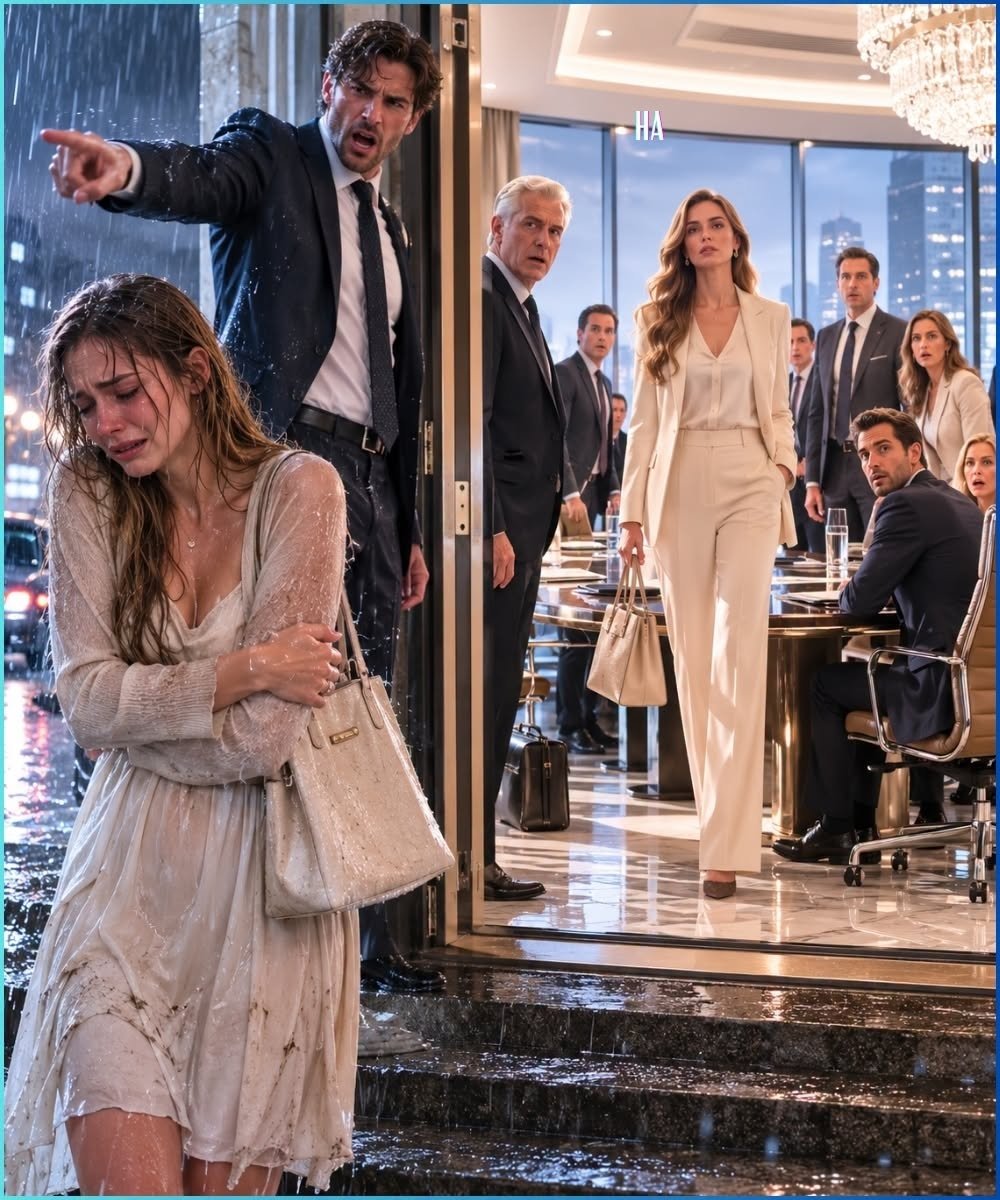
At the gala across the street, Grant stood near the ballroom bar while Vanessa replayed the cropped video on her phone.
She had removed the moment he pushed Mara.
The clip began with Mara on the pavement and ended with Grant walking away.
Vanessa added a caption.
Some people will do anything for attention when they realize they have lost.
Evelyn approved.
“Post it,” she said. “If Mara tries to accuse Grant of anything, people will already know she is unstable.”
Grant stared at the image of his wife sitting in the rain.
For one uncomfortable second, guilt pressed against his chest.
Vanessa touched his sleeve.
“You protected yourself.”
“She shouldn’t have brought the suitcase through the main entrance.”
“Exactly.”
“She threatened me with an attorney.”
Vanessa smiled. “People with nothing love making legal threats.”
Grant’s phone chimed.
An email from Broadmoor’s executive office appeared on the screen.
The expansion approval meeting had been moved to the forty-seventh-floor boardroom at Ellison Tower. Attendance was mandatory.
Vanessa’s eyes widened.
“Ellison Tower?”
Evelyn leaned closer.
“That is very good, Grant. They don’t move ordinary meetings there.”
Grant reread the message.
His guilt vanished beneath a surge of excitement.
He believed the most powerful people in the project had finally noticed him.
He did not know his wife had signed her full legal name at the bottom of the meeting authorization.
Mara Bennett Ellison Hale.
Sole voting heir of Ellison Meridian Trust.
Part 2
The next morning, Grant entered Ellison Tower carrying divorce papers in one hand and a presentation folder in the other.
Vanessa walked beside him in a fitted gray suit. She had spent the drive rehearsing how he should describe the community clinic closures.
“Never say closure,” she reminded him. “Say temporary patient redistribution.”
“Right.”
“And don’t mention Mara unless they ask.”
Grant tightened his jaw. “Why would they ask?”
“Thomas Keene left the gala with her.”
“He probably felt sorry for her.”
Vanessa glanced at him. “Senior trustees don’t personally escort random employees to private medical wings because they feel sorry for them.”
Grant stopped near the security desk.
“What are you suggesting?”
“I’m suggesting your wife may have been hiding something.”
Evelyn, who had insisted on accompanying them, gave a dismissive laugh.
“Mara’s idea of a secret is buying store-brand cereal and putting it in an expensive container.”
Grant wanted to believe his mother.
Yet the hospital had refused to tell him whether Mara had been admitted. His calls had gone to voicemail. At six that morning, an attorney named Rachel Bennett had sent formal notice instructing him to make no direct contact.
He had searched Rachel’s name.
She was not a neighborhood divorce attorney.
She represented private foundations, family offices and multinational trusts.
The elevator doors opened.
A security officer checked the meeting list.
“Mr. Hale and Ms. Cross may proceed,” he said.
Evelyn stepped forward.
“I’m Grant’s mother.”
“You are not listed.”
“I advise him.”
“Not in an official capacity.”
Evelyn looked at Grant, expecting him to object.
Grant avoided her eyes.
“Wait in the lounge, Mom. We won’t be long.”
The boardroom occupied the entire east side of the forty-seventh floor.
Broadmoor executives sat along one side of a long walnut table. Independent auditors and legal counsel occupied the other. Thomas Keene stood near the windows, speaking quietly with Daniel Wren, chief governance officer for Ellison Meridian’s healthcare division.
At the head of the table was an empty chair.
Grant recognized several people who had ignored his emails for months.
He straightened his tie.
This was the room he had wanted.
But no one congratulated him when he entered.
Vanessa noticed the external compliance attorneys first.
Her face tightened.
“Why are auditors here?” she whispered.
Before Grant could answer, Rachel Bennett rose.
“Please take your assigned seats.”
Grant remained standing.
“I was told this was the final approval meeting.”
“It is now a preliminary governance review.”
“A review of what?”
Rachel opened a folder.
“Potential conflicts of interest, unsupported financial assumptions, patient-access risks, misuse of company resources and conduct likely to expose Broadmoor Health to reputational and legal harm.”
Vanessa’s voice sharpened. “My firm was not notified of any allegations.”
“You were instructed last night to preserve all communications related to the expansion project.”
“By whom?”
The boardroom door opened.
Every conversation stopped.
Thomas Keene stood first.
Then Daniel Wren.
One by one, the Broadmoor executives rose from their chairs.
Mara walked into the room wearing a dark navy suit.
Her hair was pulled back. A faint bruise remained near her wrist. The gold pendant rested openly against her collarbone.
Grant stared at her.
“What are you doing here?”
Mara did not answer.
Rachel addressed the room.
“For the record, this review is proceeding under the authority of Mara Bennett Ellison Hale, sole voting heir and newly appointed chair of the Ellison Meridian Healthcare Council.”
Grant’s face emptied.
Vanessa gripped the edge of her chair.
“No,” Grant whispered.
Daniel Wren remained standing until Mara reached the empty chair at the head of the table.
She sat.
Only then did everyone else sit.
Grant did not move.
His mind fought against the evidence in front of him.
Mara’s old car.
Her clearance-rack dresses.
The apartment where they had lived for six years.
Her lunch containers stacked beside his expensive meal-delivery boxes.
Her job at the clinic.
The woman in front of him could not be the quiet wife he had thrown into the rain.
“Mara,” he said. “What is this?”
“The meeting you wanted.”
“You’re an Ellison?”
“Yes.”
“Ellison Meridian?”
“Yes.”
Grant looked toward the windows, as though the name on the tower might rearrange itself into something less devastating.
“You own this building?”
“The trust owns it.”
“And the trust belongs to you?”
“I hold its controlling vote.”
Vanessa slowly removed her hand from Grant’s arm.
He saw the movement.
“Why didn’t you tell me?” he demanded.
Mara’s expression did not change.
Rachel stepped forward. “Mrs. Hale’s private family structure is not relevant to this review.”
“It is relevant to me. She is my wife.”
Mara finally met his eyes.
“Last night, I was a charity case with borrowed shoes.”
Grant flinched.
“I didn’t understand what was happening.”
“You understood that I was your wife.”
Silence spread through the boardroom.
Mara’s voice remained soft.
“You understood that I had stood beside you for six years. You understood that I worked double shifts when you were studying for certification exams. You understood that I used my savings to cover rent after you lost your first job.”
“Mara—”
“You understood that I loved you.”
He looked down.
“The amount of money behind my name should not have determined whether you pushed me into the street.”
No one moved.
Grant had prepared excuses for anger, embarrassment and marital conflict.
He had no answer for the truth stated so plainly.
Rachel touched a remote.
The large screen at the end of the room lit up.
Vanessa’s edited video appeared first.
Mara was shown on the pavement, Grant towering over her. The shove was missing.
Then the screen changed to the hotel’s exterior security footage.
There was no dramatic music.
No commentary.
Only Grant grabbing for the pendant, Mara turning away and his hand driving into her shoulder.
Her suitcase fell.
Then she did.
Vanessa stood. “That footage is being taken out of context.”
Thomas Keene looked at her. “It is a continuous recording.”
“She provoked him.”
“With what?” Rachel asked.
Vanessa opened her mouth.
Nothing came out.
Rachel displayed the audio transcript.
Grant’s words filled the screen.
You have no money, no family, and no place in my future.
The next line came from Vanessa.
A charity case in borrowed shoes.
Then Evelyn’s voice.
Some women need to be shown where they belong.
Grant sat down slowly.
Rachel placed three preservation notices on the table.
“One for Mr. Hale, one for Ms. Cross and one for Evelyn Hale. All messages, emails, financial records, photographs and social media communications between you are now subject to preservation.”
Vanessa turned toward Grant.
“You said she had nothing.”
Grant’s shame became anger because anger was easier to carry.
“She lied to me.”
Mara shook her head.
“I protected information you never cared enough to ask about.”
“You let me believe you were poor.”
“I let you believe I was ordinary.”
“That’s the same thing.”
Several people at the table looked away.
Mara’s eyes filled, but her voice did not break.
“No, Grant. To you, it became the same thing.”
Daniel Wren began presenting the expansion review.
Grant’s memorandum projected millions in donor commitments that had never been confirmed. It underestimated transportation costs and overstated the capacity of neighborhood clinics. It also recommended a consulting contract extension for Vanessa’s company without disclosing their romantic relationship.
A compliance attorney placed enlarged copies of text messages on the screen.
Vanessa: Once I’m officially running the strategy, we won’t need your little clinic wife at events.
Grant: She’ll be gone after the gala.
Vanessa: Make sure she signs before the board meets.
Grant: She has nowhere else to go.
Vanessa looked sick.
“Those are private messages.”
“They concern a company contract and an employee involved in its approval,” the compliance attorney said.
Grant leaned toward Mara.
“You went through my phone?”
“No.”
“Then how did you get those?”
“Broadmoor’s compliance system archived communications sent through your company account.”
Grant closed his eyes.
Vanessa had repeatedly warned him not to use his work phone.
He had been too confident to listen.
Daniel moved to the next document.
Vanessa’s proposed fee had risen from $180,000 to $640,000 in nine months. One revision had been submitted the morning after Grant spent a weekend with her at a resort in Charleston.
Vanessa’s consulting partners began whispering to their attorney.
“This was Grant’s recommendation,” she said quickly. “I didn’t approve my own contract.”
Grant turned toward her. “You wrote the scope.”
“Because you asked me to.”
“You said the board had already agreed.”
“I said they were receptive.”
“You said—”
Mara raised one hand.
They stopped.
“This review is not a stage for the two of you to decide which person carries more blame,” she said. “The documents will answer that.”
Grant looked at her as though he had never heard her speak with authority.
For years, he had mistaken patience for passivity.
Now he saw the difference.
The board’s acting chair announced the immediate measures.
Grant’s access to expansion files was suspended.
His promotion consideration was terminated.
Vanessa’s consulting contract was frozen pending an independent investigation.
The expansion vote was postponed until patient-access protections could be added.
No one shouted.
No one threatened to ruin anyone.
That made the consequences feel more permanent.
When the meeting adjourned, Grant approached Mara near the windows.
Rachel remained close.
“You planned this,” Grant said.
“I planned a governance review after learning your proposal could hurt thousands of patients.”
“You brought me here to humiliate me.”
“You brought yourself here.”
His face twisted.
“You could have told me who you were years ago.”
“I almost did.”
“When?”
“The night you passed your first certification exam. You came home with grocery-store flowers and told me that even if you never became rich, you would be proud as long as you became a good man.”
Grant remembered.
They had eaten pizza on the floor because their table had not yet arrived. Mara had cried when he gave her the flowers.
“I was going to tell you that night,” she continued. “Then I decided I wanted one more evening when I knew your happiness was real.”
“It was real.”
“I know.”
“Then why didn’t you tell me later?”
“Because each year, you became more interested in what people could do for you. I kept waiting for the man with the grocery-store flowers to come back.”
Grant looked at her bruise.
“I made a mistake.”
“No. You made hundreds of choices. Last night was simply the first one captured clearly enough that you could no longer rewrite it.”
Evelyn appeared in the doorway.
She had ignored the instruction to remain in the lounge.
“Mara, whatever disagreement exists between you and my son should stay within the family.”
Rachel stepped forward. “Mrs. Hale, you are subject to a preservation notice.”
“I’m speaking to my daughter-in-law.”
“You called me dead weight,” Mara said.
Evelyn swallowed.
“I wanted Grant to succeed.”
“You wanted him to become someone other people envied.”
“A mother protects her son.”
“You watched your son push his wife into the street and helped another woman edit the truth.”
Evelyn’s voice dropped.
“It was one bad night.”
“No,” Mara replied. “It was six years of small cruelties finally becoming large enough for strangers to see.”
For the first time since Mara had met her, Evelyn had nothing to say.
Mara walked toward the elevators.
Grant followed.
“Please,” he said.
She stopped, but she did not turn around.
“I don’t care about the trust,” he said.
“You cared about it the moment you learned it existed.”
“That’s not fair.”
Mara faced him.
“Last night, you offered me the money in our checking account as though it were charity. This morning, you discovered my family controls assets worth more than a trillion dollars. You have not asked whether my knee hurts. You have not apologized for reaching toward the pendant my grandmother gave me. You have not asked what your plan would have done to the clinics.”
Grant’s mouth opened.
Then closed.
“You care about the trust,” she said. “You just wish you had discovered it before showing me who you had become.”
The elevator doors opened.
Mara entered with Rachel.
Grant stood outside.
As the doors began closing, he whispered, “Do you still love me?”
Pain crossed Mara’s face.
“That is what makes leaving so difficult.”
Then the doors closed between them.
Part 3
By noon, Vanessa’s video had disappeared from social media.
Deleting it changed nothing.
Rachel’s office had preserved the original upload, its timestamp, the edited footage and every comment Vanessa had encouraged people to make about Mara.
The hotel provided exterior camera recordings. Three valets gave statements. Thomas Keene confirmed what he had witnessed. Broadmoor security delivered the incident report to the police.
Grant’s version of the story collapsed before he could finish inventing it.
He returned to the apartment alone that evening.
Mara’s mug remained beside the coffee machine. Her clinic badge lay on the entry table. A container of soup she had prepared for him two nights earlier sat untouched in the refrigerator.
On the bedroom dresser, their anniversary photograph was facedown.
Grant had turned it over before the gala because Vanessa said sentimental objects made people weak during separation.
He lifted the frame.
In the picture, Mara stood beside him at a county fair, laughing because he had failed to win her a stuffed bear. His arm was wrapped around her waist. His shirt had cost twelve dollars. Her dress came from a thrift store.
They had looked happy.
Not impressive.
Not powerful.
Happy.
Grant sat on the edge of the bed.
He remembered the evenings Mara proofread his reports without taking credit. He remembered how she could look at a spreadsheet for thirty seconds and find the mistake his entire team had missed.
He had never wondered why.
He had simply accepted her intelligence when it helped him and dismissed it when it threatened him.
A courier arrived at seven.
Inside the envelope was a formal separation notice, a request to preserve marital financial records and a copy of the prenuptial agreement Grant had signed before the wedding.
At the time, he had joked about it.
“What are you protecting?” he had asked Mara. “Your twelve-year-old car?”
She had smiled sadly.
“My family requires it.”
Grant assumed her relatives were embarrassed about debt.
He signed without reading more than the first page.
Now an attorney explained the document to him over the phone.
All inherited assets, trust interests, voting rights, family-controlled properties and investment income remained Mara’s separate property.
Grant had no claim to the Ellison Meridian Trust.
No claim to Ellison Tower.
No claim to the family residences, private companies or investment accounts.
The apartment where they lived was rented in both names. The old sedan was Mara’s. Their joint savings totaled less than Grant had spent entertaining Vanessa during the previous year.
“There has to be a way to challenge it,” Grant said.
“On what grounds?” his attorney asked.
“She concealed the value of her assets.”
“The agreement identifies inherited trust interests.”
“It doesn’t give a number.”
“It did not need to.”
“I didn’t understand what I was signing.”
“You had independent counsel available and declined it in writing.”
Grant pressed his fingers against his forehead.
“What happens if I challenge it?”
“Every financial decision during the marriage becomes relevant. So does the affair, the pressure to sign divorce papers and the incident outside the gala.”
The attorney paused.
“My professional advice is that you cooperate.”
Grant stared at Mara’s empty side of the closet.
For the first time, he understood that she had not trapped him.
She had given him every opportunity to behave decently while believing she had no power.
He had failed when he thought failure carried no cost.
The Broadmoor investigation lasted seven weeks.
It confirmed that Grant had violated conflict-of-interest policies, misrepresented projected donor commitments and attempted to direct a major contract toward a consultant with whom he had an undisclosed relationship.
He resigned before the board completed termination proceedings.
Vanessa’s firm dismissed her after internal investigators found she had used confidential information to manipulate the project’s selection process. Her professional license was not taken away, but her reputation in healthcare consulting collapsed.
She called Grant once.
“You told me she was nobody,” Vanessa said.
“I thought she was.”
“That is not a defense.”
“You wanted me to leave her.”
“I wanted the version of your life you promised me.”
Grant laughed bitterly. “At least you’re honest now.”
“I was always honest about what I wanted. You were the one pretending ambition was love.”
She hung up.
Evelyn tried a different approach.
She wrote Mara a four-page letter describing a mother’s fear of watching her son struggle. She mentioned her own difficult childhood, Grant’s sacrifices and the pressure he had faced in competitive corporate environments.
She apologized for “any misunderstanding that caused pain.”
Mara read the letter in Rachel’s office.
“She never says what she did,” Rachel observed.
“She is sorry there were consequences,” Mara replied. “That is not the same as being sorry.”
Mara folded the letter and returned it to the envelope.
She did not arrange a private meeting.
She did not accept Evelyn’s invitation to discuss matters “woman to woman.”
All communication continued through attorneys.
Grant eventually pleaded no contest to a misdemeanor assault charge. He received probation, community service and mandatory behavioral counseling.
Mara did not ask prosecutors for special treatment in either direction.
She gave a statement, provided evidence and allowed the legal process to continue.
“I don’t want revenge,” she told Rachel. “I want the record to tell the truth when memory becomes convenient.”
The divorce moved slowly.
There were financial disclosures, mediation sessions and formal hearings. Grant repeatedly requested a private conversation with Mara.
She refused until the final mediation.
They sat across from each other in a quiet conference room.
Grant looked older than he had two months earlier. His expensive suits were gone. He wore a plain blue shirt, and for the first time in years, there was no watch on his wrist.
Mara placed the signed settlement agreement on the table.
He studied her name.
Mara Bennett Ellison.
She had already removed Hale.
“I’m attending counseling,” he said.
“I know.”
“I started before the court required it.”
Mara nodded.
“I moved away from my mother.”
“That is probably healthy.”
“I’m not asking you to come back.”
She waited.
“I know I don’t deserve that,” he continued. “But I need to understand something. Did any part of our marriage matter to you?”
Mara’s eyes softened.
“All of it mattered to me.”
“Even the end?”
“The end taught me that loving someone does not require me to remain where I am being diminished.”
Grant looked down at his hands.
“I keep thinking about the night you almost told me.”
“The flowers?”
“Yes.”
“I still remember them.”
“They were terrible flowers.”
“They were beautiful.”
He smiled faintly, then the smile disappeared.
“I became everything I used to hate.”
“You can decide whether you remain that person.”
“Will you ever forgive me?”
Mara took a slow breath.
“I hope one day I can remember you without anger. But forgiveness is not the same as restored access.”
He nodded as tears gathered in his eyes.
“I understand.”
“No,” she said gently. “You are beginning to.”
Mara signed the final page.
Grant signed beneath her.
There was no dramatic reconciliation.
No last-minute embrace.
No promise that love would overcome what cruelty had destroyed.
They left through separate doors.
Six months later, Broadmoor Health opened the Ellison Patient Advocacy and Safety Center in downtown Atlanta.
The center offered free support for patients facing medical debt, disability discrimination, domestic financial control and barriers to healthcare access. It included a legal clinic, temporary housing assistance and transportation grants for families displaced during hospital construction.
The revised expansion plan kept all three neighborhood clinics open.
Mara required the project to hire additional nurses, social workers and patient navigators before any construction began.
On opening day, reporters filled the lobby.
They expected Mara to discuss her inheritance.
Instead, she spoke about a woman named Gloria who had delayed cancer treatment because she did not understand an insurance denial. She spoke about a father who rode two buses with a sick child because the nearest urgent care center had closed. She spoke about people who were treated as invisible because they lacked money, titles or powerful last names.
“Too many systems decide a person’s importance before that person enters the room,” Mara said from the podium. “We built this center on a different principle. Dignity is not a reward for wealth. Safety is not a privilege. And no human being should have to prove they are powerful before someone believes they were harmed.”
The gold pendant rested against her white blouse.
This time, she did not hide it.
Thomas Keene stood near the front row. Rachel sat beside several community clinic directors. Nurses, volunteers and former patients filled the remaining seats.
After the ceremony, Mara walked through the new advocacy wing.
A young woman sat alone outside one of the counseling offices, holding a grocery bag filled with clothes. A fading bruise marked her cheek.
Mara stopped.
“Are you waiting for someone?”
The woman looked embarrassed.
“They said an advocate would help me. I don’t have insurance. I don’t have much money.”
“You don’t need either one.”
“My husband threw me out last night.”
Mara lowered herself into the chair beside her.
The movement caused a faint ache in the knee Grant had injured. Most days she barely noticed it. That morning, it reminded her why the building existed.
“What is your name?” Mara asked.
“Lily.”
“I’m Mara.”
“I know who you are.”
Mara smiled.
“Then you know the least important thing about me.”
Lily looked down at the grocery bag.
“He told me nobody would believe me.”
“I believe you.”
The young woman began crying.
Mara remained beside her until an advocate arrived. She did not offer grand promises or tell Lily that everything would become easy.
She simply made certain the woman did not have to walk into the next room alone.
Across town, Grant watched a recording of the opening ceremony from the small apartment he now rented.
He saw Mara standing beneath the Ellison name, surrounded by people who respected her.
For months, he had told himself he had lost a trillionaire wife.
Watching her sit beside Lily after the cameras had moved away, he finally understood the truth.
He had not lost Mara because she was secretly powerful.
He had lost her because he had needed to believe she was powerless.
He had taken the woman who loved him before he had status, wealth or influence and treated her kindness as evidence that she could be discarded safely.
The fortune had not destroyed their marriage.
It had merely exposed the poverty inside him.
Grant closed the video.
The next morning, he reported for community service at a nonprofit warehouse that supplied furniture to families leaving emergency shelters. No cameras followed him. No executives watched. Nobody cared what position he once held.
For the first time in years, he completed work that could not improve his image.
It was not redemption.
Redemption was not a single act, and it was not something Mara owed him for attempting.
It was only a beginning.
Mara left the advocacy center after sunset.
The street was still damp from an afternoon storm, and the city lights reflected across the pavement. For a moment, she remembered the gala, the suitcase in the gutter and Grant’s voice telling her she had no place in his future.
Rachel joined her at the entrance.
“Your driver is waiting.”
“I think I’ll walk for a while.”
“Alone?”
Mara looked at the busy sidewalk, the glowing clinic windows and the families entering a building that had once existed only as notes in the margin of an expansion proposal.
“I’m not alone.”
Rachel smiled and returned inside.
Mara stepped onto the sidewalk.
She was no longer hiding from her inheritance.
She was no longer waiting for someone to prove that her ordinary self deserved love.
And she no longer confused silence with peace.
The woman Grant had pushed into the rain had carried one cheap suitcase and a truth he was too arrogant to imagine.
The woman walking home carried no suitcase at all.
Her hands were free.
THE END
Website Disclaimer
The information provided on this website is for general informational and educational purposes only. While we strive to ensure that all content is accurate and up to date, we make no guarantees regarding the completeness, reliability, or accuracy of any information published.
The views and opinions expressed in articles belong to their respective authors and do not necessarily reflect the views of this website. Any action you take based on the information found on this website is strictly at your own risk. We will not be liable for any losses, damages, or inconveniences arising from the use of our content.
Some articles may contain opinions, third-party information, or external links. We do not endorse or guarantee the accuracy of content on external websites and are not responsible for their practices or policies.
All content on this website is provided in good faith and is intended for informational purposes only. Readers are encouraged to verify information independently and seek professional advice where appropriate.