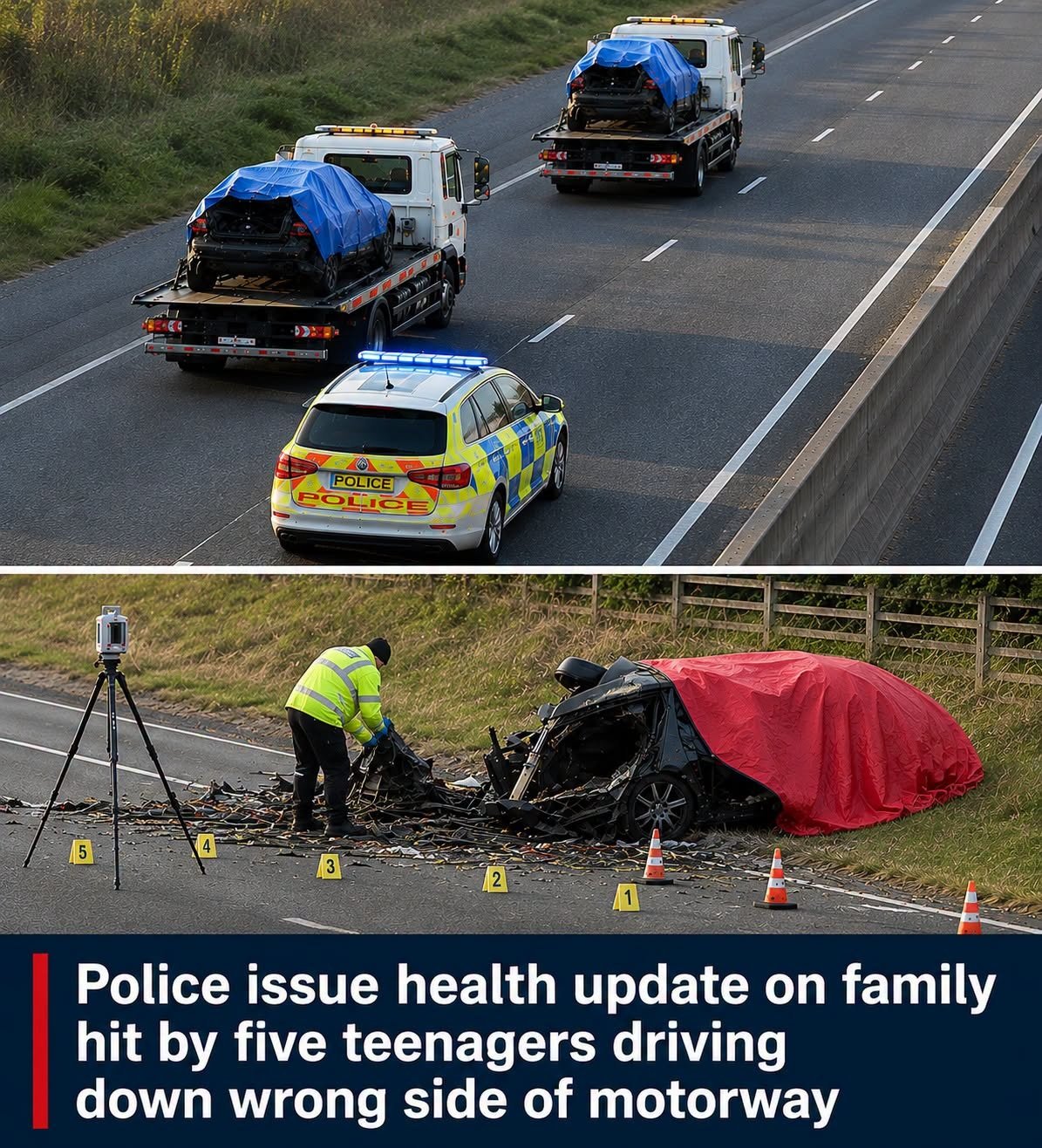
A devastating collision on Ireland’s M9 motorway has left five teenagers dead and four members of another family seriously injured. The crash happened at about 3 a.m. on Sunday, August 16, 2026, near Moone in County Kildare. Gardaí said one of the vehicles was travelling in the wrong direction on the motorway before the head-on collision. Five teenage boys who were inside that car died following the impact. In the other vehicle were three women and a seven-year-old boy, all of whom required hospital treatment for serious injuries.
The incident immediately became the subject of a major Garda investigation. The family in the second vehicle had been travelling toward Dublin Airport when the collision occurred. Later local reporting identified the injured people as sisters Alma Kinsella, Niamh Kinsella and Ella Hendricken, along with Alma’s seven-year-old son, Yemi. Reports in the days after the crash said Alma and Niamh were being treated at Tallaght University Hospital, while Ella was receiving treatment at St Vincent’s University Hospital.
Yemi was being cared for at Children’s Health Ireland at Crumlin. Local reporting on August 20 said that he had suffered serious leg injuries. Their recovery remained an immediate concern for relatives and the wider community. The five teenagers who died were subsequently named in news reports as Joe Carthy, Jack Kennedy, Alex McCarthy, Jeremy O’Brien and Kamil Pustkowski. They came from several communities, including Athy, Carlow and Limerick.
Their deaths created grief for parents, relatives, classmates and friends who were suddenly facing the loss of young people whose lives had ended abruptly. Funerals and memorial events began taking place during the days following the collision. Whatever questions investigators continue to examine about the circumstances before the crash, the deaths themselves have left five families dealing with permanent loss. That human reality remains separate from the legal and investigative questions surrounding what happened.
The collision also left another family dealing with an entirely different kind of aftermath. The three women and the child survived, but survival did not mean that their ordeal ended when emergency crews removed them from the scene. Serious injuries can require prolonged hospital care, repeated medical assessments and a gradual recovery process. In this case, public reports have continued to describe the four family members as receiving treatment days after the collision. Their future medical progress belongs primarily to them and their doctors, and it would be inappropriate to predict specific outcomes that have not been publicly established. What is known is that their injuries were significant enough to require continued hospital care.
The seven-year-old boy’s injuries have understandably drawn particular concern. Local reporting said Yemi was being treated for serious leg injuries at Crumlin Children’s Hospital. A serious injury at such a young age can interrupt school, family routines and ordinary childhood activities, although the exact long-term effects in his case have not been publicly established. It is therefore important not to claim that he will need to relearn specific movements or live with permanent disability unless medical professionals or his family confirm that information. His present situation should be described only through verified details. For now, reports indicate that he remains under specialist care while relatives and supporters hope for continued improvement.
Emergency responders faced an exceptionally difficult scene in the early hours of the morning. Gardaí, firefighters, paramedics and other emergency personnel were required to manage multiple casualties following a high-speed motorway collision. Their immediate tasks would have centered on securing the area, assisting the injured and preserving the crash scene for investigation. Large motorway incidents can also require road closures while evidence is documented and debris is removed. The M9 was closed for a period after the collision as authorities worked at the scene. Such operations combine urgent medical response with the methodical work needed to determine how the crash occurred.
The circumstances surrounding the BMW became a central part of the Garda investigation. Authorities confirmed that it had been travelling in the wrong direction before the head-on collision. Reports also said Gardaí had received information about a wrong-way vehicle shortly before the crash. Questions were subsequently raised about police contact with the vehicle before it entered the motorway. A Garda representative body said officers had been advised not to engage in a pursuit once the vehicle was travelling against motorway traffic because of the danger involved. The precise sequence of events remains part of ongoing scrutiny rather than something that should be reconstructed through speculation.
Because of those circumstances, the incident was referred to Fiosrú, Ireland’s policing ombudsman. Such referrals allow the actions surrounding an incident involving Garda contact to be examined independently. The referral does not by itself establish wrongdoing by any Garda member. It is part of the process used when significant incidents require external examination. Reporting should therefore avoid implying conclusions before that process is completed. The purpose of an investigation is to establish evidence rather than confirm assumptions already circulating online.
The crash also intensified discussion about wrong-way motorway driving. Driving against the normal flow of motorway traffic creates an extraordinary danger because vehicles can approach one another at combined closing speeds far higher than those involved in ordinary same-direction collisions. Motorists travelling correctly may have very little time to understand why headlights are suddenly appearing directly ahead of them. At motorway speeds, even immediate braking may not provide enough distance to prevent a collision. That makes wrong-way driving particularly dangerous not only to the people in the offending vehicle but also to completely unrelated motorists. The M9 collision demonstrated that risk in the most severe possible way.
Garda Commissioner Justin Kelly publicly addressed concerns about dangerous wrong-way driving after the collision. He referred to reckless driving behavior and the problem of young people using dangerous activity as material for social media. Reports following the crash also described online videos showing motorists deliberately driving against traffic on Irish roads. Authorities and public officials have expressed concern that such content can reward dangerous behavior with attention. However, the existence of broader online trends should not be used to make unsupported claims about the exact motivation of every person involved in this particular collision. Investigators must establish the facts of the individual case.
That distinction is especially important because viral discussion can quickly transform allegations into supposed facts. Videos began circulating after the crash, including footage associated with teenagers connected to dangerous driving. Some reports said one of the young people who died had previously posted footage showing wrong-way motorway driving. Other videos were described as possibly connected to the group. Unless authorities establish precisely when each clip was recorded and who was present, viewers should not assume that every circulating video shows the final journey. Online footage requires the same verification as any other evidence.
The danger of misinformation becomes even greater after a tragedy involving young people. Emotional reactions may lead users to share rumors about criminal activity, family backgrounds or earlier incidents without checking whether those claims have been established. Some news reports have cited Garda suspicions concerning incidents before the collision, but suspicion is not the same thing as a criminal conviction. The five teenagers cannot now respond to allegations made about them. Responsible coverage should therefore use careful attribution whenever discussing investigative claims. Confirmed facts and allegations should remain clearly separated.
The injured family deserves the same protection from unsupported claims. Public attention has focused heavily on their hospital treatment and the circumstances of their journey. Local reports indicate that they were travelling to Dublin Airport when their vehicle was hit. Accounts differ slightly on whether their planned trip was for a holiday or a family wedding, which is one reason those details should be treated cautiously unless directly confirmed by the family. What is consistently reported is that they were travelling normally in their own vehicle when the wrong-way car collided with them. There has been no credible suggestion that they caused the crash.
That distinction matters because the collision created two separate forms of loss. Five young people died, leaving families and friends grieving lives that ended far too early. At the same time, four people in another vehicle were seriously injured through circumstances they did not create. Acknowledging the grief experienced by the teenagers’ relatives does not require minimizing what happened to the surviving family. Likewise, recognizing the suffering of the injured family does not require directing hostility toward grieving relatives of those who died. Compassion does not have to be limited to only one side of a tragedy.
Community leaders have emphasized that point during gatherings held after the crash. A prayer vigil took place at St Clare’s Church in Graiguecullen on August 21 for Alma, Niamh, Ella and Yemi. Hundreds of candles were lit as people gathered to support the injured family. Bishop Denis Nulty and local clergy spoke about the seriousness of the collision and the impact on multiple families. Their comments also encouraged people to respond with care rather than allowing anger and social-media hostility to dominate. Such gatherings reflect support for people facing a difficult recovery rather than providing evidence about how every local resident feels.
Financial assistance also began arriving for the injured family. A public fundraiser received substantial support in the days following the collision. News reports documented hundreds of thousands of euros in donations as people attempted to help with expenses likely to arise during a prolonged period of hospital treatment and recovery. Fundraising totals can change rapidly, so any published amount should be clearly tied to the date on which it was reported. The response demonstrates that many people wanted to provide practical assistance in addition to messages of support. It does not remove the uncertainty surrounding the family’s medical recovery.
The road ahead for the three sisters and the child may involve medical treatment over an extended period, although details about their individual prognosis should remain with their healthcare teams. Serious injuries often require rehabilitation, follow-up appointments and adjustments to normal routines, but it would be wrong to assume that every such intervention will be necessary in this specific case. Reliable reporting should resist filling gaps with imagined medical narratives. Describing a survivor as having to “relearn how to walk,” for example, would require direct confirmation. At present, the most accurate statement is that all four sustained serious injuries and remained under medical care in the days after the crash.
For Yemi, returning eventually to ordinary childhood routines may be especially meaningful. School, friendships, play and family life can provide stability after an unexpected hospitalization, but his doctors and family will determine what is appropriate and when. The public does not need access to every medical milestone. Privacy can be particularly valuable when the patient is a child. Continued attention should focus on confirmed updates released with the family’s consent. Concern does not create an entitlement to private health information.
The three adult women face their own recovery. Serious injuries can affect work, mobility, caregiving responsibilities and household routines even when long-term outcomes are still unknown. Families frequently have to reorganize daily life around hospital visits and medical appointments after major collisions. Relatives and friends may provide transportation, childcare, meals or other practical assistance. These are common realities after serious road injuries, though the exact arrangements made by this family have not been fully publicized. Their private decisions should remain private unless they choose to share them.
The deaths of the five teenagers have meanwhile produced funerals and periods of mourning in their own communities. Joe Carthy, Jack Kennedy, Alex McCarthy, Jeremy O’Brien and Kamil Pustkowski each had relatives and friends whose grief did not disappear because of the circumstances under investigation. Funeral services began during the week after the crash. Coverage described families gathering to say goodbye while Gardaí maintained a presence around some services. These ceremonies primarily belong to the families and communities mourning those who died. They should not be turned into opportunities for harassment or confrontation.
Public anger after a preventable-looking tragedy can be intense, particularly when innocent motorists suffer severe harm. Yet anger directed at surviving relatives does not establish accountability. The people who attend a funeral are not automatically responsible for the actions of the person being buried. Families can simultaneously grieve and recognize the seriousness of what occurred. Treating grief as an endorsement of dangerous behavior oversimplifies a deeply painful situation. The strongest response remains one grounded in facts, road safety and respect for those who survived.
The collision has also opened broader questions about youth involvement in dangerous driving. Irish authorities have been examining reports of groups using vehicles recklessly and posting footage online. Some officials have called for stronger interventions and more resources to address such behavior. These discussions are legitimate public-policy questions, but reporting them should not pretend to speak on behalf of Irish residents or tell people how they should vote or think. A neutral account can simply explain that the crash has prompted debate among public officials, police representatives and specialists. The reader can evaluate those positions independently.
Social-media companies have also come under scrutiny. TikTok was criticized after material depicting or appearing to glorify dangerous driving circulated online. The company has said it removes content that violates its rules. Irish lawmakers have sought greater engagement from platforms concerning dangerous behavior shown to younger audiences. The issue is not unique to one platform, because attention-seeking driving videos can spread across multiple services. The central safety concern is that online visibility should not become an incentive for conduct capable of killing both participants and strangers.
Researchers and safety specialists have long recognized that young drivers can face elevated crash risks because driving experience develops over time. That general reality, however, should not be used to characterize every teenager as reckless. Millions of young people drive responsibly. The M9 collision involved an extreme and highly dangerous circumstance: a vehicle travelling the wrong way on a motorway. Focusing on that specific behavior is more accurate than making broad claims about an entire age group. Effective road-safety discussion should distinguish individual behavior from stereotypes.
Wrong-way motorway incidents are particularly challenging for police because an attempted pursuit can itself create additional danger. Once a vehicle is travelling toward oncoming traffic, adding another fast-moving vehicle may increase the risk to other road users. That is part of the reason the question of Garda pursuit procedures has received attention following the collision. Justice Minister Jim O’Callaghan has discussed improving pursuit training for Garda members. Any review of procedures will need to consider both enforcement and public safety. Determining exactly what should have happened in this case remains a matter for formal examination.
A separate wrong-way driving incident was reported only days after the M9 tragedy, adding to public concern. Gardaí investigated reports of motorists driving against traffic on another motorway. The occurrence so soon after five deaths naturally drew attention to the broader problem. Yet separate incidents should not automatically be treated as part of one organized trend unless investigators establish a connection. Similar behavior can occur without the participants knowing one another. Responsible reporting avoids turning coincidence into proof.
For motorists who unexpectedly encounter a wrong-way driver, the situation can develop within seconds. Road-safety authorities generally advise avoiding sudden maneuvers that create additional collisions, reducing speed when possible and contacting emergency services once it is safe to do so. The precise safest action depends on road conditions, traffic and available escape space. Drivers should not attempt to chase or confront another motorist. Professional emergency services are better equipped to respond. Prevention ultimately remains more effective than relying on other drivers to escape at the last moment.
The M9 collision also demonstrates why speed magnifies danger. Motorways are designed for vehicles travelling in the same direction within separated carriageways. When one vehicle enters that system in reverse, the relative closing speed between cars can become enormous. Occupants may have only a brief opportunity to react before impact. Modern vehicle safety systems can reduce injury risk, but they cannot eliminate the forces involved in every high-energy head-on collision. This is why wrong-way driving can produce catastrophic outcomes even when people in the other vehicle are behaving correctly.
Road design can include measures intended to reduce accidental wrong-way entry. Signs, road markings, ramp layouts and warning systems can help drivers recognize that they are entering incorrectly. Some jurisdictions also use detection technology capable of alerting authorities when a vehicle moves against traffic. Such systems may be valuable where wrong-way incidents occur repeatedly. However, infrastructure alone cannot prevent deliberate reckless behavior. Driver decisions remain a fundamental part of motorway safety.
The Garda investigation will be responsible for establishing as complete a timeline as possible. Investigators may examine the condition of the vehicles, roadway evidence, cameras, communications and witness accounts. They have also appealed for anyone who witnessed relevant events or has dashcam footage to come forward. Such material can help clarify where the BMW entered the motorway and what happened before the collision. People with evidence are most useful when they provide it directly to investigators rather than posting it online.
Dashcam and CCTV recordings can be particularly important because eyewitness memories after sudden events may be incomplete. Video can establish timing, direction of travel and vehicle movements without depending entirely on recollection. Digital evidence can also help investigators determine whether footage circulating online is authentic and when it was created. That verification matters because clips can be reposted with inaccurate captions. A video that looks connected to the crash may actually have been recorded weeks or months earlier. Investigators are better positioned than social-media users to establish those details.
Postmortem examinations were also arranged after the deaths of the five teenagers. Such examinations are routine in serious unexplained or sudden deaths and can help establish medical details relevant to an investigation. Their existence should not be interpreted as evidence of any particular theory. Toxicology, if conducted, can also take time to complete. Until authorities release findings, claims about alcohol, drugs or impairment would be speculative. No such conclusion should be inserted merely to make the story more dramatic.
The crash has inevitably generated discussions about accountability, but accountability can take several forms. Investigators first need to determine the actions and circumstances that led directly to the collision. Public agencies may separately examine whether policies or interventions can be improved. Social-media platforms may review how dangerous content is promoted or removed. Families and schools may reconsider how risks are discussed with young people. These conversations can occur without pretending that one simple reform would certainly have prevented this specific event.
The strongest lesson from the collision does not require exaggeration. Five teenagers are dead. Three women and a seven-year-old child were seriously injured. The collision occurred because a vehicle was travelling in the wrong direction on a motorway before striking another car head-on. Those facts already describe an exceptionally serious event. Sensational descriptions add little and can sometimes distract from the people whose lives have actually been changed.
For the injured family, public attention will eventually decrease while recovery continues privately. News cycles move rapidly from one event to another, but hospitals, rehabilitation and family responsibilities do not follow that timetable. Medical progress can take place through small steps that are never reported publicly. Some aspects of recovery may remain permanently private. Respecting that privacy allows survivors to move forward without having every detail converted into online content. The seven-year-old child deserves that protection especially strongly.
The same principle applies to the five families mourning the teenagers. Their grief will continue after the funerals end and media attention fades. They may have complicated feelings about the circumstances of the crash, but outsiders cannot assume what those feelings are. Public reporting should not invent remorse, denial, anger or any other emotion unless relatives have actually expressed it. Grief itself is enough to acknowledge. No parent expects to lose a teenage child in a motorway collision.
Emergency workers may also be affected by incidents involving multiple deaths and seriously injured children. First responders are trained for severe crashes, but professional training does not make them immune to difficult experiences. Services typically have systems intended to support personnel after traumatic incidents. It would be speculative to claim that individual responders in this case developed particular symptoms or psychological problems. What can reasonably be recognized is that responding to a scene with nine people killed or seriously injured required demanding and highly professional work.
Hospitals have played an equally important role since the collision. Emergency departments, surgeons, nurses, pediatric specialists and other medical professionals have continued caring for the four survivors. Their work takes place largely outside public view. Stabilizing serious injuries is only one stage; ongoing assessment and rehabilitation planning can follow. Medical teams must also protect patient confidentiality. This is another reason information about the family’s condition may remain limited.
The community’s financial and emotional support may make some practical challenges easier, but money cannot reverse what happened. Fundraising can help with travel, time away from employment, accommodation or other costs associated with prolonged medical care, depending on how funds are ultimately used. Donors often contribute because they want to do something tangible after a tragedy they cannot undo. The significant response to the fundraiser shows the level of concern surrounding the injured family. It should not become an excuse to demand access to their private recovery.
Schools and youth groups connected with those who died may also have to support young people processing the deaths of classmates or friends. Bereavement affects individuals differently, particularly when several people from connected communities die at once. Schools may offer counseling or other resources depending on local needs. Young people should also be discouraged from repeatedly watching graphic or disturbing crash material online. Respectful remembrance does not require exposure to upsetting images or rumors.
Another important responsibility lies with people sharing information online. Photos of crash scenes, funeral material and personal accounts can travel far beyond their original audience. Before reposting such content, users should consider whether it is verified, necessary and respectful. False claims can deepen distress for families who are already coping with loss or injury. Even accurate information can become intrusive when repeated without purpose. Responsible sharing is part of responding thoughtfully to a tragedy.
The M9 investigation may continue producing new information after this article is published. Conditions of injured patients can change, official findings may clarify the vehicle’s movements, and reviews of police procedures may eventually reach conclusions. Any future account should therefore be updated rather than presenting early reports as permanent facts. This is especially important during fast-moving investigations. Accuracy sometimes means acknowledging what is not yet known.
As of the latest reports available in the days following the crash, the surviving family remained focused on medical recovery. Niamh and Alma Kinsella continued to receive hospital treatment, Ella Hendricken was being treated for serious injuries, and seven-year-old Yemi was receiving specialist care for serious leg injuries. A vigil brought hundreds of supporters together in Graiguecullen on August 21. Their situation remains one of recovery rather than resolution.
The deaths of Joe Carthy, Jack Kennedy, Alex McCarthy, Jeremy O’Brien and Kamil Pustkowski also remain irreversible. Their families are facing a different future from the one they expected before August 16. The circumstances surrounding the collision have generated anger and difficult questions, but those questions do not eliminate the grief created by five deaths. Communities can condemn dangerous driving while still recognizing the humanity of grieving parents and siblings. Those positions are not contradictory.
For the wider public, the most useful response is to take the danger of wrong-way motorway driving seriously without turning the crash into entertainment. The collision should not become material for copycat videos, online challenges or competitive attention. Sharing dangerous driving footage approvingly can reward behavior that places uninvolved motorists at risk. Platforms, parents, schools and authorities all have roles in challenging that normalization. The tragedy itself demonstrates what can happen when vehicles are used in ways completely incompatible with basic road safety.
It is equally important not to blame ordinary young drivers collectively. The overwhelming majority of teenagers do not deliberately drive against motorway traffic. Road-safety education works best when it explains specific risks rather than portraying an entire generation as irresponsible. Young people can also be among the strongest voices discouraging dangerous behavior among friends. Social norms matter, particularly when online attention is involved. Making reckless driving socially unacceptable can complement enforcement and engineering measures.
The family in the Hyundai represents why such behavior affects far more than the people choosing to take the risk. Motorways are shared spaces. A driver’s decision can reach strangers whose names they do not know and whose plans have nothing to do with them. Alma, Niamh, Ella and Yemi were simply travelling when another vehicle entered their path from the wrong direction. Their injuries demonstrate the consequences imposed on people who did not choose to participate in the danger.
That reality is why discussions about road safety should remain focused on prevention rather than revenge. No punishment can undo five deaths or instantly restore the injured family’s health. The meaningful questions concern how similar events can be made less likely and how survivors can receive appropriate support. Investigations, enforcement, training, infrastructure, education and responsible platform policies can all form part of that discussion. Claims that any single measure would certainly prevent every future tragedy would be unrealistic.
Ultimately, the M9 collision is a story of devastating consequences rather than a simple headline about five deaths. Five families lost teenagers. Another family of four was seriously injured and remains on a difficult path of recovery. Emergency workers, medical professionals and investigators have spent days responding to the aftermath. Communities have gathered for funerals, vigils and practical support. The investigation continues, and not every question has yet been answered.
The most responsible way to remember what happened is to keep the confirmed facts at the center. The crash occurred on August 16, 2026, on the M9 in County Kildare. A BMW carrying five teenagers travelled in the wrong direction and collided head-on with a Hyundai carrying three women and a seven-year-old boy. The five teenagers died, while the four occupants of the Hyundai suffered serious injuries. Everything beyond those established facts should be clearly attributed to investigators or reliable reporting rather than presented as certainty.
For the injured family, attention should now remain on recovery, privacy and the medical care they require. For those mourning the teenagers, there will be funerals, memories and a loss that does not disappear when public discussion moves on. For investigators, there is still the responsibility of establishing the exact sequence of events. And for everyone who uses the roads, the collision offers a stark reminder that dangerous driving decisions can affect people who had no opportunity to consent to the risk. The lasting response should be accuracy, compassion and a serious commitment to preventing another family from experiencing the same kind of night.
Website Disclaimer
The information provided on this website is for general informational and educational purposes only. While we strive to ensure that all content is accurate and up to date, we make no guarantees regarding the completeness, reliability, or accuracy of any information published.
The views and opinions expressed in articles belong to their respective authors and do not necessarily reflect the views of this website. Any action you take based on the information found on this website is strictly at your own risk. We will not be liable for any losses, damages, or inconveniences arising from the use of our content.
Some articles may contain opinions, third-party information, or external links. We do not endorse or guarantee the accuracy of content on external websites and are not responsible for their practices or policies.
All content on this website is provided in good faith and is intended for informational purposes only. Readers are encouraged to verify information independently and seek professional advice where appropriate.