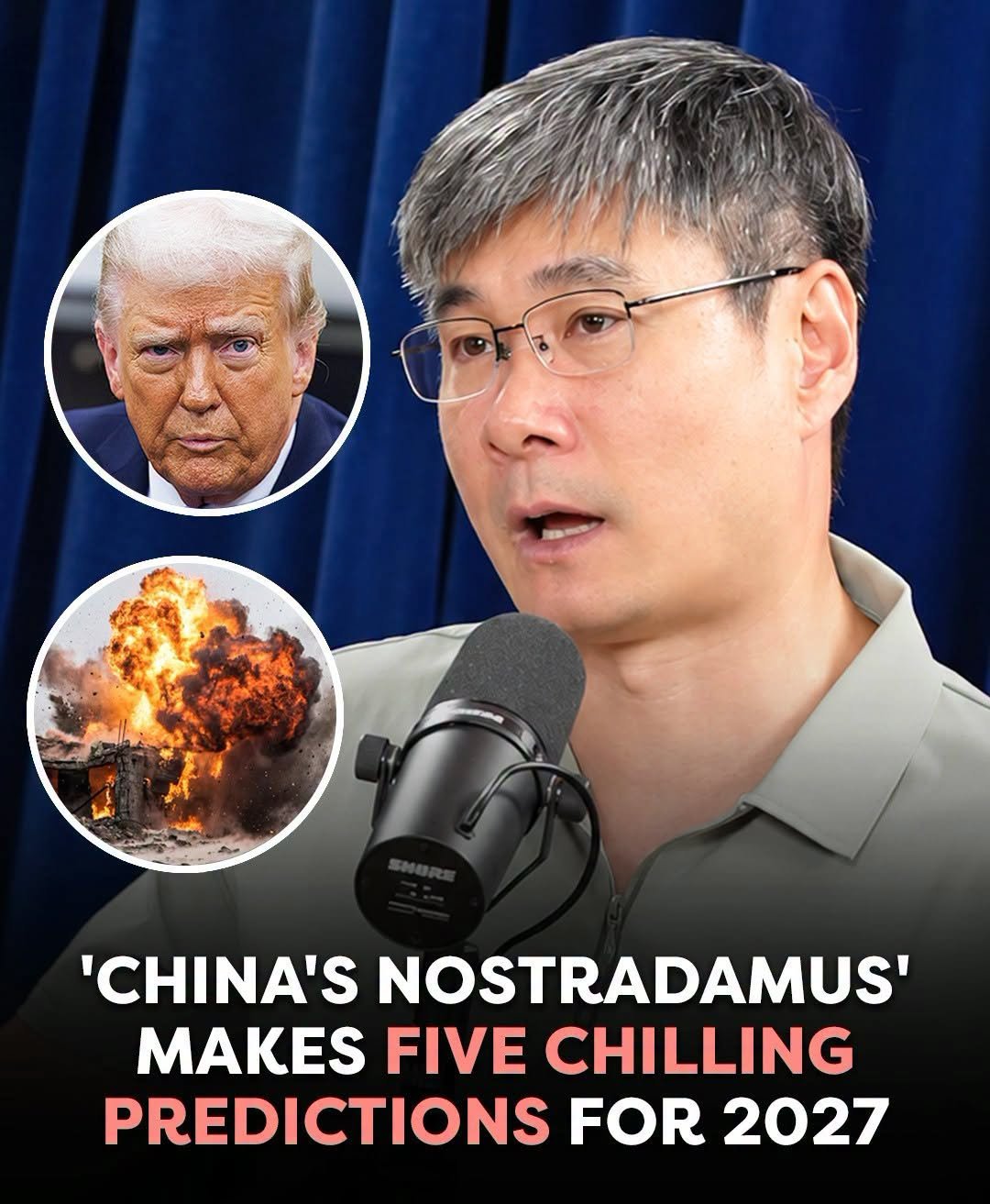
A man nicknamed “China’s Nostradamus” has laid out five predictions for 2027, and the article presenting them is clear about one thing: these are his claims, not established facts. The man is said to be Jiang Xueqin, a Chinese-Canadian Yale graduate known online as “Professor Jiang”, who runs a YouTube channel called Predictive History with nearly three million subscribers, built on the idea that history repeats itself and past patterns can forecast the future.
Jiang reportedly earned the nickname after predicting in 2024 that Donald Trump would return to the White House and that a second presidency could lead to US conflict with Iran. His five predictions for 2027, as reported, are: the Iran conflict becoming an inescapable quagmire with a possible US ground invasion; the US laying the framework for reinstating a national military draft; domestic security forces such as ICE and the National Guard expanding dramatically into American cities; a global economic collapse as cheap energy fails, centred on a possible blockade of the Strait of Hormuz causing fuel and supply shortages; and deep US internal divisions creating conditions for civil unrest approaching civil war.
None of this is presented as verified. The article itself notes that some of Jiang’s earlier predictions missed, including a 2024 running-mate call, and his method — game theory, historical patterns and eschatology — is a forecasting framework, not evidence about the future.
That is the honest way to read the piece: a forecaster with a large audience, a track record that includes both a high-profile hit and notable misses, and five stark claims for 2027 that remain, for now, only claims.
Website Disclaimer
The information provided on this website is for general informational and educational purposes only. While we strive to ensure that all content is accurate and up to date, we make no guarantees regarding the completeness, reliability, or accuracy of any information published.
The views and opinions expressed in articles belong to their respective authors and do not necessarily reflect the views of this website. Any action you take based on the information found on this website is strictly at your own risk. We will not be liable for any losses, damages, or inconveniences arising from the use of our content.
Some articles may contain opinions, third-party information, or external links. We do not endorse or guarantee the accuracy of content on external websites and are not responsible for their practices or policies.
All content on this website is provided in good faith and is intended for informational purposes only. Readers are encouraged to verify information independently and seek professional advice where appropriate.