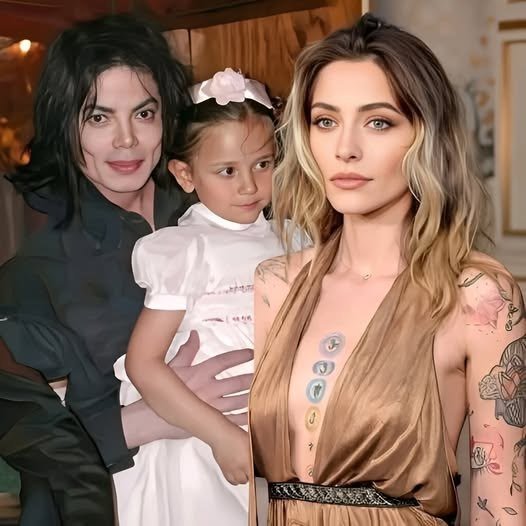
The world remembers Michael Jackson as a superhuman enigma, a figure existing somewhere between a global myth and a surreal stage presence. Yet, for his daughter Paris, the contrast between the public spectacle and her private reality was stark. Behind the reinforced gates of Neverland and far beyond the reach of intrusive flashbulbs, Michael cultivated an environment that functioned as a deliberate sanctuary. To the public, he was the King of Pop; to Paris, he was a gentle, hands-on father who viewed parenting as his most sacred and intricate art form.
What emerges from Paris’s recent emotional reflections is a portrait of profound pedagogical devotion. This was not a father who merely shielded his children from the toxicity of fame; he actively armored them with the emotional intelligence required to navigate a predatory world. Paris recalls a childhood woven with intention, where normalcy was not an accident but a carefully constructed shield. She describes late-night conversations that stretched into deep philosophical inquiries, where the world’s suffering was discussed not as a source of despair, but as a call to actionable hope. In the Jackson household, education was never confined to a textbook. It was a lived experience of recognizing human dignity in everyone, from high-powered studio executives to the strangers gathered hopefully outside their windows.
The specificity of her testimony carries a resonance that generic celebrity tributes lack. Paris vividly remembers how her father prioritized critical thinking over blind compliance. He taught her to question prevailing narratives while maintaining a deep respect for the lived experiences of others. These were not the lessons of a distant icon dispensing wisdom from a throne; they were the actions of a parent kneeling to meet his daughter’s gaze, ensuring she understood her intrinsic worth before the world could attempt to define it for her. In an industry notorious for commodifying childhood and consuming innocence, Michael fought a private war to preserve both for his children.
However, Paris is careful not to romanticize the sheer complexity of her inheritance. She acknowledges the staggering burden of the Jackson name and the immense pressure of being the offspring of arguably the most famous entertainer in human history. Yet, rather than being crushed by that shadow, she has chosen to translate it into her own generational language. Through her music and visual art, she carries forward the values of empathy and human connection—not as a stagnant tribute, but as a living continuation. Her creative output has become an act of filial translation, turning her father’s private lessons into a public message of compassion.
The significance of these revelations extends far beyond the realm of celebrity biography. By sharing these intimate memories, Paris offers a rare cultural reminder that behind every deified or debated public figure exists a private individual capable of extraordinary, ordinary love. She challenges the media’s reduction of her father to mere controversy and costume, insisting instead on his humanity—the morning rituals, the late-night fears, and the small, quiet sacrifices that constitute true parenthood.
Ultimately, Paris Jackson’s testimony redefines the very meaning of legacy. It suggests that Michael’s greatest creation was not “Thriller” or the moonwalk, but the ethical framework he imprinted on his children. As she speaks his parenting into the historical record, she shifts the narrative from entertainment milestones to emotional inheritance. The music may eventually fade, and the performances remain frozen in time, but the compassion he modeled continues to pulse through his daughter’s voice and choices. In breaking her silence, Paris hasn’t just defended a memory; she has illuminated the enduring power of intentional love, proving that the lessons whispered during thunderstorms are the true architecture of immortality.
Website Disclaimer
The information provided on this website is for general informational and educational purposes only. While we strive to ensure that all content is accurate and up to date, we make no guarantees regarding the completeness, reliability, or accuracy of any information published.
The views and opinions expressed in articles belong to their respective authors and do not necessarily reflect the views of this website. Any action you take based on the information found on this website is strictly at your own risk. We will not be liable for any losses, damages, or inconveniences arising from the use of our content.
Some articles may contain opinions, third-party information, or external links. We do not endorse or guarantee the accuracy of content on external websites and are not responsible for their practices or policies.
All content on this website is provided in good faith and is intended for informational purposes only. Readers are encouraged to verify information independently and seek professional advice where appropriate.