The young volunteer at the shelter kept glancing down at the clipboard in her hands as though the paper itself might rescue her from the conversation she clearly didn’t want to have. Her sneakers squeaked faintly against the linoleum every time she shifted her weight, and that nervous sound echoed down the corridor lined with metal cages.
“Ma’am,” she said at last, keeping her voice professional but soft, “this dog is scheduled for euthanasia on Thursday morning.”
I leaned a little harder on my cane, the rubber tip pressing into the floor as if it were the only thing anchoring me to the room. My hand had started trembling again—the way it always did when people talked around me like I wasn’t capable of hearing the truth.
“He’s twelve,” she continued, finally lifting her eyes. “Severe arthritis, a heart murmur the vet classified as Grade Four, and he’s extremely anxious around strangers—especially men. Most families want younger dogs. Puppies, you know? Easier to train. Safer.”
Her words hung in the air like a polite rejection letter.
“You probably want a puppy,” she added quickly. “Something energetic. Something that can keep up.”
I let out a small laugh that surprised even me.
“Keep up with what?” I asked.
She blinked.
“Ma’am?”
“With what exactly would a puppy keep up?” I asked again, my voice calmer now but carrying a quiet edge that made her shift awkwardly. “My afternoon naps? My prescription schedule? My twice-weekly physical therapy sessions?”
A faint blush crept up her neck.
“I didn’t mean—”
“I know what you meant,” I said gently. “You meant well.”
And she probably did.
But people had been meaning well toward me for three years now, ever since the winter morning my husband, Martin, collapsed in our driveway while shoveling snow and never stood up again.
People meant well when they spoke slowly to me.
People meant well when they suggested retirement homes, assisted living facilities, meal delivery services, and social clubs for widows who gathered in church basements to play cards and pretend loneliness wasn’t sitting at the table with them.
They meant well.
But meaning well didn’t stop the silence from swallowing a house whole.
“I’m not looking for a puppy,” I told the volunteer, my voice steady despite the tremor in my hand. “I’m looking for someone who already knows how it feels when the world moves on without you.”
The girl didn’t know what to say to that, so she simply gestured down the hallway.
“The older dogs are in the back,” she murmured.
I thanked her and started walking.
The shelter had that familiar smell—a sharp mixture of disinfectant and damp fur—and the deeper I moved into the building the quieter things became.
Near the entrance the cages were full of bouncing bodies and high-pitched barking, puppies throwing themselves against the wire doors with reckless enthusiasm, their tails wagging so hard their entire bodies wobbled.
Families clustered around those kennels.
Children squealed.
Phones came out for photos.
Hope lived there in the front rooms.
But the back corridor was different.
Here the lights were dimmer.
The barking faded into tired whimpers or silence.
Some of the dogs barely lifted their heads when someone passed.
And that’s where I saw him.
He was lying in the corner of the last kennel on the left, his body curled awkwardly against the concrete wall, his gray-muzzled face resting on paws that looked too heavy for his thinning frame.
A faded sign on the cage read:
Name: Bruno
Age: 12
Breed: Pitbull Mix
Status: Owner Surrender
He wasn’t looking at the door.
He wasn’t watching the hallway.
He was staring at the wall as though he had already accepted that nothing new would ever happen again.
I recognized that look immediately.
It was the same expression that stared back at me from the bathroom mirror every morning.
“Hey there,” I said softly.
His ears twitched.
Slowly, almost reluctantly, he lifted his head.
His eyes were cloudy with age, but they still held something deep inside them—a tired kind of patience that only comes from living long enough to understand disappointment.
I crouched carefully, my bad hip protesting.
“Bruno,” I read aloud.
He blinked once.
Behind me the volunteer had followed at a distance.
“He used to belong to a family,” she said quietly. “They moved to a condominium complex that banned ‘aggressive breeds.’ They said they tried to find another place, but… well… they didn’t.”
I ran my fingers along the cool metal of the cage.
“He hasn’t barked in almost a month,” she added.
I slipped my hand through the bars.
Bruno didn’t flinch.
He simply leaned forward and rested his heavy forehead gently against the wire where my fingers touched.
It was such a small gesture.
But in that moment it felt like the quietest handshake in the world.
“I’ll take him,” I said.
My daughter, Rebecca, nearly dropped her phone when I told her.
“You did what?” she said.
“I adopted a dog.”
“Mom,” she groaned. “You can barely manage the stairs in that house. What happens if he pulls you over? What if he knocks you down? What if—”
“Rebecca.”
I rarely interrupted my daughter.
But that day I did.
“I’m lonely,” I said.
The line went quiet.
Then she sighed.
“You’re not alone,” she said.
“I know,” I replied. “But the house is.”
Bruno and I spent the first few days learning each other’s rhythms.
He moved slowly, the way old dogs do, carefully placing each paw like he was measuring the distance before committing to the step.
I moved slowly too.
So it worked.
He learned the uneven sound of my footsteps—the faint tap of the cane followed by the drag of my left leg.
I learned that sometimes he whimpered in his sleep, his paws twitching like he was running through memories he couldn’t quite escape.
When those dreams came, I’d sit beside him and rest my hand on his back.
“Easy there,” I’d whisper.
He always calmed down.
Two broken creatures.
Sharing the quiet.
Then the blizzard arrived.
The news stations had been warning about it for days, using phrases like “historic cold front” and “dangerous conditions,” but people in the Midwest hear those warnings every winter.
Most of the time they exaggerate.
This time they didn’t.
By nightfall the wind was screaming against the house so violently the windows rattled in their frames.
Snow piled against the doors.
And around eight o’clock, without ceremony or warning, the power died.
The house fell silent.
The heater stopped.
The refrigerator hummed once… and then nothing.
I pushed myself out of my chair.
“Flashlight,” I muttered.
The junk drawer in the kitchen had one somewhere.
I shuffled across the living room.
Bruno followed.
And that’s when my slipper caught the edge of the rug.
It happened so quickly I didn’t even understand what was happening until I was already falling.
My cane slipped from my hand.
My body twisted.
And the sound that came out of my hip when I hit the floor was a sickening crack that echoed through the dark kitchen.
Pain exploded through my leg like lightning.
I gasped.
But no sound came out.
The wind roared outside.
The house was already getting colder.
I tried to sit up.
My leg refused.
Panic crept into my chest.
“Bruno,” I whispered.
His nails clicked against the tile as he trotted toward me.
He tilted his head.
Confused.
I tried to reach for the counter.
Too far.
The phone was in the living room.
Too far.
Cold crept through the linoleum into my bones.
The house temperature was dropping quickly.
I knew enough about winter accidents to understand what that meant.
“Help,” I croaked.
My breath fogged the air.
For a moment Bruno simply stared at me.
Then he did something unexpected.
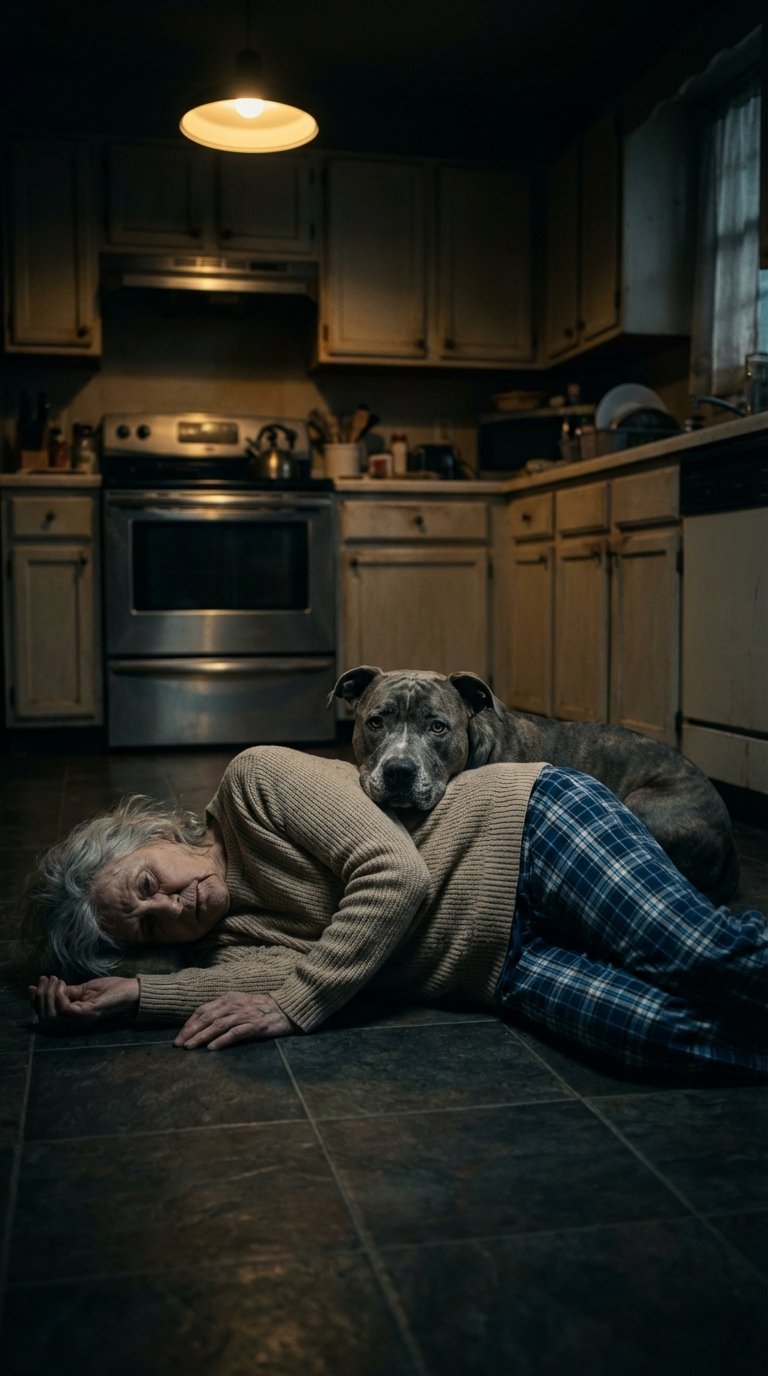
He walked in a slow circle around my body, let out a low groan—the kind old dogs make when their joints ache—and carefully lowered himself across my chest.
Seventy pounds of warm fur.
His head rested beside my shoulder.
His breathing steady.
His body heat wrapped around me like a living blanket.
I closed my eyes.
The warmth spread slowly through my freezing limbs.
Every time I began drifting into that dangerous, drowsy fog that cold can bring, Bruno lifted his head and licked my face.
Rough.
Wet.
Insistent.
“Okay,” I murmured weakly. “Okay… I’m awake.”
Three hours passed that way.
Maybe more.
Time stretched into something strange and shapeless.
Then suddenly—
Light swept across the kitchen window.
Headlights.
Bruno’s head snapped up.
And for the first time since I’d brought him home…
He barked.
Not a nervous bark.
Not a timid bark.
A thunderous, chest-shaking roar that rattled the walls.
Again.
And again.
The back door burst open seconds later.
“Mrs. Hale?!” a young voice shouted.
A flashlight beam cut through the darkness.
It was my neighbor’s teenage son, Lucas, a quiet kid who usually walked around with headphones glued to his ears.
He froze when he saw us.
An old woman on the floor.
An old dog standing over her like a guardian statue.
“Oh my god,” he breathed.
The paramedics arrived soon after.
They tried to move Bruno.
He growled low.
Protective.
Until I touched his nose.
“It’s okay,” I whispered.
He stepped aside.
Reluctantly.
At the hospital the doctor studied my chart.
“You’re lucky,” he said. “Fractured hip, yes—but no hypothermia.”
He shook his head.
“In a house that cold, you should have gone into shock.”
I smiled faintly.
“Something kept you warm,” he added.
“Someone,” I corrected.
But the real storm hadn’t ended yet.
Three days later, a letter arrived.
Not a get-well card.
Not flowers.
A certified envelope from the neighborhood association.
Someone had reported a “dangerous animal” at my house during the ambulance incident.
According to their bylaws, Bruno’s breed was banned.
He had fourteen days to leave.
Or I would face fines.
Possibly legal action.
I stared at the letter for a long time.
Then I looked at Bruno, sleeping beside my recliner, his old paws twitching gently.
The dog they said no one should adopt.
The dog who kept me alive.
Rebecca sighed when I told her.
“Mom… you can’t fight the board.”
I stood slowly.
Leaning on my cane.
Looking around the house Martin and I built forty years ago.
“They can fine me,” I said quietly.
“They can take the furniture.”
I rested my hand on Bruno’s head.
“But they’re not taking the heart that saved mine.”
Lesson of the Story
Sometimes society labels both people and animals as “too old,” “too broken,” or “too difficult.” Yet those same overlooked souls often carry the deepest loyalty, resilience, and love. True worth isn’t measured by age, breed, or circumstance—it’s revealed through actions, especially in moments when no one is watching. Compassion has a way of saving both the giver and the one who receives it.
Website Disclaimer
The information provided on this website is for general informational and educational purposes only. While we strive to ensure that all content is accurate and up to date, we make no guarantees regarding the completeness, reliability, or accuracy of any information published.
The views and opinions expressed in articles belong to their respective authors and do not necessarily reflect the views of this website. Any action you take based on the information found on this website is strictly at your own risk. We will not be liable for any losses, damages, or inconveniences arising from the use of our content.
Some articles may contain opinions, third-party information, or external links. We do not endorse or guarantee the accuracy of content on external websites and are not responsible for their practices or policies.
All content on this website is provided in good faith and is intended for informational purposes only. Readers are encouraged to verify information independently and seek professional advice where appropriate.