I have replayed that text message more times than I care to admit, not because the words were dramatic — they weren’t — but because of how little they said, how ordinary they looked on the screen before everything detonated beneath them, how something as bland as “She’s not here” can carry the weight of a confession if you learn to read the negative space around it.
My name is Rowan Hale, and I work with a certified search-and-rescue shepherd named Atlas, a sable-coated German Shepherd with the steady gaze of an old soul and the patience of a monk, and on the night our neighbor claimed his wife had simply “gone,” Atlas would lead us through snow, into a garage that smelled like bleach and hot metal, and down a hidden stairwell that would crack open more than just a crime — it would fracture the illusion that our tidy cul-de-sac was immune to the kind of darkness we usually scroll past in headlines.
Before that night, Alder Ridge Court was the kind of neighborhood real estate agents describe with lazy optimism — “tight-knit,” “family-oriented,” “safe” — the kind where porch lights come on automatically at five and nobody forgets to wave, where packages sometimes sit on doorsteps for hours and nothing ever happens to them, where the worst scandal in recent memory involved a mailbox run over by a teenager who apologized the next morning with flowers and a dented checkbook.
Atlas and I had moved there two years earlier, after I left full-time field deployment and shifted into regional volunteer response work, which meant I still took calls at odd hours when someone was missing or something didn’t add up, but I also had the luxury of routine — morning jogs with Atlas, training drills in the park, coffee on the porch while the neighborhood woke slowly. He was technically “off-duty” most nights, though working dogs never truly clock out, and I’d developed the habit of pressing my forehead to his before leaving for any late call, whispering the same promise each time: I’ll be back soon.
The irony is not lost on me now that the night everything changed began with that same ritual, except I wasn’t responding to an official dispatch — I was answering a text from across the street.
The message came from Owen Mercer, who lived in the gray colonial directly opposite mine, a man in his mid-thirties with an engineer’s tidy haircut and the kind of smile that never quite reached his eyes. He and his wife, Lila Mercer, had moved in six months earlier, and while Lila blended easily into block barbecues and winter potlucks, Owen always seemed slightly apart, polite but measured, as if he were calculating the exact number of seconds required to appear neighborly.
The text read: She’s not here.
Then, a second later: I’m home. Where is she?
There was something off about the punctuation, the abruptness, the fact that Owen never texted me unless it was about a misplaced delivery or a homeowners’ association notice. Atlas, who had been lying by the door while I laced my boots, lifted his head before I even stood, as if he sensed the shift in the air that I was only just beginning to register.
I crossed the street in under a minute, snow crunching beneath my boots, my breath fogging in front of me, and found Owen in his driveway with his car door still open and the engine running, his face pale under the sodium streetlight glow.
“She’s gone,” he said immediately, before I could ask anything, and his voice sounded too controlled, like someone reading a script in a language they hadn’t fully learned.
“What do you mean gone?” I asked.
“She called me ten minutes ago, said she was on her way home from the clinic, sounded irritated about traffic,” he replied, running a hand through his hair. “Then she just hung up. I got here and the front door was open.”
Open doors in Minnesota winter are rare — people here respect heating bills like religion — so that detail lodged somewhere deep in my mind. Atlas pressed lightly against Owen’s leg, a grounding presence, but Owen stepped back almost imperceptibly, as if contact unsettled him.
Inside, the Mercer house was quiet in a way that felt staged rather than accidental, as though someone had curated the silence. The entryway rug was slightly skewed, the hallway light on, Lila’s purse missing from its usual hook. I’ve learned over years of search work that panic tempts you to sprint past details in favor of dramatic possibilities, but the truth hides in the small misalignments.
I asked Owen for something of Lila’s — a scarf, a sweater — and he brought me a wool wrap from their bedroom closet, still faintly scented with her perfume. Atlas inhaled once, twice, then moved toward the side door, nose low, tail steady.
At the curb, another neighbor, Damien Crowe, brushed past us in a heavy parka, barely making eye contact before climbing into his SUV. Damien lived two houses down and worked odd freelance jobs, mostly digital media work, and I’d never had reason to distrust him, but Atlas’s ears twitched as Damien sped off, tires skidding slightly on ice.
We followed the scent trail along the fence line between the Mercer and Crowe properties, Atlas weaving with focused intensity. Snow preserves stories if you know how to read it — compressed footprints, scuffed drifts, displaced crystals. Behind Damien’s detached garage, half-concealed beneath a snowbank, sat a cardboard box sealed with fresh tape, a white label affixed to its side.
The word printed in bold letters was Fertilisering.
Below it, smaller text: Teksting av Elias Vinter.
Even before opening the box, my stomach tightened. Lila worked at a reproductive health clinic downtown; she had mentioned once, in passing, how sensitive their materials were, how tightly regulated embryo transport had to be. Why would a box labeled in Norwegian — fertility — be hidden behind Damien Crowe’s garage the night Lila vanished?
Owen’s hands trembled as he crouched beside me. “What is that?”
“Something that doesn’t belong in snow,” I replied, already dialing 911 and putting the call on speaker.
Inside the box was a portable medical cooler, two cryogenic vials secured in foam, and a folder stamped with the logo of Lila’s clinic — except the documentation looked wrong, the signatures slightly misaligned, the transfer logs inconsistent. Taped to the folder was a USB drive.
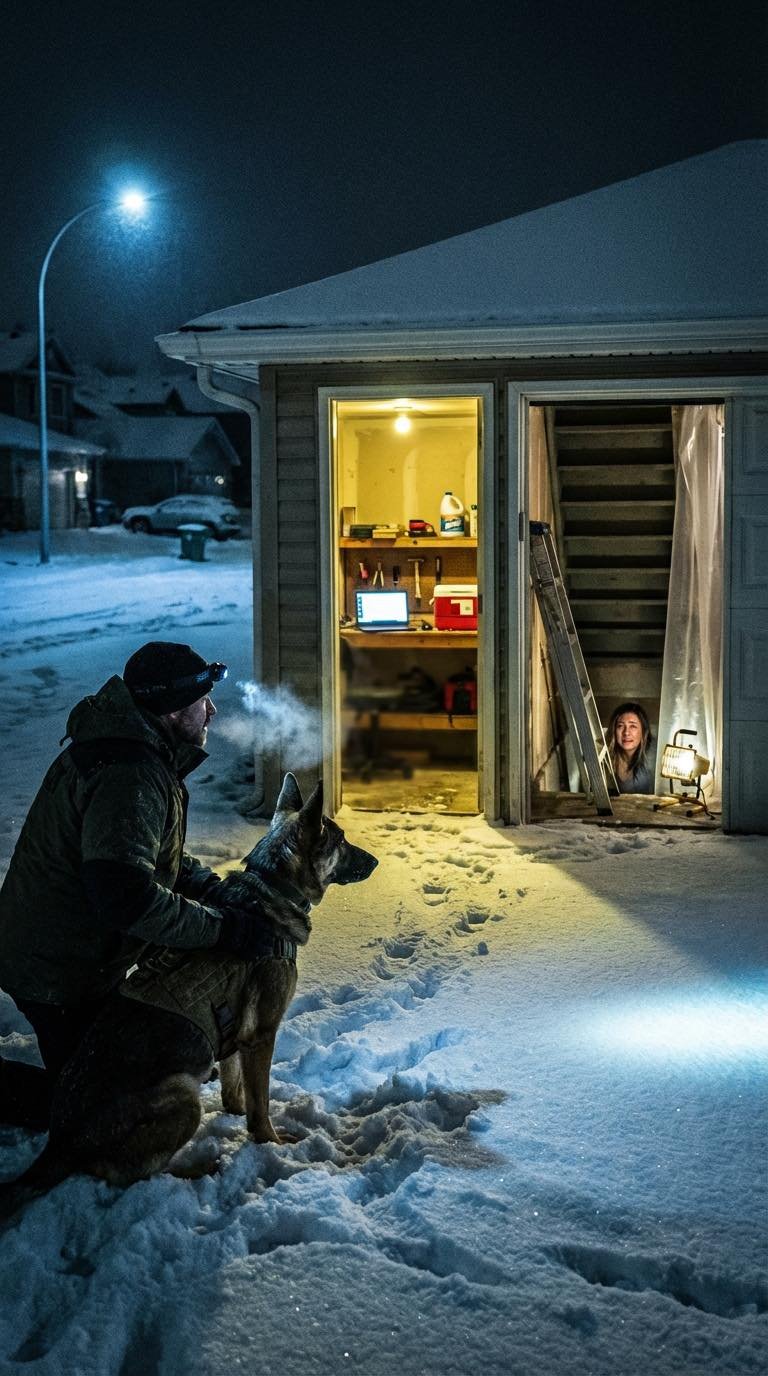
Atlas’s focus shifted abruptly from the box to the side door of Damien’s garage, which sat slightly ajar, a thin blade of light cutting across the snow. His hackles rose, not in fear but in alertness, and a low vibration built in his chest.
I told the dispatcher we had a missing person and suspicious medical property discovered on a neighboring lot. She asked whether we felt safe. I answered honestly: I don’t know.
The garage interior smelled of bleach, cold steel, and something else — overheated plastic. A brass bell hung on the far wall, a mallet resting beneath it. On a workbench sat another cooler and an open laptop, paused on a grainy video with Norwegian subtitles scrolling across the bottom, the same credit — Teksting av Elias Vinter — stamped beneath.
I hit play.
A voice droned: “This is the end of the video. Thank you for watching.”
Then it looped.
I scrubbed backward frame by frame, ignoring the repetitive overlay, until the underlying footage revealed itself — two seconds of Lila in this very garage, clutching a box, her shoulders tense, and a male voice snapping off-screen, “Move. We’re already late.”
Owen made a strangled sound. Atlas shifted toward a shelving unit stacked with paint cans. One can rocked unnaturally when he nudged it. The entire shelf trembled slightly, as if mounted on hinges.
Behind it was a narrow door.
The air that spilled out was warmer, damp, tinged with concrete dust. Somewhere below, faint but unmistakable, came the sound of restrained movement — a muffled scuff, then silence.
The dispatcher instructed us to exit and wait for officers. I should have listened. I did not.
Atlas descended first, deliberate and controlled, and I followed with Owen close behind, phone line still open in my pocket.
The basement was unfinished but organized with chilling intention. A single work lamp illuminated a metal folding chair and an IV stand. Plastic sheeting covered part of the floor. On a side table lay zip ties, gauze, and a small digital recorder.
Lila was behind a partition curtain, wrists bound, ankles secured, cheeks streaked with dried tears. When Atlas approached, her eyes opened and filled with disbelief, then relief so sharp it hurt to witness.
“You’re safe,” I told her, though the words felt fragile.
She whispered hoarsely, “He’s moving embryos… selling them. Off the books. I found discrepancies in the logs. He said if I told anyone, I’d disappear.”
“He?” Owen asked, voice breaking.
“Damien,” she breathed.
Above us, a car door slammed. Then the bell rang — GONG. GONG. GONG.
Atlas’s head snapped toward the stairs. The sound vibrated through the concrete.
Footsteps followed.
Damien Crowe appeared at the bottom, face flushed from cold, eyes wide when he saw Lila freed from the ties. Behind him stood a thinner man wearing a knit cap and carrying a camera rig, the same man credited in the video subtitles — Elias Vinter.
Damien’s voice hardened. “Where is the drive?”
Atlas moved between them and the stairs, body low but controlled.
Elias lifted his phone, recording. “This is the end of the video,” he said loudly, as if repetition could overwrite reality.
Police sirens wailed outside, finally close. Damien lunged for the table, grabbing at the cooler instead of reaching for Lila — a detail that told me everything about his priorities. Owen shoved him back, and the two collided with the shelving unit, paint cans crashing to the floor.
Atlas barked once, a sharp command.
Officers stormed down the stairs seconds later, weapons drawn, voices authoritative and unmistakable. Damien froze. Elias tried to pivot into a performance about documentary filming and misunderstood footage, but the USB drive in my hand told a different story.
Here’s the twist none of us expected: Damien wasn’t working alone, but he wasn’t the mastermind either. The investigation that followed revealed a small but organized network siphoning off viable embryos from fertility clinics across three states, selling them under falsified documentation to desperate clients who never questioned irregularities as long as they got results. Lila hadn’t stumbled upon a one-man crime — she’d uncovered a system.
And the most unsettling revelation? Owen had known something was wrong for weeks. He had noticed discrepancies in Lila’s behavior, tension in her voice, unexplained overtime, yet he hadn’t pressed her because he assumed it was workplace stress. His text — She’s not here — wasn’t just panic. It was guilt that he hadn’t asked sooner.
Damien took a plea deal. Elias cooperated in exchange for a reduced sentence. The clinic launched internal audits. The neighborhood installed more cameras. People began locking doors they’d once left open.
Months later, at trial, the prosecution played the unedited footage recovered from Elias’s equipment. The courtroom went silent at the moment Lila flinched under Damien’s voice. That was the sound of trust breaking — not just marital trust, not just neighborly trust, but communal trust.
Alder Ridge Court never fully returned to its old version of harmless. But something else grew in its place — vigilance, maybe, or a deeper understanding that safety is not the absence of crime but the willingness to respond when something feels wrong.
Atlas still sleeps by my door. Owen and Lila moved to another city, starting fresh. Sometimes Lila sends me holiday cards with handwritten notes thanking Atlas for finding the door no human would have thought to check.
But I always think the real beginning of that night wasn’t the bell or the basement. It was the text.
She’s not here.
Sometimes the most ordinary words are the ones that demand the most attention.
Lesson
If there is one thing that night taught me, it’s that danger rarely announces itself with drama. It seeps in quietly, disguised as routine, as polite neighbors and ordinary garages, as text messages that look unremarkable until you examine what they don’t say. Trust your instincts when something feels misaligned, because communities don’t stay safe by assuming the best — they stay safe by acting when doubt first whispers. Silence protects predators; attention protects people.
Website Disclaimer
The information provided on this website is for general informational and educational purposes only. While we strive to ensure that all content is accurate and up to date, we make no guarantees regarding the completeness, reliability, or accuracy of any information published.
The views and opinions expressed in articles belong to their respective authors and do not necessarily reflect the views of this website. Any action you take based on the information found on this website is strictly at your own risk. We will not be liable for any losses, damages, or inconveniences arising from the use of our content.
Some articles may contain opinions, third-party information, or external links. We do not endorse or guarantee the accuracy of content on external websites and are not responsible for their practices or policies.
All content on this website is provided in good faith and is intended for informational purposes only. Readers are encouraged to verify information independently and seek professional advice where appropriate.