I arrived at my younger sister’s home without prior notice on a freezing Friday evening, carrying only a modest travel bag and an uneasy sensation that had followed me relentlessly throughout the journey. The feeling was not precisely fear, nor was it simple anxiety, but rather a persistent pressure in my chest that refused to dissolve, the kind of instinctive warning that surfaces when something invisible feels deeply out of place.
I had driven for nearly fourteen hours from Tucson, Arizona, toward a quiet suburban neighborhood outside Denver, Colorado, spending far too much time wrestling with doubt, second guessing my decision, and attempting unsuccessfully to convince myself that intuition sometimes exaggerates harmless concerns. The visit had never been scheduled, the route had never been planned, and most importantly, I had never informed anyone that I was coming.
The previous night, shortly before midnight, a message appeared on my phone from an unfamiliar number, containing only a brief plea that carried disproportionate weight. The words were simple, disturbingly restrained, yet impossible to ignore.
“Please come if you can. I live next door. Something is very wrong.”
There was no name attached, no further explanation provided, and no context offered to clarify urgency. Even so, I read the message repeatedly, recognizing with uncomfortable certainty that ignoring it would leave a permanent fracture in my conscience, an unanswered question that would linger far longer than inconvenience or embarrassment.
The residential community appeared exactly as Juliette had described years earlier, with orderly streets, identical façades, and carefully manicured lawns designed to project tranquility, stability, and predictable routine. She once told me she appreciated the neighborhood precisely because nothing unexpected ever seemed to disturb its calm rhythm.
I parked directly in front of house number forty two and approached the entrance, mentally rehearsing awkward explanations to justify my sudden appearance, while attempting unsuccessfully to suppress the growing tension tightening steadily within me. When I pressed the doorbell, no response emerged, and after a second attempt, the silence remained absolute.
That was when I noticed the detail that shattered any remaining illusion of normalcy.
The front door was slightly open, allowing a narrow stream of warm interior light to spill onto the porch. I hesitated briefly, instinct urging caution, yet concern overpowered hesitation, prompting me to push the door inward with careful restraint.
In that instant, breathing became impossible.
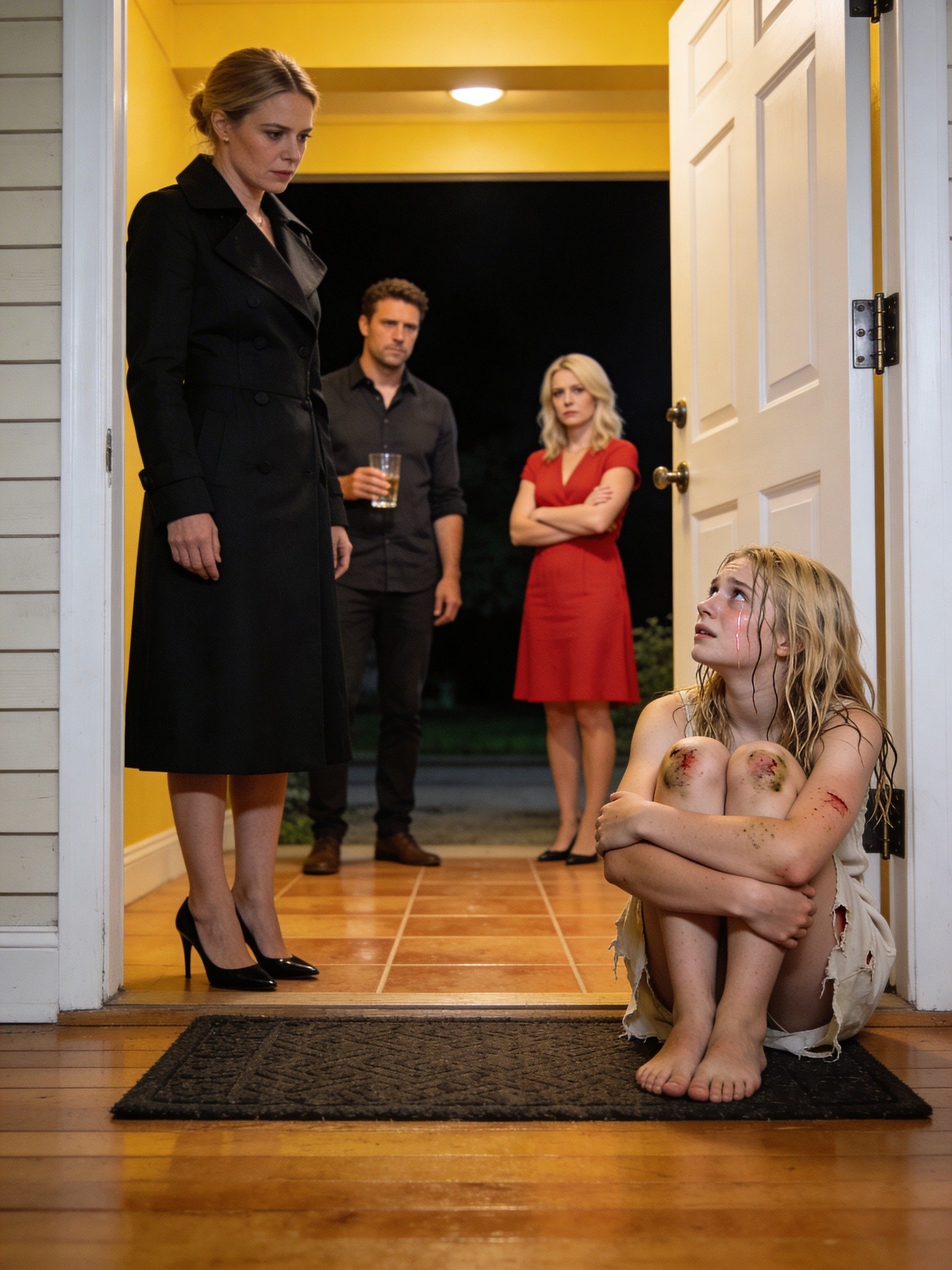
Curled against the threshold, half inside and half outside the house, lay my sister Juliette Meyer, her frail posture communicating exhaustion so profound it transcended ordinary fatigue. For several seconds, my mind rejected the reality before me, struggling desperately to reconcile memory with the devastating image occupying my vision.
Her clothing appeared worn, thin, and ill fitting, as though borrowed without care or necessity, while her hair hung tangled and lifeless, stripped entirely of the vibrancy that once reflected creativity and self assurance. Scratches covered her hands, her skin reddened and inflamed in ways that suggested relentless labor rather than accidental injury.
Inside the house, laughter erupted with startling clarity.
The sound carried lightness, amusement, and a disturbing absence of tension, as though no suffering existed within proximity. Then a man’s voice, confident and careless, echoed through the entry hall.
“Relax,” he said casually. “She is just our overly dramatic housekeeper.”
Something within me solidified completely.
Moments later, Peter Callahan emerged into view, adjusting his cufflinks with effortless composure, stepping past Juliette without acknowledgment, his movements reflecting habit rather than hesitation. Behind him stood a young blonde woman in a striking crimson dress, her expression curious, entertained, almost intrigued by the unfolding scene.
Peter finally noticed me standing motionless inside the doorway.
Color drained instantly from his face.
Juliette stirred weakly, lifting her head with visible effort, her eyes unfocused until recognition slowly replaced confusion. “Caroline?” she whispered faintly, disbelief trembling through every syllable.
“Good evening,” I replied calmly, surprised by the steadiness of my own voice. “I hope I am not interrupting anything essential.”
Peter swallowed visibly, struggling to reconstruct authority that evaporated the moment reality intruded. “And you would be?” he asked stiffly, though the answer had already formed behind widening pupils.
“My name is Caroline Meyer,” I answered evenly. “I am Juliette’s sister, and I am also the attorney responsible for structuring the agreements governing this property.”
Recognition struck him with immediate, uncontrollable force.
“This residence,” I continued deliberately, “belongs to a holding entity representing my firm, the same entity that absorbed your failing consultancy eighteen months ago under explicitly documented conditions.”
The woman behind him shifted uneasily, confusion replacing detached curiosity. “Peter, what exactly is she saying?” she asked quietly, tension threading through uncertainty.
“The conditions,” I explained calmly, “required that Juliette Meyer be treated as an equal stakeholder, protected from financial exploitation, emotional degradation, and any conduct inconsistent with basic human dignity.”
Peter’s glass trembled violently within his grip.
“You are misunderstanding everything,” he insisted, forcing a brittle smile. “Juliette has not been entirely stable lately, and we have all been attempting to support her through difficult episodes.”
I neither frowned nor raised my voice.
“Support,” I repeated softly, “rarely includes forcing someone to sleep beside a doorway like discarded furniture.”
Without waiting for further justification, I knelt beside Juliette, placing a steady hand upon her shoulder. Up close, the damage revealed itself with brutal clarity, her frame alarmingly thin, her wrists fragile, her body reflecting prolonged erosion rather than temporary distress.
“I am here,” I told her gently. “This situation ends tonight, and you will never sleep on the floor again.”
She blinked slowly, confusion yielding gradually to fragile relief, before clinging to me with exhaustion that spoke of months spent shrinking beneath invisible weight.
Peter cleared his throat sharply. “I am her husband,” he declared defensively. “I have rights within this household.”
“You had responsibilities,” I replied quietly. “Every single one has been violated.”
From my portfolio, I withdrew a folded document.
“I recommend revisiting clause twelve of the restructuring agreement,” I continued calmly. “Abuse, infidelity, or exploitation by controlling parties triggers immediate forfeiture of associated assets.”
“Controlling parties?” he repeated hoarsely.
“Yes,” I nodded. “Juliette Meyer owns majority interest across all holdings connected to this residence, the consultancy, and every financial structure you mistakenly believed you controlled.”
Silence engulfed the room completely.
Within the hour, private security personnel arrived discreetly, updating digital access systems, revoking permissions, and escorting Lena Foster from the premises amid protests that dissolved quickly once external authority intervened. Peter’s outrage intensified, yet fury collapsed into helpless disbelief as accounts froze and credentials expired before his eyes.
“That is illegal,” he shouted desperately.
“I authored the contracts,” I answered calmly.
That night, Juliette slept in a real bed, beneath clean sheets, behind a closed door, enveloped by safety rather than humiliation. In the weeks that followed, we remained together, rebuilding conversation through shared memories of architecture, design, and the quiet understanding that spaces possess extraordinary power to wound or restore.
One afternoon, she paused at the entrance, studying the worn rug for several reflective moments before lifting it decisively and discarding it without hesitation.
“I want to redesign this threshold,” she said softly. “I want arrival to feel entirely different from now on.”
I smiled gently.
“I happen to know an exceptional architect.”
For the first time in an immeasurable span of time, she smiled without fear.
Website Disclaimer
The information provided on this website is for general informational and educational purposes only. While we strive to ensure that all content is accurate and up to date, we make no guarantees regarding the completeness, reliability, or accuracy of any information published.
The views and opinions expressed in articles belong to their respective authors and do not necessarily reflect the views of this website. Any action you take based on the information found on this website is strictly at your own risk. We will not be liable for any losses, damages, or inconveniences arising from the use of our content.
Some articles may contain opinions, third-party information, or external links. We do not endorse or guarantee the accuracy of content on external websites and are not responsible for their practices or policies.
All content on this website is provided in good faith and is intended for informational purposes only. Readers are encouraged to verify information independently and seek professional advice where appropriate.