Part 1
The first time my father ever told me to be quiet, I was seven years old and crying because Lucas had broken my science fair volcano on purpose. Dad didn’t even look up from the newspaper. He just said, “Camila, don’t make a scene,” like my tears were the problem, not my brother’s grin.
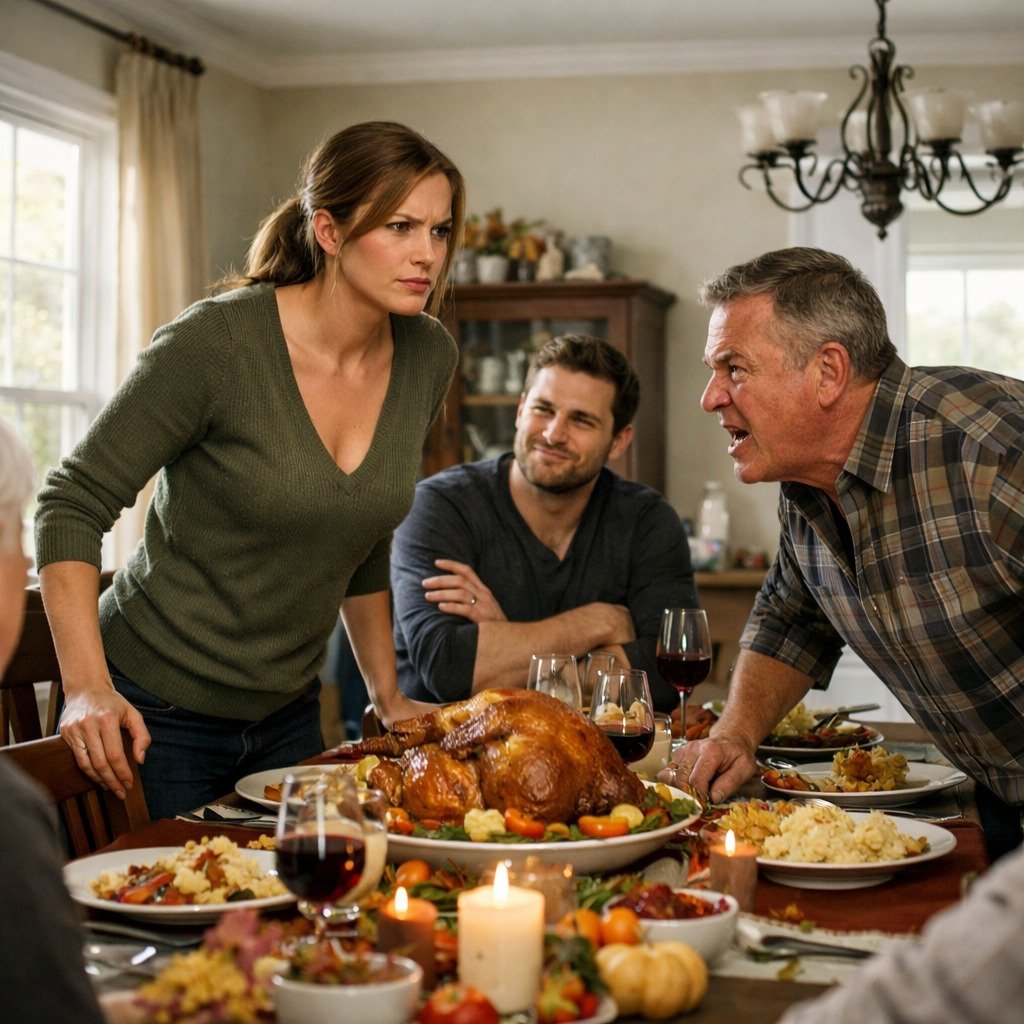
The last time he told me to be quiet was Thanksgiving, and he didn’t bother hiding the scene he was making.
“You can move to the laundry room or leave,” Dad said, carving turkey like he hadn’t just exiled his own daughter in front of the entire family.
The dining room smelled like roasted herbs, butter, wine, and the kind of hypocrisy that clings to curtains. The table was set the way Mom used to set it: the good plates, the cloth napkins, the little leaf decorations she pretended were cute even though she’d roll her eyes at them later in the kitchen. The only difference was Mom wasn’t there to soften the edges or change the subject with a joke.
Mom had been gone two years. Sometimes the house still felt like her—vanilla candle wax, lemon cleaner, the faint trace of her lotion in the hallway. Other times it felt like a stage set where the lead actress had died, and everyone else was just reading lines.
Lucas sat across from me with that same boy grin, older now but still sharp around the edges. His wife, Brielle, held her glass of Chardonnay like it was a microphone. She whispered something in his ear and he smirked wider, like the punchline was me.
Dad kept slicing turkey with careful precision. He didn’t look at me until he’d put a neat portion onto Lucas’s plate first. Then Brielle’s. Then his own. Like I was an afterthought waiting for scraps.
“You understand, don’t you?” Dad added, as if the choice was reasonable. As if the words weren’t a public slap.
The laundry room. In the house I grew up in. The room with the humming dryer and detergent smell. The room where Mom used to make me sit on the counter while she folded warm towels and asked me about school like my thoughts mattered. Now it was my designated “space,” like I was a coat Dad was tired of hanging in the hall.
I looked at my father. Really looked. He’d aged since Mom died, but not in the way grief ages people into softness. His grief had hardened into entitlement. Into the belief that because he’d lost his wife, the world owed him obedience.
Silence had been my survival skill in this family for as long as I could remember. Silence meant I didn’t get blamed for Lucas’s messes. Silence meant I didn’t get accused of being dramatic. Silence meant I didn’t trigger Dad’s temper.
That night, I chose silence one last time.
I set my napkin beside my untouched plate. My hands didn’t shake. My voice didn’t rise.
“Calm and clear,” I said. “Completely.”
Then I stood up and walked out.
No one called after me. Not Dad. Not Lucas. Not Brielle. Not my aunt who always acted like she didn’t hear anything uncomfortable. The door shut behind me with a soft click that felt louder than the whole dinner.
Outside, the air bit my face. November cold, sharp and honest. I stood on the porch for half a second, breathing in the smell of wet leaves and chimney smoke. Through the dining room window, I could see Lucas lifting his fork like nothing had happened.
In their minds, I was replaceable.
I was the quiet daughter. The one who didn’t ask for much. The one who never fought for her share. The one who cleaned up after their messes.
What they didn’t know was I’d stopped being that person years ago. I just stopped announcing it.
When Mom died, I was the one who stayed. Lucas was “too busy” with his startup—his fourth one, if you counted the ones that never made it past a logo and a pitch deck. Dad was “too emotional,” which meant he drank, made phone calls he didn’t remember, and gave away Mom’s sweaters to charity without asking if I wanted one.
So I handled the estate.
I handled the paperwork, the calls, the bank meetings, the funeral home decisions, the endless questions people asked as if grief turned you into a customer service representative. I learned about trusts and titles and tax deadlines and the way a single signature could move money like a lever.
Mom had named me co-trustee.
A small word with enormous power.
They never read it. Not really. Grief made them blind, and arrogance made them lazy. They assumed the legal stuff was boring, and boring things were my job.
I didn’t use that power then. I didn’t freeze anything. I didn’t play games. I waited, because I still believed my family would eventually remember I was a person, not a utility.
Thanksgiving proved what I’d been avoiding admitting.
They weren’t going to remember.
So I drove away from the house with my hands tight on the steering wheel and my throat burning—not from tears, but from something else.
Resolve.
Part 2
I spent that night in my apartment on the other side of town, the one Dad still called “Camila’s little place” like it was a phase. It wasn’t little. It was mine. It was quiet on purpose. Warm lamps, soft blankets, a bookshelf full of things I actually liked. No framed photos of Lucas. No family portrait that made me feel like an extra standing behind the lead actors.
I poured a glass of water, sat on my couch, and let the silence settle around me.
At 9:15 p.m., my phone buzzed.
A text from my aunt: Hope you’re okay. Your dad’s under a lot of stress.
No apology. No acknowledgment of what was said. Just the usual excuse that stress turns cruelty into something everyone is supposed to tolerate.
I didn’t answer.
At 10:02, I got a text from Brielle.
You embarrassed your father. It’s Thanksgiving. Try being grateful.
I stared at it, then laughed once, short and humorless. Brielle loved gratitude the way she loved branding—only when it benefited her.
I didn’t answer.
At 11:30, nothing. No call from Dad. No message from Lucas. Just silence. Which, in my family, was their version of punishment. They thought ignoring me would make me crawl back.
Instead, it gave me room to think clearly.
The truth was, the laundry room comment wasn’t a random insult. It was the latest chapter in a pattern I’d been trained to accept.
Lucas was the golden child. The bright boy, the “visionary,” the one Dad bragged about at parties even when Lucas had nothing to show but another half-baked idea. Lucas got patience. Lucas got praise. Lucas got second chances.
I got responsibility.
I was the one who remembered birthdays, scheduled doctor appointments, mailed Christmas gifts, handled repairs, filled out forms. When Dad needed something explained—health insurance, online banking, a new phone—I was the one he called.
When Mom got sick, it was me who sat in the hospital, learning medication schedules and listening to doctors’ jargon while Lucas sent “thinking of you” texts from whatever coworking space he was pretending was his office.
And when Mom died, it was me who opened the trust binder she kept tucked inside the linen closet, behind the fancy sheets she only used when guests came.
Mom’s handwriting was in the margin, small notes like she was talking to herself.
Call Lila (estate attorney).
Renew home insurance.
Do not let them rush you.
There was a letter too, sealed in an envelope with my name.
I opened it on the kitchen floor that day, surrounded by paperwork that smelled faintly like dust and her lavender detergent.
Camila, it read, if you’re reading this, it means I’m gone. I’m sorry. I know you will handle everything because you always do. I also know your father and Lucas will assume handling means surrendering. Please don’t. I made you co-trustee because I trust you to be fair. I trust you to protect yourself. Don’t let them turn your kindness into a cage.
I cried hard enough that day that my ribs hurt. Not just because Mom was gone, but because even in death, she’d been the only person in that house who truly saw me.
Co-trustee meant I wasn’t just an errand runner. It meant Mom had designed a safety rail into the legal structure of our family—something that would keep Dad and Lucas from bulldozing through everything she built.
The trust held the house. The insurance. The joint accounts used for mortgage and utilities. It wasn’t all mine, but it wasn’t all theirs either.
And there were rules.
Rules like dual authorization for major changes. Rules like trustee approval for expenses tied to estate property. Rules like the right to demand an accounting. The right to pause distributions if a trustee believed the assets were being mismanaged.
I’d read it all carefully while Dad and Lucas drifted through grief like it was fog, assuming I’d keep the machine running quietly.
I had. For two years.
I’d approved maintenance costs. I’d coordinated contractors. I’d made sure the mortgage never missed a payment. I’d even covered gaps when Dad “forgot” to transfer money into the joint account, because the idea of the house—Mom’s house—getting into trouble felt unbearable.
I didn’t do it for praise. I did it because it was the right thing.
But Thanksgiving dinner showed me something important: being the right thing in this family was the same as being the doormat.
Two days later, Dad called.
Not to apologize. Not to ask if I was okay. His voice was bright with that fake cheer people use when they want something.
“Your brother’s moving into your old room,” he said. “He’s setting up his office there. He needs space.”
I kept my voice neutral. “Okay.”
“And we’re thinking of renting your old apartment,” Dad added, like it was his to rent. “Extra income.”
My old apartment—meaning the one I’d moved out of years ago that Dad still referred to like it was my “starter place,” even though I’d been the one paying it and I’d been the one who sold it when I moved.
I almost corrected him, but what was the point? Dad didn’t hear corrections. He heard challenges.
“You’ll be fine, Camila,” he said, as if blessing me with permission to survive. “You always are.”
He hung up before I could reply.
I stared at my phone for a long moment.
Then I smiled, slow and steady.
Because he was right.
I was fine.
And I was done covering everything.
Part 3
That night, I didn’t do anything dramatic. I didn’t send angry texts. I didn’t post vague quotes on social media. I didn’t call my friends to scream. I just opened my laptop and logged into the estate portal.
It still ran under my credentials, because I was the one who set it up. The one who created the digital access, uploaded identification documents, linked accounts, made sure two-factor authentication was working, and taught Dad how to sign in—twice—before he gave up and told me to “just handle it.”
The portal greeted me like nothing in my life had exploded.
Trust: Reeves Family Living Trust.
Trustees: Daniel Reeves, Camila Reeves.
I clicked through the accounts.
Mortgage autopay: linked to a joint checking account under the trust’s name.
Property taxes: scheduled, paid annually.
Utilities: electric, water, gas, internet, all tied to that same account.
Home insurance: paid through trust account, renewal in eight months.
Maintenance: a monthly buffer Dad called “the house fund,” which meant the money I quietly topped off when he drained it buying Lucas something “important.”
Every time I’d covered a shortfall, I’d told myself it was temporary. Just until Dad got on his feet. Just until Lucas’s startup stabilized. Just until grief calmed. Just until they stopped acting like my responsibility was their right.
Temporary had lasted two years.
I wasn’t going to destroy anything. I wasn’t going to sabotage. I wasn’t going to do what people like my brother always expected me to do: explode emotionally so they could call me irrational.
I was going to do something simpler.
I was going to stop enabling.
The trust had a clause—one Mom’s attorney had explained carefully when we signed paperwork after the funeral.
Dual authorization required for changes to payment systems and major disbursements.
Trustees may require joint approval for recurring expenses if mismanagement is suspected.
It was legal language for: you can put the brakes on if someone is reckless.
So I did.
I didn’t “freeze” the account like a cartoon villain. I changed the authorization settings so any payment above a certain threshold required my digital signature in addition to Dad’s. I flagged the mortgage autopay for manual approval until both trustees acknowledged the monthly transfer.
I rerouted the property tax payment authorization through the trustee workflow. Same with insurance renewals, maintenance contracts, and utility payments.
In other words, I didn’t break the system.
I made it follow the rules Mom wrote.
Then I emailed the estate attorney—Lila—who had been Mom’s friend before she was our attorney.
Subject line: Trustee compliance question.
My message was short: If one trustee is using trust funds for personal benefit and excluding another beneficiary from the residence, what are my options?
Lila replied within the hour.
Camila, I can meet tomorrow. Bring the trust binder. And Camila? I’m glad you’re finally asking.
The next day, I sat in Lila’s office with the binder on my lap. Her walls were full of framed degrees and photos of her hiking mountains like she enjoyed suffering recreationally.
She listened without interrupting as I told her about Thanksgiving.
The laundry room comment.
The smirk.
The “you understand, don’t you?”
The part where nobody even asked me to stay.
Lila didn’t gasp dramatically. She just nodded slowly, then opened the trust binder to a page she’d marked with a small sticky note years ago.
“This is what your mother was afraid of,” she said.
I swallowed. “I didn’t want to believe it.”
Lila leaned back. “You didn’t want to believe it because you’re decent. But decent people get eaten alive by families who confuse decency with obedience.”
She tapped the clause about trustee authority. “You have every right to require joint approval for trust expenditures. Especially since the home is a trust asset and you’re a beneficiary.”
“What about living there?” I asked quietly, because that part still stung.
Lila’s eyes sharpened. “Your father can’t legally exclude you from a trust-owned property if you’re a beneficiary and co-trustee, unless there’s a court order or a trust amendment. And he certainly can’t assign you to a laundry room like you’re a guest in your own home.”
I let out a breath I didn’t realize I’d been holding.
“So what do I do?” I asked.
Lila’s voice stayed calm. “You decide what you want. Not what you want to prove. Not what you want to punish. What you want.”
I thought about the house. It wasn’t just real estate. It was Mom’s laughter in the kitchen. It was her garden. It was the hallway where she’d hugged me goodbye for college.
But it was also the dining room where Dad had exiled me like trash.
“I don’t want to live there,” I said finally. “I just don’t want them to treat me like I’m disposable.”
Lila nodded. “Then you set boundaries with teeth.”
She outlined options like she was mapping a battlefield.
Option one: require full accounting and agreement on all trust expenses.
Option two: propose a written occupancy agreement if Dad wants to remain in the home, including fair contributions and respect of beneficiary rights.
Option three: force sale or buyout if cooperation fails, through mediation or court.
My stomach clenched at “force sale.”
Lila saw it. “Camila. This isn’t revenge. This is structure. Your mother built structure because she knew feelings wouldn’t protect you.”
I nodded slowly.
That night, I drafted a formal notice.
Nothing emotional. Nothing angry. Just facts.
As co-trustee, I am requesting an accounting of trust expenditures for the last 24 months.
As co-trustee, I am requiring joint authorization for trust-related expenses going forward.
As beneficiary, I am requesting a written occupancy arrangement for the residence.
I sent it to Dad’s email and Lucas’s email, because Lucas loved pretending he was “in business” and business meant documentation.
Then I waited.
The first response came from Lucas, as predicted, not from Dad.
He called, not texted, because bullies prefer voices.
“What the hell did you do?” Lucas snapped the second I answered. “Dad says the mortgage company says the account is locked!”
I smiled, even though he couldn’t see it.
“It’s not locked,” I said. “It’s compliant.”
“Compliant?” Lucas barked a laugh. “Stop being weird. Fix it.”
“I didn’t break it,” I said. “I just stopped covering it automatically.”
There was a pause, like his brain couldn’t process a world where I didn’t jump when he yelled.
“You’re being petty,” Lucas hissed. “This is Mom’s house. Dad lives there.”
“Yes,” I said softly. “And Mom made it part of the trust. Which means Dad doesn’t get to treat it like his personal kingdom.”
Lucas’s voice turned sharp. “Dad’s under stress. He said what he said because you always—”
“Because I always take it,” I finished for him.
Silence.
Then Lucas muttered, “You understand, don’t you?” in the same tone Dad used, mocking me.
My smile vanished. “No,” I said. “I don’t.”
I hung up.
And for the first time in my life, hanging up didn’t feel like fear.
It felt like air.
Part 4
The panic didn’t arrive like a storm. It arrived like a slow leak that finally reached the floor.
On day three, Dad called me at 7:12 a.m., which was his favorite time to act like he had authority over my schedule.
“Camila,” he said, voice already irritated. “Why is the bank calling me?”
I kept my tone calm. “About what?”
“You know what,” he snapped. “The mortgage. They said the payment didn’t go through.”
“I changed the approval workflow,” I said. “It needs both trustee authorizations.”
Dad exhaled hard like I was being difficult on purpose. “Why would you do that?”
I waited a beat. “Because you told me to move into the laundry room or leave.”
He went quiet for a second, then tried to reframe. “That’s not what I meant.”
“It is what you said,” I replied. “And you said it like you were doing me a favor by giving me options.”
Dad’s tone shifted into the voice he used when he wanted obedience without argument. “Camila, don’t do this. Your mother would hate this fighting.”
“My mother wrote the trust,” I said. “She built the structure that allows me to do this.”
Dad’s breath caught. “Stop hiding behind paperwork.”
I didn’t raise my voice. “Stop hiding behind grief.”
The silence on the line went heavy and real.
Then Dad tried another angle. “Lucas and Brielle are moving in. It’s a family decision.”
“Family decisions,” I said evenly, “include the family. You made a decision about my space without me. Now I’m making a decision about my responsibilities with you.”
Dad’s voice sharpened. “So what, you want me to beg?”
“No,” I said. “I want you to respect the trust. And respect me.”
He scoffed. “You’ve always been sensitive.”
There it was again. The old label. The way they turned my dignity into a flaw.
“Dad,” I said slowly, “you taught me silence was respect. I believed you for twenty-six years. I don’t anymore.”
He paused, then tried to sound reasonable. “Okay. Fine. Tell me what you want.”
I was ready for that question, because I’d already decided.
“I want a written occupancy agreement,” I said. “If you want to stay in the house, we document who pays what and how trust funds are used. No more pulling from the house fund for Lucas’s ‘important’ needs. No more deciding I’m less than a guest.”
Dad barked out a laugh without humor. “An agreement? Like we’re strangers?”
“Like we’re adults,” I corrected.
Dad’s voice went low. “You’re making this about Thanksgiving.”
“Yes,” I said. “Because Thanksgiving was the moment you said out loud what you’ve treated as true for years. That I’m optional.”
Dad huffed. “This is ridiculous.”
“I agree,” I said. “It never should’ve gotten here.”
He hung up.
Two hours later, Brielle texted me from Lucas’s phone.
You’re hurting your father. You’re selfish.
I stared at the words and felt nothing but exhaustion. Brielle loved calling people selfish because it allowed her to avoid looking in the mirror.
I didn’t answer.
Later that afternoon, Lila called.
“I’m hearing your father is contacting the bank,” she said.
“He is,” I replied.
“He can’t override trustee workflow without your signature if the trust is set up correctly,” Lila said. “But he can still miss payments if he refuses to cooperate. Which means you need to decide: are you willing to let the house take a hit to prove a point?”
That question lodged in my chest like a stone.
It wasn’t just my father’s roof. It was Mom’s legacy. It was my own financial stability too, tangled with the trust.
“I don’t want foreclosure,” I said quietly.
Lila’s voice softened. “Then you protect the asset while still holding boundaries. You can deposit funds into an escrow account controlled by the trust and authorize mortgage payments yourself. But you’ll document everything. And you’ll require reimbursement if the trust terms support it.”
I swallowed. “So I keep paying.”
“You keep the asset from being damaged,” Lila corrected. “But you don’t keep covering their choices without accountability.”
That night, I authorized one mortgage payment from the trust account after confirming the balance. I documented it in a trustee log. I sent an email to Dad and Lucas:
Mortgage paid this month to prevent default. Going forward, payments will be authorized only with signed occupancy agreement and full expense accounting.
Dad didn’t respond.
Lucas did.
He called again, voice smoother this time, which meant he was switching tactics.
“Cam,” he said, using the nickname he only used when he wanted to sound like a brother. “Come on. We can talk. Dad didn’t mean the laundry room thing. He’s old-school. He panicked.”
“He didn’t panic,” I said. “He declared.”
Lucas sighed. “Brielle’s stressed. The holidays are hard.”
I almost laughed. “The holidays are hard for everyone. That doesn’t give you the right to exile me.”
Lucas’s voice sharpened again. “You’re acting like you own the place.”
I paused, letting the words hang.
“Lucas,” I said calmly, “you might want to read the trust documents.”
He scoffed. “I don’t have time for that.”
“I know,” I said. “That’s why this is happening.”
Silence again, then a muttered curse. “Dad said you’ve been paying for things. Is that true?”
There it was. The crack.
“Yes,” I said. “I’ve been keeping the house afloat. Quietly. For two years.”
Lucas’s tone shifted, uneasy. “Why didn’t you say anything?”
I smiled, bitter. “Because no one asked. Because you all assumed it was my job.”
Lucas went quiet, and I could almost hear his brain rewiring.
“Dad’s freaking out,” he admitted. “He didn’t know.”
“No,” I said. “He didn’t. Because he never looked.”
A week passed. Then the real panic began.
Dad called me at 6:48 p.m., his voice tight and desperate, like he’d been holding his breath for days.
“Wait,” he said. “Lucas says… Camila covered everything. What does that mean?”
I leaned back on my couch, staring at the ceiling.
It was the moment they finally realized the quiet daughter wasn’t quiet because she was weak.
She was quiet because she was carrying them.
“It means,” I said slowly, “everything tied to Mom’s trust goes through me. Mortgage. Taxes. Insurance. Utilities. Maintenance.”
Dad’s voice cracked. “But I’ve been paying—”
“No,” I said. “You’ve been spending.”
The line went silent.
Then Dad whispered, almost panicked, “Camila… don’t do this.”
I felt something in my chest shift. Not cruelty. Not joy.
Just clarity.
“I didn’t start this,” I said. “You did. At Thanksgiving. When you told me where I belonged.”
Part 5
They didn’t sign the occupancy agreement. Not at first.
Dad wanted everything to go back to normal, meaning he wanted the invisible machinery I ran to start humming again without him having to admit anything. Lucas wanted to “talk it out,” meaning he wanted me to cave without paper.
So I held.
Not loudly. Not dramatically. Just firmly.
The next mortgage payment came due, and I waited.
I told myself it was a test. Not of them—of me.
Could I stop rescuing people who wouldn’t even acknowledge the water I kept them from drowning in?
Dad missed the payment.
I found out through the portal notification, not through him.
Missed Payment Notice: Mortgage.
Action Required.
My stomach dropped. Not because I wanted Dad to suffer, but because I refused to let Mom’s house be destroyed out of stubborn pride.
I paid it again, directly, with documentation. Then I sent another email.
Second payment made to prevent default. This is not sustainable. Sign the agreement or we move to mediation.
Dad called immediately.
“You’re threatening me,” he said.
“I’m protecting the trust,” I replied. “There’s a difference.”
Lucas got on the line too, like this was a conference call for the family business.
“You’re really going to drag us to court?” Lucas snapped.
I stayed calm. “Mediation first. Court if necessary.”
Brielle shouted something in the background—something about ungrateful daughters and “after everything Dad’s done.”
I didn’t respond to her. I didn’t owe her my energy.
Dad’s voice dropped low. “So what, you’re going to take the house from me?”
I paused. “I’m going to make sure the trust is handled correctly.”
“That’s not an answer,” Dad said, angry now.
“It’s the only answer that matters,” I replied.
Lila scheduled mediation for the following week.
Dad showed up in his best sweater, like looking respectable would change the facts. Lucas showed up late, on his phone, as if he was doing us a favor by attending. Brielle came too, of course, because she loved watching conflict like it was entertainment.
Lila laid out the trust terms calmly. She explained beneficiary rights. Trustee duties. She explained that Dad couldn’t exclude me. She explained that my co-trustee role gave me authority to require accountability. She explained that the house was half mine in beneficial interest, and the trust owned the asset.
Dad stared at her like she was speaking a foreign language.
Lucas looked annoyed, which was his default emotion when the world didn’t bend around him.
Brielle crossed her arms and whispered, “This is insane.”
Lila didn’t flinch. “No,” she said. “This is paperwork. The insane part was pretending it didn’t exist.”
Dad tried guilt. “Your mother would be ashamed.”
Lila’s eyes narrowed slightly. “I knew your mother. She would be relieved.”
That line landed like a slap.
Dad’s face reddened. “Camila, you’re doing this because you’re mad.”
“I’m doing this,” I said evenly, “because you told me I could live in the laundry room or leave.”
Lucas scoffed. “It was a joke.”
My gaze locked on him. “It wasn’t funny.”
Silence.
Then Lila slid the occupancy agreement across the table. “Here are your options,” she said. “Sign this, contribute fairly, and respect the trust structure. Or we proceed with a petition for partition and sale.”
Dad’s hands trembled slightly. “Sale?” he repeated, like the word tasted bitter.
“Yes,” Lila said. “It means the house can be sold and proceeds distributed according to trust terms.”
Brielle’s eyes widened. Lucas’s jaw clenched.
Dad looked at me, and for the first time, something like fear surfaced.
“Where would I go?” he asked.
I didn’t answer right away. Because that question was the first time in years he’d asked about consequences, not control.
“You would rent,” I said finally. “Like everyone else who can’t afford to treat property as entitlement.”
Dad’s voice cracked. “You’d do that to me?”
I leaned forward slightly. “Dad. You did it to me. You made me feel homeless at your table.”
Lucas opened his mouth, ready to argue, but Lila cut him off. “This isn’t emotional,” she said. “It’s legal. The longer you refuse to cooperate, the more you damage your own position.”
Dad didn’t sign.
Not that day.
He walked out furious. Lucas followed, cursing under his breath. Brielle shot me one last look like I’d committed a crime.
I sat there in the quiet after they left, and Lila sighed.
“They’re going to test you,” she said.
“I know,” I replied.
And they did.
Dad missed the next payment too.
That one triggered a Notice of Default.
Thirty days to cure or the bank would initiate foreclosure proceedings.
I stared at the letter like it was a countdown timer on a bomb.
That night, I didn’t sleep. I ran numbers. I calculated. I looked at my savings, my retirement account, the trust’s liquidity, and the ugly truth: Dad and Lucas were willing to burn the house down if it meant I didn’t “win.”
So I chose a third path.
I called the bank.
I asked about reinstatement and payoff options. I asked about pre-foreclosure purchase. I asked how quickly I could make a cash offer to protect the asset.
The bank representative sounded bored. I sounded calm.
Because I wasn’t doing revenge.
I was doing math.
Within two weeks, I had paperwork in motion: a buyout offer structured through the trust, with my personal funds supplementing where needed. Lila handled filings. The bank approved a payoff plan before the property ever hit public listing.
Dad didn’t understand what was happening until the day he got the official notice.
He called me screaming.
“Camila,” he shouted, voice cracking. “What did you do?”
I sat at my kitchen table with a pen in my hand, signing the last document.
“I stopped covering everything,” I said. “And I reclaimed what Mom already protected.”
Dad went quiet.
Then his voice dropped to panic.
“Wait,” he whispered. “You bought the house?”
“Yes,” I said. “I did.”
Part 6
The closing happened on a Monday morning at 9:42 a.m.
Of course it did. Revenge, if you could call it that, isn’t cinematic. It’s fluorescent lighting and a notary stamping paper.
Lila sat beside me. A representative from the bank was on speaker. The title company agent slid documents across the table with practiced smiles.
I signed. Initialed. Signed again. My hand stayed steady the whole time.
Outside the conference room, my phone kept buzzing.
Dad.
Lucas.
Dad.
Lucas.
I didn’t answer.
When the last document was signed and the agent said, “Congratulations,” I felt… nothing dramatic. No fireworks. No giddy victory.
Just a quiet click inside my chest.
Final.
Lila walked me out to my car and handed me a folder. “You did what your mother wanted you to do,” she said. “You protected yourself.”
I nodded. “It doesn’t feel like winning.”
Lila smiled faintly. “That’s because you’re not like them. Winning to you isn’t watching someone suffer. It’s stopping the suffering from being yours.”
Dad found out officially when the notice arrived: ownership transferred, occupancy required a lease agreement, and the trust portion had been settled according to terms.
He showed up at my apartment building that evening.
I watched him from my balcony as he stood in the parking lot, looking up like he expected me to come down and fix everything like I always had.
For a second, the old instinct rose in me—run down, soothe him, apologize for making him upset.
Then I remembered the laundry room.
I went downstairs anyway, but not as the old Camila.
Dad’s face was red with anger and fear. “You took my house,” he said.
I kept my voice level. “No. I bought a house you were letting go into foreclosure.”
“It was my home,” he hissed.
“It was Mom’s home,” I corrected. “And she put it in a trust for a reason.”
Lucas appeared behind Dad, jaw clenched, eyes sharp with resentment. Brielle stood with him, arms crossed, wearing that expression like she’d been waiting for her moment.
“You’re insane,” Lucas said. “You did this to embarrass us.”
“I did this,” I said calmly, “because you refused every reasonable option. You refused to sign an agreement. You refused to contribute. You refused to acknowledge I wasn’t your servant.”
Dad’s voice cracked. “Where are we supposed to go?”
I took a breath. “You rent. Or Lucas buys you something. Or you figure it out like adults.”
Brielle scoffed. “You’re cold.”
I looked at her. “You called me selfish for not being grateful. Gratitude doesn’t mean surrender.”
Lucas stepped forward. “This isn’t over.”
I nodded. “It is. Legally.”
Dad stared at me like he was seeing me for the first time. “Camila… you covered everything?” he asked, quieter now, like the words finally carried weight.
“Yes,” I said. “For two years. And you didn’t even notice.”
Dad’s shoulders sagged, and for a moment he looked old in a way I hadn’t seen before. Not powerful. Not entitled.
Just… small.
Lucas grabbed Dad’s arm. “Come on,” he muttered, pulling him away like Dad was a liability now too.
They left.
A week later, Dad and Lucas moved into a rental across town. I heard through my aunt that Dad complained about “ungrateful children” to anyone who would listen, but people weren’t as sympathetic as he expected. Thanksgiving stories spread. People asked questions.
Lucas’s startup folded three months later. Apparently investors don’t love instability and public drama. Brielle started posting “new beginnings” quotes online and then, not long after, she disappeared from family events completely.
I didn’t celebrate any of it. It wasn’t my goal.
My goal was structural.
I drafted one last letter, not to gloat, not to punish, just to put the truth in ink.
Dear Dad and Lucas,
This isn’t personal. It’s structural.
You spent years reminding me this house wasn’t mine. I agreed.
Now it truly isn’t yours either.
Consider it even.
Camila
I didn’t hear from them directly after that. No calls. No texts. No apologies.
I expected to feel triumphant.
Instead, I felt lighter.
A month later, I sold the house—not because I couldn’t keep it, but because I didn’t want my life tied to a building full of old silence.
A young couple bought it. Two little kids, endless energy, laughter that spilled out the open front door during the walk-through.
When I handed over the keys, I didn’t feel like I was giving something up.
I felt like I was returning the space to what it should’ve been: a home, not a battlefield.
I took a portion of the proceeds and set up a small scholarship in Mom’s name at the community college she used to donate to quietly. It wasn’t a grand gesture. Just a steady one.
The kind that builds something instead of burning it.
Part 7
The first Thanksgiving after everything, I didn’t go anywhere near my father’s table.
Instead, I hosted Friendsgiving in my apartment.
Tasha brought sweet potato casserole like it was a religion. Malik showed up with store-bought pie and no shame. Jenna brought a turkey she insisted was “her redemption arc” because she’d once set a roast chicken on fire and never recovered emotionally.
We ate on mismatched plates. We drank cheap wine. We played music too loud. We laughed with our mouths full and nobody told anyone to be quiet.
Halfway through dinner, Tasha raised her glass and said, “To Camila. For finally choosing herself.”
My face got hot, and I rolled my eyes to hide it. “Stop,” I said, but I smiled anyway.
Later, when everyone left and my apartment fell quiet, I sat on my couch and let the silence settle.
This silence was different.
This silence felt safe.
In December, my aunt called and tried to do her usual dance.
“Your dad misses you,” she said.
I didn’t take the bait. “Does he miss me,” I asked, “or does he miss what I covered?”
She didn’t answer.
In January, Dad sent a card. No apology. Just a line: Hope you’re well.
I read it once and put it in a drawer. Not because it meant nothing, but because it wasn’t enough.
Life moved on the way life does—steady, stubborn, unwilling to pause for old drama.
I got a promotion at work. I took a weekend trip to the mountains and learned I liked hiking when it wasn’t used as punishment. I started therapy, not because I was broken, but because I was tired of carrying a family’s expectations like a backpack I never agreed to wear.
My therapist asked me once, “What did you lose when you walked out?”
I thought about it for a long moment.
“I lost the illusion that they would choose me,” I said.
“And what did you gain?” she asked.
I didn’t hesitate. “Myself.”
Somewhere in the middle of spring, I drove past the old house for the first time since selling it.
I hadn’t planned to. I was just in the neighborhood, taking a shortcut, and then there it was. The porch. The windows. The tree Mom loved.
Two kids were chasing each other across the lawn, shrieking with laughter. The mother stood on the porch with a cup of coffee, smiling like the world wasn’t constantly trying to sharpen itself into something harsh.
I pulled over across the street and watched for a moment.
Not because I missed the house.
Because I needed to see it filled with sound again.
My phone buzzed while I sat there. A text from Lucas, the first one in months.
We need to talk.
No greeting. No apology. Just a demand wrapped as a request.
I stared at the message and felt the old reflex—tight chest, nervous stomach, the urge to fix.
Then I looked at the kids on the lawn and remembered that fixing wasn’t love when it was forced.
I typed back one word: No.
Then I deleted the thread.
I drove away slowly, not with anger, not with satisfaction, but with the quiet certainty that I was no longer available for their version of family.
Part 8
Two summers later, Dad ended up in the hospital.
I found out the same way I found out everything about my family now: through someone else, after the fact.
My aunt called, voice frantic. “Camila, your dad had chest pain. He’s okay, but they’re keeping him overnight.”
I was silent for a beat.
A part of me wanted to say, You should call Lucas. A bigger part of me wanted to say, He never called me when Mom was dying.
Instead, I asked one question. “Does he want me there?”
My aunt hesitated. “He… he didn’t say. Lucas is here.”
Of course Lucas was there now. Emergencies were where he liked to show up for optics.
I hung up and sat at my kitchen table staring at nothing.
Therapy had taught me something uncomfortable: boundaries don’t erase love. They just stop love from being used as a weapon.
I drove to the hospital anyway.
Not because Dad deserved rescue.
Because I deserved to be the kind of person who could show up without surrendering.
Lucas was in the waiting room, pacing like a man trying to look concerned. Brielle wasn’t there. They’d divorced quietly the year before, after Lucas’s startup collapse turned their marriage into a blame game.
Lucas saw me and froze. “You’re here,” he said, like he couldn’t decide if that was good or inconvenient.
“I’m visiting Dad,” I replied.
Lucas’s jaw tightened. “He’s not in a good mood.”
I almost laughed. “When is he?”
Dad was in a private room, pale but stable, hooked up to monitors that beeped like impatient reminders. When he saw me, his eyes widened slightly.
“You came,” he said.
“Yes,” I replied. “I’m not a monster.”
He looked away, embarrassed, then back. “I didn’t call.”
“I know,” I said.
Silence settled between us, thick with everything we’d never said.
Dad’s voice was quieter than I remembered. “Lucas told me you sold the house.”
“I did,” I said.
Dad swallowed. “I hated you for it.”
I didn’t flinch. “I know.”
He exhaled slowly, and for a moment he looked like a man older than his pride. “Then Lucas told me something else.”
I waited.
“He told me you’d been paying the mortgage,” Dad said, voice rough. “That you’d been handling everything since your mother died.”
My throat tightened, but I kept my voice steady. “Yes.”
Dad’s eyes glistened slightly. “I didn’t know.”
“That’s the problem,” I said softly. “You never looked.”
Dad stared at the ceiling for a long moment, then whispered, “I was scared.”
That surprised me more than any apology would have.
“Scared of what?” I asked.
Dad swallowed hard. “Scared of losing control. Scared of the house slipping away. Scared of being alone in it. After your mother…” His voice broke slightly. “Everything felt like it was falling apart. Lucas felt like the only thing I could still hold onto.”
The words didn’t excuse him. But they explained the shape of his damage.
“And me?” I asked quietly.
Dad’s eyes closed for a second. “You were steady,” he said. “You always were. So I treated you like you didn’t need anything.”
The sentence hit like a bruise you didn’t notice until someone touched it.
I nodded slowly. “I did need things,” I said. “I needed respect. I needed you to choose me too.”
Dad’s face twisted with something like shame. “I don’t know how to fix it.”
“I’m not asking you to fix the past,” I said. “I’m asking you to stop repeating it.”
He looked at me, really looked. “I’m sorry,” he said.
It wasn’t perfect. It wasn’t poetic. It didn’t erase Thanksgiving.
But it was the first real apology I’d heard from him in my entire life.
Lucas walked in mid-silence, saw our faces, and hesitated. “Dad,” he said, too loud. “The doctor said—”
Dad lifted a hand. “Not now.”
Lucas blinked like he’d never been told that before.
Dad looked back at me. “I don’t expect you to come back,” he said. “I just… I want to stop being the man who said laundry room.”
My throat tightened. I nodded once. “Then do the work,” I said. “Not words. Work.”
Dad’s eyes glistened again. “Okay.”
I left the hospital that night with a strange feeling: not forgiveness, not closure, but something quieter.
Space.
Space where a relationship might exist someday, not as control and silence, but as two adults who finally saw each other clearly.
Part 9
The next Thanksgiving, I didn’t drive past the old house.
I didn’t need to.
Instead, I hosted again.
Same friends. Bigger table this time. More food than we needed. Someone brought a ridiculous centerpiece shaped like a turkey wearing sunglasses. We laughed until our faces hurt.
Halfway through dinner, my phone buzzed.
A text from Dad.
Happy Thanksgiving, Camila. I hope you’re surrounded by people who love you.
I stared at the screen, surprised by the simplicity. No guilt. No demands. No “you should come here.” Just a wish.
I typed back: Happy Thanksgiving. I am.
That was it.
Not a reunion. Not a movie ending where everyone hugs and the past disappears.
Just a small, real step.
Later, after my friends left and the dishes were stacked, I stood by my window and looked out at the city lights. I thought about Mom and how she’d folded safety into paperwork because she knew love wasn’t always enough.
I thought about Thanksgiving two years ago—the turkey, the hypocrisy, Lucas’s smirk, Dad’s ultimatum.
You can move to the laundry room or leave.
I had left.
And in leaving, I’d found something I never had in that house: dignity that didn’t depend on their permission.
I learned something important from my family. They taught me to stay quiet. They taught me silence was respect. They taught me being useful meant being loved.
I just learned to do silence strategically.
I learned to keep receipts.
To read what people don’t bother reading.
To protect myself without burning the world down.
To understand that revenge doesn’t have to be loud to be final.
Sometimes revenge is signed, notarized, and filed at 9:42 a.m. on the Monday after Thanksgiving.
But what I built afterward wasn’t revenge.
It was peace.
And when my phone buzzed again—this time a message from Lucas, just a simple: Hope you’re good—I didn’t feel anger.
I felt distance.
Healthy, earned distance.
I replied with two words: I’m fine.
Because I was.
Better than fine, actually.
I was free.
Part 10
The weird thing about finally setting boundaries is that everyone who benefited from your lack of them suddenly becomes a philosopher.
In March, Lucas started posting online about “family loyalty” and “forgiveness,” like he’d discovered wisdom instead of consequences. He shared quotes over pictures of mountains. He wrote captions about letting go. He never once wrote the word sorry.
I didn’t comment. I didn’t react. I watched it the way you watch someone juggle knives from a safe distance—curious, unimpressed, and aware it might still end with blood.
Then, in April, I got the call.
Not from Lucas. From Dad.
He hadn’t called much since the hospital. We’d kept it simple. Occasional texts. Short check-ins. No big conversations where he tried to rewrite the past. Just… cautious, polite contact. Like we were learning how to be related as adults.
So when his name flashed on my screen on a Tuesday morning, I answered immediately.
“Camila?” His voice sounded tight. “Are you at work?”
“Yes,” I said, stepping into the hallway outside my office. “What’s wrong?”
He hesitated, and I could hear the hum of a TV in the background, which meant he was calling from the rental. “I got a letter.”
“What kind of letter?”
“A notice,” he said, as if the word hurt. “From the IRS.”
My stomach sank. “Dad. Why would the IRS be sending you a notice?”
Silence.
Then he said, small and brittle, “Lucas told me not to worry.”
Of course he did.
I didn’t yell. I didn’t need to. Anger was wasted fuel at this point.
“Read me what it says,” I told him.
Dad rustled paper. “It says… ‘intent to levy.’ It says I owe money. More than I have.”
My throat tightened. “How much?”
He whispered the number, and it wasn’t catastrophic in billionaire terms, but it was catastrophic for a man who was already renting and living on bruised credit. It was the kind of number that meant someone had been skipping payments and ignoring warnings for a long time.
“Dad,” I said carefully, “did you sign anything for Lucas recently?”
He hesitated again. “He said it was just paperwork. Something about a business structure. He said it wouldn’t affect me.”
I closed my eyes.
In my family, “just paperwork” had always meant “Camila will handle it later.”
“Dad,” I said, “I need you to listen. Don’t sign anything else. Don’t send anyone money. Don’t panic. I’m going to call Lila.”
Dad’s voice cracked. “Camila, I can’t lose what little I have left.”
“I know,” I said, softer. “That’s why we’re going to handle it correctly.”
Lila met me the same day. She didn’t look surprised, which told me she’d seen this pattern a hundred times: golden child uses parent as a safety net, parent calls responsible child when the net snaps.
“We need details,” Lila said, flipping open a legal pad. “What did he sign? When? What entity? What filings?”
I called Dad back on speaker with Lila beside me.
Dad was jittery. “Lucas is coming over later. He said he’ll fix it.”
“No,” I said flatly. “He won’t.”
Dad’s voice rose. “He’s my son.”
“And you’re his shield,” I replied. “You don’t have to be anymore.”
Lila leaned in. “Daniel, I’m going to ask you questions. Answer honestly. This isn’t about blame. It’s about protecting you.”
For forty minutes, we pieced it together. Lucas had used Dad’s name on forms to secure something—an account, a line of credit, a “temporary” business arrangement that turned into tax penalties when filings weren’t made and payments weren’t sent. Lucas hadn’t meant to harm Dad, I’m sure. Lucas rarely thought far enough ahead for intent to matter.
When we finished, Lila said, “Camila, your father needs representation. And he needs to stop letting Lucas manage anything.”
Dad swallowed hard. “What does that mean?”
“It means,” I said, “Lucas doesn’t get access to your finances anymore. Period.”
Dad’s voice went small again. “He’ll be angry.”
“I know,” I said. “He’ll survive.”
That evening, Dad invited Lucas over with the quiet lie that “we’re just going to talk.”
I went to the rental too, because if there was one thing I’d learned, it was that conversations with Lucas were safer when there were witnesses and paper trails.
Lucas arrived twenty minutes late, wearing a hoodie that cost too much and the confident expression of a man who still believed consequences were negotiable.
He saw me and froze. “Why is she here?”
Dad straightened in his chair like he was trying on backbone. “Because she understands the paperwork.”
Lucas scoffed. “Of course. Camila’s always ready to play accountant.”
I didn’t bite. “Hi, Lucas.”
He waved a hand like swatting a fly. “Dad, what’s this about? You said you got a weird letter.”
“It’s not weird,” Dad said, voice shaky but firm. “It’s the IRS.”
Lucas blinked. “Okay, but that’s probably nothing. They send those for—”
“It’s not nothing,” I cut in calmly. “There’s an intent to levy notice.”
Lucas’s face shifted. He looked at Dad, then at me, and the smirk flickered. “How do you know that?”
“Because Dad read it,” I said. “Because we called the attorney. Because it’s real.”
Lucas’s jaw clenched. “This is overblown. It’s a misunderstanding. I’ll handle it.”
Dad’s voice rose, sharper than I’d heard in years. “No.”
Lucas stared at him like Dad had spoken in another language. “What?”
Dad’s hands trembled slightly on the armrests. “You said it wouldn’t affect me.”
Lucas’s voice turned defensive immediately. “It won’t, if you don’t freak out. You always freak out when Camila gets involved. She makes everything dramatic.”
I leaned forward, calm as a locked door. “Lucas, this isn’t drama. This is federal enforcement.”
Lucas’s face reddened. “You love this, don’t you? You love being the hero.”
I smiled faintly. “No. I hate it. I hate that I’m still cleaning up your messes. But I’m not doing it for you. I’m doing it for Dad.”
Lucas shot to his feet. “So what, you’re turning him against me now? Same old thing.”
Dad stood too—slowly, carefully, but he stood. “No, Lucas. You turned me against you when you used my name like it was yours.”
The room went silent. Even the TV seemed quieter.
Lucas’s mouth opened, closed. He looked suddenly younger, like the boy who broke my volcano and expected me to get blamed. “I didn’t mean to—”
“Meaning doesn’t erase consequences,” I said.
Lucas’s eyes flashed. “So what now? You’re going to sue me?”
I didn’t even blink. “If you don’t cooperate with fixing this, yes.”
His face twisted. “You wouldn’t.”
Dad’s voice came out low and stunned, like he couldn’t believe he was saying it. “She would.”
Lucas stared at Dad like he’d been slapped. “You’re taking her side?”
Dad’s shoulders sagged, but his voice stayed steady. “I’m taking the side that keeps me from losing everything.”
Lucas’s gaze slid to me, sharp with resentment. “You win again.”
I shook my head. “This isn’t a game. This is your father’s life.”
Lucas grabbed his keys, anger vibrating off him. “Fine. Whatever. I’ll talk to whoever. I’ll fix it.”
He left with the door slamming hard enough to rattle a cheap frame on the wall.
Dad sank back into his chair, breathing hard.
For a moment, neither of us spoke.
Then Dad whispered, “I’m sorry.”
Not for the IRS. For everything.
I nodded once. “I know you are.”
And for the first time, it felt like he meant it without trying to use it as a shortcut.
Part 11
By August, the IRS mess was contained.
Not magically erased. Not “fixed” by Lucas’s confidence. It was handled the boring, exhausting way: payment plans, amended filings, documentation, a written agreement that Lucas signed acknowledging his responsibility. Lila made sure everything was airtight.
Lucas hated it. He hated being boxed in by structure.
I loved it, not because it hurt him, but because structure was the only language our family respected.
Dad started doing something new after that summer.
He started asking before assuming.
It was small at first. He’d text: Can I call? instead of just calling. He’d ask: Are you free on Saturday? instead of declaring plans. He’d say: Thank you, and pause long enough for it to land as real instead of obligation.
Lucas, predictably, didn’t transform into a saint. But the smirk faded. The ease with which he used Dad as a cushion got harder when Dad stopped volunteering as a landing pad.
In October, Dad called me and said, “I want to make Thanksgiving different.”
My stomach tightened on reflex. “Different how?”
“I want to come to you,” he said quietly. “If you’ll let me.”
I was silent for a beat, because the word let me mattered. It wasn’t entitlement. It was a request.
“What about Lucas?” I asked.
Dad hesitated. “I’ll invite him. But I won’t force you.”
That sentence would’ve been unthinkable three years ago.
I took a breath. “Okay,” I said. “But I have conditions.”
“I figured,” Dad said, and there was a faint, almost embarrassed warmth in his voice.
I made them simple.
No insults. No digs. No pretending the past didn’t happen. If Lucas showed up, he showed up with respect or he didn’t show up at all.
Dad agreed immediately.
Thanksgiving morning, I woke up early and cooked with music on, the way Mom used to. I didn’t try to recreate her table exactly. I didn’t need the good plates to prove anything.
I used the dishes I liked. I made food that made me happy. I let my apartment smell like butter and cinnamon and garlic, not like tension.
At two o’clock, Dad arrived carrying a pie like it was a peace offering.
He stood in my doorway for a second, looking around like he expected to be judged.
I stepped aside. “Come in.”
He walked in slowly, then stopped, eyes shining just a little. “This feels… nice,” he said.
“It is,” I replied. “Because it’s mine.”
He nodded, swallowing. “I’m glad.”
At two-thirty, Lucas texted: On my way.
I felt my pulse spike, then I forced myself to breathe. I wasn’t trapped at someone else’s table this time. I wasn’t the quiet daughter in the corner.
This was my space. My rules.
Lucas arrived at three, empty-handed. Of course.
He stepped in, glanced around, and I watched the old instinct try to rise in him—assess the room, find the power point, aim for it.
But Dad was standing beside me, and something about Dad’s posture was different. Less bending. More grounded.
“Hey,” Lucas said, forcing casual.
“Hey,” I replied evenly.
He looked at Dad. “So you really came here.”
Dad’s voice was calm. “Yes.”
Lucas’s eyes flicked around. “This is… cozy.”
It wasn’t a compliment. It was a jab wrapped in politeness.
I didn’t react. “Take your shoes off,” I said, pointing at the mat. “Or leave them on and you can eat outside.”
Lucas blinked. “What?”
Dad cleared his throat. “Camila’s rules,” he said.
Lucas stared, then slowly kicked off his shoes.
We ate.
It wasn’t perfect. It wasn’t warm and glowing like a commercial. There were awkward moments. There were long pauses where forks scraped plates and everyone avoided certain topics like landmines.
But there was no cruelty.
At one point, Lucas started to complain about “how Camila always makes things legal,” and Dad cut him off.
“She makes things clear,” Dad said. “There’s a difference.”
Lucas looked stunned.
I kept eating, letting the moment stand on its own without me polishing it.
After dessert, Dad stood up and cleared his throat like he was about to give a toast. My stomach tightened again, but I stayed still.
“I want to say something,” Dad began, looking at both of us. “I’ve done a lot wrong.”
Lucas shifted uncomfortably. I didn’t move.
“I treated Camila like she didn’t need anything,” Dad continued. “Like she’d always be fine, so I could focus on Lucas. I thought I was holding the family together, but really… Camila was.”
My throat tightened. Dad’s voice cracked slightly. “And I punished her for being strong.”
Lucas stared at his plate like it suddenly had secrets.
Dad looked at me. “The laundry room comment… was the ugliest thing I’ve ever said to my own child. And I’m sorry.”
I didn’t speak right away, because apologies weren’t magic. They were seeds. You still had to water them with behavior.
So I said the truth. “Thank you for saying it.”
Dad nodded, eyes shining.
Lucas’s jaw worked like he wanted to argue, but he didn’t. For once, he didn’t have a smirk ready.
When the evening ended, Dad hugged me at the door. It was awkward, careful, but real.
“I’m proud of you,” he said quietly. “Not for the house thing. For who you are.”
I swallowed hard. “Okay,” I managed.
Lucas lingered behind him, hands in his pockets.
He didn’t apologize. Not fully. Lucas wasn’t there yet.
But he looked at me and said, stiffly, “Your food was good.”
I raised an eyebrow. “Was that hard to say?”
He rolled his eyes, but there wasn’t venom in it. “Don’t make it weird.”
I smiled faintly. “Everything with you is weird.”
He almost smiled back, then caught himself, like he didn’t want to give me the satisfaction.
When they left, I closed the door and leaned against it, exhaling.
I looked at my living room—empty plates, soft lamp light, the faint smell of cinnamon. I felt tired, but it was a clean kind of tired. The kind you earn from doing something hard without losing yourself.
My phone buzzed again.
A text from Dad: Thank you for letting me be here.
I typed back: Thank you for respecting it.
Then I put my phone down and started cleaning up, not because I was the family janitor, but because I liked waking up to a tidy kitchen.
Later that night, I stood by the window and watched city lights blink like quiet promises.
They taught me to stay quiet.
I still could.
But now my silence wasn’t obedience.
It was peace, chosen on purpose.
Website Disclaimer
The information provided on this website is for general informational and educational purposes only. While we strive to ensure that all content is accurate and up to date, we make no guarantees regarding the completeness, reliability, or accuracy of any information published.
The views and opinions expressed in articles belong to their respective authors and do not necessarily reflect the views of this website. Any action you take based on the information found on this website is strictly at your own risk. We will not be liable for any losses, damages, or inconveniences arising from the use of our content.
Some articles may contain opinions, third-party information, or external links. We do not endorse or guarantee the accuracy of content on external websites and are not responsible for their practices or policies.
All content on this website is provided in good faith and is intended for informational purposes only. Readers are encouraged to verify information independently and seek professional advice where appropriate.