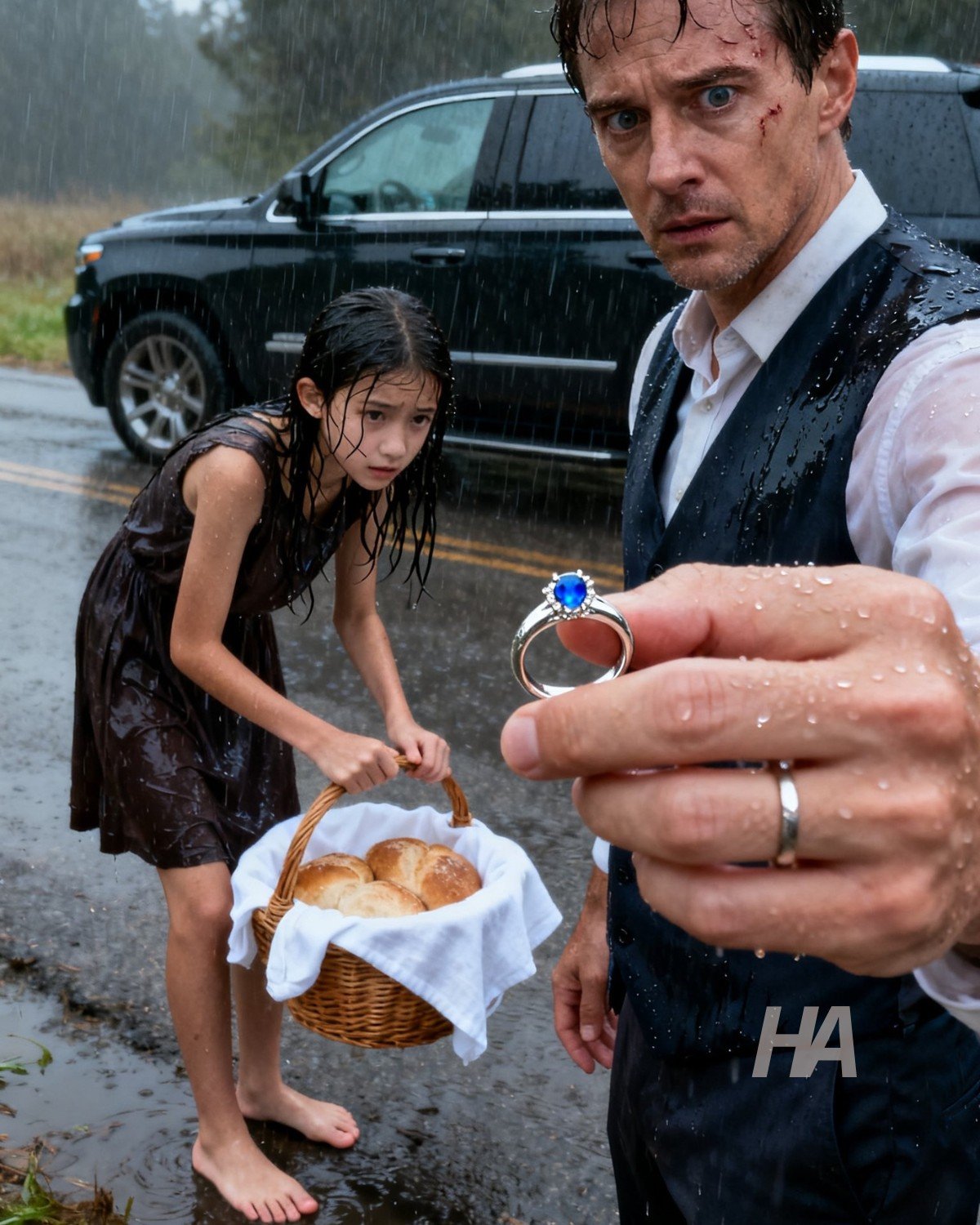
You get back into the black truck and everything smells like leather, rain, and the lie you have been telling yourself for sixteen years. The driver asks if you want the heater on, but you barely hear him. Your eyes are still trapped on that flash of silver and that impossible blue stone, shining on a girl’s finger like a lighthouse calling you toward a shipwreck you never finished drowning in. You tell him to drive, and your voice comes out calm, the way people sound right before they break.
You sit in the back seat and open your phone, thumbs hovering over old numbers you swore you’d never call again. Letícia’s number has been dead for years, but your body still remembers the ritual: type it, stare at it, delete it. Rain drums the roof in a steady heartbeat, and you realize yours is out of sync. You don’t want to chase the girl, but you also don’t want to let the universe steal her from you twice.
You make one decision, small and viciously precise. You ask your head of security to pull the traffic camera footage from the intersection, not the city’s cameras, yours. Money can’t buy love, but it can buy angles, timestamps, and the direction a barefoot girl takes when she disappears into Paraty’s wet labyrinth. Your driver glances at you again like he can sense a storm forming inside the car, and you give him the only instruction that matters: “Find out where she lives.”
You tell yourself you’re being careful. You tell yourself you’re not going to scare her, not going to drag her into some billionaire nightmare of questions and lawyers and blood tests. But the truth is simpler and uglier: you are terrified that if you wait, she’ll evaporate like every other good thing in your life. You watch the wipers slice the world into clean and dirty halves, and you wonder which side you belong on.
That night, you don’t go back to your mansion overlooking the bay. You go to your office, because offices are where feelings go to be punished into silence. Glass walls, cold lights, assistants who don’t ask personal questions, and a desk that has heard you say “handle it” more times than it has heard you say “I miss her.” You pull up the old file you never deleted, labeled LETÍCIA M. and dated sixteen years ago like a wound that still has stitches in it.
There are photos in the file, the ones you kept even after you burned the rest of your life down. Letícia laughing with flour on her cheek because she insisted on making pão de queijo from scratch even when you could have hired a chef. Letícia in your hoodie, hair in a messy bun, holding the ultrasound photo like it was a ticket to a future she trusted. You stare until your eyes sting, then you scroll to the last thing in the file: the letter she left you.
You could recite it from memory, but you read it anyway, the way people touch bruises just to confirm they’re real. She wrote that she had to go. She wrote that she was sorry. She wrote that you would hate her but that one day you’d understand.
You never understood. You built an empire instead, because empires don’t leave you pregnant and alone.
Your security chief calls at 11:43 p.m. and tells you they found the girl. You don’t say “thank you” like a normal person; you say, “Where?” The address he gives you isn’t a street so much as a description: a narrow lane behind the old church, near the cobblestones that never dry, in a part of town tourists photograph but don’t really see. He adds one detail that makes your throat tighten: “She lives with her mother.”
You stand up so fast your chair squeals. Your body reacts like it has been waiting sixteen years for permission. You look at the mirror in your office window, the reflection of a man in an expensive suit pretending he isn’t about to run into the rain and beg the past to stop running. You whisper her name once, not into the phone, not for anyone else, just to hear if the world still recognizes it: “Letícia.”
You drive there yourself. You don’t bring a convoy, you don’t bring cameras, you don’t bring the kind of noise your name usually drags behind it. You bring only one thing you’ve avoided carrying for years: hope. In the passenger seat, you hold a small velvet box you found in your safe, the twin of the ring you gave her, because you had ordered two back then like an idiot who believed in matching forever.
When you reach the lane, the rain has softened into a mist that clings to your skin like a warning. The houses are close together, painted colors that look cheerful during sunlight and bruised at night. You park, step out, and the world feels too quiet, as if Paraty itself is holding its breath. You walk toward a door that doesn’t belong to your world, and your shoes splash in puddles that reflect street lamps like floating coins.
A window glows faintly. You can see a shadow moving inside, the shape of someone small crossing the room. Your heart trips over itself when you recognize the posture before you recognize the face, because grief becomes fluent in body language. You raise your hand to knock, and for a second you can’t, because knocking means answers, and answers mean consequences.
The door opens before you touch it.
Isabela stands there, damp hair braided down her back, eyes wider than they were in the rain. She looks at you like you’re a ghost who returned with manners. “Sir?” she whispers, and you realize she has been expecting you, which is either a miracle or a trap.
“I’m sorry,” you say, because you can’t think of any other first sentence that won’t shatter something. “I didn’t want to scare you. I just… I saw your ring.”
Her fingers curl instinctively around the blue stone like she’s protecting it from being stolen. “It was my mother’s,” she says carefully. “She told me not to take it off. Not ever.”
Your lungs forget their job. “Is your mother home?” you ask, and your voice is softer than it has any right to be.
Isabela hesitates, then glances over her shoulder. “She’s… she doesn’t like visitors,” she admits, and there’s something practiced in her tone, like she has been managing her mother’s borders for years. Then she adds the sentence that tilts the ground under you: “But she said if a man ever asked about the ring, I should listen.”
Before you can respond, a second voice cuts through the room, sharp as a match struck in the dark. “Isabela, who is it?” The accent you remember lives in that voice like a ghost refusing to die.
Your mouth opens, but nothing comes out. The hallway light flickers once, and you take a step forward like your body is being pulled by a chain you forgot you wore. Isabela moves aside, and you see her mother in the dimness.
She is not the woman from your photos. She is older, thinner, and there’s a tiredness in her bones that looks like survival, not aging. Her hair is shorter, her face has a faint scar near the temple, and her eyes… her eyes are the same eyes that used to look at you like you were the safest place in the world. She stares at you as if she’s looking at a painting she once loved and then burned.
“Eduardo,” she says, and your name sounds foreign in her mouth, like she’s tasting it to see if it’s still poison.
You don’t step closer. You don’t touch her. You don’t do any of the desperate things your heart screams for, because one wrong move could send her back into hiding and you cannot survive losing her twice. “Letícia,” you manage, and the room seems to tighten around the syllables.
Isabela looks between you and her mother like she’s watching a storm choose where to land. “Mom?” she asks, voice small. “You know him?”
Letícia’s throat moves as she swallows something heavier than words. “Go to your room, meu amor,” she says, and Isabela immediately shakes her head, stubborn in a way that makes your chest ache. The girl doesn’t know it, but she is arguing with your own blood, with your own defiance, with the exact kind of courage you always wanted to protect.
“No,” Isabela says. “You always send me away when it’s important. I’m not a kid.”
Letícia’s eyes soften for half a second, and you catch it like a man catching a falling glass. “You’re not,” Letícia agrees quietly. “You’re the reason I’m still here.”
Silence settles over the room. Outside, the rain whispers against the shutters like gossip. You realize you are standing in a tiny house that smells faintly of yeast and soap, a house where your life could have lived if the universe hadn’t taken a knife to it.
You speak gently, each word a careful step across broken glass. “I’m not here to hurt you,” you say to Letícia. “I don’t even know what happened. I only know you vanished. And now I see that ring on her hand, and I…” You stop, because admitting you have been hollow for sixteen years feels pathetic in front of a woman who has clearly been fighting for oxygen.
Letícia’s jaw tightens. “You think I wanted to disappear?” she asks, voice low. “You think I woke up one morning and decided to ruin you for fun?”
Isabela’s eyebrows knit together, confusion turning to fear. “Mom, what is he talking about?” she demands. “What do you mean, disappeared?”
Letícia closes her eyes, and when she opens them, you see resignation, the kind that comes after carrying a secret too long. She looks at Isabela, and you see love there, fierce and exhausted. “Because if I told you,” Letícia says, “I would have to tell you everything.”
You feel your stomach drop. “Tell us,” you say, and you hate how selfish it sounds. But you also know the truth is a locked door and you are done living outside in the rain.
Letícia motions toward the small kitchen table. It’s chipped at the corners, covered with a plastic cloth patterned with little flowers that look too cheerful for the heaviness in the room. You sit, and the chair creaks as if it isn’t used to men like you. Isabela sits too, arms crossed, eyes sharp, ready to fight the universe if it tries to lie to her.
Letícia doesn’t sit at first. She paces once, then stops behind Isabela, resting her hands lightly on the girl’s shoulders. That touch is both anchor and apology. “Sixteen years ago,” Letícia begins, “I was three months pregnant. I was happy. And then I learned something I wasn’t supposed to learn.”
Your brain scrambles through old memories like a filing cabinet on fire. “What?” you ask.
She laughs once, humorless. “Your company,” she says. “It wasn’t just technology. It was power. And power attracts men who think love is a weakness they can exploit.”
You open your mouth to deny it, but you remember the early days. The investors. The backroom meetings. The threats disguised as offers. The way you learned to buy silence because silence was cheaper than war. You remember one name, and the memory tastes like metal.
Letícia says it before you can. “Marcos Vieira,” she spits, and the room goes cold.
Your fists clench. Marcos had been your partner before he became your enemy, the man who smiled while he planted knives. “He’s gone,” you say. “I pushed him out years ago.”
Letícia’s eyes sharpen. “Now he is,” she agrees. “But back then he wasn’t. Back then he came to me.”
Isabela’s head snaps up. “He came to you?” she repeats. “Why?”
Letícia’s hands tighten on Isabela’s shoulders, not hurting, just bracing. “Because I was carrying you,” she says softly, and Isabela freezes, the sentence hitting her like a wave she didn’t see coming.
You stop breathing. The world reduces to one detail: Letícia just told the girl she is the baby. The baby you lost. The baby you thought never existed beyond an ultrasound photo and a dream.
Isabela’s voice trembles. “What are you saying?” she whispers. “Mom, what are you saying?”
Letícia kneels beside her, eyes level with hers, and the air in the room feels fragile, like a glass ornament held over stone. “I’m saying,” Letícia says, “your father is Eduardo.”
Isabela turns slowly to look at you. Her eyes search your face with the same survival instinct she had in the rain, but now it’s mixed with something else: betrayal, curiosity, yearning, and a furious need for truth. “No,” she says, like she can refuse reality into changing shape. “That’s not… that’s impossible.”
You want to reach for her, but you don’t. You keep your hands on your knees, palms open, showing her you are not a threat, even if your existence just became one. “It’s true,” you say quietly. “I didn’t know. I swear to you, I didn’t know.”
Isabela’s breath comes fast. “Then why wasn’t he here?” she throws at her mother. “Why did I grow up like this? Why did you let me think he was some stranger in the world?”
Letícia closes her eyes, and when she opens them, the tears are there but they don’t fall yet. “Because Marcos told me he would destroy Eduardo,” she says. “Not with lawsuits. With blood.”
Your spine stiffens. “He threatened you?” you ask, voice dangerously calm.
“He threatened you through me,” Letícia corrects. “He told me if you found out about the baby, if I stayed with you, he would make sure you lost everything. He would ruin your company, frame you, bury you in scandals, take your freedom. And then he said something worse.”
Isabela’s voice is small again. “What?”
Letícia swallows. “He said he would make sure you never met your daughter,” she says. “Because dead dreams are easier to control than living ones.”
Your vision blurs at the edges. You remember the year after Letícia vanished, the accidents that suddenly happened around you: a hacked server, a suspicious fire in a storage facility, a car that followed you for weeks. You thought it was business warfare. You never considered it might have been a leash around your family.
Letícia continues, voice steady now because she has been rehearsing this confession in her head for sixteen years. “I tried to tell you,” she says. “I tried. But Marcos intercepted my messages. He had someone watching me. He cornered me outside the clinic, and he…” She touches the scar near her temple unconsciously. “He pushed me. I hit my head.”
Isabela’s hand flies to her mouth. Your chest tightens so hard it feels like ribs might crack. “You were hurt,” you whisper.
“I woke up in a hospital in Angra,” Letícia says. “They told me I’d been in an accident. My memory was… scattered. Like someone tore pages out of a book and threw them into the sea.”
You stare at her, sick with it. “And Marcos?” you ask, because you already hate the answer.
“He visited me,” Letícia says, voice flat. “He brought flowers. He smiled. He told me I was confused. He said you didn’t want me, that you were ashamed, that you had begged him to ‘handle it’ because a baby would ruin your image.”
Isabela flinches like she’s been slapped. She looks at you, and you can see the question burning in her eyes: Did you?
“No,” you say immediately, voice breaking around the word. “No. I would have died before saying that.”
Letícia watches you, and something shifts in her face, not forgiveness, not yet, but recognition. “I didn’t believe him at first,” she admits. “But I didn’t have you to prove him wrong. And then he did the one thing that finally made me run.”
Isabela whispers, “What?”
Letícia’s eyes drop to the ring on Isabela’s finger. “He tried to take it,” she says. “He said it was evidence. That if anyone saw it, they’d ask questions. He grabbed my hand, tried to rip it off. I screamed.”
You feel a cold rage settle into your bones. You imagine Marcos yanking at the ring you had engraved with a promise, turning your love into a crime scene. You breathe slowly, because if you let the rage loose, you will scare them, and fear is what Marcos used to control this house for sixteen years.
Letícia continues, softer now. “A nurse came in. Marcos left. And that night I remembered something clear as lightning: you on one knee, laughing because you were nervous, sliding the ring on my finger and whispering that it wasn’t about money, it was about choosing each other. I didn’t remember all of you,” she says, voice cracking. “But I remembered enough to know Marcos was lying.”
Isabela’s eyes are wet. “So why didn’t you find him?” she asks, and the “him” is you, and it hits you like a fist.
Letícia exhales, long and shaky. “Because Marcos had already done the rest,” she says. “He told the hospital I was unstable. He arranged paperwork. He moved me. By the time I escaped, I had no phone, no documents, and I was pregnant in a body that still couldn’t hold memories without dropping them.”
Your throat burns. “But you remembered Isabela,” you whisper.
Letícia nods. “I remembered her,” she says. “And I remembered the ring. I thought if I could keep that, if I could keep one proof, one thread, then one day the truth could find its way back.”
Isabela rubs her thumb over the blue stone as if it might speak. “You made me wear it,” she realizes. “That’s why.”
Letícia nods again. “I told myself I was protecting you,” she says. “But I was also… leaving a trail for him. Even if I was too afraid to follow it myself.”
You sit there, feeling time rearrange itself in your chest. Sixteen years of anger turns into something else, something heavier: grief with a target. You look at Isabela, at her stubborn posture, her sharp eyes, her brave mouth, and you see pieces of yourself woven into her like an accusation and a gift.
Isabela wipes her cheeks with the back of her hand, furious at her own tears. “So what now?” she demands, voice shaking. “He’s my father and he’s standing in our kitchen like he’s lost and I’m supposed to just… accept it?”
You nod slowly. “No,” you tell her. “You’re not supposed to do anything. You don’t owe me an instant family. I owe you the truth, and time, and whatever you decide after that.”
Letícia studies you like she’s trying to detect a trap. “And what do you decide?” she asks, cautious. “Because this isn’t just feelings. Marcos might be gone, but men like him leave echoes.”
You lean forward, elbows on your knees. “I decide to protect you,” you say. “Both of you. Not by controlling you, but by making sure no one can ever threaten you again.”
Isabela scoffs through tears. “With money?” she challenges. “Because that’s what you do, right? Buy buildings, buy silences, buy—”
“Buy second chances?” you say gently. “I can’t buy those. I know. But I can show up. I can listen. I can prove I’m not the villain in your mother’s nightmare.”
Letícia’s lips tremble. “Eduardo,” she says, and there’s exhaustion in your name. “You don’t know what it was like. Every time I thought about finding you, I pictured Marcos standing behind you with a smile. I pictured you getting hurt because of me. I pictured Isabela paying for my choices.”
You swallow hard. “And I pictured you dead,” you confess. “Or hating me. Or forgetting me. I pictured everything except this.”
Isabela’s gaze flicks between you and her mother, and you can see a decision forming, not fully shaped but inevitable. She stands abruptly, chair scraping. “I need air,” she announces, then walks to the small doorway that leads to the front step.
For a moment, it’s just you and Letícia again, like the universe is cruel enough to give you privacy inside a miracle. She sits finally, shoulders slumping, and you notice how small she looks now, how survival has stolen her softness and replaced it with edges. You reach into your pocket and pull out the velvet box, placing it on the table without opening it.
Letícia stares at it. “What is that?” she asks.
“A mistake,” you say, voice thick. “And a hope. I had it in a safe because I couldn’t throw it away. It’s the twin of your ring.”
Her eyes fill, and this time the tears fall, silent and steady. “You kept it,” she whispers, as if the fact itself is proof you weren’t capable of the cruelty Marcos described.
You nod. “I kept everything,” you admit. “Not the furniture, not the houses. The small things. The recipes you wrote on scraps of paper. The voicemail where you laughed because I tried to sing. The photo booth strip from the fair where you made me wear that stupid crown.”
Letícia laughs softly through tears, and the sound slices you open. “I can’t believe,” she says, voice breaking, “that we wasted sixteen years.”
You shake your head. “We didn’t waste them,” you tell her. “You spent them keeping her alive. I spent them building something strong enough that if you ever came back… I could keep you safe.”
Outside, Isabela leans on the doorway, staring at the rain. You watch her for a second, and your heart does something unfamiliar: it feels like it’s growing new rooms. You stand slowly and move toward the door, stopping at a respectful distance.
“Isabela,” you say softly.
She doesn’t look at you at first. “My whole life,” she says, voice flat, “I thought fathers were just… stories people told on TV. Or ghosts in other people’s photos.”
You swallow. “I’m sorry,” you say, and the apology feels too small for the damage.
She finally turns, eyes red, chin lifted in defiance. “If you’re my father,” she says, “then why did I have to sell bread in the rain?”
The question is sharp, fair, and deadly. You hold it like a blade offered handle-first. “Because I didn’t know,” you say. “But now I do. And I can’t change the rain you walked through,” you add, “but I can promise you something: you will never walk through it alone again. Not if you don’t want to.”
Isabela studies your face like she’s trying to see if the truth is stable. “I don’t want your pity,” she warns.
“I don’t have pity,” you answer. “I have regret. And something else I’m not allowed to demand from you.” You pause, then say it anyway, carefully: “A chance.”
She looks away, blinking hard. “A chance,” she repeats, tasting the concept like it might be bitter. Then she points at your chest, not touching you but close enough that you feel the heat of her anger. “If you’re lying,” she says, “if this is some weird rich-person game, I’ll hate you forever.”
You nod once. “Fair,” you say. “So let’s do this the right way. Tomorrow, we can get answers. Not with cameras. Not with headlines. Just truth.”
Letícia steps into the doorway behind you, and you feel the gravity of her presence. “DNA test,” Letícia says, voice steady but tired. “And legal protection. If Marcos had people… we need to be careful.”
You exhale. “I’ll arrange everything,” you say, then correct yourself because you’re trying to learn a new language where you don’t control everything. “I’ll offer everything,” you say. “And you decide.”
The next morning, Paraty wakes under a washed-out sky. The rain has moved on, leaving the cobblestones slick and shining like they’ve been varnished. You arrive with one car, no entourage, dressed plainly for once, because you’re not trying to impress them; you’re trying not to intimidate them. Isabela watches you from the doorway with arms crossed, and you realize she inherited her mother’s suspicion as a survival tool.
You take them to a private clinic in Rio, one you trust, one where silence is protected by ethics instead of money. The nurse explains the process kindly, and Isabela makes a joke about vampires stealing her blood, which surprises you, because humor is courage wearing a mask. Letícia holds her hand during the swab, and you see how their bond has been the spine of their lives.
While you wait for results, you don’t force intimacy. You don’t call Isabela “daughter” like you’ve earned the word. You don’t touch Letícia’s hand like the past is automatically yours. You sit with them in the awkward space between strangers and family, and you let that space exist without trying to fill it with gold.
Still, little moments leak through. Isabela points at a pastry display and critiques the texture like a professional baker, and you remember Letícia’s obsession with perfect dough. Letícia notices the way you always position yourself between them and the door, a protective habit you didn’t even know you had, and her expression softens for a heartbeat. In that heartbeat, you see the woman from your photos, the one who believed in you before the world trained you to buy silence.
The results come two days later.
The doctor calls you into a small office with neutral art on the walls, the kind meant to calm people who are about to have their lives rearranged. Letícia sits beside Isabela, shoulders squared. You sit opposite them, hands clasped so tightly your knuckles pale, because suddenly the future depends on a piece of paper.
The doctor clears his throat. “The test confirms,” he says, “a biological parent-child relationship between Eduardo Albuquerque and Isabela.”
For a second, the room loses sound. Your ears ring, and you feel like you might float out of your own skin. You look at Isabela, and she is staring at the doctor like she’s waiting for him to say “just kidding.” Then she turns to you slowly, and the anger drains into something raw and frightened.
You don’t smile. You don’t celebrate. You don’t treat it like a victory, because it isn’t. It’s a door that opens onto sixteen years of darkness, and now you all have to walk through it together.
Isabela’s voice cracks. “So it’s true,” she whispers.
You nod, throat tight. “It’s true,” you say. “I’m your father.”
She stares at you for a long time. Then, to your shock, she laughs, one short burst that sounds like a sob with teeth. “My father is a millionaire,” she says, incredulous, then immediately shakes her head like the sentence is too ridiculous to sit still. “That’s… that’s so stupid.”
You let out a breath that might be the first honest breath you’ve taken in years. “It is stupid,” you agree softly. “But it’s also true.”
Letícia covers her mouth, tears spilling freely now. Isabela looks at her mother, then back at you, and something in her expression shifts from interrogation to evaluation. “Okay,” she says finally, voice trembling but firm. “Then prove it.”
You blink. “Prove what?” you ask, because you would sign over half the world if she asked, and you’re terrified she will.
“Prove you’re not just a name,” she says. “Prove you’re not going to disappear like everyone else. Prove you want us, not… the idea of us.”
You nod slowly. “Tell me how,” you say.
Isabela thinks, jaw working. “Start with this,” she says, pointing at Letícia. “She’s been scared for sixteen years. She doesn’t trust you. And I don’t trust anyone who treats my mother like an accessory.”
Letícia flinches, but there’s pride in her eyes too. You turn toward Letícia. “You don’t have to trust me today,” you tell her. “You don’t even have to forgive me for not finding you. But you can let me help you now.”
Letícia wipes her cheeks and looks at you like she’s deciding whether your sincerity can survive reality. “Help how?” she asks.
You choose your words carefully, because this is where men like you usually get it wrong. “Not by moving you into a mansion,” you say. “Not by forcing a new life on you. By giving you options and protection. A lawyer to review everything, a security plan that doesn’t feel like a prison, medical support if you need it, therapy if you want it. And time. As much time as you need.”
Letícia’s shoulders sag, and you see how tired she is of being brave. “And Marcos?” she asks in a whisper. “If he left echoes…”
You nod. “I’ll find them,” you promise, voice calm in a way that scares even you. “Not with violence. With evidence. With the law. With light.”
In the weeks that follow, you learn a new kind of work. It’s not hostile takeovers or boardrooms or negotiating silence. It’s learning what kind of tea Isabela likes when she’s upset, and learning that she pretends she isn’t upset by getting louder. It’s learning that Letícia flinches at certain car models, and you quietly swap vehicles without making a show of it. It’s learning to sit in a small kitchen and eat simple bread without checking your phone, because you’re trying to prove your presence is real.
You rent a modest house in Paraty, close enough that you can be there without invading. Isabela calls it your “practice house,” and when she says it, there’s a hint of humor, which feels like a rose growing through concrete. Letícia keeps selling bread at first, stubborn and proud, refusing your money like it’s a trap. You don’t argue; you buy bread the way you did the first day, but now you buy it because it’s hers, not because it’s charity.
One afternoon, Isabela drags you to the market and makes you carry a basket like a punishment. You stumble on the wet stones, and she laughs so hard she nearly drops a bag of fruit. “Careful, billionaire,” she teases. “These streets don’t care who you are.”
You grin despite yourself. “Good,” you say. “Neither do you.”
She freezes at that, then rolls her eyes dramatically like she’s annoyed by her own emotions. “Don’t get cheesy,” she warns, but her voice is softer.
The real test comes a month later.
A man shows up at Letícia’s door while you’re out, claiming to be from a legal office. He carries documents that look official and asks questions that are too specific, too hungry. Isabela senses something wrong immediately, because she has been surviving lies her whole life. She shuts the door in his face, locks it, and calls you with shaking hands.
You arrive ten minutes later, and by then your security team has already identified him. He isn’t a lawyer. He’s a private investigator with ties to an old network Marcos once used. The realization is a cold hand around your throat: the past is still alive enough to knock.
You don’t panic in front of them. You take a slow breath and kneel in front of Isabela, meeting her eyes. “You did the right thing,” you tell her. “You were smart. You were brave.”
Isabela’s lips tremble. “He found us,” she whispers. “He found us again.”
“No,” you correct gently. “He tried. And he failed. Because now you have me too.”
Letícia stands behind Isabela, pale but steady, and you see something in her gaze that looks like the first brick of trust. Not love. Not forgiveness. But the recognition that you are not running.
You file reports. You involve federal authorities. You provide evidence of harassment, and because you have resources and influence, the system actually moves instead of shrugging. It isn’t cinematic revenge. It’s paperwork and court dates and tight security plans, the boring kind of protection that saves lives. And in that boredom, you discover something sacred: safety is often quiet.
One evening, after everything settles, Isabela sits on the porch steps with you. The sky is clear for the first time in weeks, and the stars above Paraty look like someone spilled sugar on velvet. She fidgets with the ring, spinning the blue stone back and forth.
“Do you miss her?” she asks suddenly, meaning Letícia, meaning the past, meaning all of it.
You swallow. “Every day,” you admit.
Isabela nods slowly. “She misses you too,” she says, voice matter-of-fact, as if she’s reporting the weather. Then she adds, softer: “She just doesn’t trust happiness. Not yet.”
You look at your daughter, your real, living daughter, and the word “daughter” feels both terrifying and holy. “Do you?” you ask carefully. “Do you trust it?”
Isabela snorts. “I don’t even trust stairs,” she says, then her expression shifts, sincerity slipping through the sarcasm. “But… I’m trying.”
You nod. “Me too,” you say.
The next day, Letícia finds you in your rented house kitchen, staring at a bowl of dough like it’s a foreign language. You look up when she enters, and for the first time she doesn’t look like she’s bracing for impact. She walks to the counter, washes her hands, and silently takes over, fingers moving with practiced ease.
“You’re kneading like you’re fighting,” she says lightly.
You chuckle, embarrassed. “That’s all I know how to do,” you admit.
Letícia glances at you. “Then learn something else,” she says.
You watch her hands work the dough, and you feel a strange calm settle into your bones. You realize that this is the real miracle, not the DNA paper, not the ring, not even the reunion. The miracle is a woman who was once forced to run now standing in a kitchen with you, teaching you how to make something gentle.
“I’m sorry,” you say again, because apologies are all you have that don’t feel like bribes. “For not finding you. For not protecting you. For—”
Letícia stops kneading and looks at you, eyes clear. “You can’t rewrite the past,” she says. “But you can write what comes next. And you don’t have to write it alone.”
Your throat tightens. You nod, unable to speak, and Letícia returns to the dough like she has made a decision.
That night, Isabela comes home with her basket of unsold bread and finds the two of you at the table, flour on your hands, a ridiculous little loaf rising between you like a newborn promise. She stops in the doorway, suspicious. “What is this?” she demands.
You glance at Letícia, then back at Isabela. “A disaster,” you confess. “But a hopeful one.”
Isabela walks closer, peers at the loaf, then wrinkles her nose. “It looks like a sad rock,” she says.
Letícia laughs, genuine. “It will taste better than it looks,” she promises.
Isabela sits, still cautious, but she breaks off a small piece and chews. Her eyes widen in surprise. “Okay,” she admits grudgingly. “It’s… not terrible.”
You smile, and the smile feels like it belongs to someone you used to be. “High praise,” you say.
Isabela rolls her eyes, but she doesn’t stand up and leave. She stays. And when Letícia reaches across the table and wipes a smear of flour from your cheek, Isabela pretends not to notice, but her shoulders relax as if some tight knot inside her has finally loosened.
Later, when the house is quiet, you find Isabela on the porch again, ring glinting under the porch light. She holds it up to you. “You know what’s funny?” she says.
“What?” you ask.
She taps the inside of the band with her nail. “I used to think the letters inside were magic,” she says. “Like a spell. E and L. Forever.” She looks at you, eyes serious. “I didn’t know it was… you.”
Your chest aches. “It was always you too,” you tell her gently. “Even when I didn’t know your name.”
Isabela swallows hard. “I’m still mad,” she warns.
“I know,” you say.
“But,” she adds, voice quieter, “I’m also… glad you stopped that day.”
You nod, and something inside you finally unclenches. “Me too,” you whisper.
She hesitates, then steps forward and leans into you. It’s not a movie hug. It’s awkward and brief and trembling at the edges. But it is real, and it hits you harder than any deal you ever closed.
When she pulls back, she wipes her face quickly like she’s annoyed at her own softness. “Don’t make it weird,” she mutters.
You smile through the sting in your eyes. “I won’t,” you promise. “But I will make it steady.”
And that is how the story ends, not with fireworks, not with some perfect erased past, but with the quietest kind of victory. A ring that once marked a loss now marks a connection. A girl who used to walk through rain alone now has two shadows beside her. And you, Eduardo Albuquerque, finally learn that the richest thing you can build isn’t an empire.
It’s a home.
Website Disclaimer
The information provided on this website is for general informational and educational purposes only. While we strive to ensure that all content is accurate and up to date, we make no guarantees regarding the completeness, reliability, or accuracy of any information published.
The views and opinions expressed in articles belong to their respective authors and do not necessarily reflect the views of this website. Any action you take based on the information found on this website is strictly at your own risk. We will not be liable for any losses, damages, or inconveniences arising from the use of our content.
Some articles may contain opinions, third-party information, or external links. We do not endorse or guarantee the accuracy of content on external websites and are not responsible for their practices or policies.
All content on this website is provided in good faith and is intended for informational purposes only. Readers are encouraged to verify information independently and seek professional advice where appropriate.