Part 1
If you met my mom in a grocery store, you’d think she was one of those women who always remembered birthdays and brought casseroles to sick neighbors. She had that voice—sweet on the surface, sharpened underneath, like she could make a compliment feel like a warning.
Growing up, that voice belonged to my sister, Kayla.
Kayla is two years younger than me, but in our house she might as well have been the only child. When she wanted dance lessons, mom found the money. When she wanted a better phone, mom “made a few calls.” When she wanted to quit her job because her manager “didn’t respect her vibe,” mom told her to “protect her peace” and covered her rent.
When I wanted something, I got a speech about character.
I’m Morgan, twenty-five, and I live in Denver in a one-bedroom apartment that I earned the unglamorous way: remote programming gigs, late nights, weekends that turned into Monday mornings without me noticing. I’ve never been flashy. I’m the kind of person who reads terms and conditions and has a spreadsheet for my budget. I started saving in college because I knew nobody was coming to rescue me.
By last spring, my savings account was the first thing in my life that felt like a safety net. Not a huge one, but enough to breathe. Enough to say, if my laptop dies, I won’t spiral. If I lose a client, I won’t panic. It was mine. It was proof that my life belonged to me.
Then Kayla racked up fifteen thousand dollars in debt.
I didn’t hear it from her. I heard it from my mom, who showed up at my door on a Tuesday afternoon like she was delivering a subpoena.
I opened the door and saw her standing there with her purse tucked under her arm, mouth already set. She didn’t ask how I was. She didn’t comment on the Denver weather. She stepped inside like my apartment was an extension of hers.
“Morgan,” she said, letting the word stretch, “we need to talk.”
I already knew what was coming. Mom never visited unless she needed something.
I crossed my arms. “Okay.”
She pulled out her phone, tapped a few times, then thrust the screen toward me like evidence. A list of creditor names, amounts, due dates. Kayla’s name at the top.
“Kayla got in over her head,” mom said, voice tight, like I should feel sorry for her. “It’s not her fault. Those companies prey on young women.”
“Kayla is twenty-three,” I said. “Not thirteen.”
Mom’s eyes flashed. “Don’t start.”
I looked at the numbers again. Fifteen thousand, stacked in ugly little rows. Credit cards, buy-now-pay-later accounts, a personal loan with a rate that made my stomach flip.
“How did she even—” I started.
“She needed things,” mom cut in. “Car repairs. Work clothes. And she had that emergency with the dog.”
I stared at her. Kayla didn’t have a dog.
Mom’s cheeks reddened a fraction. “Whatever. That’s not the point.”
“What’s the point?” I asked, even though I could feel it approaching like a truck.
Mom inhaled and said it like she was doing me a favor. “You’re going to help pay it off.”
My laugh came out sharp. “No.”
Her expression shifted immediately, sweet to cold. “Excuse me?”
“I’m not paying Kayla’s debt,” I said. “That’s not ‘help.’ That’s enabling.”
Mom stepped closer. “Family sticks together, Morgan.”
“I am family,” I said. “And nobody sticks together for me.”
Her lips pressed thin. “You have savings.”
The way she said it—like savings were communal property—made something in my chest tighten.
“I have savings because I worked for them,” I replied. “I didn’t buy them on a credit card.”
Mom’s voice rose. “You’re being selfish.”
“I’m being responsible.”
She shook her head like I was disappointing her on purpose. “Kayla is drowning.”
“Then she can call the creditors and make a plan,” I said. “She can get a second job. She can sell the stuff she bought.”
Mom’s nostrils flared. “You want your sister to suffer?”
I held her gaze. “I want her to learn.”
The silence between us got thick, packed with every old argument we’d never had out loud. Mom’s face twisted—not sad, not hurt, but angry. Like I’d broken a rule she thought I’d never question.
“You think you’re better than her,” she said.
I didn’t answer, because I wasn’t going to spend my life defending myself against accusations designed to make me fold.
Mom’s voice dropped. “You’re going to regret this.”
Then she left, slamming my door so hard my cheap wall art rattled.
I stood there for a long moment, heart pounding, and told myself it was done. I’d said no. Boundaries. Adult life.
That night I triple-checked that my door was locked. I went to bed with my laptop on the nightstand like some weird comfort object. I fell asleep thinking about my next sprint at work, about deadlines and code and a life that felt predictable.
At 6:12 a.m., my phone buzzed.
Then buzzed again.
Then buzzed again.
I grabbed it, still half asleep, and saw bank alerts stacked like dominoes.
Credit card: new charge.
Credit card: new charge.
Savings: withdrawal.
Savings: withdrawal.
I sat up so fast my head spun.
I opened my banking app with shaking fingers.
My credit card balance was maxed. Fifteen thousand dollars in payments processed overnight, routed to Kayla’s creditors. My savings account—my careful, earned safety net—was nearly wiped out.
For a second, my brain refused to accept it. I stared at the screen like it might correct itself if I waited long enough.
Then I remembered something small and stupid.
The spare key.
Years ago, back when I’d moved into my first apartment and thought it was normal for parents to have access “just in case,” I’d handed my mom a spare key. When I moved, I never asked for it back. It didn’t occur to me that “just in case” could mean “just in case you don’t obey.”
My hands went cold.
I called her.
She answered on the third ring, cheerful enough to make me feel insane. “Morning, Morgan. Sleep well?”
My voice came out low and flat. “Did you come into my apartment last night?”
A pause. A tiny one. The kind that tells you everything.
“Don’t be dramatic,” mom said lightly.
“I’m looking at fifteen thousand dollars of charges,” I said. “You used my card and drained my savings to pay Kayla’s debts.”
Another pause. Then, with a sigh like I was the problem, she said, “You were being stubborn. Kayla needed help.”
“That’s theft.”
“It’s not theft if it’s family,” she snapped. “And you’ll get over it once you calm down.”
Something in me went quiet. Not numb—focused.
I could have screamed. I could have driven to her house. I could have called Kayla and unloaded every ounce of rage I’d been storing since childhood.
Instead, I said, “Okay.”
Mom hesitated, thrown off. “Okay?”
“Okay,” I repeated. “Good to know.”
Then I hung up.
I sat on the edge of my bed and stared at the wall while my heartbeat tried to hammer its way out of my chest. I felt violated in a way that had nothing to do with money. Like my home had been breached, like my life had been picked up and rearranged without my consent.
And underneath the shock, a colder thought formed.
They didn’t just do this because Kayla had debt.
They did it because they assumed I’d take it.
They assumed I’d complain, maybe cry, but ultimately fold, because that’s what I’d always done—work harder, swallow more, keep the peace.
I wiped my face with the back of my hand, grabbed my coat, and texted the one person who never told me to “be the bigger person” when someone hurt me.
Tasha: Are you free this morning? Emergency.
Three dots appeared immediately.
Tasha: Where are you? I’m on my way.
Part 2
Tasha met me at a coffee shop downtown with the kind of energy you want in a crisis: calm, practical, slightly furious on your behalf.
I slid into the booth across from her and pushed my phone toward her. She scrolled through the transactions, eyes widening.
“Okay,” she said, voice steady. “Okay. We’re not reacting emotionally. We’re reacting strategically.”
“I already called her,” I admitted.
Tasha’s eyebrows shot up. “And?”
“She didn’t deny it,” I said. “She acted like it was normal.”
Tasha leaned back, exhaled through her nose like she was trying not to commit a crime. “All right. Step one: freeze everything. Step two: evidence. Step three: police. Step four: locks.”
I nodded, because I needed someone to hand me a list. My brain was too loud for free-form thinking.
On my laptop, right there in the coffee shop, I called my bank and reported the card stolen and the transactions unauthorized. I asked for a full fraud investigation. I moved what little remained in savings to a brand-new account and set up alerts for everything. I changed my passwords, added two-factor authentication, and put a freeze on my credit.
Tasha watched the whole thing like a coach. “Good,” she said. “Now we prove it.”
Back at my apartment, the air felt different—like the place had been contaminated. I stood inside my doorway and looked around, imagining my mom moving through my rooms at midnight. Opening drawers. Knowing where my wallet was. Knowing where my paperwork lived.
I swallowed the nausea and did what Tasha told me.
My building had a security app. I’d never used it, because I’d never needed to. I logged in, pulled up the camera timeline, and scrolled back to last night.
At 12:07 a.m., my mom appeared on screen.
She wore a hood like she was some kind of amateur burglar. She moved fast, glancing around the hallway, unlocking my door with the spare key like she owned the place. Thirty minutes later she left with a small bag tucked under her arm.
I watched it twice, then a third time, saving the clip to my laptop, then to a thumb drive, then emailing it to myself like redundancy was a form of safety.
“That’s your proof,” Tasha said, voice tight. “Clear as day.”
Next came the transaction logs. I downloaded bank statements with timestamps, printed them, highlighted the charges. Every payment linked to Kayla’s creditors, not mine. The timing matched the footage.
Then I dug through my texts. Weeks of messages from mom, pushing and pressuring, laying the guilt on thick.
Kayla is in deep.
You’re the responsible one.
Don’t let your sister drown.
Family helps family.
Tasha pointed at a message from the day before, right after I’d refused. You’re going to regret this.
“Threat,” she said. “Motive. Pattern.”
My hands moved automatically, organizing everything into a folder: video, statements, texts, screenshots, notes. The shock faded into something sharper—control.
Then I remembered my dad.
My parents divorced when I was sixteen. Dad moved out of the chaos and into a quieter life, the kind where you can hear yourself think. He lived in a small town outside Denver now. We didn’t talk every day, but when we did, he never tried to talk me out of reality.
I called him.
He answered on the second ring. “Morgan? Everything okay?”
I skipped the small talk. “No. Mom broke into my apartment last night and stole my credit card to pay off Kayla’s debt.”
There was a long silence, the kind that wasn’t disbelief but recognition.
Dad exhaled slowly. “She did it again.”
“Again?” I asked, throat tight.
He hesitated. “Morgan… do you remember Grandpa’s estate? The trust?”
Vaguely. My grandfather had been a cautious man, the kind who read contracts twice and kept files labeled in neat handwriting. When he died, there’d been money, but most of it was structured—locked up, distributed over time, protected.
“I remember there was a trust,” I said. “Why?”
Dad’s voice lowered. “Because your grandpa put a clause in it. Protection against exactly this. Fraud against family triggers forfeiture.”
My pulse jumped. “What does that mean?”
“It means if your mom or Kayla are convicted of stealing from a family member, their shares get redistributed to the remaining beneficiaries,” he said carefully. “He built it because he saw her patterns. He didn’t trust her.”
I sat down hard on my couch. Tasha’s eyes locked on mine, already understanding the leverage.
“How much are we talking?” I asked.
Dad’s tone stayed measured, but I could hear anger underneath. “Your mom’s portion is sizable. Kayla’s smaller. But together… it’s not nothing.”
I swallowed. “And you can enforce it?”
“I’m secondary trustee,” Dad said. “If there’s a conviction, yes. The paperwork is airtight. I’ll email you the documents tonight.”
After I hung up, I stared at the wall, letting the implications settle.
Mom didn’t just steal fifteen thousand dollars.
She put her own future inheritance on the line to save Kayla from consequences.
Because in my mother’s mind, Kayla’s comfort was always worth more than my security.
Tasha sat beside me. “You don’t have to use the trust clause as revenge,” she said quietly. “But you should know you have it. It’s protection. It stops them from doing this to you again.”
“I’m not trying to ruin them,” I said, even though my voice shook.
Tasha’s expression didn’t soften. “Morgan. They already chose to ruin you. You’re just choosing not to absorb it quietly.”
That night, Dad emailed the trust documents. I read them like I read code: slowly, carefully, looking for loopholes.
The clause was clear. Any beneficiary found guilty of fraud, theft, or financial exploitation against an immediate family member would forfeit their share. Redistribution would go to the remaining beneficiaries—me, and a few cousins.
I closed my laptop and felt something in my chest settle into place.
This wasn’t just about getting my money back.
This was about ending a pattern.
The next morning, I went to the police station.
Part 3
Walking into the downtown Denver station felt surreal, like I was stepping into someone else’s life. The fluorescent lights made everything look slightly drained. My hands were steady, but my stomach kept flipping like it expected the ground to give way.
Tasha came with me anyway. She didn’t say much, just sat beside me like a boundary in human form.
We met with Detective Miller in a small interview room. She was in her forties, hair pulled back, eyes sharp. She listened without interruption as I explained the sequence: the demand, the refusal, the break-in, the charges.
When I handed over the printed statements, she studied them, then looked at the video clip on my phone. Mom’s hooded figure slid into frame like a bad decision made physical.
Detective Miller nodded slowly. “This is strong,” she said. “Entry without consent, timed with the transactions, and clear beneficiary of the funds. You’re saying the charges paid your sister’s creditors?”
“Yes,” I said. “All of it.”
“Do you have any texts or messages showing pressure or intent?” she asked.
I passed over the screenshots. She read them, lips tightening.
Tasha leaned in slightly. “She also has the spare key,” she added. “And Morgan never gave permission for entry or use of the card.”
Detective Miller scribbled notes. “All right,” she said. “We’ll open a case. We’ll request full bank documentation and we’ll contact your mother for an interview. You did the right thing coming in quickly.”
My chest loosened a fraction. Not relief exactly, but confirmation. Someone official was calling this what it was.
The case number sat heavy in my palm when I left.
Two days later, my phone rang with an unfamiliar number.
I answered cautiously. “Hello?”
A man’s voice, tense and tired. “Morgan? It’s Nathan.”
Nathan was Kayla’s fiancé. I’d met him twice, both times at family gatherings where Kayla clung to him like he was proof she had her life together. He’d seemed quiet, a little overwhelmed by my family, but kind.
“We need to talk,” he said. “Alone.”
We met at a park near the South Platte River, where joggers passed by and the water moved steadily like it had better things to do than carry our drama.
Nathan looked wrecked. He sat on the bench beside me and stared at his hands.
“I didn’t know about your card,” he said. “Kayla told me you loaned the money. She made it sound like… family support.”
My jaw tightened.
He swallowed. “The police came to our apartment yesterday. Kayla tried to lie at first, but… she cracked. She confessed everything.”
My stomach sank, then hardened. “Everything?”
Nathan pulled out his phone, thumb shaking. “She and your mom planned it,” he said quietly. “Weeks ago. Kayla visited you and scoped where you keep your wallet and documents. She told your mom when you’d be asleep. They joked about how you’d ‘cool off’ and accept it.”
He turned the phone screen toward me: screenshots of texts between Kayla and my mom. The dates lined up with the pressure messages I’d saved. Kayla’s words were casual, almost playful, like stealing from me was a group project.
I felt something go cold behind my ribs.
Nathan’s voice cracked. “I ended the engagement this morning. I can’t marry someone who would do this. Who would laugh about it.”
I nodded slowly, because I didn’t trust myself to speak without shaking.
“I’m sorry,” Nathan said. “For being connected to this. I just… I thought you should have these.”
I forwarded the screenshots to Detective Miller right there, hands moving on autopilot. Evidence. More proof. No ambiguity.
Nathan stood, shoulders slumped. “Good luck,” he said, and walked away like someone leaving a life he hadn’t expected to lose.
After he left, I sat by the river and tried to breathe.
Kayla wasn’t just irresponsible.
She was willing to weaponize my kindness. Willing to plan. Willing to steal.
When the court date came, the courthouse downtown looked massive and indifferent. Mom and Kayla arrived with a lawyer, dressed in conservative outfits like clothing could rewrite history. Uncle Jerry—my mom’s brother—trailed behind them like a worried shadow.
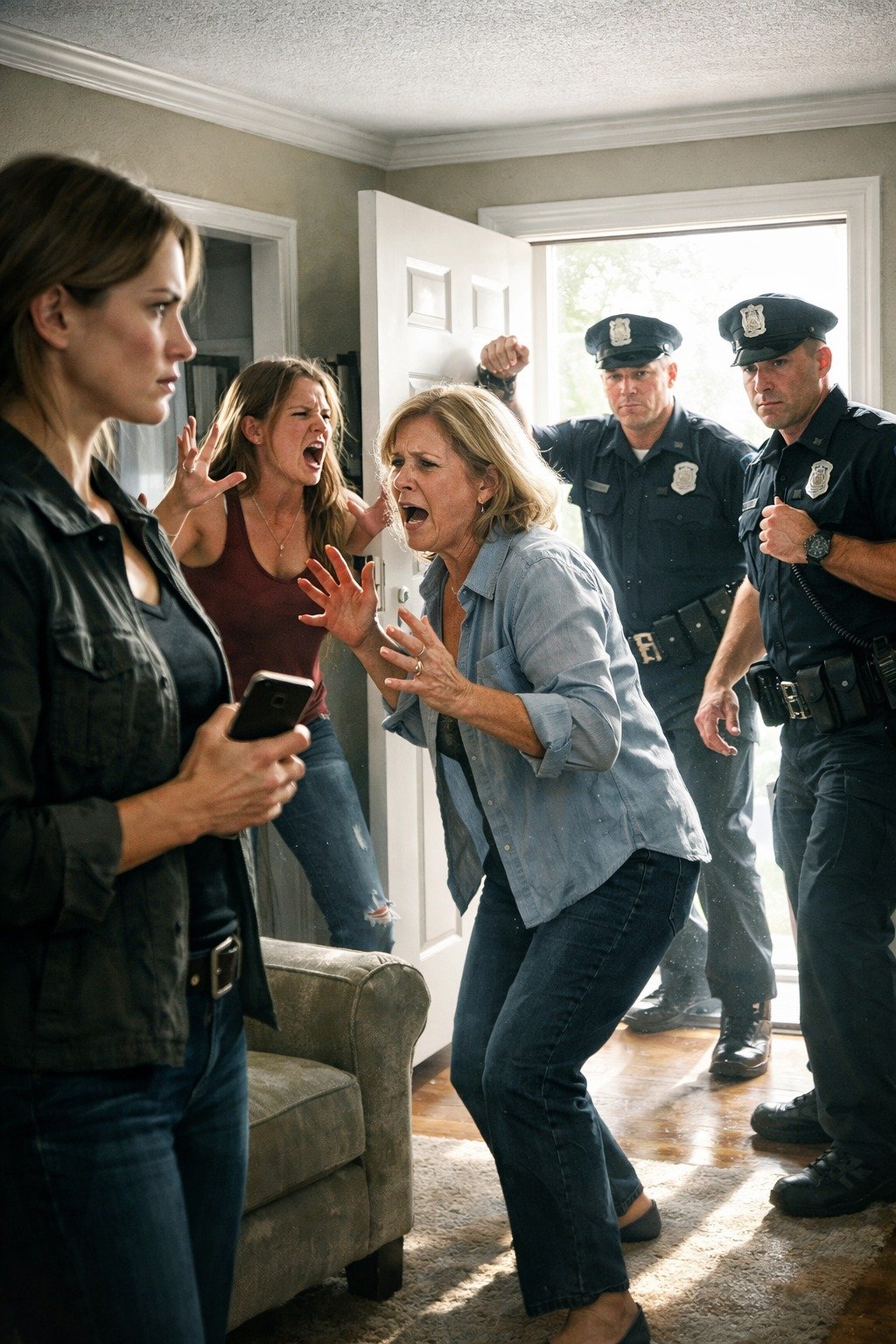
Inside, the prosecutor outlined the charges. Unauthorized entry. Credit card fraud. Theft. Detective Miller presented the evidence. The video played on a screen, my mom’s hood making her look like a stranger.
Mom didn’t cry theatrically. She didn’t faint. She just looked smaller, like she’d finally realized the world outside family rules had real consequences.
When their lawyer stood, I expected a fight.
Instead, he cleared his throat and said, “Your Honor, my clients wish to enter a guilty plea.”
The room seemed to inhale.
Mom’s voice was barely above a whisper when she admitted it. “I entered my daughter’s apartment without consent. I took her credit card and made payments for my other daughter’s debts. I knew she hadn’t approved it.”
Kayla spoke next, eyes down. “I helped by telling my mom where Morgan kept her cards. I knew the money was taken improperly.”
Hearing it out loud in a courtroom was different than hearing it in a phone call. In a courtroom, there was nowhere to hide. No family language to soften it. No guilt-trips to flip it around.
In the hallway during a break, Uncle Jerry cornered me.
“Morgan,” he said, voice urgent, “this has gone far enough. You made your point. Drop it now for the family’s sake.”
I stared at him. “They stole from me.”
“They’re your mother and sister,” he insisted. “People make mistakes.”
“They made a plan,” I said flatly. “They broke in at midnight with a spare key. That’s not a mistake. That’s a decision.”
Uncle Jerry’s face tightened. “You’re going to tear this family apart.”
I held his gaze. “They already did.”
Back in session, the judge accepted the plea deal: probation, community service, mandatory counseling, full restitution within thirty days, and jail time if they violated any term.
Mom nodded like she was watching herself from a distance.
Kayla looked like someone who’d never imagined consequences could be louder than excuses.
When it was over, I walked out of the courthouse into bright Colorado sun and felt strangely light. Not happy. Not victorious.
Just no longer trapped.
A week later, I met my dad at his house with the trust paperwork spread across his kitchen table. He adjusted his glasses, read the conviction documents, then tapped the clause with a finger.
“This triggers forfeiture,” he said. “Your grandfather meant it.”
My throat tightened at the thought of Grandpa planning for this. Not out of spite, but out of protection.
Dad signed as co-trustee. I signed where I needed to. We filed notice with the court that afternoon.
This wasn’t revenge.
This was enforcement.
Part 4
The letter confirming redistribution arrived sixty-three days later.
It came in a plain envelope that looked like junk mail, which felt fitting. Big life changes often arrive without ceremony.
I opened it at my kitchen counter, hands steady, and read the words slowly.
Forfeiture approved.
Mom’s share. Kayla’s share. Redistributed to remaining beneficiaries.
My portion was large enough to change my life, but not large enough to erase what happened. Money doesn’t reverse betrayal. It just gives you options afterward.
I deposited it anyway. I paid off the remaining balance on my card. I restored my emergency fund. I set aside a portion for taxes and invested the rest conservatively, the way someone does when they’ve learned that security is not a vibe—it’s a system.
Mom called when she found out.
Her voice was edged with panic, not apology. “Morgan, your lawyer—”
“I don’t have a lawyer,” I said calmly.
“Well, Attorney Clark says—”
“The clause applies,” I interrupted. “You were convicted. It’s done.”
“You’re ruining us,” she said, and I could hear her trying to summon the old power dynamic, the old guilt.
“You ruined you,” I replied. “You broke into my home.”
Kayla texted too, alternating between vague apologies and frantic bargaining.
I’m sorry.
You didn’t have to do this.
We’re family.
Please tell Dad to stop it.
I’ll pay you back eventually.
I didn’t answer.
Restitution came through on day twenty-nine, likely because the court’s deadline left no room for games. I watched the deposit appear and felt nothing. It wasn’t satisfaction. It wasn’t closure.
It was arithmetic.
The consequences hit them fast.
Mom’s job required periodic certification renewals. Her background check flagged the conviction. She was let go quietly, the kind of firing that comes with “we wish you the best” and no eye contact. She bounced between part-time gigs after that—data entry, reception work, anything that didn’t ask too many questions.
Kayla struggled even harder. With probation requirements, community service hours, and a wrecked credit score, her options narrowed. She took a call center job and hated it. She complained to anyone who would listen that she was being “punished for trying to survive.”
Nobody listened for long.
Family gatherings became sparse. Relatives who’d once defended Kayla stopped inviting her to things. Not out of cruelty, but out of exhaustion. People only have so much energy for someone who keeps grabbing the steering wheel and then blaming everyone else for the crash.
Uncle Jerry called once, voice subdued. “They’re struggling, Morgan.”
I stared at my laptop screen, code running cleanly in the background, and said, “That’s what consequences are.”
After that, I blocked my mom and Kayla on everything. I didn’t do it out of anger. I did it because my nervous system deserved peace. Every voicemail, every text, every attempted guilt-trip was a hook in my skin.
Cutting ties felt like pulling a splinter that had been embedded for years. Painful, but relieving.
I kept seeing Tasha every week. Sometimes we talked about the case. Sometimes we didn’t. We started hiking trails near Boulder on weekends, climbing until the city shrank behind us and my thoughts got quieter.
“You’re lighter,” Tasha said once at a summit, handing me water.
“I feel… clean,” I admitted. “Like I finally stopped carrying their stuff.”
Work improved too. I pitched a project idea to my team—an internal software tool for remote account monitoring and anomaly detection, inspired by how quickly the theft happened and how hard it was to catch in the moment. The tool took off inside the company. I got a promotion and a raise. My manager called me “a problem-solver,” and for the first time, that label felt like it belonged to me, not something I’d earned by fixing other people’s messes.
My dad and I grew closer. We had dinner once a month, simple meals and quiet conversation. He told stories about Grandpa—how he’d been generous but cautious, how he believed love could coexist with boundaries.
“He’d be proud,” my dad said one night, clinking his glass gently against mine.
I believed him.
Over the next year, I used a small portion of the inheritance to take a trip alone. I went to the Grand Canyon and stood at the edge, staring down at something so vast it made my family drama feel like a speck of dust. The wind whipped through my hair and I laughed out loud, alone, because freedom sometimes feels ridiculous when you finally have it.
I went to therapy too, not because I was broken, but because I wanted to understand the pattern I’d escaped. My therapist said something that stuck with me: boundaries aren’t walls. They’re foundations.
I built mine.
Two years later, I heard through a cousin that Kayla wanted to meet. That she was “different now.” That probation had ended. That she’d “learned her lesson.”
I didn’t rush. I didn’t react. I sat with it.
Then I wrote a single email from an address she didn’t have blocked.
If you want contact, you can start with accountability. That means no excuses, no blaming, no “you took it too far.” You stole from me. Mom stole from me. If you can say that plainly and accept that I may still choose distance, we can talk.
She didn’t reply for weeks.
When she finally did, the email was short.
I stole from you. I planned it. I was wrong. I understand if you never forgive me.
I stared at it for a long time.
Then I closed my laptop and went for a walk in the Denver evening, the skyline glowing softly, the air cool and steady.
I didn’t meet her right away. Maybe I never would. But for the first time, the decision felt like mine, not something demanded of me.
That’s the ending people don’t always like in stories. It isn’t a big reunion. It isn’t a dramatic reconciliation. It’s quiet.
It’s a woman with a rebuilt savings account and a locked front door and a life that feels stable because she finally stopped paying for someone else’s chaos.
My mom and sister thought stealing would force me back into my old role: the reliable one, the forgiving one, the one who absorbs.
Instead, it did the opposite.
It showed me exactly what they were willing to do to keep Kayla comfortable.
And it gave me the clarity to leave—emotionally, legally, permanently—before they could ever do it again.
Part 5
Kayla’s email sat in my inbox like a stone you keep turning over in your hand, trying to decide if it’s just heavy or actually sharp.
I stole from you. I planned it. I was wrong. I understand if you never forgive me.
It wasn’t poetry. It wasn’t a performance. It was blunt in a way Kayla rarely was. For two days, I didn’t respond. Not as punishment. As protection. I wanted to make sure I wasn’t reacting out of the old reflex that had run my whole childhood: fix it, smooth it, don’t make waves.
On the third day, I opened a blank draft and wrote one sentence.
If we meet, it will be in public, for one hour, with clear boundaries. No mom. No guilt. No bargaining.
I stared at it for a long time, then added:
If you agree, you can propose a place and time.
I hit send before my brain could talk me out of it.
Kayla replied within an hour.
Okay. Saturday 2 p.m. at Union Station. I understand about mom.
I didn’t trust “I understand” as a phrase in my family, so I built structure around it anyway. I asked Tasha to come. She didn’t hesitate.
“I’ll sit at the next table,” she said. “Close enough to hear if it gets weird.”
Saturday afternoon, Union Station was busy in that Denver way—tourists taking photos, people in athleisure carrying expensive coffee, the faint smell of pastries and train air. I arrived early, chose a table near the center, and sat with my hands wrapped around an iced tea I didn’t want.
When Kayla walked in, I almost didn’t recognize her.
She’d lost weight. Not the trendy kind. The stressed kind. Her hair was pulled back without effort, her face paler than I remembered. She looked around like she expected someone to jump out and accuse her again.
Then her eyes landed on me, and she walked over slowly, like the floor might shift.
“Hi,” she said, voice small.
“Hi,” I replied.
She hovered for a second. Old Kayla would’ve gone in for a hug automatically, to create instant intimacy, to make it harder for you to stay angry. This Kayla didn’t.
She sat down and placed her hands flat on the table, palms down, like she was proving she wasn’t holding anything.
“I’m not here to ask you to drop anything,” she said immediately. “I know you already did what you did.”
I nodded once. “Okay.”
Kayla swallowed. “I’ve rehearsed this in my head and it still feels… stupidly hard to say. So I’m just going to say it.” Her eyes flicked up to mine. “I targeted you because I thought you would take it.”
There it was. The truth I’d been living with, finally spoken by someone else.
Kayla kept going, words tumbling out faster. “I knew Mom would do it if I pushed. I knew you’d say no, and I knew Mom wouldn’t accept no. So I fed that. I made it a whole thing about family, because that’s what works on her. And then… I told myself it wasn’t stealing. I told myself you had savings, you were fine, you were always fine.”
My jaw tightened.
“I wasn’t fine,” I said quietly. “I looked fine because I planned. Because I worked. Because I assumed my home was safe.”
Kayla’s eyes filled. “I know. Now. I didn’t know it in my body back then. I just… wanted it to go away. The debt. The shame. I wanted the panic to stop.”
“That’s not an excuse,” I said.
“No,” she agreed quickly. “It’s not. It’s just… what I was doing.”
She wiped her face with the sleeve of her jacket. “The night Mom took the card, I didn’t sleep. I kept thinking you’d wake up and call and scream and then everything would blow up. And then when the police came, it did blow up, and I realized… I’m not the person I kept pretending I was.”
I watched her carefully, looking for the familiar manipulations—the pivot into victimhood, the sudden anger, the demand for comfort. None of it appeared. She looked miserable in a way that didn’t ask me to fix it.
“What do you want from me?” I asked.
Kayla took a breath. “I want to apologize without trying to control your response. I want you to know I’m doing what the court required, and I’m also doing extra. I’m in counseling. I’m working with a financial coach. I sold a bunch of stuff to pay restitution faster. I’m not saying that to impress you. I’m saying it because I don’t want to be that person again.”
I didn’t soften. I didn’t nod like it erased anything. I let the silence sit.
Then I said, “I have conditions.”
Kayla’s head bobbed immediately. “Okay.”
“One: Mom doesn’t get access to me through you,” I said. “No updates, no messages, no ‘she’s been crying’ stories.”
Kayla nodded. “Agreed.”
“Two: if you want contact, it stays limited for a while. Public places. Planned times. No drop-ins. No surprises.”
“Okay,” she said again, voice steady.
“Three: you don’t ask me to rescue you,” I continued. “Not financially, not emotionally. I’m not your plan.”
Kayla flinched, like that hit a bruise. Then she nodded. “That’s fair.”
“And four,” I said, keeping my voice calm, “you don’t rewrite history. You don’t call it a ‘mistake.’ You don’t say Mom ‘helped’ you. You stole. She stole. That’s the language.”
Kayla’s eyes filled again. “Yes,” she whispered. “Stole.”
I leaned back. My chest felt tight, but clearer.
Kayla hesitated, then said, “Can I tell you something you might not want to hear?”
“Go ahead.”
“Mom is furious at you,” she said softly. “Not because of the conviction. Not because of probation. Because… she thought you’d fold. And you didn’t.”
I stared at the crowded station, at strangers living their normal lives. “That’s her problem.”
Kayla nodded like she’d expected that answer.
Then she said, “I’m moving out.”
That made me look back at her.
“I’ve been living with her since Nathan ended it,” she explained quickly. “It was supposed to be temporary, but she uses it. She keeps saying I owe her loyalty. She keeps telling me you’re heartless, that you ruined everything. And I realized… she’s not helping me. She’s keeping me the same so she can still feel like the hero.”
My throat tightened at the familiarity of that dynamic.
“I found a room,” Kayla continued. “Just a room, but it’s mine. And I’m going to keep paying off the rest of my debt myself. Without schemes. Without Mom.”
I studied her face. She looked scared, but determined.
“Good,” I said finally.
Kayla exhaled like she’d been holding her breath for months.
My phone buzzed softly in my pocket—Tasha checking in from the next table. I didn’t look yet.
Kayla glanced at the clock on the wall. “We’ve been talking for forty minutes,” she said, almost like she was trying to prove she respected the structure.
“Yeah.”
“I won’t ask for forgiveness,” she said. “I know I’m not owed that. I just… hope someday you don’t feel sick when you think about me.”
I swallowed. “I hope so too.”
When the hour ended, Kayla stood up first.
She didn’t ask for a hug. She didn’t reach across the table. She just said, “Thank you for meeting me,” and walked away, shoulders tense but upright.
I watched her go and felt something strange.
Not forgiveness.
But the first small crack in the certainty that my family story would always be the same.
Part 6
The first attempt to pull me back into the old system came a week later.
It was a knock at my door on a Wednesday night, loud and insistent, like whoever it was believed they had a right to my space.
I didn’t open it immediately. I checked the peephole.
Mom.
She stood in the hallway with her purse clutched tight, hair brushed too neatly, face set in the expression she used when she planned to win.
My stomach dropped, but my mind stayed clear. I didn’t owe her a conversation. I didn’t owe her access.
I spoke through the door. “Go away.”
“Morgan,” she called, voice dripping false calm. “We need to talk.”
“No,” I said flatly. “Leave.”
Her voice sharpened. “You can’t ignore me forever.”
I didn’t respond. I opened my phone and started recording audio, not because I needed drama, but because I’d learned documentation was a form of armor.
Mom knocked again. “You’re acting like a stranger stole from you. It was family.”
“You were convicted,” I said through the door. “If you don’t leave, I’m calling the police.”
Silence. Then a bitter laugh. “You really are heartless.”
I kept my voice steady. “Leave.”
Another pause. Then her tone shifted into the sweet, wounded version she used for audiences. “I just want to understand why you hate us.”
I didn’t answer that. It was bait.
A neighbor’s door opened down the hall. Mom’s posture changed instantly, shoulders softening, face rearranging into sadness. She wanted witnesses.
I called the building’s non-emergency security line and reported an unwanted visitor. Within minutes, a security guard arrived. Mom left before they even reached my door, calling over her shoulder, “I’ll remember this.”
That night, I emailed Detective Miller and asked how to file a formal no-trespass notice. It wasn’t a restraining order yet, but it was a documented step: she was not allowed on my property. My building management supported it immediately. They changed access codes. They flagged my unit. They added a note for front desk staff.
The next day, I changed my locks anyway.
Then I did something I should’ve done years ago: I took my life out of “just in case” mode.
I installed a doorbell camera. I added a second deadbolt. I moved my wallet and important papers into a small safe bolted inside my closet. I created new bank accounts at a different institution and closed the old ones, not because the bank had failed me, but because my mother knew too much about my patterns.
The practical stuff helped, but it didn’t solve the deeper problem.
Mom didn’t want my money. Not really.
She wanted the power dynamic back.
She wanted me scared enough to comply, guilty enough to pay, exhausted enough to surrender.
So she tried other routes.
She called relatives. She cried to Uncle Jerry. She told anyone who would listen that I’d “chosen money over family,” that I was “cold,” that I’d “always been jealous of Kayla.”
The old narrative, repackaged.
But something had changed after the conviction. People didn’t bite as easily. Some relatives still tried to “mediate,” but their voices lacked the confidence they used to have when Mom’s version of events felt plausible.
One Saturday, I got a voicemail from Aunt Denise.
“Morgan, honey,” she said, voice cautious, “your mom is really struggling. Maybe you could… you know… find a way to move forward.”
I listened once, deleted it, and didn’t call back.
Instead, I called my dad.
He didn’t tell me to be the bigger person. He just said, “If anyone tries to guilt you, remind them: you didn’t do this. They did.”
Work stayed steady through all of it, but I noticed something new: my body reacted to stress faster than my mind did. I’d be in the middle of writing code and suddenly feel my heart racing, palms sweating, like Mom was outside the door again.
Therapy helped with that. My therapist taught me to separate danger from discomfort. To recognize that guilt is not the same as obligation. To understand that my family trained me to interpret “no” as violence.
In reality, “no” was a tool.
Tasha stayed close. She invited me out more—simple things, not therapy disguised as brunch, just normal life. A movie. A hike. Trivia night with friends who didn’t know my family and didn’t care. It was weirdly healing to be around people who didn’t have a role prewritten for me.
Meanwhile, Kayla kept her distance the way we’d agreed. She didn’t call. She didn’t text frequently. Every few weeks, she’d send a short update, not to seek comfort, but to confirm she was holding her own.
Moved into the room. New job interview next week.
Finished 50 hours of service.
Financial counselor says I’m on track.
No guilt. No hidden request.
It didn’t make me trust her yet, but it made me less tense.
The real shift came when Kayla sent one message that surprised me:
Mom tried to get me to ask you for money again. I said no. Just wanted you to know.
I stared at it, thumb hovering.
Then I typed back:
Thank you.
Two words, but they meant something. They meant Kayla was finally stepping out of the system instead of feeding it.
Mom didn’t stop trying. She never stopped trying.
But over time, her attempts hit stronger walls.
Not because I built them alone, but because the people around me began to recognize the pattern too.
And because I finally believed, in my bones, that protecting my life wasn’t cruelty.
It was adulthood.
Part 7
In the spring, Kayla asked to meet again.
Same structure, same place, same one-hour boundary.
We sat outside a coffee shop in LoDo, the air warming up, people laughing like life was simple. Kayla looked healthier this time. Still tired, but less haunted. She’d gained a little weight back. She had color in her cheeks.
She slid a folded paper across the table.
“What’s that?” I asked.
“My budget,” she said, almost embarrassed. “My counselor told me to show it to someone I’ve harmed, as part of accountability. Not so you approve it. Just so you see I’m actually doing it.”
I unfolded it.
Income. Rent. Food. Debt payments. Savings—small but present.
It was boring.
Which, for Kayla, was revolutionary.
I looked up. “This is… good.”
Kayla exhaled like she’d been waiting for permission to breathe. “I didn’t know how to do any of this,” she admitted. “Mom always handled things or bailed me out. I thought money was just… something you got from someone.”
I kept my expression neutral. “Money is something you manage.”
“I know that now,” she said quickly. “And I hate that I had to hurt you to learn it.”
We sat with that.
Then Kayla said, “I want to tell you what happened after you blocked Mom.”
I didn’t flinch. “Go ahead.”
“She spiraled,” Kayla said. “Not about me. About you. She kept saying you’d ‘come crawling back.’ She kept inventing reasons why you’d fail. Like she needed you to be punished for standing up.”
My stomach tightened. I believed it completely.
Kayla continued, voice quieter. “And then she started turning on me. Like, really turning. She’d say it was my fault she lost her job. That if I hadn’t gotten into debt, none of this would’ve happened. She’d say she should’ve let me drown instead of helping.”
“She didn’t help,” I said softly. “She stole.”
Kayla nodded, eyes wet. “I know.”
“I moved out sooner than planned,” she said. “Because I realized she wasn’t safe for me either. She needs someone to control. If it’s not you, it’ll be me.”
I felt a strange mix of anger and relief. I didn’t want Kayla harmed. I didn’t want anyone harmed. But hearing her recognize the pattern meant I wasn’t alone in reality anymore.
Kayla wiped her face. “I’m not asking you to have a sister relationship,” she said. “I’m asking… if it’s okay if I sometimes ask practical questions. Like, how to pick a retirement plan, or how to talk to creditors. Not for you to fix it. Just for advice.”
I considered it.
This was dangerous territory. Advice could become dependence. Dependence could become expectation. Expectation could become the same old role.
So I gave her a boundary that protected us both.
“I’ll send you resources,” I said. “Websites. Books. A financial literacy class. But I’m not your coach.”
Kayla nodded immediately. “That’s fair.”
“I’m not your bank either,” I added.
“I know,” she said quickly. “I won’t ask.”
We finished the hour without drama, and when Kayla left, she didn’t look back like she wanted me to chase her.
That mattered.
A month later, I got an email from my building management: Mom had tried to enter the building and was turned away. She argued. She claimed she needed to drop something off. She was reminded of the no-trespass notice.
She left angry.
I didn’t feel fear this time. I felt tired.
So I did the next adult thing.
I moved.
Not immediately, not in a panic, but intentionally. I found a better apartment in a different part of Denver with stronger security and a quieter street. I didn’t give the address to anyone who might “accidentally” share it.
I gave it to my dad. To Tasha. To two close friends.
Kayla didn’t get it yet.
Not because I wanted to punish her, but because trust is built in layers, and she wasn’t at that layer.
When I told her I’d moved, she didn’t ask where. She just said:
Good. You deserve peace.
The summer after my move, I got promoted again at work. The remote monitoring tool I’d built became part of a larger security initiative. My manager asked me to lead a small team. For the first time, my professional world mirrored my personal one: boundaries, systems, prevention, protection.
I liked that symmetry.
Around the same time, my dad told me my cousins had received their redistributed shares from the trust, and one of them—my cousin Bri—wanted to talk.
We met at a diner. Bri leaned forward and said, “I heard you don’t want the money to be about revenge.”
“I don’t,” I said.
Bri nodded. “Me neither. So I’m putting part of mine into my kid’s college fund and part into a community program. I wanted you to know… I respect what you did.”
Hearing that from family felt strange, like a language I didn’t grow up speaking.
“I didn’t do it to be respected,” I said honestly.
“I know,” Bri said. “That’s why it counts.”
Later that year, Kayla finished probation. She got a better job—still entry-level, but stable. She paid down a chunk of her remaining debt. She kept going to counseling. She didn’t post dramatic updates online. She didn’t try to win sympathy points.
And Mom?
Mom kept blaming.
Sometimes she blamed me. Sometimes she blamed Kayla. Sometimes she blamed the world for being “too harsh.” But the one person she never blamed was herself.
That, more than anything, told me she wasn’t changing.
The story didn’t end with a tearful reunion.
It ended with something quieter: a new pattern replacing an old one.
Kayla learning to stand without being carried.
Me learning to live without being pulled.
And my mother, finally, learning that the daughter she thought she owned had become a woman she couldn’t control.
Part 8
By the time I turned twenty-seven, my life looked different in ways I could feel in my shoulders.
I slept better. I startled less at unexpected knocks. I opened my banking app without a spike of dread. The security routines I’d put in place became background noise, like locking a door without thinking.
I’d stopped checking my phone for messages from people who didn’t deserve access.
That kind of peace is addictive.
Work was going well. I led a small security-focused engineering team now, and my company trusted me with projects that mattered. The funny part was that I didn’t become harsher as I gained power. I became clearer. No didn’t need decoration. Boundaries didn’t need apologies.
Tasha said I looked like someone who finally stopped bracing for impact.
Meanwhile, the inheritance funds remained mostly untouched. Not because I was afraid to spend money, but because I refused to let it become the center of the story. It wasn’t a prize. It was a buffer. A tool.
Still, I did one thing with it that felt right.
I created a small scholarship fund at a local community college—quietly, without my name attached to it in some flashy way. It supported students in tech programs who needed help with laptops, exam fees, or basic living costs while they trained.
I didn’t tell my family. I didn’t post about it. I told my dad and Tasha, and that was enough.
It was my way of turning something ugly into something useful.
Kayla found out by accident through my dad.
She texted:
I heard about the scholarship. That’s really good of you.
I stared at the message, then replied:
It’s not “good.” It’s just what I wanted to do.
Kayla responded:
Still. It’s the opposite of what we did to you.
That line sat with me for a long time.
In late winter, Kayla asked if she could meet again. Same structure, but with a new request.
“I want to pay you back,” she said as soon as she sat down. “Not the restitution—that went through the court. I mean… the damage. I know you can’t quantify it.”
I didn’t answer immediately.
Kayla continued, voice steady. “I’m not asking you to tell me what you need. I’m telling you what I’m doing. I started volunteering at a credit counseling nonprofit. Not for court, not for optics. Because I want to spend time fixing the kind of mess I made.”
I studied her face. She looked nervous, but not performative.
“That’s… a decent way to try,” I said.
Kayla exhaled. “Also, I want to pay you for the lock changes and the safe and the camera. I know the court didn’t cover that.”
I raised an eyebrow. “That’s not necessary.”
“It is,” she said firmly, surprising me. “Because you shouldn’t have had to spend money to feel safe in your own home.”
I sat back, considering. Accepting money could feel like absolution. But refusing it could also keep us stuck in the dynamic where she never fully carried her responsibility.
So I offered a compromise.
“Donate that amount to the scholarship fund,” I said. “Not as a gesture. As restitution with purpose.”
Kayla’s eyes filled. “Okay,” she whispered. “I will.”
A week later, my scholarship account received a deposit with no note attached. Just a number.
That didn’t fix the past, but it did something important: it proved Kayla could take action without demanding emotional reward.
Mom, of course, didn’t like any of this.
When Kayla stopped being useful as a pawn, Mom started trying to recruit other people. A cousin. An aunt. Even my dad, which was almost funny.
Dad told me she’d called him crying, saying she “missed her family” and “didn’t understand why everyone abandoned her.”
Dad’s response was simple: “Because you hurt your daughters.”
Mom hung up on him.
That told me everything.
In the summer, Kayla invited me to a small dinner at her place—her actual place, not a room, a modest apartment with mismatched furniture and a sense of effort. She asked weeks in advance and said explicitly, “If you’re not comfortable, no pressure.”
I said yes, mostly because I wanted to see who she was when she wasn’t under threat.
The dinner was… normal. Pasta. Cheap wine. A couple of her friends who seemed grounded. No dramatic stories. No digging for information. No subtle digs.
When someone asked what my mom was like, Kayla said, calmly, “We’re not close right now,” and changed the subject.
No villain monologue. No plea for sympathy. Just a boundary.
On the walk to my car afterward, Kayla stood in the parking lot and said, “I know you might never trust me like you used to.”
“I don’t,” I said honestly.
Kayla nodded, accepting the truth without flinching. “Okay. Then I’ll keep earning the level you can tolerate.”
That sentence was more mature than anything I’d heard from her in years.
As for my mom, I hadn’t seen her since the hallway knock. I heard about her through the grapevine: a smaller apartment, unstable work, bitterness that grew sharper as time passed.
Sometimes people learn from consequences.
Sometimes they just collect them like proof the world is unfair.
I stopped trying to predict which she’d be.
Because my life, finally, wasn’t built around her moods.
Part 9
Three years after the night my mother used a spare key like a weapon, I sat on my balcony in Denver with a cup of coffee and watched the city wake up.
My life wasn’t perfect. No one’s is. But it was mine in a way it hadn’t been before.
I’d moved into a two-bedroom condo with a secure entrance and a view of the mountains if the air was clear enough. The monitoring tool I built had grown into a full product, and I’d become the person junior engineers came to for calm answers when something went wrong. I had an emergency fund that didn’t make my chest ache with fear, and a retirement account that made future-me feel like a real person instead of a fantasy.
Tasha lived ten minutes away now. We still hiked, still had coffee, still laughed about how my family tried to make “boundaries” sound like a crime.
My dad retired and bought a small place with a garden. He seemed lighter too, like watching me stand up to Mom had given him permission to stop carrying old guilt.
Kayla and I weren’t best friends. We weren’t “close” in the nostalgic way people like to imagine siblings should be.
But we were… real.
We met every month or two. Sometimes for coffee. Sometimes for a walk. Occasionally for dinner at her place.
We never pretended nothing happened.
We also didn’t let what happened swallow every conversation.
One afternoon, Kayla handed me a small envelope. “I want you to have this,” she said.
Inside was a cashier’s check for the exact amount I’d spent on lock changes, security upgrades, and moving costs that were directly tied to the break-in. A number I’d never told her, which meant she’d done the work to find it through receipts she asked for instead of guessing.
“I know you said donate,” she said, reading my face. “I already did that too. This… is for you. Not as forgiveness. As responsibility.”
I stared at the check. “Kayla—”
“I’m not trying to buy anything,” she said quickly. “I’m trying to close a loop I opened.”
I took it, because refusing would’ve turned it into a new loop: me denying her the chance to carry her own accountability.
“Thank you,” I said quietly.
Kayla nodded, eyes wet, then changed the subject the way emotionally stable people do. “Also, my credit score hit 700,” she said, trying to smile.
I let myself smile back. “Good. Keep it boring.”
Kayla laughed. “Boring is my new religion.”
As for Mom, she stayed a distant weather system. Sometimes calm, sometimes stormy, always unpredictable.
She tried a couple more times to reach me through other people, but fewer relatives were willing to act as her messengers. Time had shifted loyalties. Evidence does that. So does a conviction record. So does watching someone refuse to be manipulated and still thrive.
Once, I got a handwritten letter from her. No return address. The handwriting was unmistakable.
It wasn’t an apology. It was a complaint dressed as heartbreak.
You never loved me the way Kayla did.
You always thought you were better.
I did what I had to do.
You’re punishing me for being a mother.
I read it once, folded it back up, and put it in a file box labeled FAMILY in my closet, like a document from an old life.
Then I went on with my day.
That’s what closure looked like for me. Not dramatic. Not cinematic. Just choosing, again and again, not to step back into the role she wrote for me.
On my twenty-eighth birthday, I hosted a small dinner at my condo. Tasha, my dad, a couple of friends from work, and, after a long pause, Kayla.
Kayla arrived with a plant as a gift and stood awkwardly by the door like she didn’t know if she belonged.
I took a breath and said, “You’re allowed to be here.”
Kayla’s eyes filled instantly. She nodded and stepped inside.
Later that night, after cake and laughter and people leaving one by one, Kayla lingered on the balcony with me. The city lights flickered below us.
“I think about that night a lot,” she admitted softly.
“I do too,” I said.
Kayla swallowed. “If I could undo it—”
“You can’t,” I interrupted gently. “So don’t live in that fantasy. Live in what you do now.”
Kayla nodded, staring out at the street. “I’m trying.”
“I see that,” I said, and I meant it.
Kayla’s shoulders sagged with relief, like she’d been holding that effort up for years and needed someone to acknowledge it without making it a performance.
She hesitated, then asked, “Do you ever feel guilty?”
I thought about it. About the court. About the trust clause. About my mother losing money she felt entitled to. About Kayla’s probation. About family dinners where people looked away from the truth because it was uncomfortable.
“No,” I said finally. “I felt guilty for a while because I was trained to. But guilt isn’t a compass. It’s just a feeling.”
Kayla nodded slowly. “Yeah.”
I looked at her, really looked, and saw not the little sister who got everything, but a young woman who had finally met consequences and chosen growth instead of denial.
Then I looked at my own life—the condo, the career, the peace, the people who treated me with respect.
Mom tried to steal my future because I refused to pay fifteen thousand dollars for Kayla’s debt.
Instead, she handed me the cleanest lesson I’ve ever learned:
Family isn’t who demands your resources.
Family is who respects your boundaries.
And if someone can’t respect them, you don’t owe them access, no matter what they call themselves.
THE END!
Website Disclaimer
The information provided on this website is for general informational and educational purposes only. While we strive to ensure that all content is accurate and up to date, we make no guarantees regarding the completeness, reliability, or accuracy of any information published.
The views and opinions expressed in articles belong to their respective authors and do not necessarily reflect the views of this website. Any action you take based on the information found on this website is strictly at your own risk. We will not be liable for any losses, damages, or inconveniences arising from the use of our content.
Some articles may contain opinions, third-party information, or external links. We do not endorse or guarantee the accuracy of content on external websites and are not responsible for their practices or policies.
All content on this website is provided in good faith and is intended for informational purposes only. Readers are encouraged to verify information independently and seek professional advice where appropriate.