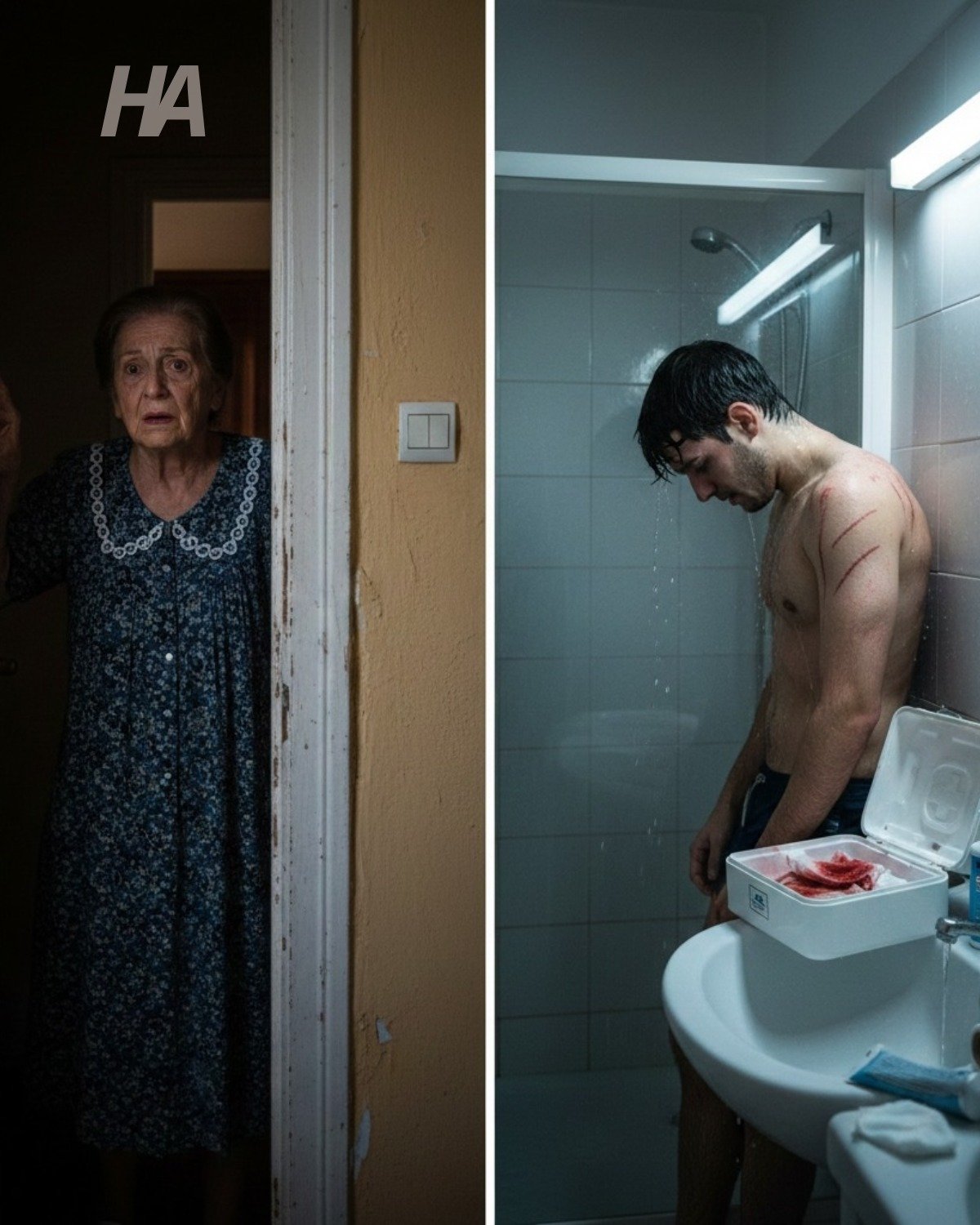
You are Dona Helena, seventy-three, carrying your life the way some women carry grocery bags, one handle in each hand, knuckles white, smiling anyway.
You tell yourself that the worst storms already passed, that old age is supposed to be a porch swing and quiet mornings.
So when you move into your only son Ricardo’s luxury apartment in Vila Olímpia, you expect peace to be waiting like a made bed.
Instead, you step into a home that looks like a magazine but feels like a refrigerator someone forgot to close.
The building is modern, with a lobby that smells like polished stone and expensive perfume.
The doorman greets you politely, but his eyes flick toward Ricardo the way people glance at thunderclouds.
Ricardo doesn’t notice, or pretends not to, because pretending has become his second language.
Camila follows behind him, soft-footed, shoulders slightly curled, like she’s trying to take up less air.
Your room is beautiful, too beautiful, like it belongs to someone who doesn’t sweat or worry.
There’s a view of the city, all lights and movement, and you catch yourself thinking the skyline looks like teeth.
Ricardo shows you where the towels are, where the coffee capsules are, where not to touch.
He says “Make yourself at home” with a voice that means “Don’t make noise.”
The first dinner you try to make becomes an awkward little ceremony.
You lay out rice and beans the way you always did, the way your hands remember without asking permission.
Camila sits down and thanks you too quickly, like gratitude is a shield she can raise in a hurry.
Ricardo checks his watch before he even checks your face.
“Ricardo, you won’t eat with us?” you ask, keeping your voice light.
He doesn’t look up from his phone, and when he finally does, his eyes have that distant, metallic shine.
“I have work,” he says, like the word “work” is a lock that closes every conversation.
Camila starts to speak, then swallows her words like they’re dangerous.
You watch Camila’s hands while she reaches for the spoon.
A bruise peeks from her sleeve, dark and new, blooming near her wrist.
Your stomach tightens, because bruises have a language you learned the hard way, years ago, back in that simple house in Minas Gerais.
A house where silence was not peace, it was strategy.
When Ricardo snaps—over soup, over nothing—your body remembers before your mind can argue.
He slams his spoon down and says, “I’m not hungry. Enough.”
The sound is small compared to what you used to hear, but your chest still stutters like a frightened bird.
Camila forces a smile that doesn’t reach her eyes and says, “He’s tired, mãe. Just tired.”
That night, you lie awake listening to the apartment breathe.
The air conditioner hums like it’s trying to cover secrets.
From the master bedroom, you hear soft movement, then a muffled sound that could be a cough or a sob.
You tell yourself it’s nothing, because denial is a warm blanket, until it becomes a rope.
At exactly three in the morning, water starts running in the bathroom.
Not the gentle, steady stream of someone rinsing sleep away, but a frantic on-and-off rhythm.
It sounds like someone is turning the shower into an argument, slamming the valve open and shut.
Under it, you hear something else, a broken sound that doesn’t belong in a peaceful home.
You sit up, heart quick, hands trembling slightly in the dark.
You think of Camila’s bruise, and your mind begins to stitch possibilities into a terrible quilt.
“Why is Ricardo bathing at this hour?” you whisper to yourself, as if the question might behave if you say it softly.
Then you swing your feet to the floor, because fear can paralyze, but love can move.
The hallway is dim, lit by the faint glow under the bathroom door.
Your slippers make no sound on the polished floor, but your pulse is loud enough to betray you.
The closer you get, the more you realize the water isn’t masking the noise.
It’s trying to drown it.
You lean down slowly, knees aching, and look through the narrow crack beneath the door.
At first you see tiles, steam, the blur of a shower curtain.
Then the curtain shifts, and your breath catches so hard you almost choke.
Because Ricardo is not bathing like a tired man, he is scrubbing like a guilty one.
He stands under the water, shoulders hunched, his head bowed as if the shower is interrogating him.
In his hands is a nail brush, and he is dragging it over his palms again and again, too hard, too desperate.
The water around his hands swirls darker than it should, tinted, not gory, but unmistakably stained.
And between his clenched teeth, you hear a whisper: “Off… get it off… please, get it off.”
Your throat goes dry, and for a second you truly think you will faint.
Because you recognize that kind of washing.
It is not cleanliness, it is punishment.
It is a person trying to scrub away something that lives under the skin.
Then he presses his forehead to the tile wall like he’s holding himself up.
He lets out a sound that is half sob, half growl, and you see his mouth form a word.
Not Camila’s name.
Not yours.
He says, “Pai.”
Your husband’s ghost steps into the hallway with that one syllable.
Your late husband, the man who looked kind in public and sharp in private, the man whose anger used to arrive like a storm without warning.
You haven’t heard Ricardo say “Pai” like that since he was a teenager, voice cracking, eyes hard.
The word hits you like a thrown cup, and you grip the wall to stay upright.
Ricardo twists the shower valve harder, as if boiling water could erase memory.
He scrubs his hands again until he flinches, then drops the brush and grabs a towel.
Through the crack you see him press the towel to his hands, then to his face, wiping, wiping, wiping.
It looks like a man trying to wipe himself out of existence.
You back away silently, because the hallway suddenly feels too narrow for your lungs.
Your mind races, tossing questions like stones into a dark river.
Is he hurting Camila, then trying to wash the evidence away?
Or is someone hurting him, and he’s trying to wash away shame?
You return to your room and sit on the edge of the bed, staring at nothing.
Your hands shake, and you fold them together, trying to make them behave.
Your body wants to call the police, to shout, to break the door down.
But your heart knows something else too: you need to understand the shape of the monster before you swing at it.
In the morning, you watch Ricardo over breakfast the way a doctor watches a fever.
His hair is damp, as if he rinsed his whole night down the drain.
His jaw flexes when he chews, and he avoids Camila’s eyes with a practiced precision.
Camila moves carefully, like the air around him might bruise her.
You wait until Ricardo leaves for work before speaking.
The door clicks shut, and the apartment exhales.
Camila starts washing dishes too quickly, hands busy, eyes down.
You step beside her and say softly, “Show me.”
Camila freezes, soap bubbles sliding down her fingers like small, nervous ghosts.
“What do you mean?” she asks, but her voice is already cracking.
You point gently at her wrist, where yesterday’s bruise still shows in the morning light.
Camila swallows, then slowly lifts her sleeve higher.
There are more marks.
Not dramatic, not theatrical, but real, the kind that make your stomach twist because they look like they happened in ordinary moments.
A grip too tight.
A shove into a counter.
A hand that didn’t mean to leave proof, but did.
Your vision blurs, and you blink it clear like you’re refusing to give your tears permission.
Camila’s eyes fill anyway, because she has been holding a flood behind her eyelids for too long.
“He wasn’t like this,” she whispers.
And you hate that sentence, because you’ve heard it before, from your own mouth, years ago.
You sit with her at the table, hands wrapped around coffee that goes cold.
Camila tells you it started after Ricardo’s promotion, after the company piled more money on his desk and more pressure on his spine.
He began coming home later, sleeping less, snapping faster.
He started taking showers at odd hours, like he was trying to wash his days off before they touched his dreams.
“He says he’s dirty,” Camila says, voice thin.
“He says he has to keep his hands clean.”
You feel your pulse drum in your ears, because last night you saw those hands being scrubbed like a confession.
“Clean from what?” you ask, though you’re not sure you want the answer.
Camila shakes her head.
“He doesn’t tell me,” she says.
“But he gets calls late at night. He steps into the balcony and talks like someone is holding a knife to his back.”
She presses her palm to her stomach, not pregnant, just bracing herself, like the body does when it expects impact.
You look around the apartment, the expensive furniture, the spotless counters, the art on the walls.
Luxury doesn’t erase fear; it just gives it a prettier frame.
You notice small details now, the way a detective does when grief sharpens the senses.
A broken phone charger replaced too quickly. A vase positioned to hide a dent in the wall.
That afternoon, you do something you didn’t plan to do.
You go to the laundry basket in the hallway closet, where Ricardo drops his clothes like they’re evidence and he’s tired of carrying it.
Your fingers tremble as you lift a shirt, then another.
You’re not proud, but you’re not blind either.
In one of his dress shirts, near the cuff, you find a faint stain that isn’t coffee.
It’s a rusty shadow, like something that tried to dry and failed.
You press the fabric between your fingers, and you feel your heart fold inward.
You don’t know if it’s blood, but your body reacts as if it is.
You put everything back exactly as it was, because survival taught you to leave no trace.
Then you sit down at your bed and stare at your hands, your old hands, spotted and strong.
You think of all the times you told yourself you stayed with your husband “for the child.”
And you wonder if the child grew up and became the storm anyway.
That night, Ricardo comes home later than usual.
He smells like cologne over something sharper, like fear dressed in expensive scent.
He kisses your forehead, quick and stiff, the way people pet dogs they don’t trust.
Camila offers him dinner with a hopeful voice, and you watch him inhale before answering, like he’s preparing for pain.
“I ate,” he says.
His eyes flick to Camila’s wrist for half a second, then away.
Camila’s smile collapses quietly, like a balloon losing air in another room.
At two forty-five, you wake up without knowing why.
Your body has learned the schedule of danger the way it once learned the schedule of your husband’s footsteps.
You lie still, listening, counting your breaths.
At three on the dot, the shower starts.
You get up again, slower this time, steadier.
You’re afraid, but you’re also angry, and anger can be a cane that helps you stand.
You reach the bathroom door and lower yourself to look.
Your eye finds the crack, and the apartment seems to hold its breath with you.
Ricardo is there again, but tonight he is not scrubbing his hands.
Tonight he is holding something small and rectangular, wrapped in plastic, pressed to his chest like a secret.
He sobs once, silently, then bites his knuckle to stop the sound.
Water pours over his shoulders, and his whole body looks like a man losing a battle no one can see.
Then he opens the plastic wrap.
Inside is a small flash drive.
You feel your heart skip, not from fear now, but from clarity.
Work. Pressure. Late-night calls. “Keep your hands clean.”
A flash drive held like a weapon, like a lifeline.
You don’t know what’s on it, but you know what it means: there’s something Ricardo can’t carry alone.
Ricardo presses the drive to his lips, like a prayer he doesn’t believe in.
He whispers, “I didn’t choose this,” and the words slide under the door and into your bones.
Then he turns off the water abruptly and steps out, wrapping a towel around his waist, breathing hard.
He looks into the mirror, and you see his expression shift from grief to rage, like a mask snapping into place.
Your stomach tightens.
Because that rage has to land somewhere.
And in this home, it lands on Camila.
The next morning, you decide you’re done being a guest in your own family’s crisis.
You ask Camila to walk with you to the building’s small garden area, a tidy patch of green designed to make rich people feel human.
Camila agrees, eyes scanning the hallway like she expects Ricardo to appear around every corner.
Outside, the city hums, indifferent.
You sit on a bench and take Camila’s hand.
“We are making a plan,” you say.
Camila’s eyes widen with fear and relief at the same time, like two strangers sharing one face.
“A plan for what?” she whispers.
“For safety first,” you answer.
“For truth second.”
“For your life third, because I won’t bury another woman’s youth under a man’s anger.”
Camila’s lip trembles, and she nods like she’s been waiting for someone to give her permission to survive.
You start with small things.
You tell Camila to pack a bag, not obvious, just essentials: documents, spare keys, a little cash, medications, a change of clothes.
You tell her to hide it somewhere Ricardo won’t look, like the back of the storage closet behind the holiday decorations he never touches.
Camila listens like a student whose test is life or death.
You also tell her to write down dates.
Every bruise, every outburst, every threat, every apology that comes with a “but.”
Not because you enjoy collecting pain, but because pain without proof gets dismissed as drama.
Camila’s face tightens, but she nods again.
She has lived long enough in fear to understand the power of paper.
Then you do something else, something you didn’t think you’d have to do at seventy-three.
You call an old friend from Minas, a woman who survived her own marriage like a war.
Your friend answers and hears your voice, and she doesn’t ask polite questions.
She asks the right ones.
You don’t say “domestic violence” aloud at first.
The words feel like a curse, like naming it makes it permanent.
But your friend says it for you, calm and sharp, like a knife cutting cloth.
“You’re in the middle of a cycle,” she says. “Break it before it becomes a funeral.”
You hang up with a list in your head.
Women’s support resources. Legal advice. Safe places nearby.
You feel the strange power of taking action, how it changes fear into something you can carry.
You are still scared, but now you are moving.
That night, Ricardo comes home with a smile that looks borrowed.
He brings flowers for Camila, bright and expensive, and the gesture almost fools the air.
Camila accepts them with stiff fingers, eyes flicking to you for a fraction of a second.
You don’t move, because you’ve seen flowers used as erasers before.
At dinner, Ricardo talks about a new project, a new contract, a new opportunity.
He laughs too loudly, like laughter is a shield.
His phone buzzes, and his face tightens before he forces it loose again.
He excuses himself to the balcony, and you watch him through the glass.
His posture changes out there.
Inside he is the director, the son, the husband.
Outside he is a man being handled.
He nods repeatedly, rubs his forehead, then grips the railing so hard his knuckles pale.
When he comes back in, Camila’s shoulders tense automatically.
Ricardo smiles and asks, “Everything okay?” like he hasn’t been scaring the room for weeks.
Camila answers, “Yes,” because survival often sounds like a lie.
You feel anger rise in you, hot and steady.
At three a.m., the shower starts again, but this time you don’t go to the door.
Instead, you walk to the hallway closet and open it quietly.
Your eyes scan the shelves, the stacked towels, the cleaning supplies, the neat boxes labeled by someone who wants control.
Then you see something odd: a towel folded too thick, like it’s hiding a lump.
You pull it out slowly.
Inside, wrapped in fabric, is another flash drive, identical to the one you saw in Ricardo’s hands.
Your heart thuds.
He has backups.
You sit on your bed with the flash drive in your palm, feeling its weight like a coin that could buy freedom or disaster.
You don’t have a computer you trust, not in this house.
You don’t know if plugging it in will trigger something, if it’s tracked, if it’s a trap.
But you know one thing: whatever Ricardo is washing off his hands, it’s connected to these tiny pieces of plastic.
In the morning, you wait until Ricardo leaves.
Then you take Camila to a small internet café two blocks away, the kind that still exists because not everyone trusts their own walls.
You choose a computer in the corner, away from windows.
Camila’s hands shake as you insert the flash drive.
A folder opens.
Inside are documents, spreadsheets, recorded calls, emails with subject lines that make your stomach drop.
There are words like “transfer,” “offshore,” “shell,” “signature required,” “liability.”
And there, buried among the files, is a video clip.
You click it, and your breath stops.
It’s Ricardo, in an office, speaking to someone off camera.
His voice is strained, pleading, and you’ve never heard your son plead like that.
A deeper voice answers, calm and amused, saying things that sound like commands dressed as advice.
Then the off-camera voice says, “If you don’t do what I say, your wife will pay first. Your mother will pay second.”
Ricardo flinches like he’s been struck.
The video ends, and the café’s dull hum becomes suddenly too loud.
Camila covers her mouth, eyes wide with terror.
“So it’s not just me,” she whispers, and you hate that her relief comes from shared danger.
You feel cold, but not the city’s cold.
This is the cold of realizing your family has been targeted like prey.
Now the bruises make a different kind of sense.
Not excusable, never excusable, but explainable in a way that points to something bigger than a temper.
Ricardo is trapped, and when trapped animals thrash, they hurt whoever is closest.
But being trapped does not give him the right to become his father.
You refuse to let that math work.
You copy the files onto a second drive you brought, because you came prepared like an old woman who has lived through storms.
You don’t open everything, because you’re not trying to drown in details.
You only take what matters: threats, proof, names, money trails.
Then you remove the drive and leave the café like you’re carrying a live wire.
Back at the apartment, you and Camila move differently.
You speak less, because walls can have ears and fear makes you suspicious of paint.
You keep your phones on silent and your eyes on doors.
You start to notice how often Ricardo checks the hallway camera feed on his phone.
That evening, Ricardo comes home and finds you and Camila sitting together at the table.
Not cooking, not cleaning, not pretending.
Just waiting.
He pauses, as if he can feel the shift in the air.
“What’s going on?” he asks, voice careful.
Camila’s fingers tighten around her mug, and you can see her rehearsing silence.
But you are done rehearsing.
You stand slowly, your knees complaining, your spine straight anyway.
“We know,” you say.
Ricardo’s face drains so quickly it’s almost impressive.
His eyes flick toward Camila, then to you, then to the hallway closet, like he’s mentally checking where he hid the truth.
He tries to speak, but no sound comes out, only breath.
For the first time since you arrived, he looks young again, like a boy caught stealing because he didn’t know how else to survive.
“You looked through my things?” he finally snaps, anger jumping up like a reflex.
You don’t flinch.
You’ve seen anger before, and you refuse to worship it now.
“I looked through the lies,” you answer, and your voice is quieter than his, which makes it stronger.
Camila stands too, trembling but standing.
“You let someone threaten us,” she says, and the sentence cracks open something in her.
Ricardo’s jaw clenches, and his eyes shine with tears he refuses to spend.
“I was fixing it,” he whispers. “I was trying to fix it.”
“By breaking her?” you ask, and you point at Camila’s bruises without touching them.
Ricardo flinches like you slapped him.
His hands lift, palms open, and you remember him as a child showing you scraped knees, wanting comfort.
Now he shows you his hands like he wants forgiveness without consequences.
“I didn’t mean—” he starts.
But you cut in, because meaning doesn’t heal bruises.
“You didn’t mean, but you did,” you say.
“And every time you shower at three in the morning, you’re not washing away what you did. You’re only rinsing your guilt so you can do it again.”
Ricardo’s breathing becomes ragged.
He looks toward the balcony, then toward the door, like escape is the only language he knows.
Then he collapses into a chair and covers his face with his hands.
His shoulders shake, and the sound that comes out of him is not a director’s voice, not a husband’s voice, but a frightened child’s.
“He said he’d ruin me,” Ricardo chokes.
“He said he’d destroy everything I built, and then he… he said he’d come for you.”
You feel something twist in your chest, something like pity trying to soften your anger.
But you hold your line, because pity without boundaries becomes a cage.
“You should have told us,” Camila says, tears sliding down her face.
Ricardo laughs once, bitter and broken.
“Told you what? That I’m a coward? That I signed things I shouldn’t have signed? That I’ve been laundering money for a man who smiles while he threatens my family?”
The words pour out now, filthy and freeing.
You sit down across from him, eyes locked on his.
“You are not your father,” you say, and you watch the sentence hit him like a bell rung close to the ear.
He shakes his head.
“I am,” he whispers. “I hear him in my mouth. I see him in my hands.”
Your stomach tightens at the honesty.
You remember your late husband’s cold look, and you remember Ricardo as a teen, watching, absorbing, learning the wrong lessons.
You also remember all the times you told yourself you were protecting Ricardo by staying.
Sometimes protection is just a different shape of damage.
You lean forward.
“Listen to me,” you say, and your voice turns iron.
“If you ever touch her again, you will lose your family completely. Not emotionally, not dramatically, legally.”
Ricardo looks up, eyes red.
“You’d call the police on your own son?” he whispers, like the idea is unthinkable.
You nod once.
“Yes,” you say.
“Because I already buried one woman’s life inside a marriage. I won’t bury Camila’s too, and I won’t bury mine because you’re afraid to be exposed.”
The apartment is silent except for Ricardo’s uneven breathing.
Camila steps closer to the table and places the copied flash drive down gently, like setting down a verdict.
“We have evidence,” she says.
“And we’re going to use it.”
Ricardo stares at the drive like it’s a snake.
“You don’t understand,” he says.
“He has people.”
You think of the voice in the video, calm and cruel, and you believe him.
But you also think of Camila’s bruises, and you decide fear doesn’t get to vote anymore.
“Then we do this the right way,” you say.
“Not alone. Not in secret. Not at three in the morning under running water.”
Ricardo’s shoulders sag, and for a moment you see him surrendering to exhaustion.
The next day, you and Camila leave the apartment early, before Ricardo can change his mind.
You go to a lawyer first, because you want to understand your options.
Then you go to the police with the evidence that includes threats, documents, and the recorded voice.
Your hands don’t shake as much as you expect; they feel steady, like they’ve been waiting for this moment for decades.
An investigation begins, slow and official, like a machine waking up.
People ask questions. People take statements. People copy files.
Camila is offered resources and protection, and you stay close enough that she can feel your presence like a wall at her back.
Ricardo is contacted, interviewed, and told very clearly what his cooperation could mean.
Ricardo tries to back out twice.
He calls you late at night, voice panicked, saying he can’t do it, saying they’ll kill him, saying he should just disappear.
You listen, because you are his mother, but you don’t soothe him into silence.
You push him toward accountability, because love without accountability is just another kind of abandonment.
When the corporate figure behind it all is finally arrested, the news spreads quietly at first, then loudly.
There are headlines, whispered scandals, people in suits pretending they didn’t know.
Ricardo’s company scrambles like ants after a boot steps near the nest.
Ricardo is suspended, then offered a deal if he testifies fully and enters mandated counseling.
Camila moves out before any court date.
Not in the dramatic way movies show, with screaming and shattered plates.
She leaves with a small suitcase, your arm around her shoulders, and a calmness that looks almost holy.
You go with her, because you won’t be the kind of mother who watches another woman walk into danger alone.
Ricardo doesn’t stop you.
He stands in the doorway, eyes hollow, and says, “I’m sorry,” like the words are stones he’s spitting out.
Camila doesn’t answer, because “sorry” is not a bandage.
You look at Ricardo and say, “Get help. Or get out of our lives forever.”
He nods, and you don’t know yet if he’s nodding toward change or toward shame.
Weeks pass.
You and Camila stay in a smaller place, safe and ordinary, where the walls don’t feel like they’re listening.
Camila starts sleeping through the night again, though sometimes she wakes up shaking, and you sit with her in the dark like a lighthouse that refuses to turn off.
You cook rice and beans, and this time the meal tastes like survival, not nostalgia.
Ricardo enters therapy and a batterer intervention program as part of his conditions.
He sends letters, handwritten, because his hands need to learn a new kind of work.
He doesn’t ask for forgiveness.
He describes what he’s learning: triggers, control, responsibility, the way trauma can explain but never excuse.
You read his letters alone first, because you won’t hand Camila his words like a weapon disguised as remorse.
Some letters make you angry.
Some make you sad.
One makes you cry quietly because he writes, “I hated you for staying with Dad. But now I hate myself for becoming him.”
You don’t reply right away.
Because mothers are not repair shops, and you are tired of fixing men who refuse to fix themselves.
But you do keep the letters, because evidence of change matters, and you refuse to live in pure bitterness.
Bitterness is a prison too, only the bars are inside.
Months later, the case ends with convictions for the man who threatened your family and others like him.
Ricardo’s cooperation reduces his sentence, but it doesn’t erase what he did at home.
Camila obtains legal protections, and any contact is controlled, supervised, structured like safety should be.
Ricardo shows up to the supervised visits looking smaller than he used to, but steadier.
One afternoon, after a meeting with lawyers, Camila turns to you and says, “I thought I was alone.”
You squeeze her hand.
“You were never alone,” you answer.
And you realize you are saying it to your younger self too, across the decades like a bridge.
That night, you wake up at three a.m. out of habit.
The apartment is quiet.
No water running.
No doors glowing with secret light.
You sit up and listen anyway, because healing doesn’t erase memory overnight.
But the silence is different now.
It isn’t the silence of fear holding its breath.
It’s the silence of safety, wide and honest.
You go to the kitchen and drink a glass of water.
Your hands are steady, and you look at them with a strange tenderness.
These hands survived a cruel husband, raised a son, and now helped save a daughter-in-law.
They are old, yes, but they are not finished.
When you return to bed, you don’t feel peace like a perfect ending.
You feel it like a scar that stopped bleeding.
You know there will be hard days, court paperwork, therapy sessions, conversations that hurt.
But you also know the cycle broke, not with shouting, not with denial, but with truth and action.
And if anyone ever asks why you didn’t just “keep the family together,” you already have the answer.
Because you finally learned the difference between a family and a cage.
Because love is not supposed to bruise.
And because at seventy-three, you chose something you should have chosen a long time ago: safety over silence.
Website Disclaimer
The information provided on this website is for general informational and educational purposes only. While we strive to ensure that all content is accurate and up to date, we make no guarantees regarding the completeness, reliability, or accuracy of any information published.
The views and opinions expressed in articles belong to their respective authors and do not necessarily reflect the views of this website. Any action you take based on the information found on this website is strictly at your own risk. We will not be liable for any losses, damages, or inconveniences arising from the use of our content.
Some articles may contain opinions, third-party information, or external links. We do not endorse or guarantee the accuracy of content on external websites and are not responsible for their practices or policies.
All content on this website is provided in good faith and is intended for informational purposes only. Readers are encouraged to verify information independently and seek professional advice where appropriate.