Every Monday at 9:00 a.m., I sent my parents $700 without fail.
It didn’t matter if I’d slept two hours or none. It didn’t matter if my feet still ached from a twelve-hour night shift or if Ava had woken up twice with a bad dream and clung to my arm like she could keep the dark away by holding on tight. It didn’t matter if the fridge was almost empty or if my own rent was due and I was doing that quiet single-mom math in my head—gas, groceries, daycare, co-pay, shoes because kids outgrow them like weeds.
At nine o’clock, I sat at the kitchen table, opened my banking app, and paid for peace.
That’s what it was. A weekly tithe to an altar I didn’t believe in anymore. A ritual that let me pretend we were still something like a family. A small, automatic sacrifice meant to keep their anger from turning toward me like a spotlight.
Coffee. Scrubs. Tired eyes. A $700 transfer. Every Monday.
For eight straight months, it was my routine, as regular as the hum of the refrigerator and the soft whir of the ceiling fan. I’d come home from the hospital, peel off my shoes by the door, wash my hands twice out of habit, and stand in Ava’s doorway for a second just to watch her breathe. She always slept with one arm flung above her head, hair tangled, cheeks warm from the nightlight’s soft glow. Sometimes her stuffed rabbit—Hope, she’d named it when she was four—was tucked under her chin like a secret.
Then I’d sit at the table with my laptop open and Ava’s drawings taped to the wall beside the bills. Stick figures holding hands. A sun in the corner with a smile. A house with a chimney. Hearts everywhere. In Ava’s drawings, our family was always complete. Grandma. Grandpa. Mommy. Sometimes an “Uncle Ryan” if she remembered my brother had promised to visit. Sometimes a dog. Always smiles.
Kids always draw what they wish is true.
I typed in the same numbers every week, stared at the confirmation message blinking on the screen like a pulse.
Payment sent.
My mother never thanked me. My father never mentioned it. They acted as if the money had materialized by itself, like electricity or rain. When their car broke down, I paid the mechanic. When their power bill was overdue, I covered it before they even asked. When my mother’s prescription ran out, she texted me the pharmacy number as if I were her assistant.
It wasn’t generosity.
It was survival.
Keeping them calm meant keeping the peace. And peace, in my world, had always come with a price tag.
Ava didn’t understand, of course.
She believed the stories I fed her the way children always do—wholeheartedly, without suspicion, because their hearts haven’t been burned enough yet to learn caution.
“Nana and Grandpa live far away,” I’d say when she asked why they didn’t come to the park or to her school’s little sing-along. “They’re busy.”
She accepted it, because she was six and the word “busy” made sense. Adults were always busy.
When she started dance class and learned how to spin without falling, she stood in the living room in her glittery skirt and practiced for me, arms raised like she was balancing the air.
“Can they come to my recital?” she asked one afternoon, breathless with hope.
I swallowed the truth, smiled, and said, “Maybe next time, sweetheart.”
She nodded. “Okay,” she said, as if “next time” was a real place you could reach.
I used to believe in next time too.
I believed parents eventually soften. I believed time eroded pride. I believed love, even damaged love, found a way back through cracks.
I had whole fantasies about it. Ridiculous, hopeful ones that made my chest ache when I let myself think them too long. My parents sitting at my kitchen table. My mother pouring tea without criticism. My father reaching across to pat Ava’s small hand. Stories about when I was little. Warm laughter. A photo that looked like Ava’s drawings.
But every call with my mother reminded me how far away that was.
She spoke to me like I was an employee, not a daughter. Clipped. Precise. Efficient.
“Don’t forget to add groceries this week,” she’d say.
“Your father’s cholesterol pills are running out,” she’d say.
Once, when I tried to tell her I’d been offered a different shift at the hospital that might mean more time with Ava, she said, “That’s not our problem, Penelope. Just make sure the money hits on time.”
No “How are you?” No “How’s Ava?” No “Are you sleeping?” Just the money.
Some nights, after Ava fell asleep, I’d hear her in her room talking to her dolls, giving them names and roles like she was directing a play.
“Grandma, grandpa, mommy,” she’d say in a whisper, making them hug and laugh and share pretend cookies. Sometimes she’d make her dolls clap like they were watching her dance. Sometimes she’d make the grandma doll say, “I’m proud of you.”
Watching her did something sharp inside me.
Ava was building the family she wished she had.
And I was the one paying real money to keep the illusion alive.
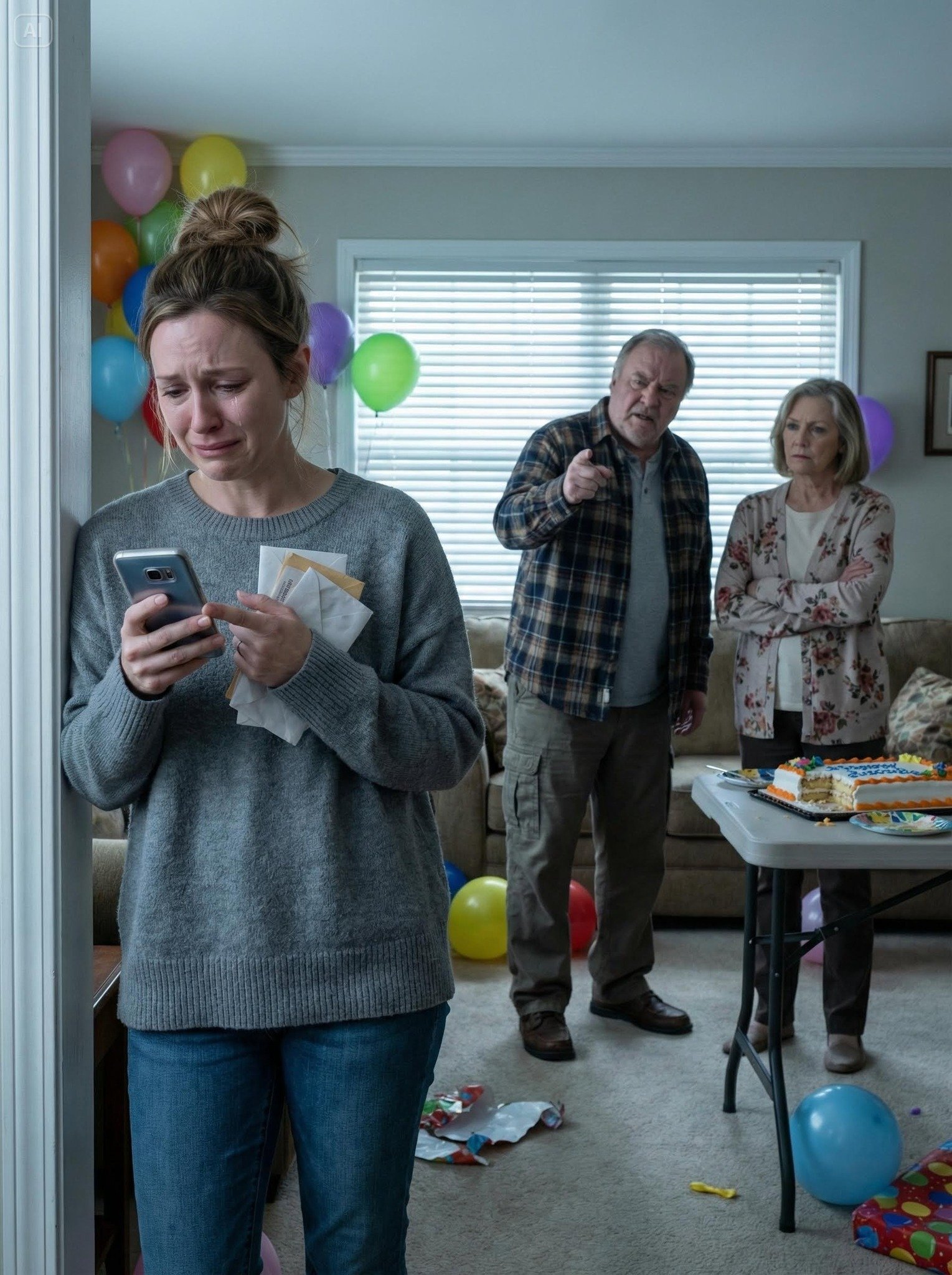
So when her birthday came around—six years old, old enough to remember, old enough to notice who showed up—I went all out.
Streamers. Balloons. Lemonade in mason jars. A cheap bouncy castle I found secondhand from a woman in the next town who said her kids had outgrown it. I scrubbed it down, patched a small hole, and set it up in our yard like I was building magic with duct tape and hope.
Ava twirled in her pink dress, her hair braided like Elsa, cheeks flushed with excitement. She looked like a tiny sun. She ran in circles and shouted, “Look at me, Mommy!” until I was laughing even though my chest felt tight with nerves.
“Do you think they’ll come this time?” she asked, peering through the fence as neighbors arrived with gifts.
I hesitated, forcing a smile that didn’t reach my eyes.
“Maybe, baby,” I said. “Let’s wait a little longer.”
But deep down, I already knew.
I had invited them. I had reminded them twice. I had even sent my mother a photo of Ava holding the handmade card she’d made at school: a crooked heart, glitter glue smudged, the words “Nana & Grandpa” written in careful, uneven letters.
My mother had responded that morning with one text:
Tell Ava happy birthday from us.
That was it. No call. No “We’ll try.” No excuse.
Just a sentence like a receipt.
Still, I told myself maybe they’d surprise us. Maybe they were late. Maybe my father’s car had trouble. Maybe, maybe, maybe.
By three o’clock, the candles had melted into soft pink puddles on the cake, and the lemonade was warm. The yard smelled like sugar and sunscreen, but the laughter was fading. Ava kept glancing toward the front gate, her fingers sticky from frosting, the hem of her dress catching sunlight like glitter.
Every few minutes she asked the same question, softer each time.
“Mommy… do you think Nana and Grandpa are almost here?”
I smiled the way mothers do when they’re breaking inside.
“Maybe,” I said. “Maybe traffic’s bad.”
But there was no traffic.
There was no call, no excuse, just silence.
I kept the party going even when the last guest left. I handed out leftover cupcakes. I hugged parents. I thanked people for coming. I laughed at jokes I didn’t hear. I kept my face steady like I was holding a cracked plate and pretending it wasn’t breaking in my hands.
Ava sat on the porch steps with a cupcake in her hand, sparkly shoes dangling. She stared at the road like faith itself might drive up and park.
When the sun dipped low, she whispered, “Maybe they forgot.”
I knelt beside her, brushing hair from her face.
“Maybe,” I said, and my throat tightened so hard I could barely speak. “But we still had fun, didn’t we?”
She nodded, tired now. Her lashes were heavy with sleep, frosting smeared near her mouth.
That night, after I tucked her in, I sat on the couch scrolling through photos. Ava smiling with her friends. Balloons bobbing. The bouncy castle in the background like a bright, ridiculous promise. Every picture felt like proof that I had tried.
Then I saw my mother’s text again.
Tell Ava happy birthday from us.
No period. No heart. No call.
I stared at the screen for a long time, my thumb hovering over the call button like it had its own gravity.
I don’t even know why I called.
Maybe I wanted an explanation. Maybe I wanted a lie that sounded like love. Maybe I wanted to hear my father’s voice and find some hint of softness, some hint that the people who raised me were still human under their pride.
My father answered on the third ring.
His voice was sharp, annoyed, like I’d interrupted something.
“What is it, Penelope?”
The way he said my name made it feel like an accusation.
“Why didn’t you come today?” I asked, and I hated how small my voice sounded.
A pause. A sigh heavy with contempt.
“We didn’t feel like it.”
For a second, I thought I misheard.
“Dad,” I said quietly, “Ava was waiting for you. She made a card.”
Another pause.
Then the sentence that split my world clean in half.
“Your child means nothing to us.”
I stopped breathing.
It wasn’t metaphorical. My lungs simply froze. My body went cold before my mind caught up. The sound of the refrigerator humming became unbearably loud. My heart pounded in my ears like a warning.
“What did you just say?” I whispered.
He didn’t repeat it.
He just hung up.
The call ended and the silence that followed was the kind of silence that doesn’t just fill a room—it presses down. It makes you feel like the air itself is heavier.
I sat there with the phone still in my hand, staring at the blank wall across the room. Not crying. Not shouting. Just frozen.
Behind me, Ava’s drawings fluttered on the fridge as the air conditioner clicked on. Little crayon hearts and stick figures smiling in a world that didn’t exist.
My hands started to shake.
I turned the phone over, set it on the counter, and whispered to no one, “Okay.”
The quiet felt heavier than grief.
I walked to Ava’s room. She was asleep, hair tangled, cheeks still pink from the day, one hand clutching Hope the rabbit like it was the last safe thing in the world. I knelt beside her and kissed her forehead.
“You’re everything,” I whispered. “Even if they can’t see it.”
Back in the kitchen, I looked at the clock.
9:07 p.m.
The same time I usually checked the week’s payments and made sure everything was set for Monday. The habit was automatic—my thumb hovering over the banking app before I stopped myself.
Not this time.
I poured the leftover lemonade down the sink, watching the pale yellow swirl vanish like something sweet being erased. I wiped the counter clean. I stood in the stillness and felt something change—not dramatically, not with fireworks, but with the quiet finality of a door locking.
I didn’t sleep that night.
I sat at the kitchen table watching the clock tick past midnight, replaying my father’s words over and over.
Your child means nothing to us.
They didn’t echo.
They carved.
Every syllable felt like a cut I couldn’t stop touching, like your tongue worrying a sore spot until it bleeds.
The phone was still on the counter where I’d left it. My reflection shimmered faintly on the dark screen—hair messy, eyes swollen, a version of myself I barely recognized. I reached for it not to call them, not to beg, not to argue.
To end something.
For years, I had kept the peace by paying for it. Every Monday at 9:00 a.m., I turned guilt into currency. I bought myself the illusion that I was still a daughter, that Ava still had grandparents, that my family might soften if I just kept being good enough.
Now, I was done buying forgiveness that never existed.
I opened my banking app.
My hands trembled as I scrolled through recurring payments: rent, utilities, insurance, daycare. Each one familiar, each one a thread holding our life together.
Then I reached the section labeled “Automatic Transfers.”
There it was—like a heartbeat.
$700 every Monday. Recipient: Mom & Dad.
For a long moment, I stared at it.
I thought about my father’s voice. Cold. Steady. Certain.
I thought about Ava on the porch steps, cupcake in hand, staring at the road.
Then I started deleting, one by one, like cutting puppet strings.
Click.
Cancel.
Confirm.
With each tap, my heartbeat steadied. The trembling eased. The guilt—this constant background noise in my life—began to drain away like water.
When I reached the last line, the $700 transfer, I felt strangely calm.
I deleted it too.
And just like that, eight months of habit vanished.
For a moment the room was silent in a new way. The fridge hummed. Pipes groaned. The night pressed against the windows.
Then my phone buzzed.
A text from Mom.
Can you order us dinner? Nothing fancy, just Chinese or something. We don’t have food in the house.
I stared at it.
Forty minutes.
That’s how long it took for them to notice.
Forty minutes after erasing my daughter with a sentence, they wanted takeout.
My thumb hovered above the screen. I could have typed something. A warning. A final message. A list of everything I’d done. A reminder of what they’d said.
But I didn’t.
I locked the phone and slid it face down.
Instead, I walked back to Ava’s room. She was curled up, breathing softly, her small hand clenched around Hope the rabbit. I sat on the edge of her bed and brushed a strand of hair from her forehead.
“Never again,” I whispered.
Not to her.
To myself.
That was the moment the guilt died.
I realized I didn’t owe them money.
I didn’t owe them explanations.
I didn’t owe them another ounce of peace.
My silence was enough. It was louder than any confrontation could ever be.
When I finally stood, the air felt lighter. The weight on my chest lifted for the first time in years. I turned off the hallway light and watched the house sink into darkness. A clean, final kind.
Some betrayals don’t need a fight.
They need a funeral.
And that night, I buried the version of me that still believed family meant love.
The morning after that phone call, sunlight spilled across the kitchen table like nothing had happened.
Ava’s cereal bowl sat in the sink. Her backpack leaned against the wall. The world kept moving the way it always does, indifferent and bright.
But I couldn’t shake my father’s voice. It echoed beneath every sound, even the hum of the fridge.
Ava was still asleep. I made coffee just to have something to hold, because my hands needed something solid.
The phone rang.
Unknown number.
For a second, I almost ignored it. But something in me—some instinct sharpened by years of being the responsible one—made me answer.
“Hello?”
“Ms. Hayes?” a man asked. His voice was polite but cautious. “This is Richard. I’m your parents’ landlord. I just wanted to check in. The rent didn’t come through, which is… unlike you.”
Unlike me.
The phrase hit like a slap.
“Why would their rent be like me?” I asked, and my voice surprised me. Flat. Steady. Not apologetic.
There was a pause. “They told me you managed their payments.”
“I used to,” I said. “Not anymore.”
His breath changed on the line, like he hadn’t expected that. “Well… they’ll need to handle it. I just wanted to make sure there wasn’t an error.”
“No error,” I said. “They’re adults. They’ll figure it out.”
When I hung up, I felt something shift, like a cord snapping.
I wasn’t their safety net now.
Just a person drinking coffee in her own kitchen.
At ten, my brother called.
Ryan’s name flashed on my screen and I answered before it finished ringing, because Ryan was the only person in my family whose voice still felt safe.
“Pen,” he said, and his voice was careful. “Mom says you’ve lost your mind.”
I laughed softly, a sound that surprised me because it wasn’t humor. It was exhaustion. “Define lost,” I said.
“She says you’re cutting them off.”
“I am,” I replied.
Ryan went quiet for a beat. Then, softly, “Good.”
I blinked. “What?”
“I’m done too,” Ryan said, and his voice cracked slightly. “Pen… I’ve been sending them money.”
My stomach dropped. “You have?”
“Not as much as you,” he admitted. “A few hundred a month. Groceries, gas, little things. I thought… I thought maybe if we both helped, they’d change.”
I closed my eyes, the weight of it sinking in.
“They never told me,” I whispered.
“They never told me about you either,” Ryan said. “Guess we were paying rent on the same guilt.”
The sentence hollowed me out.
So they had been taking money from both of us, quietly, without gratitude, without acknowledgment. Two children propping up the same parents who couldn’t even pretend to love their granddaughter.
Before I could respond, my phone lit up with another notification—Facebook tag.
A live stream replay.
The title punched me in the stomach.
The Truth About Our Daughter.
My chest tightened. “Oh God,” I whispered.
Ryan’s voice sharpened. “Don’t watch it, Pen.”
But my thumb was already tapping.
The video loaded.
There was my mother, framed in the center like she was on a talk show, clutching a tissue with perfect timing. My father sat beside her, arms crossed, face set in that familiar expression of righteous indignation.
My mother sniffled. “We’ve always supported Penelope through everything,” she said, voice trembling in a way I recognized too well. “But she’s made up lies, telling people we’re monsters who refuse to see her child. None of that is true.”
My stomach turned.
My father leaned closer to the camera. “She’s been forcing money on us for years,” he said coldly. “She needs help.”
Forcing money on us.
As if those Monday transfers had been an assault. As if my guilt had been a weapon against them.
I didn’t blink. I watched numb until the moment came—the part I knew was coming like a car crash you can’t stop watching.
My father lifted a printed photo of Ava smiling in her pink birthday dress and said the same words again, this time to the world.
“This child does not exist to us.”
I froze.
Ava’s laughter from yesterday—the way she’d squealed in the bouncy castle, the way she’d clapped when we lit candles—flickered in my head like film burning out.
I closed the video, unable to finish.
Within an hour, messages started pouring in.
Are you seeing this?
Is that your dad?
What the hell?
Comments piled under the video—some sympathetic, some judgmental, all loud.
Who says that about a six-year-old?
Praying for their hearts.
If this is real, it’s disgusting.
She probably deserved it. (That one made me want to throw my phone across the room.)
I turned my phone off.
The house felt too quiet, like even the air didn’t want to move.
Later that afternoon, Ryan texted me:
Don’t post anything. Let them choke on their own words.
I obeyed.
Silence, I was learning, could be louder than rage.
By evening, the video had spread through our small town’s social circles like smoke. People who knew my parents from church shared it with prayer-hands emojis. Others shared it with captions like “unbelievable.” The tide was turning without me lifting a finger.
The next morning, Richard the landlord texted again.
They’ve been told to vacate. 30 days. I’m sorry it came to this.
I didn’t reply.
I didn’t need to.
Justice, for once, was efficient.
Two days later, my cousin Lauren called. Her voice was tight with anger.
“They’re at the family reunion,” she said. “Can you believe it?”
I frowned. “They weren’t invited.”
“They showed up anyway,” Lauren said. “Trying to get sympathy. Like they’re the victims.”
My jaw clenched. “Of course.”
Lauren exhaled sharply. “I’m done pretending,” she said. “You might want to check Facebook later.”
Then she hung up.
An hour later, I did.
Another video was already climbing in shares. Grainy handheld footage from someone’s phone. A sunny backyard. Picnic tables. Plastic cups. A grill smoking in the corner. Children running through grass.
My parents stood near the center, my mother speaking to a circle of relatives, voice pleading and theatrical.
“No matter what Penelope told you,” she said, “we love her. And that poor child… she’s confused.”
The words made my skin crawl. Confused, like Ava was a mistake that needed correcting.
Then Lauren’s voice cut in, sharp and clear. “Before or after you said her kid doesn’t exist?”
The camera swung toward Lauren. She was holding up her phone, volume blasting.
From the tiny speaker came my father’s voice, unmistakable.
Your child means nothing to us.
Gasps rippled through the yard. A collective inhale. My mother froze mid-sentence. My father’s face drained of color.
The whole backyard fell silent except for a lawn mower humming somewhere in the distance, indifferent to family collapse.
Then Uncle James—my father’s older brother—stood up slowly. He was a tall man with quiet authority, the kind of man who rarely raised his voice because he never had to.
“If that’s how you treat your granddaughter,” Uncle James said calmly, “you don’t belong here.”
No one argued.
No one comforted my parents.
No one tried to smooth it over.
They left without a word, faces pale, eyes down, moving fast as if they could outrun the truth.
The camera panned back to Lauren. Someone muttered, “Good for her.” Another voice said, “About time.”
I watched the clip three times.
Then I set the phone down and laughed.
It wasn’t cruel laughter. It wasn’t triumphant. It was shaking, released, like something deep inside my chest had finally unclenched.
Ryan called that evening.
“You saw it,” he said.
“I did,” I whispered.
“They humiliated themselves,” Ryan said, and there was something like relief in his voice. “Finally, they did.”
“And I didn’t have to do a thing,” I said softly.
“Sometimes the truth handles itself,” Ryan murmured.
That night, I sat by Ava’s bed while she slept, her hand wrapped around Hope. For the first time in months, my chest didn’t ache the way it always did when I thought about my parents. The ache had been replaced by something quieter.
Acceptance.
I listened to the faint sound of rain tapping against the window and thought of every Monday morning I’d wasted paying for love that never existed.
I opened my laptop—not to send money, but to look at the payment history. Eight months of transfers, line after line, completed. I scrolled to the end and whispered, “Not anymore.”
The next morning, the local Facebook group was brutal.
Church couple exposed for disowning grandchild.
Someone had clipped both videos together—the live stream and the reunion confrontation—and posted it as a single montage of self-destruction.
The comments were merciless.
Hypocrisy at its finest.
You can’t erase your own blood.
That poor little girl.
By noon, their church deleted their photos from the website. The landlord changed the locks. Their supporters went quiet. The people who had once defended them suddenly remembered they had other things to do.
I didn’t post anything.
I didn’t celebrate.
I simply took Ava to the park.
The air smelled like wet leaves and chalk dust. Ava drew stars on the sidewalk and said, “Mommy, this one’s for Uncle Rain,” mispronouncing Ryan the way she always did, because when you’re six, names are flexible and love is not.
She laughed, and the sound was so pure it hurt.
When we got home, I found an envelope in the mailbox—cream paper, my name written neatly across the front in handwriting I recognized immediately.
Aunt Virginia.
Aunt Virginia was my mother’s older sister, the quiet one who never played my parents’ games. She lived in a small house with lace curtains and always smelled like lemon pie. When I got pregnant with Ava, she was the only adult in my family who hugged me without making it feel like a punishment.
Inside the envelope was a short note:
They chose pride over love. You chose your child. That’s what family is supposed to look like.
I folded it and slipped it into a drawer.
Some victories don’t need applause.
That night, as I tucked Ava into bed, she yawned and rubbed her eyes.
“Mommy,” she asked softly, “can Nana and Grandpa come next year?”
My throat tightened.
I could have lied again. I could have said “maybe” and kicked the truth down the road like I always did. But lies were what I’d been paying for, and I was done.
“No, baby,” I said gently. “They won’t be coming anymore.”
Ava nodded, thoughtful. She didn’t cry. She didn’t panic. She just absorbed it in that quiet way children sometimes do, because they trust that if the world changes, their parent will still be there.
“That’s okay,” she said after a moment. “We can invite Uncle Ryan instead.”
I smiled, brushing hair from her cheek. “Yeah, sweetheart,” I whispered. “That sounds perfect.”
When I turned off the light, the room fell quiet.
But this time, the quiet wasn’t empty.
It was peaceful.
Earned.
The following week, everything felt quieter, like the world had finally exhaled. The endless pings, the messages, the noise—it all faded into a dull hum. My parents vanished from social media. Their profiles wiped clean, photos gone, as if deleting evidence could undo what they’d said out loud.
Their church released a short statement about “family healing.” Everyone knew what it meant: please stop associating us with those people.
I didn’t feel victorious.
I felt free.
Freedom doesn’t always feel like fireworks. Sometimes it feels like sitting in sunlight at your kitchen table without your stomach twisting at the thought of Monday.
Ava hummed at breakfast, spreading jelly on toast, oblivious to the storm that had finally passed.
Ryan stopped by that weekend with groceries and a grin that reached his eyes.
“You look lighter,” he said.
“Maybe I am,” I replied.
We drove to Aunt Virginia’s for Sunday lunch. Lemon pie cooling on the counter. Sunlight pouring through lace curtains. Ava ran straight to Aunt Virginia and hugged her legs like she’d been starving for affection that didn’t come with conditions.
Aunt Virginia hugged Ava first, then me.
“Peace looks good on you, Penelope,” she said softly.
Over lunch, she talked about boundaries the way some people talk about weather—calm, matter-of-fact, as if it should have always been part of the forecast.
“Love without respect isn’t love,” she said, slicing pie. “It’s control.”
I listened. Really listened.
And for the first time, I believed it.
Later, while Ava colored at the table, Aunt Virginia slipped an envelope into my hand.
“For when you forget,” she murmured. “Why you stopped.”
Inside was a single line written neatly:
Kindness with boundaries is strength.
That night, I stood by Ava’s door, watching her chest rise and fall beneath the soft glow of her nightlight. For the first time in years, I didn’t dread tomorrow.
I didn’t owe anyone peace but us.
My parents had chosen pride.
I chose freedom.
And that choice—quiet, steady, final—was the loudest revenge I could ever give.
Because it wasn’t revenge, really.
It was protection.
It was a mother deciding that her child would not grow up watching love being bought with guilt.
It was a daughter finally accepting that you cannot pay someone into caring.
And if walking away is what it takes to keep your home gentle, then walking away isn’t failure.
It’s courage.
The end.
Website Disclaimer
The information provided on this website is for general informational and educational purposes only. While we strive to ensure that all content is accurate and up to date, we make no guarantees regarding the completeness, reliability, or accuracy of any information published.
The views and opinions expressed in articles belong to their respective authors and do not necessarily reflect the views of this website. Any action you take based on the information found on this website is strictly at your own risk. We will not be liable for any losses, damages, or inconveniences arising from the use of our content.
Some articles may contain opinions, third-party information, or external links. We do not endorse or guarantee the accuracy of content on external websites and are not responsible for their practices or policies.
All content on this website is provided in good faith and is intended for informational purposes only. Readers are encouraged to verify information independently and seek professional advice where appropriate.