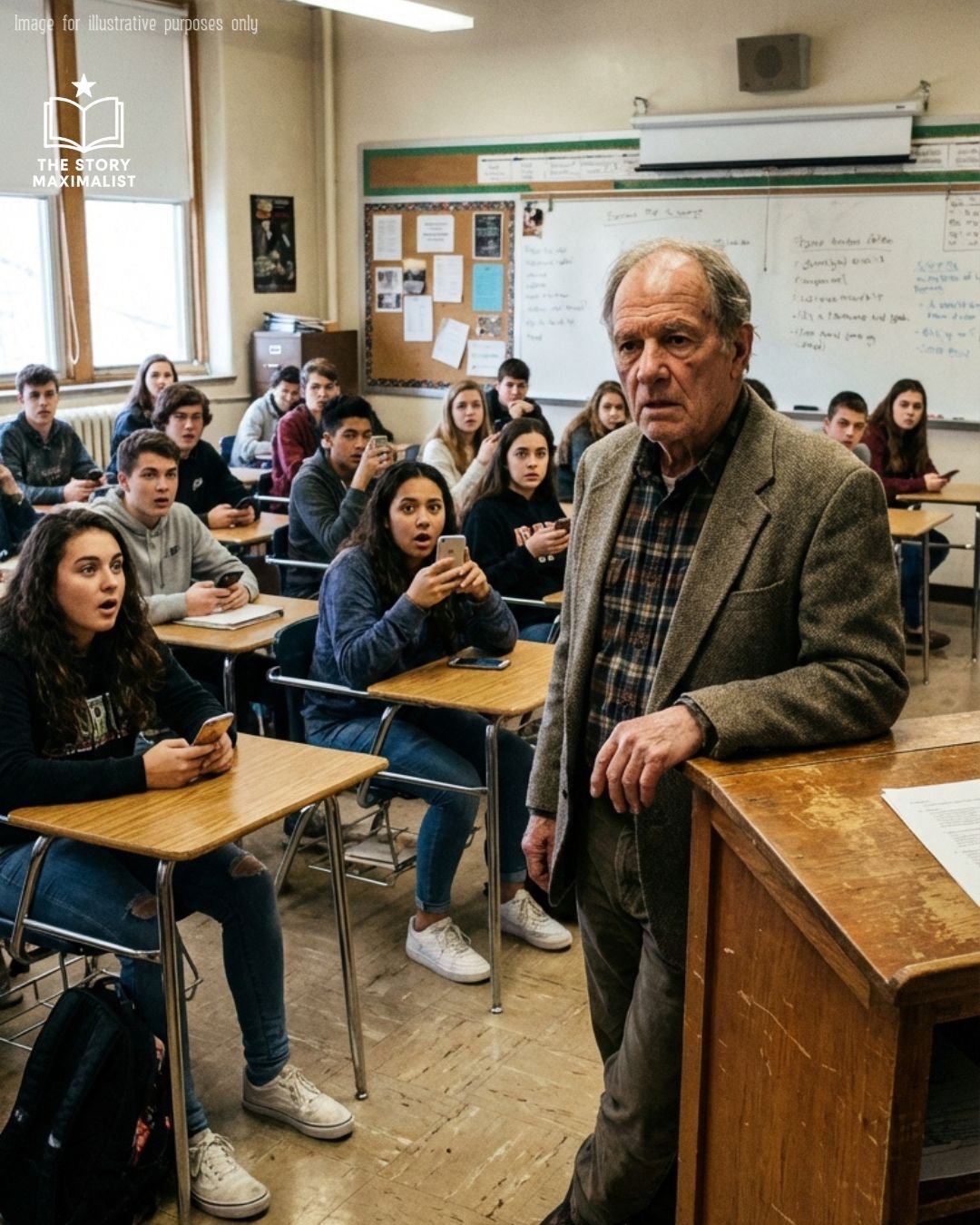
I told a room full of teenagers that I watched my best friend die in the mud just to see if they’d look up from their phones.
The room didn’t just go quiet. It went dead.
Thirty glowing screens lowered to the desks. The hum of the air conditioner suddenly sounded like a jet engine.
I’m seventy-six. My hearing is shot, my left hip is held together by titanium and stubbornness, and I was the last person these kids wanted to see on “Career Day.”
The presenter before me was a twenty-something app developer in a hoodie who talked about “scaling” and “passive income.” The kids were glued to him.
Then came me. The relic.
My grandson, Tyler, sank so low in his chair I thought he was trying to merge with the floor tiles. He’d begged me not to be embarrassing.
I stood there in my best blazer, the one that smells like mothballs no matter how many times I dry clean it. I had a stack of index cards in my shaking hand. Prepared remarks about discipline, patriotism, and the post office pension plan.
I looked at their faces. Blank. Bored. Lonely.
That’s the thing nobody tells you about getting old. It’s not the joint pain that kills you; it’s the invisibility. You walk through the grocery store, and people look right through you like you’re a ghost that hasn’t realized it’s dead yet.
I looked at these kids, and I realized something terrifying. They looked exactly like I feel.
Isolated.
So I tore the index cards in half.
I dropped the pieces on the teacher’s desk. Tyler covered his eyes.
“I don’t know anything about coding,” I said. My voice was raspy, stripped of the polite “customer service” tone I used for years. “And I don’t know how to build a brand.”
I took a step closer.
“But I know what it’s like to be eighteen years old and so scared you can’t breathe.”
I told them about 1968. Not the history book version.
I told them about the humidity that felt like a wet wool blanket wrapped around your face.
I told them about “Ski.”
Ski was a kid from Chicago who loved baseball and hated the rain. We were dug into a foxhole the size of a bathtub. For three days, we didn’t sleep. We didn’t eat. We just talked.
I told this class of silent teenagers that in that mud, Ski knew more about me than my own mother did. He knew I was afraid of the dark. He knew I wanted to be an architect.
“We didn’t have followers,” I told them. “We didn’t have ‘likes.’ We had each other. And when the mortar hit, I held him while he bled out. I didn’t check a screen to see if anyone cared. I was the only one there.”
A girl in the front row, with purple streaks in her hair and heavy eyeliner, wiped her cheek. She didn’t try to hide it.
“I came home,” I continued. “And I realized the jungle wasn’t the lonely part.”
I told them about walking through the airport in San Francisco. People screaming at me. Calling me a baby killer.
I told them about sitting at the dinner table with my parents, the silence stretching out like a minefield. My dad saying, “Let’s just move on, son.”
“I spent forty years surrounded by people,” I said, leaning against the whiteboard. “I got married. Had kids. Went to barbecues. And I felt like I was the only person on earth.”
I pointed at the sea of smartphones on their desks.
“You guys have a thousand friends in that little box,” I said. “But who is going to hold your hand when the world falls apart? Who is going to sit in the mud with you?”
I let the question hang there.
“Don’t mistake attention for connection,” I whispered. “One is a drug. The other is oxygen. I learned that the hard way. Don’t wait until you’re my age to figure out the difference.”
The bell rang.
Usually, that sound triggers a stampede.
Nobody moved.
The teacher, a young guy who looked like he’d been crying, had to clear his throat. “Class dismissed,” he croaked.
As they packed up, the purple-haired girl walked up to the front. She didn’t say a word. She just reached out and took my gnarly, wrinkled hand. She squeezed it hard, looked me in the eye, and nodded.
Then she walked out.
Tyler waited until the room cleared. He walked up to me, his eyes red.
“I’m sorry, Grandpa,” he said.
“For what?”
Original work by The Story Maximalist.
“For thinking you didn’t get it.”
We walked to the parking lot together. He didn’t pull out his phone once. He just asked, “Can we get a burger? I want to hear more about Ski.”
We sat in a booth at the diner for two hours.
I realized something today. We talk about the “generation gap” like it’s some impossible canyon. We think these kids are soft, distracted, lost. They think we’re angry, out of touch, obsolete.
But stripped of the tech and the years, we’re all just looking for the same thing.
Someone to sit in the foxhole with us.
Someone to say, “I see you. You aren’t alone.”
Maybe if we stopped scrolling and started speaking, we’d realize we’re all fighting the same war.
And we all need the same peace.
PART 2 — “THE BURGER AFTER THE BELL”
By the time the waitress came back with the check, Tyler had stopped pretending he wasn’t crying.
He kept wiping his face like he was mad at the wetness for existing. Like tears were some kind of pop quiz he hadn’t studied for.
I stared at the laminated menu and realized my hands weren’t shaking anymore.
That’s what scared me most.
Not the shaking—I’ve lived with that for years.
The calm.
The kind that comes after you’ve said something out loud that you’ve been choking on for decades.
Tyler pushed the basket of fries toward me. “Eat, Grandpa.”
“I am eating,” I lied, picking up one fry and holding it like a cigarette.
He leaned forward, elbows on the table. No phone. No tapping. No half-listening.
Just a kid with his whole face turned toward me.
“Tell me about Ski,” he said again. Softer this time. Like he was asking for something sacred.
I looked past him at the diner window. Outside, headlights slid by on wet pavement. The sky was the color of dishwater. The world kept moving the way it always does—quick, loud, uncaring.
And I thought, That’s the trick.
The world doesn’t stop when something in you breaks.
It just keeps driving.
“He wasn’t his real name,” I said.
Tyler blinked. “What was?”
I shrugged. “We didn’t use real names much. Not on purpose. It just… happened. Everybody had a nickname. You get called something once and then you’re that thing forever.”
“Ski because…?”
“Because he could water-ski,” I said. “On a lake back home. Used to brag about it. Said he could ‘ski’ on anything. Water, snow, your mom’s kitchen floor if you spilled enough soap.”
Tyler almost smiled.
Almost.
Then it collapsed.
“That’s so stupid,” he whispered. “It’s so… normal.”
“Yeah,” I said. “That’s why it hurts.”
I finally put the fry in my mouth. It tasted like salt and old grease and something comforting I couldn’t name.
Tyler stared at me for a long moment, then said, “Do you ever… dream about it?”
I didn’t answer right away.
Because the truth is, I don’t just dream.
I visit.
And sometimes I come back with mud still under my nails.
“Not like movies,” I said. “Not every night. But enough.”
He nodded like he understood. Like he was trying to put my words into a box his brain could carry.
Then his hand slid across the table.
He didn’t grab mine.
He didn’t make a big show.
He just rested his fingers against the back of my knuckles like he was anchoring me to the booth.
A simple thing.
A human thing.
The kind of thing no screen can replicate.
And I thought, Maybe today wasn’t just about those kids.
Maybe it was about me finally learning to let someone sit in the foxhole with me again.
We walked out into the cold after that, the air snapping at my lungs like it wanted to fight.
Tyler opened my car door without being asked.
I should’ve made a joke. Should’ve told him I wasn’t dead yet.
But the truth is I liked it.
I liked being cared for.
That’s another thing nobody tells you about old age: you spend your whole life trying not to need anyone, and then suddenly needing people is the only thing that feels real.
Tyler buckled in and stared out the windshield.
“You think those kids will be okay?” he asked.
I started the engine. The heater coughed like an old smoker.
“I don’t know,” I admitted. “But I saw something in that room.”
“What?”
“A pulse,” I said. “For a second, it felt like a living place. Not just… bodies and screens.”
Tyler swallowed. “They were listening.”
“Yeah,” I said. “And that scares people.”
He frowned. “Why would that scare people?”
I pulled out of the parking lot slow, careful on the slick road.
“Because listening changes things,” I said. “And people like things the way they are—even when the way they are is killing them.”
Tyler didn’t answer.
He just stared at the passing streetlights like he was watching his childhood shrink in the rearview mirror.
That night, I slept like a stone.
No jungle.
No mortar.
No mud.
Just darkness and quiet.
And I should’ve known that kind of peace never comes free.
The next morning, Tyler was in my kitchen before I’d finished making coffee.
He didn’t say good morning.
He didn’t even sit down.
He just held his phone out like it was a dead fish he’d found on the porch.
“Grandpa,” he said, voice tight. “You need to see this.”
I stared at the phone like it might bite.
After yesterday, I’d hoped he’d keep it in his pocket more. That he’d learned something.
But then I looked at his face.
And I realized this wasn’t casual scrolling.
This was fear.
“What is it?” I asked.
He tapped the screen.
And there I was.
On a grainy video. In a classroom. Under fluorescent lights that made my skin look like wax.
My blazer. My shaking hand. My mouth moving.
My voice—my real voice—coming out of that little speaker like someone had trapped my soul inside glass.
I told a room full of teenagers that I watched my best friend die in the mud…
I heard the room go dead again.
I watched thirty screens lower.
I watched the purple-haired girl wipe her cheek.
I watched Tyler disappear into his chair.
And then I saw something I didn’t see yesterday.
In the back row, a kid had his phone angled just right—recording the whole thing.
My stomach dropped.
Tyler swiped down and I saw the numbers.
Too many.
Thousands of comments.
Hundreds of shares.
It was spreading like a match thrown into dry grass.
“They posted it last night,” Tyler said. “Someone clipped it. It’s everywhere.”
“Everywhere where?” I snapped before I could stop myself.
He flinched like I’d slapped him.
“Everywhere,” he repeated, quieter. “People are… reacting.”
I stared at my own face frozen on the screen—wrinkled, earnest, furious, pleading.
A face I hadn’t seen in a while.
Not since the man in the airport.
Not since the yelling.
Not since I learned what it feels like to be made into a symbol instead of a person.
Tyler swallowed hard. “Some people are saying you’re a legend. That you ‘owned’ the kids.”
“Owned?” I said, disgusted. “I didn’t own anybody.”
“I know,” he said quickly. “I know. But other people are saying…”
He trailed off.
“What?” I demanded.
Tyler looked down. “They’re saying you traumatized them. That you’re pushing propaganda. That you shouldn’t talk about war in a school.”
I barked out a laugh that wasn’t funny.
“War in a school,” I muttered. “As if they aren’t already at war.”
Tyler’s eyes flicked up. “Grandpa…”
I paced the kitchen, hip aching, coffee forgotten. My mind was racing—faster than it had any right to at seventy-six.
“Did you record it?” I asked suddenly.
“No,” Tyler said. “I swear. I didn’t even— I didn’t take my phone out.”
“I saw that,” I said, softer. “I’m not blaming you.”
But I was blaming the world.
The same world that ignored me when I needed help and then screamed at me when it noticed me again.
Tyler scrolled. His thumb moved like it had a mind of its own.
“Look,” he said. “This one says—”
“I don’t want to read them,” I snapped.
He froze.
I took a breath, forced my voice back down into something human.
“Tyler,” I said. “When people don’t know you, they make you into whatever story they need.”
He looked up at me, confused. “But they do know you. They saw you.”
“They saw a clip,” I corrected. “A bite of a meal. Not the whole thing.”
He hesitated. “The school called.”
My spine stiffened. “They did?”
“Yeah. The principal wants you to come in.”
“For what?”
Tyler’s face tightened. “He said… there are parents upset. And there are parents grateful. And there are people asking if you’re coming back.”
I stared at my kitchen table—scarred wood, old coffee rings, a bowl of oranges going soft.
I’d lived my life small on purpose.
Small feels safe.
Small keeps you from getting shot at, whether by bullets or opinions.
And now, overnight, my words had escaped the room and run wild.
I rubbed my face with both hands.
“I didn’t ask for this,” I said.
Tyler’s voice cracked. “Neither did the kids.”
That stopped me.
Because he was right.
No one asked to be born into a world where your loneliness comes with a comment section.
I looked at him—my grandson with his hair still damp from a shower, his hoodie bunched at the wrists, his eyes too old for his age.
“Okay,” I said quietly. “We’ll go.”
Tyler exhaled like he’d been holding his breath for hours.
“But,” I added, “I’m not going in there to apologize for telling the truth.”
Tyler nodded. “Then don’t.”
He paused, then said, “Just… don’t let them turn you into a villain.”
I almost said, Kid, I’ve been a villain before.
But I didn’t.
Because I wasn’t in a jungle now.
I was in a school.
And the stakes were different.
Maybe.
The office smelled like lemon cleaner and stress.
A receptionist with a tight smile handed us visitor badges like we were entering a museum exhibit called Elderly Man: Handle With Care.
Tyler kept close to me. He looked taller today. Not in inches—just in posture.
We were led into a conference room where the principal sat with a counselor and the young teacher from yesterday—eyes still tired, still red around the rims.
The principal stood quickly, hand outstretched.
He was in his forties, maybe. Clean haircut. Polished shoes. The kind of man who lives by email.
“Mr. Harris,” he said.
I blinked. “How’d you—”
“Tyler’s emergency contact forms,” he said, as if names were just paperwork.
Right.
Mr. Harris.
That’s me now.
A name on a form.
We shook hands.
His grip was firm but careful, like he was worried I might crumble.
I sat anyway—slow, hip complaining.
Tyler sat beside me.
The counselor—a woman with kind eyes and a notebook—leaned forward.
“First,” she said gently, “I want to acknowledge that what happened yesterday was… powerful.”
I didn’t trust the word powerful.
People use it when they don’t know what else to say.
The principal cleared his throat. “It’s gotten a lot of attention.”
“A lot,” Tyler muttered.
The teacher—Mr. Larkin, I remembered—looked down at his hands. “I didn’t know anyone recorded it,” he said quietly. “We have policies. But… kids are fast.”
“Yeah,” I said. “Faster than consequences.”
The principal winced like that line might end up on a poster.
He slid a folder toward me. “We’ve received emails.”
I didn’t open it.
“How many?” I asked.
He hesitated. “Enough.”
The counselor spoke again. “Some parents feel the content was inappropriate. Too graphic. Too emotionally intense.”
I let out a breath. “I didn’t describe guts. I didn’t show pictures. I said my friend died and I held his hand.”
The teacher finally looked up. His voice shook. “Some parents don’t like their kids thinking about death at all.”
I stared at him. “Then they’re not paying attention.”
Silence.
The counselor’s eyes softened. “That’s part of the problem,” she said. “The kids are thinking about death anyway. Some of them think about it more than you’d imagine.”
Tyler’s shoulders tensed.
My mouth went dry.
I looked at the counselor. “Are you saying—”
“I’m saying,” she interrupted gently, “that loneliness doesn’t look like loneliness anymore. It looks like jokes. It looks like memes. It looks like kids laughing while they’re drowning.”
Her words hit me like cold water.
The principal rubbed his forehead. “And then there’s the other side. Parents calling to thank us. Saying their kids came home and talked for the first time in months.”
Mr. Larkin swallowed hard. “Three of my students stayed after class. They… they told me things.”
His voice broke. He coughed, tried to regain control.
“They asked me if there’s somewhere they can go at lunch,” he continued. “Somewhere without noise. Without… all of it.”
Tyler glanced at me like he was seeing the story expand past our booth in the diner.
The principal leaned forward. “This has become bigger than Career Day. We’ve got a board member asking questions. We’ve got people online calling the school irresponsible. We’ve got people online calling the school brave.”
He looked at me like I was a fire he couldn’t decide whether to put out or feed.
“We need to know,” he said, “what your intention was.”
I felt my jaw tighten.
“My intention,” I said slowly, “was to get them to look up. To look at each other. To remember they’re alive.”
The counselor nodded slightly.
The principal asked, “Would you be willing to make a statement? Something that clarifies—”
“No,” I said.
The room went still.
Tyler’s eyes widened.
The principal blinked. “No?”
“I’m not playing the online game,” I said. “I’m not posting apologies or explanations to strangers who want to chew me up for sport.”
Mr. Larkin whispered, “Thank you.”
The principal shot him a look.
I continued, voice steady now. “If people want to argue, they’ll argue. If people want to misunderstand, they’ll misunderstand. But I will not let a comment section decide whether what I said mattered.”
The counselor’s pen stopped moving.
The principal exhaled. “Okay. Then we have to consider—”
The door opened.
And the purple-haired girl stepped in.
No knock.
Just walked in like she belonged there.
Like she was done asking permission to exist.
Everyone froze.
“May I speak?” she asked.
Her voice didn’t tremble. But her hands did.
The counselor stood halfway. “Maya—”
So that was her name.
Maya looked at the counselor, then at the principal, then at me.
“I’m one of the kids,” she said. “From yesterday.”
The principal’s face went tight. “Maya, this isn’t—”
“It is,” she cut in.
The room went electric.
Tyler’s mouth fell open.
Maya’s eyeliner was smudged today, like she’d wiped her face and given up on fixing it.
She pointed at me. “He didn’t traumatize me.”
The principal said, “This meeting is about—”
“It’s about adults being uncomfortable,” she said, sharp as a blade. “Not about kids being harmed.”
The counselor’s eyes widened. “Maya, slow down—”
“No,” Maya said. “Because you’re all talking like we’re fragile glass.”
Her voice cracked. She swallowed and kept going.
“We’re already thinking about death,” she said, staring at the principal now. “We’re already scared all the time. We just don’t say it because nobody wants to hear it.”
Silence.
Maya looked at me again.
“When he talked yesterday,” she said, quieter, “it was the first time an adult didn’t talk at us like we’re either lazy or perfect. He talked to us like we’re human.”
My throat tightened.
Maya’s chin lifted. “And yeah, it hurt. It hurt because it was true.”
She turned to the principal. “You want to know what traumatizes us? Pretending everything is fine. Pretending we’re okay because we can make jokes online. Pretending we’re connected because we’re ‘reachable.’”
Her eyes flicked to Tyler, then back to me.
“He said attention isn’t connection,” she whispered. “And I felt that in my ribs.”
The counselor spoke softly. “Maya… thank you.”
Maya’s shoulders finally sagged, like the anger had been holding her upright.
She looked at me one more time, then said, “If you send him away, you’re telling us the truth isn’t welcome here.”
Then she walked out.
No dramatic slam.
Just the sound of the door clicking behind her.
A small sound.
A huge statement.
The principal stared at the closed door like he’d just watched a piece of the world shift out of place.
Tyler exhaled shakily.
Mr. Larkin wiped his face quickly, like he hated himself for it.
The counselor sat back down and looked at me like she was seeing me for the first time.
“Well,” she said quietly, “that answers the intention question.”
The principal rubbed his jaw. “This is… complicated.”
“Yeah,” I said. “So are teenagers. Welcome.”
He almost smiled.
Almost.
Then his phone buzzed on the table.
He glanced at it and flinched.
“I’ve got a call from the district,” he said.
Of course he did.
He stood. “Give me five minutes.”
He left the room.
The counselor turned to me. “Mr. Harris… can I ask you something?”
I nodded.
She hesitated, then said, “Did you expect it to go viral?”
I snorted. “I barely know what that means.”
Tyler muttered, “It means strangers have opinions about you now.”
I looked at him. “Strangers had opinions about me in 1968 too.”
Tyler’s face tightened.
The counselor’s eyes softened. “What happened after you came home—really?”
I stared at the tabletop.
The old instinct rose in me: Move on, son.
But Maya’s voice echoed in my head.
Pretending everything is fine.
So I told the truth.
“I came home,” I said, “and everybody wanted me to either be a hero or a monster.”
Tyler’s eyes flicked up, surprised.
“And nobody wanted me to be a person,” I finished. “A person who missed his friend. A person who shook in his sleep. A person who sat at the dinner table and couldn’t taste the food.”
Mr. Larkin whispered, “That’s what they’re doing to these kids too.”
He sounded like he was admitting something he’d been afraid to name.
The counselor nodded slowly. “We keep asking them to perform wellness,” she said. “To look okay. To achieve. To smile.”
Tyler stared at his hands.
“And online,” she continued, “everything becomes a performance. Even pain.”
My stomach turned.
Because that’s what my speech had become overnight.
A performance.
A clip.
A fight.
The principal came back in, face pale.
He sat down like he’d aged ten years in five minutes.
“They want a response,” he said. “A statement. A reassurance.”
I leaned forward. “Tell them this: I’m not here to recruit anyone for anything. I’m not here to glorify war. I’m here to talk about loneliness.”
The principal blinked. “That’s… not how they’ll hear it.”
“Then they’re not listening,” I said again.
Tyler shifted beside me. “What if you came back,” he said suddenly, “and did a real thing?”
All eyes turned to him.
He swallowed. “Like… not a speech. Like a group. A lunch thing. Something where kids can talk to older people. Or veterans. Or… anybody who remembers what life felt like before everything became… a feed.”
The counselor’s eyes widened with interest.
Mr. Larkin leaned forward like Tyler had handed him oxygen.
The principal hesitated. “We have to be careful. Liability. Parents. Boundaries.”
Tyler’s jaw tightened. “So what? We do nothing because it’s complicated?”
The room went still.
There it was.
The controversy, clean and sharp:
Do we protect kids from discomfort… or protect them from isolation?
The counselor spoke quietly. “We could create something structured. Supervised. Opt-in. Consent forms. A safe space.”
The principal looked like his brain was trying to sprint while his fear held the leash.
He stared at me. “Would you do it?”
I thought about going back into that building.
About being looked at again.
About being hated again.
About being used again.
And I thought about Maya’s hands shaking.
About Tyler’s fingers on my knuckles.
About Ski in the mud, trying to joke his way through terror.
“I’ll do it,” I said.
Tyler let out a breath like he’d been holding his entire generation in his chest.
“But on one condition,” I added.
The principal nodded quickly. “Name it.”
“No phones,” I said.
Silence.
Mr. Larkin whispered, “Oh boy.”
Tyler’s eyes widened. “Grandpa—”
“I’m not saying ban them,” I said. “I’m saying if we’re going to try connection, we do it for real. We put the little boxes away for one hour. We see if we can survive being human without an audience.”
The principal rubbed his forehead. “People will freak out.”
“Good,” I said. “Let them.”
Because if there’s one thing I learned young, it’s this:
When people freak out, it means you touched something true.
They scheduled it for the following Thursday.
They called it something bland in the email—something safe enough to slip past angry parents and nervous administrators.
A “Community Listening Session.”
I called it the foxhole.
Tyler helped me make a simple flyer on his laptop. No logos. No brands. Just words.
NO ADVICE. NO LECTURES. JUST STORIES.
The counselor insisted on having rules printed at the bottom.
Be respectful.
Don’t interrupt.
You can step out anytime.
If you’re in crisis, talk to an adult immediately.
I didn’t argue.
Because the truth is, I’m not a counselor.
I’m an old man with scars and a stubborn heart.
But I know one thing better than most:
Silence is where people die.
Thursday came fast.
I stood outside the classroom with a cardboard box in my arms like I was collecting donations.
Kids filed in. Some alone. Some with friends. Some with their faces set like they were walking into court.
A few rolled their eyes at the box.
“What’s that?” a boy asked.
“A coffin,” I said.
He blinked. “What?”
I nodded toward his phone. “For the next hour, that thing is dead.”
A laugh rippled through the hallway—uneasy, half-amused, half-offended.
“Bro, that’s controlling,” someone muttered.
“Yeah,” I said, loud enough for them to hear. “So is a thousand strangers deciding your worth before breakfast.”
That shut them up.
One by one, they dropped their phones into the box like they were surrendering tiny weapons.
Some hesitated like they were losing a limb.
One kid—tall, jittery—refused.
“I can’t,” he said, eyes wide. “My mom… she freaks if I don’t answer.”
The counselor, standing behind me, nodded. “You can keep it,” she said gently. “Just turn it off and put it facedown on the table.”
The kid’s shoulders sagged with relief like someone had finally believed him.
I watched all of it—every small panic, every twitch, every defensive joke.
And I realized something that made my chest ache:
These kids weren’t addicted because they were weak.
They were addicted because the world trained them to be.
The bell rang.
Mr. Larkin closed the door.
The room got quiet.
Not dead quiet like last time.
A different quiet.
The kind where something might grow.
I set the phone box on the teacher’s desk and sat in a chair at the front like I was about to be interrogated.
Tyler sat near the middle.
Maya sat in the front row, arms crossed, eyes sharp. Like she was daring anyone to lie.
I looked at them and felt my throat tighten.
“Okay,” I said. “Here’s the deal. I’m not here to fix you.”
A few kids blinked.
I continued. “I’m not here to tell you what to do with your life. I’m not here to say ‘back in my day’ like that solves anything.”
A small laugh.
Good.
“I’m here,” I said, “to ask one question.”
I let it hang.
Then I pointed to the empty space between desks.
“Who sits with you when it gets bad?”
The room froze.
Some kids looked down.
Some looked away like I’d turned on a light in a place they didn’t want seen.
Maya didn’t flinch.
Tyler swallowed.
Nobody answered.
So I did something I hadn’t planned.
I stood up and reached into my blazer pocket.
Pulled out a baseball.
Old. Scuffed. Faded stitching.
Tyler’s eyes widened. “Is that—”
“Yeah,” I said. “Ski’s.”
You could feel the room lean in.
I held it up.
“This ball sat in his duffel. He’d pull it out and toss it back and forth with me in the trench when we couldn’t sleep.”
I turned the ball slowly in my palm.
“You know what he said once?” I asked.
Silence.
“He said, ‘If I ever disappear, this proves I was real.’”
My voice broke on the last word.
I cleared my throat hard.
“And here’s the part nobody likes,” I said. “When he died, nobody wanted to hear about him. They wanted me to shut up. Move on. Be normal.”
I looked at their faces.
“Does that sound familiar?” I asked.
A boy in the back let out a bitter laugh.
A girl near the window nodded once, barely visible.
Maya’s eyes shone like she was fighting something.
I set the baseball on the desk.
“I don’t want you to be normal,” I said. “I want you to be honest.”
And then, for the first time in a room full of teenagers, nobody tried to be cool.
A kid raised his hand like he was in elementary school.
Mr. Larkin inhaled sharply, surprised.
I pointed. “Yeah.”
The kid’s voice was small. “My dad’s in the house,” he said, “but he’s not… there.”
A few heads nodded like that sentence was a shared language.
Another girl spoke without raising her hand. “My friends talk to me all day,” she said, “but it’s like… none of it touches. Like we’re all just throwing words at each other and hoping something sticks.”
A boy laughed nervously. “If I don’t post something, I feel like I disappear.”
The room shifted.
The truth was coming out, and you could tell it terrified them.
And you could tell it relieved them too.
Maya finally spoke. “I don’t want to die,” she said bluntly, “but sometimes I don’t want to be here.”
Silence slammed down.
My heart stuttered.
The counselor leaned forward calmly, like she’d practiced holding this kind of sentence without dropping it.
“Thank you for saying that,” she said softly. “That matters.”
Maya stared at her, eyes wet but defiant. “I said it out loud. That’s the point.”
I swallowed hard.
I didn’t try to fix her.
I didn’t give her a speech.
I just nodded like a man who understands dark thoughts because he’s lived with them as roommates.
“I get it,” I said.
And Maya’s shoulders dropped like I’d taken ten pounds off her spine.
That’s when I realized the most controversial thing I could possibly do in a modern American classroom wasn’t talking about war.
It was doing this:
Sitting in silence long enough for someone’s truth to show up.
No distractions.
No scrolling.
No escape hatch.
Just people.
The hour ended too fast.
Phones were retrieved like oxygen masks.
But something had changed.
Kids lingered.
Not because they were forced.
Because they didn’t want to go back to the hallway noise yet.
Maya walked up to me when the room thinned.
She stared at the baseball on the desk, then looked at me.
“Did he really say that?” she asked.
I nodded. “Every word.”
She chewed on her lip. “What happened to the ball?”
I hesitated, then tapped it gently. “I kept it. Because I didn’t want him to disappear.”
Maya’s voice dropped. “Sometimes I feel like I’m disappearing.”
I held her gaze.
And I didn’t say something inspirational.
I didn’t say “it gets better” like a bumper sticker.
I said the truth.
“Then you need a foxhole,” I told her. “A real one. With real people.”
Her eyes flicked past me—to Tyler.
Tyler stepped closer.
Maya wiped her face quickly, embarrassed.
“Don’t,” Tyler said, surprising both of us. “Don’t be embarrassed.”
Maya let out a shaky breath.
And for a second, in a fluorescent classroom in modern America, I saw it:
A bridge.
Not built by speeches.
Built by presence.
Built by the willingness to be seen without filters.
Outside in the hallway, I heard kids arguing already—half-mocking, half-earnest.
“This is cringe,” one said.
“No, shut up, it was actually… good,” another shot back.
“That old dude is intense.”
“Yeah, and?”
The controversy was already alive.
Good.
Let them argue.
Let them comment.
Let them fight about whether it’s “too much” to be human.
Because the thing they’ll have to admit—whether they like it or not—is this:
They felt something.
And in a world that trains you to feel nothing unless it’s curated and rewarded, feeling is rebellion.
Tyler and I walked out together.
He didn’t pull out his phone right away.
Neither did I.
At the doors, Maya called after us.
“Hey,” she said.
We turned.
She looked at me, then at Tyler.
“Same time next week?” she asked, trying to sound casual and failing.
Mr. Larkin, standing nearby, wiped his eyes with the back of his hand like he didn’t care who saw.
The counselor smiled.
The principal—watching from a distance—looked terrified and relieved at the same time.
I felt my hip ache.
I felt my age.
And I felt something else too.
Purpose.
“Yeah,” I said to Maya. “Same time next week.”
Tyler grinned.
Maya nodded once—like she’d done yesterday—only this time it wasn’t just gratitude.
It was a decision.
We stepped outside into the cold.
Cars passed.
The world kept moving.
But for the first time in a long time, I didn’t feel like a ghost in it.
Because somewhere in that building, a room full of kids had just learned something no algorithm can teach:
Attention is loud.
Connection is quiet.
And if you want peace, you don’t find it by being watched.
You find it by being held.
I reached into my pocket, felt the rough edge of the baseball’s stitching.
And in my mind, I heard Ski’s voice—half-joking, half-prayer:
If I ever disappear, this proves I was real.
I looked at Tyler walking beside me, shoulders squared, eyes up.
And I thought:
Maybe the point isn’t proving we were real.
Maybe the point is proving—right now—that we’re not alone.
Website Disclaimer
The information provided on this website is for general informational and educational purposes only. While we strive to ensure that all content is accurate and up to date, we make no guarantees regarding the completeness, reliability, or accuracy of any information published.
The views and opinions expressed in articles belong to their respective authors and do not necessarily reflect the views of this website. Any action you take based on the information found on this website is strictly at your own risk. We will not be liable for any losses, damages, or inconveniences arising from the use of our content.
Some articles may contain opinions, third-party information, or external links. We do not endorse or guarantee the accuracy of content on external websites and are not responsible for their practices or policies.
All content on this website is provided in good faith and is intended for informational purposes only. Readers are encouraged to verify information independently and seek professional advice where appropriate.