The Man Who Stayed in the City
For seventeen years, the man walked the streets of Chicago without a destination, without a map, and without any reason that could be easily explained to strangers who passed him each day without seeing him.
Most people who noticed him at all called him the cardboard man, because he was often seen near the recycling docks along the Calumet River, sorting flattened boxes with hands that had long forgotten what softness felt like. At the wholesale markets near Pilsen, some workers recognized him by the curve of his back and the lingering scent of spoiled produce that clung to his clothes after nights spent hauling crates until his shoulders burned. On certain weeks he mixed cement at construction sites; on others he scrubbed restrooms in bars that never fully slept, or gathered scrap metal under skies that shifted between blistering heat and bitter rain.
He never chose the work.
He took whatever was offered, because he was not living in the usual sense of the word.
He was searching.
He was searching for his son.
The Day Everything Slipped Away
Seventeen years earlier, when he was still a farmhand from a small town in southern New Mexico, the man—whose name once was Elias Crowley—had traveled north to Chicago to sell dried corn and handmade goods at an open market near Maxwell Street. His wife had stayed behind, trusting him to return before the end of the week, and their four-year-old son, a thin and restless child named Samuel, clung to his hand with a grip that loosened only when curiosity pulled harder.
The boy sang constantly.
He sang while they walked, while they waited, while they stood among shouting vendors and impatient crowds. His voice was uneven, often missing notes, but it carried a warmth that made strangers smile and turn their heads.
In one careless moment—one sound too loud, one shoulder pressed too hard—the small hand slipped free.
Elias noticed the absence before he understood it.
He turned, called out, pushed through bodies that did not slow for him, and shouted his son’s name until his throat burned and his voice cracked into nothing. He searched the market until dusk, then the streets beyond it, then the places the police suggested and the shelters that recorded names with tired pens.
“Sometimes children turn up,” one officer told him, with the practiced caution of someone who had learned never to promise. “Sometimes they don’t.”
For Elias, the word sometimes did not exist.
Choosing Not to Leave
He stayed in the city.
At first, he told himself it would be for a few days, then a few weeks, until some lead appeared, until someone remembered a boy who sang too much and smiled too easily. Days stretched into months, and months settled into years, while his hometown faded into something distant and unreal.
His wife grew ill from grief that never loosened its grip, and two years later, she was gone, leaving Elias with a weight that pressed on his chest each morning and refused to lift.
From that moment on, his purpose became singular and unmovable.
If his son was still breathing somewhere in that endless city, then Elias had to remain there too.
Learning the Shape of the Streets
Chicago was not kind to men who arrived with nothing and expected mercy.
Elias learned where to sleep without being chased away, where to find food that others overlooked, and which corners of the city belonged to those who survived by staying invisible. He spoke with children who lived between shelters, with dock workers who knew every face that passed through the markets, and with others like him—men and women who searched for lost people while the world searched past them.
Each time he saw a boy who looked close to the age Samuel would have been, his heart slowed, then raced, then settled into disappointment that felt heavier every year.
Yet there was one thing he never allowed himself to forget.
The Song That Refused to Fade
When Samuel had been small, there was a lullaby Elias’s wife used to hum while preparing meals late at night, a tune older than any of them, simple enough to survive imperfect memory.
Samuel never sang it correctly.
He replaced words, lost the rhythm, and laughed when he forgot entire lines, but he sang it when he felt afraid, when unfamiliar places overwhelmed him, and when sleep refused to come. Elias would hold him close, letting the child’s head rest against his chest, and hum along until the boy’s breathing slowed.
Through seventeen winters and seventeen summers, Elias carried that melody with him, letting it surface when the nights felt too long or the silence too sharp.
The song became a thread that tied his past to the present.
A Gray Afternoon
On a drizzling afternoon near an aging bus terminal on the South Side, the sky hung low and heavy, as though it shared the city’s exhaustion. Elias sorted plastic bottles and cardboard near a chain-link fence, moving slowly, conserving energy as he had learned to do.
That was when he heard it.
A voice behind him, young but worn, humming softly and slightly off-beat, as if unsure whether the sound was meant to exist in the open air.
The melody stumbled, corrected itself, then continued.
The same melody.
Elias froze.
The Sound That Stopped Time
The sack in his hands slipped to the ground, scattering bottles across the pavement. His chest tightened, and he leaned against the fence to steady himself, afraid that if he moved too quickly the sound would disappear like so many hopes before it.
When he turned, slowly and carefully, he saw a young man a few steps away, thin, dressed in clothes that had lived too many lives already, gathering cans with practiced movements.
At the base of the young man’s neck, just visible above the torn collar of his shirt, was a long, pale mark.
The same place Samuel had once burned himself as a child, too close to a cooking fire.
Elias swallowed, feeling his throat close.
The First Question
“Excuse me,” he said, his voice unsteady but clear enough to carry. “That song you were humming—what is it?”
The young man looked up, cautious but not unkind.
“I don’t know the name,” he answered. “I’ve had it in my head since I was little. I sing it when I’m alone.”
“Who taught it to you?”
The young man hesitated, searching a place in his memory that had been visited too often and never fully opened.
“I don’t really know,” he said finally. “I remember being very small, and being lost, and someone holding me and singing so I wouldn’t cry. I can’t remember his face. Just the song.”
The drizzle thickened into steady rain.
The Name That Almost Vanished
Elias stepped closer, his hands trembling as he rested them lightly on the young man’s shoulders.
“Do you know what your name was when you were little?” he asked.
The young man looked down, rain darkening the pavement around his shoes.
“I think someone used to call me ‘Sammy,’” he said quietly. “I don’t know if that was my real name.”
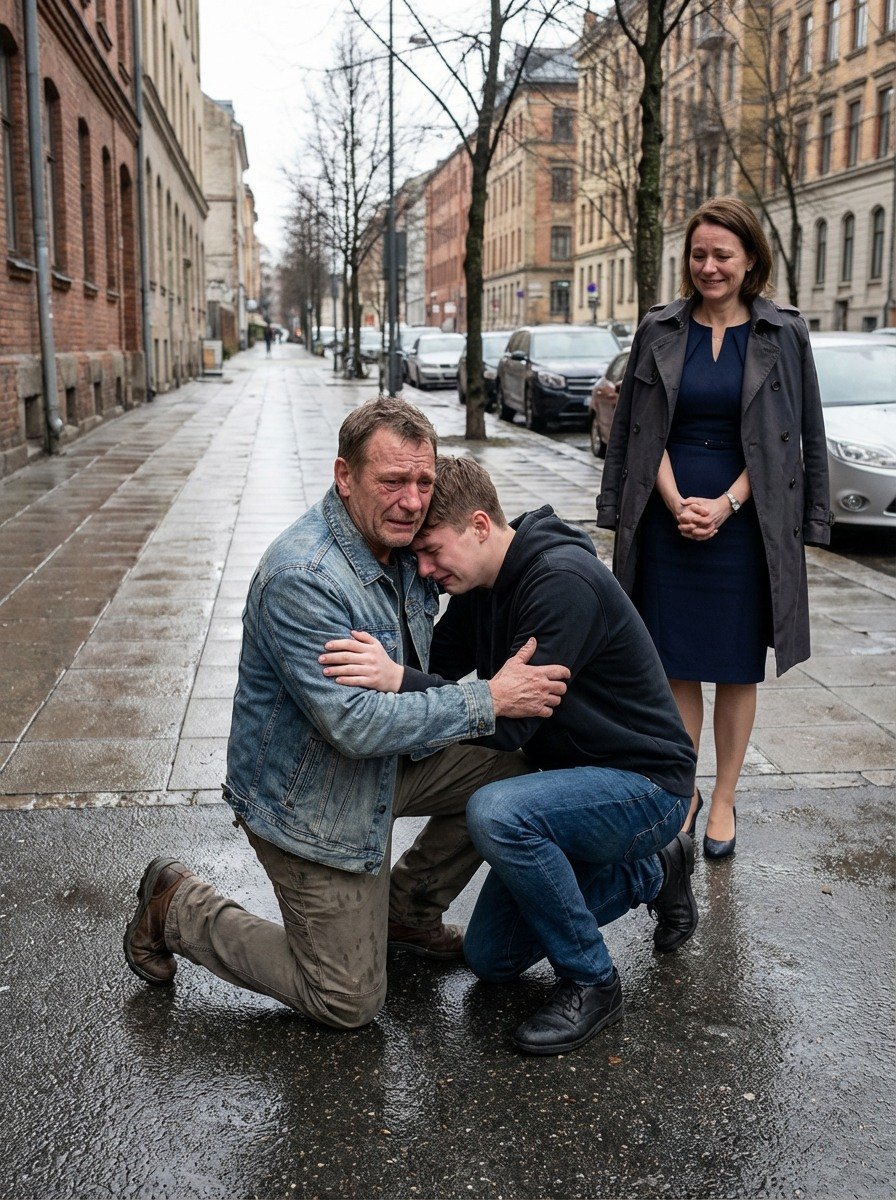
Elias’s legs gave way.
He sank to his knees on the wet ground, heedless of passing traffic or watching eyes, tears blending with rain as the years he had carried alone finally pressed outward.
“Samuel,” he said, his voice breaking. “I’m your father. I’ve been looking for you for seventeen years. I never stopped.”
The Thread That Proved Everything
The young man reached to help him up, uncertain and overwhelmed, when something caught his eye.
Around Elias’s wrist was a thin red string, frayed with age, tied in a clumsy knot.
A string Samuel himself had wrapped there long ago, insisting it would keep his father from ever getting lost.
The world seemed to tilt.
Memories returned in pieces—noise, fear, arms pulling him close, the sound of singing in the dark.
The young man dropped to his knees and wrapped his arms around Elias with a strength born from years of restraint finally breaking.
“Dad,” he said, his voice shaking. “I thought I was alone.”
The City Pauses
People slowed as they passed, some stopping briefly, others choosing to continue, sensing without understanding that something important was happening beneath the rain.
Father and son held each other as if the years between them were compressing into that single moment, the city’s noise fading into something distant and unimportant.
For the first time in nearly two decades, Elias felt the weight inside him ease.
A Small Room and a Long Night
That night, they shared a small rented room near the elevated tracks, the kind paid for by the day and forgotten just as quickly. They ate bread and beans, sitting close, speaking until exhaustion claimed them.
Elias told the story of how he stayed, how he searched, how he refused to leave.
Samuel spoke of group homes, of drifting between places, of work that barely paid enough to survive, and of loneliness that became familiar.
There were no accusations, no bitterness.
Only relief.
The Song One Last Time
Before sleep took him, Samuel hummed the lullaby once more, softly, imperfectly.
Elias closed his eyes and smiled.
In a city that had taken so much, a single song had been enough to return what was never meant to be lost forever.
And for the first time in seventeen years, Elias slept without fear.
Website Disclaimer
The information provided on this website is for general informational and educational purposes only. While we strive to ensure that all content is accurate and up to date, we make no guarantees regarding the completeness, reliability, or accuracy of any information published.
The views and opinions expressed in articles belong to their respective authors and do not necessarily reflect the views of this website. Any action you take based on the information found on this website is strictly at your own risk. We will not be liable for any losses, damages, or inconveniences arising from the use of our content.
Some articles may contain opinions, third-party information, or external links. We do not endorse or guarantee the accuracy of content on external websites and are not responsible for their practices or policies.
All content on this website is provided in good faith and is intended for informational purposes only. Readers are encouraged to verify information independently and seek professional advice where appropriate.