You don’t step into Tomás Reyes’ auto shop, you invade it.
You sweep through the bay doors like you own the air, like the smell of motor oil should apologize for existing near your designer suit.
Your name is Bárbara Solís, and people in this city usually move when you blink.
The shop goes quiet the second your heels hit the concrete, because men in greasy coveralls have still heard of your last name.
You don’t like waiting, and you like being told “yes” even less than you like being told “later.”
So you do what you’ve always done: you turn your impatience into power and call it standards.
You point at the half-lifted car, at the invoice, at Tomás’ hands, and your voice sharpens like a blade.
“Do you know who I am?” you snap, loud enough for every apprentice to hear.
And Tomás, the owner, doesn’t flinch, doesn’t bow, doesn’t perform fear for your entertainment.
He just keeps holding the wrench like a man who has fixed worse things than attitudes.
You call him hungry.
You call him greasy.
You call him small.
You call him a nobody who should be grateful you even stepped into his “little garage.”
Your words hit the air like thrown tools, heavy and meant to bruise.
The apprentices stare at the floor, pretending the ground is suddenly fascinating, because nobody wants to become the target next.
Tomás looks at you once, calm and controlled, and you mistake it for weakness.
You take his silence as surrender, because that’s what people usually do around money.
Your chest lifts with satisfaction, and you turn slightly as if you expect applause for putting a working man “in his place.”
Then the world tilts.
It doesn’t happen dramatically at first.
It’s a bright flash of pain in your lower back, the kind that makes your breath stall.
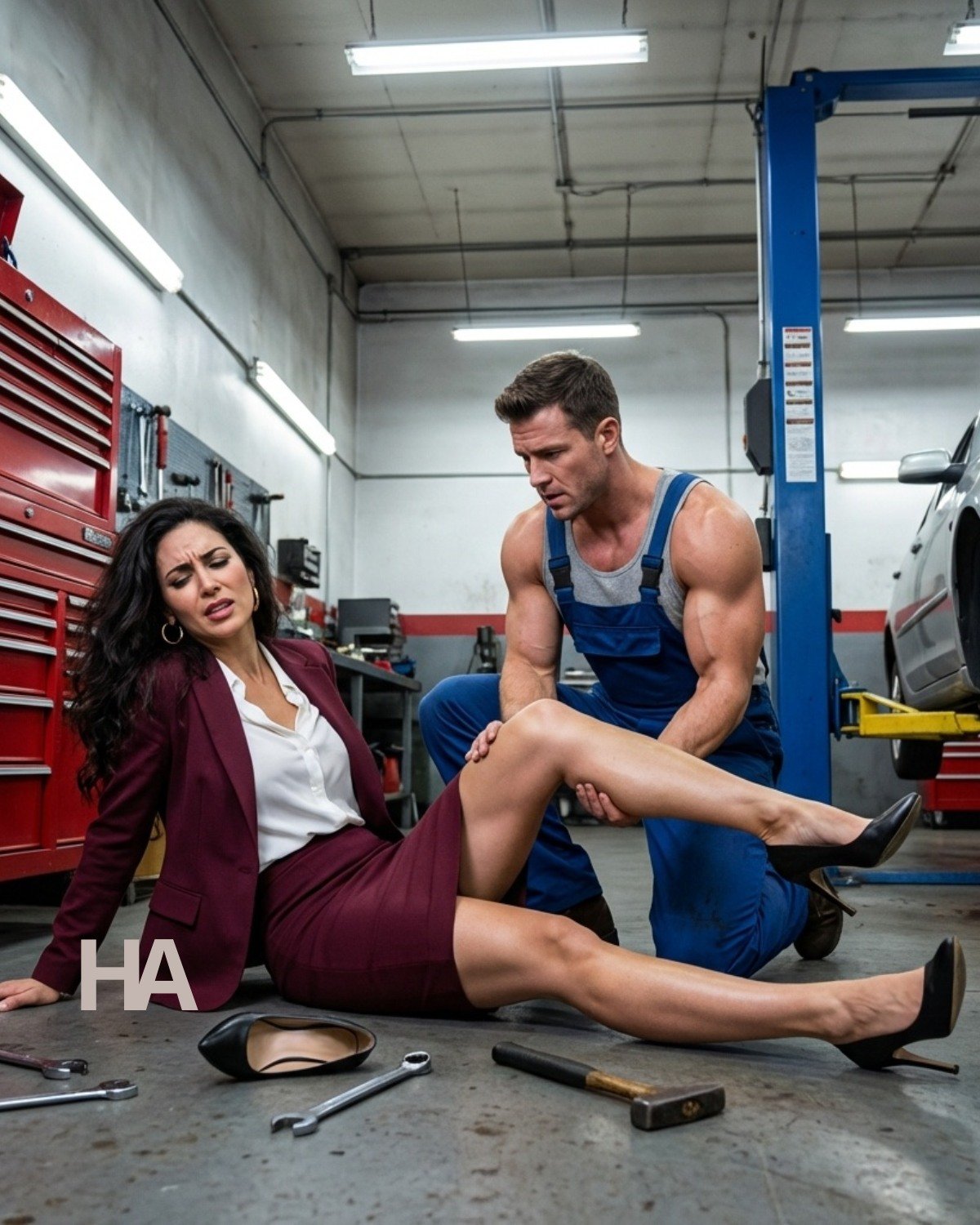
Your heel slips just a fraction on an oil-smudged spot you didn’t notice because you weren’t looking at the floor, only at yourself.
You open your mouth to insult the shop for being “dirty,” but the pain spikes again, hotter, sharper, like someone drove a burning nail into your spine.
Your knees buckle.
Your stomach drops.
Your hands claw for the air like it’s a railing.
And then your body hits the concrete with a sound that silences the entire shop.
You try to push yourself up, but your legs don’t answer.
Not weak. Not shaky. Not tired.
Nothing.
Your brain screams at your muscles and your muscles stay dead quiet, like they’ve abandoned the conversation.
Panic pours into your throat so fast you choke on it.
You drag your palms against the floor, nails scraping oil-stained cement, and the horror in your chest swells until it bursts out of you.
“I can’t feel my legs!” you scream. “Please… somebody help me! I can’t feel my legs!”
For a heartbeat, nobody moves.
Not because they don’t care, but because you’ve trained people to fear your reactions.
They’re frozen, waiting for permission to act, waiting to see if this is a trap, waiting to see if the million-dollar woman will bite even while bleeding.
Then Tomás drops the tire iron like it’s nothing, and the sound is crisp, final.
He runs to you without hesitation, without pride, without a single ounce of revenge in his eyes.
He kneels beside you on the filthy floor and doesn’t care what it does to his pants.
“Don’t move,” he orders, voice steady, the voice of someone who has watched life slip away and refused to let it.
“I’m trained in first aid. Look at me. Tell me where it hurts.”
You want to spit a insult, because that’s your armor.
But the pain has peeled the armor right off.
Your voice breaks, raw, exposed.
“My back,” you sob. “It’s like… like a knife on fire. And my legs… Tomás, I can’t feel them. They’re gone. I can’t move them.”
You hear yourself say his name, and it feels wrong in your mouth, like you don’t deserve to say it gently.
Tomás’ eyes scan you fast, not like a predator, like a mechanic diagnosing a critical failure.
He checks your breathing, your posture, the way your body is lying.
He glances at his apprentice, Miguel, whose face has drained of color.
“Miguel,” Tomás snaps, “close the shop. Get my truck. We’re going to Hospital Ángeles. Now.”
Miguel hesitates, eyes darting between you and his boss.
“But jefe… she said—”
Tomás’ voice becomes a thunderclap. “NOW, Miguel!”
Then he lowers his tone again, like he’s wrapping you in calm.
“Listen to me,” he says. “I’m going to lift you. It’ll hurt. But we can’t wait for an ambulance with traffic like this.”
Your pride wants to reject him.
Your fear doesn’t let you.
His arms slide under your shoulders and knees, careful and controlled, and you feel the shock of being held by hands that are rough from work and gentle by choice.
He carries you out like you weigh nothing.
You bury your face against his chest because you can’t meet the eyes of the men you just humiliated.
Tomás smells like engine oil, cheap soap, and honest sweat.
It’s not a scent you’ve ever allowed close to you.
Now it’s the only thing keeping you from drowning.
In the truck, you tremble violently, clutching your phone like it’s a lifeline.
You call Patricio, your fiancé, because of course you do.
Patricio always answers. Patricio always shows up. Patricio always performs the role.
Except this time, the line rings, then goes to voicemail.
One call. Voicemail.
Two calls. Voicemail.
Three calls, and your hands shake so hard you nearly drop the phone.
Tomás watches the road, weaving through traffic with the focus of a man fighting time.
“Your husband?” he asks without looking at you.
“My fiancé,” you whisper. “Patricio. He… he’s probably in a meeting.”
Tomás doesn’t comment, but his jaw tightens.
He’s seen men like Patricio.
Men who love important things and call people “optional.”
At the hospital, Tomás doesn’t wait for permission.
He lifts you again and storms into emergency, voice cutting through the sterile air.
“She needs help now,” he says, and nurses move because authority isn’t always money.
Sometimes authority is urgency mixed with certainty.
Everything becomes white lights, clipped voices, cold hands, antiseptic smell, your body strapped down, your panic turned into numbers on a monitor.
You drift between pain and fear, and through it all, Tomás stays.
He fills forms when your hands won’t stop shaking.
He answers questions because your brain keeps slipping into static.
He sits in the waiting room in his stained coveralls while rich strangers glance at him like he’s dirt that wandered indoors.
When the doctor finally comes out, his face tells the story before his mouth does.
“A massive lumbar disc herniation,” he says. “It’s compressing the spinal cord. She needs emergency surgery.”
You hear “risk of permanent damage” and your stomach turns to ice.
Then the doctor looks at Tomás. “We need consent from family. Are you her husband?”
Tomás swallows, eyes flicking toward you.
“I’m… a friend,” he says. “She doesn’t have anyone else here. Her fiancé isn’t answering.”
The word friend hits you like a punch, because it’s too generous.
You treated him like garbage.
And he just gave you the gentlest label he could.
They wheel you toward the operating room.
Your throat tightens and tears spill down the sides of your face into your hair.
You reach for Tomás’ hand, desperate.
“You don’t have to stay,” you whisper. “I was horrible to you.”
Tomás squeezes your fingers once, firm.
“Nobody should be alone like this,” he says. “I’ll be here when you wake up.”
Then the doors swallow you, and you float into darkness thinking about the last thing you expected: kindness from the man you tried to crush.
When you wake up hours later, your mouth tastes like metal and your body feels like it’s been rearranged.
Your eyes blink against the dim hospital light.
Your heart races as you remember the words: I can’t feel my legs.
You try to move your toes.
Nothing happens at first, and your fear floods back so fast you almost vomit.
Then you notice a shape in the corner: a man asleep in a plastic chair, folded awkwardly, head tilted at a painful angle.
Tomás.
Not Patricio.
Not your father.
Not your best friends in their perfect outfits and empty speeches.
Just the mechanic.
The one you called dirty.
The one who stayed.
And that’s when you realize the surgery might’ve been the easy part.
The real pain is going to be the collapse of everything you thought you were.
Recovery doesn’t feel like healing. It feels like war.
You are discharged into your luxury apartment in Polanco, surrounded by designer furniture you can’t enjoy because you can’t even get to the bathroom alone.
Your nurses are efficient and cold, like human machines.
They don’t know you, don’t care to.
Your father calls once and his first question is not “How are you?”
It’s “When can you get back to the office? The Singapore project won’t close itself.”
You choke on the realization that your value, even to him, is performance.
Patricio finally appears two days later, smelling like expensive cologne and impatience.
He kisses your forehead like he’s checking a box and keeps glancing at his smartwatch.
“I have to fly to Cancún,” he tells you. “The resort deal. I can’t cancel. Hire the best nurses, I’ll pay. I’ll see you in two weeks.”
He says it like he’s generous.
He leaves like he’s done his duty.
And when the door clicks shut, the silence in your apartment is louder than the pain.
Then, one afternoon, there’s a knock.
Not a polite knock. A solid, real knock.
You open the door and see Tomás standing there with an older woman beside him holding a container that smells like comfort.
Tomás looks awkward outside his world of engines, like he doesn’t know what to do with his hands.
“I thought you’d need… real help,” he mutters. “This is my mom. Doña Lola.”
Doña Lola steps in like she owns warmth.
“Hi, mija,” she says, and sets the food down without asking permission. “Chicken broth. The real kind. It heals the soul, not just the bones.”
You try to protest. You try to offer money.
Your instincts scream to turn this into a transaction, because that’s how you survive.
But the smell of the broth hits a memory buried under years of boardrooms and image management: childhood, before you learned to be untouchable.
Your eyes fill. Your throat breaks.
And before you can stop it, you start crying like a woman who has been starving for kindness longer than she’s been starving for food.
Doña Lola doesn’t ask questions.
She just hugs you, and for the first time in years, you’re not being held for show.
You’re being held because you’re human.
Tomás starts coming every evening after closing his shop.
He helps you with rehab exercises while you bite back screams.
He counts your steps like each one is a victory, not a humiliation.
He doesn’t pity you. He challenges you.
When you throw a pillow in frustration and sob, “I’m useless,” he picks it up and says, calm as steel, “You’re not useless. You’re injured. And injuries heal if you give them time.”
Then he adds, quieter, “Try again. One more step. For me.”
And you do.
Not because you’re suddenly strong.
Because you don’t want to disappoint the one person who has shown up with no agenda.
Your apartment changes.
It stops feeling like a showroom and starts feeling like a place where someone lives.
Doña Lola cooks and the air fills with spices, warmth, real laughter.
Tomás tells you stories about the shop, about cars with personalities, about fixing a engine like solving a puzzle with your hands.
You learn something humiliating and beautiful: Tomás reads at night. Philosophy. History. Things you thought only men in suits discussed.
He cares for his apprentices like they’re family.
He fixes cars for old women who can’t pay and sends them away smiling anyway.
Your perception cracks, and for once you let it.
One day, bored and restless, you ask to go to the shop.
You want to see real life again, not the filtered version you’ve been living.
Tomás hesitates, then agrees.
Sitting in the corner in your wheelchair, you watch him work.
You watch him treat customers with honesty, charge fair prices, refuse to exploit desperation.
You watch men respect him without fear.
And you feel something shift in your chest, something that doesn’t care about money.
“Why are you helping me?” you ask him over tacos eaten on a workbench.
“After what I said… I don’t deserve this.”
Tomás wipes his hands on a rag and looks you straight in the eyes.
“People act ugly when they’re drowning,” he says. “That doesn’t mean they’re ugly inside.”
Then he pauses, and his voice softens.
“I’ve seen who you are these months. You’re brave. You’re stubborn. And… you have a laugh that lights up this place full of grease.”
Heat rushes to your face.
Nobody in your world has ever spoken to you like that without wanting something.
Then Patricio comes back.
He arrives on a Friday night like a hurricane of entitlement, interrupting dinner with Doña Lola and Tomás as if they’re clutter.
“Love!” he booms, walking in without knocking. “I’m back!”
His eyes slide to Tomás and Doña Lola like they’re stains.
“So this is the help,” he says with a smirk.
You tense, because you already know what’s coming.
Patricio opens his wallet and flicks it like a weapon.
“How much do I owe you?” he asks Tomás. “Five thousand? Ten?”
Tomás stands slowly, fists tight, voice controlled. “We didn’t do it for money.”
Patricio laughs. “Everyone has a price, buddy. Take it and get out. I have to talk to my fiancée about our engagement party. We’ve postponed long enough.”
Doña Lola squeezes Tomás’ arm, calming him.
She turns to you and says softly, “We’ll go, mija. We’ll pick up the containers tomorrow.”
When the door closes, your apartment goes cold again like someone unplugged the warmth.
Patricio sits and starts talking about optics, investors, narratives.
He says your injury is “tragic but useful,” that it makes you look brave, that people love a comeback story.
He says the party will be next Saturday.
He says you’ll smile.
He doesn’t ask if you can stand long enough.
He tells you.
That night, you don’t sleep.
You stare at the ceiling and realize you’ve been engaged to a man who treats love like a contract and your pain like marketing.
The next day arrives too fast. Stylists invade your space, cover your bruises with makeup, wrap you in a navy silk dress that hides your weak legs.
You look in the mirror and see a trophy.
A beautiful, expensive trophy that’s still cracked underneath.
Your stomach twists with dread.
The party is everything you used to worship.
Crystal chandeliers. Champagne. Two hundred people who smile like they’re evaluating merchandise.
They look at you the way they look at stocks: Has she lost value?
Patricio stays glued to your side, gripping your waist too hard, guiding you like a prop.
“Smile,” he hisses, “the minister’s coming.”
Your throat tightens. You need air.
You excuse yourself toward the restroom corridor, leaning on your cane, heart pounding.
That’s when you hear voices.
They’re coming from a private lounge with a cracked-open door.
You slow down, not meaning to eavesdrop, then freeze when you hear Patricio’s laugh.
“Genius, Patricio,” someone says.
“I told you,” Patricio replies, ice clinking in a glass. “Yeah, she messed up her back, annoying. But it worked out. She’s desperate for validation now. Easier to manipulate.”
Your vision blurs.
He continues, not knowing you’re three steps away from your entire life collapsing.
“Her dad’s so grateful I didn’t ‘leave her’ because she’s broken that he gave me better contract terms.”
The words stab deeper than the day you hit the shop floor.
Then another man asks about Tomás.
And Patricio laughs like cruelty is entertainment.
“The grease guy?” he snorts. “Poor dude thought he was a hero. Bárbara said he grossed her out, but she needed him to carry her so she wouldn’t pay extra nurses.”
More laughter.
“Once we’re married, I’ll make sure he disappears. I don’t want that kind of people near my image.”
Your body goes very still.
The pain in your back is nothing compared to the pain in your chest.
This isn’t betrayal. This is exposure.
You finally see the truth of the world you lived in: love as transaction, loyalty as convenience, dignity as decoration.
And something inside you that’s been asleep for years wakes up angry.
Not to destroy them.
To save you.
You straighten.
You wipe your tears with the kind of rage that doesn’t care about smudged mascara.
You grip your cane, feel your legs tremble, and decide trembling doesn’t mean you can’t walk.
You walk back into the ballroom with your head up and your spine screaming.
Patricio is already on stage with a microphone, smiling his shark smile.
“And now,” he announces, “I want my wonderful fiancée Bárbara to come up. Our love has survived hard trials…”
Polite applause.
He extends his hand like he’s presenting you to the room.
You climb the stage and ignore his hand.
You take the microphone, and the room quiets because something in your face is different.
Not the trophy face. Not the obedient face.
A face that has been set on fire by truth.
“Thank you all for coming,” you begin, voice steady, loud, clear.
Patricio smiles, thinking this is gratitude.
“These months have been… revealing,” you continue, and the smile on his mouth starts to hesitate.
“When I injured my back, I discovered my legs weren’t the only thing that stopped working. My heart was paralyzed too.”
A murmur ripples.
“Paralyzed by vanity. By ego. By believing shiny lies.”
Patricio tries to interrupt, laughs a little too loud.
“She’s still on medication,” he jokes, reaching for the microphone.
You step away, surprising him with your speed.
“I’m not done,” you say, and your voice cuts the room like a bell.
“I discovered the man who claims to love me actually loves the contract my father promised him.”
Shock spreads like spilled wine.
Your father’s face goes pale in the front row.
“And I discovered,” you add, tasting the words like revenge, “that while I cried in pain, my fiancé mocked me with his friends. Called me broken. Easy to manipulate.”
Patricio’s eyes widen.
He moves again, but you raise your hand, and the authority in you stops him.
“And I discovered something beautiful,” you continue, and your voice softens just enough to make people lean in.
“I discovered that nobility has nothing to do with labels or bank accounts.”
You lift your chin, eyes sweeping the room of expensive emptiness.
“The man who saved me, who stayed, who helped me walk again, is a mechanic.”
You see faces stiffen.
You see snobbery flinch.
“The kind of man some of you wouldn’t even allow at your front door.”
You pull the engagement ring off your finger.
The diamond flashes cold under the chandelier lights, bright and empty.
You let the room watch.
You let Patricio watch.
“Patricio called him a filthy nobody,” you say. “But that man has more dignity under one greasy fingernail than you and your friends have in your entire lives.”
Then you drop the ring.
Not into Patricio’s hand.
Onto the floor.
It bounces once, and the tiny clink is louder than applause.
“I’m keeping my dignity,” you say.
“I’m keeping the truth.”
“And I’m not keeping you.”
You walk off the stage.
Your legs ache, yes. Your back throbs, yes.
But you’ve never felt so light.
You hear your father shout behind you, fury cracking his voice.
“If you walk out that door, you’re finished! Forget your inheritance! Forget the company!”
You stop at the threshold and turn.
For the first time in your life, you look your father in the eyes like an equal, not a subordinate.
“Keep your money,” you say quietly. “I’m going to find my life.”
Outside, the night air hits your face like freedom.
You don’t call your driver. You don’t demand a car.
You take a taxi like a normal person, because you’re done performing perfection.
You give the address with one sentence: “Tomás Reyes’ shop.”
The metal shutters are down when you arrive. It’s late. The street is quiet.
But a light glows in the small upstairs office like someone is still awake with honest work.
You tap your cane against the shutter until the sound echoes.
A side door opens, and Tomás appears in a worn t-shirt and pajama pants, eyes sleepy until he sees you.
He freezes.
“Bárbara?” he whispers. “What happened? Are you okay?”
You stand there in your expensive dress with your makeup ruined, looking like a storm survived.
You let your cane fall against the wall and take one careful step toward him.
“I got lost,” you say, voice shaking.
Tomás frowns. “Lost?”
“My compass was broken,” you confess. “It pointed at money and status.”
Tears burn your eyes, but you don’t hide them.
“Tonight I fixed it,” you say. “Now it points at truth. At Sunday mole. At hands that heal. It points at you.”
Tomás searches your face for cruelty, for a trick, for the old version of you.
He finds none.
He finds a woman who finally stopped lying to herself.
“I left Patricio,” you say. “I left my father. I left everything.”
Your chest tightens. “I don’t have a job anymore. I don’t know if my cards will still work tomorrow.”
You swallow, voice soft. “But I’m free. And I think I fell in love with the mechanic who taught me cars have souls… and so do people.”
Tomás doesn’t move for a second.
Then he steps forward like he’s choosing something brave too.
He pulls you into him, and the kiss that follows isn’t polished or perfect.
It’s real.
It tastes like second chances and gasoline and tears and relief.
Your hands cling to him like home, and for the first time, you understand the difference between being expensive and being cherished.
A year later, you don’t recognize your own life.
The shop has a new sign now: RENAISSANCE AUTO.
It’s bigger, brighter, full of apprentices laughing and working without fear.
You slide out from under a red sedan on a rolling creeper, wearing a blue coverall stained at the knee.
Your hair is tied back, messy, and there’s a smear of grease on your cheek you don’t bother wiping away.
You shout across the noise of engines, “Tomás! The carburetor’s done! It purrs like a kitten!”
Tomás leans out of the office where you now handle the finances together, grinning like the happiest man alive.
“That’s my girl,” he calls back, blowing a kiss.
Your legs are strong now.
They still ache when it rains, a reminder that survival leaves footprints.
But you walk with a steadiness you never had in heels.
You use your business brain not to fatten investors, but to build scholarships for kids like Miguel, to raise wages, to provide insurance, to make sure no one in this place has to beg for dignity.
There are no chandeliers here.
No fake applause.
No cold champagne.
Just hard work, honest laughter, and love that shows up even when it’s inconvenient.
And sometimes, when you catch your reflection in a shop window, you smile.
Not because you became “less” after losing money.
Because you became more after losing the lie.
So here’s the question that always starts arguments in the comments.
If you were Bárbara, would you have walked out and chosen love and dignity, even if it meant losing the inheritance… or would you have taken the safe path and played the perfect role until you could negotiate a better exit?