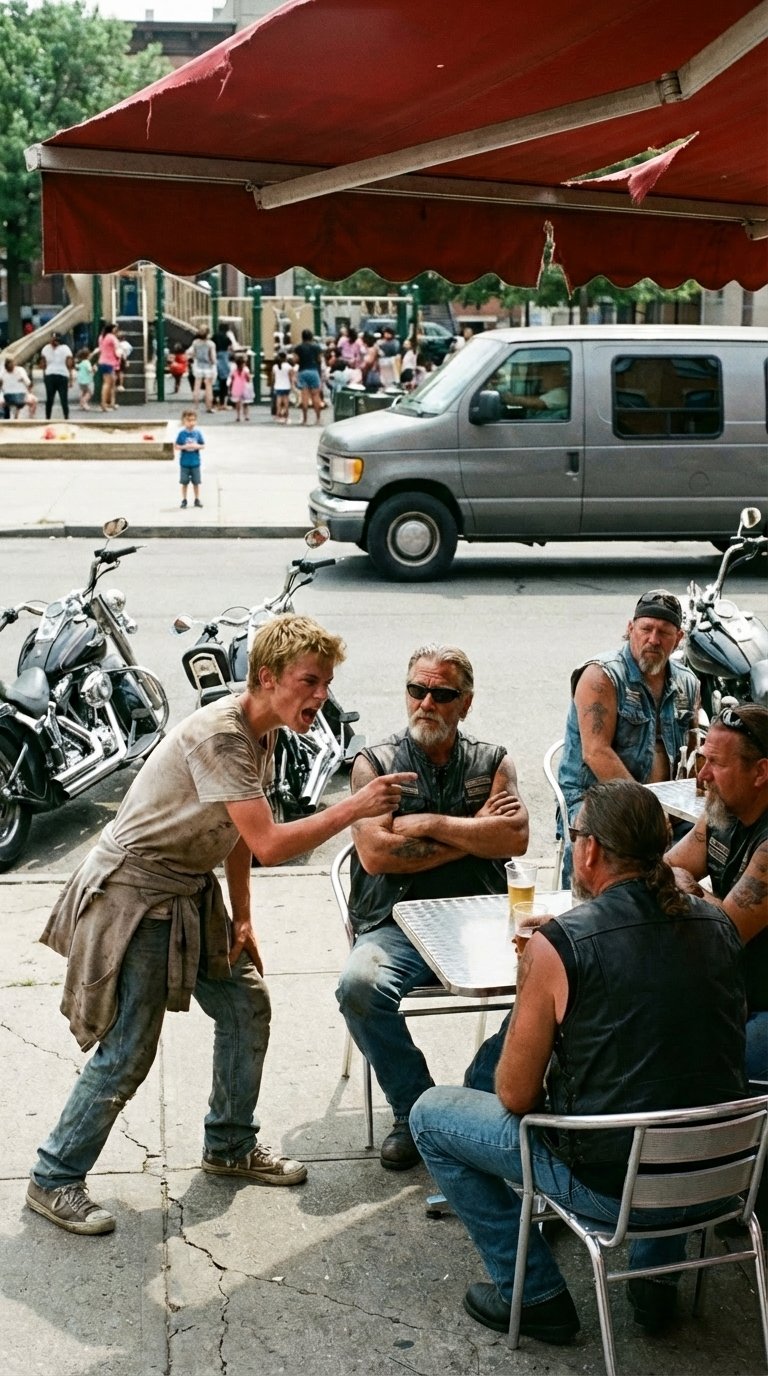
No one ever thought to ask Eli Mercer what he noticed, because the city had already decided he was invisible. At seventeen, sleeping beneath a half-collapsed awning near Redwood Commons, Eli existed in that forgotten space where people are seen often enough to be dismissed, but never long enough to be heard. He survived by observing quietly, by memorizing patterns, by understanding that danger rarely announced itself—it waited.
That July afternoon was brutally hot, the kind of heat that warped the air above the pavement. Children screamed with joy on the playground, parents half-watched from benches while staring into their phones, and everything looked exactly the way it should. Except for the van.
It wasn’t flashy or aggressive. It didn’t need to be. The dull gray cargo van slid past the playground again and again, four times in less than an hour, each loop identical. It slowed near the climbing structure where the youngest kids played. It lingered at the crosswalk like it was waiting for permission. Its tinted windows reflected the sky so darkly they looked hollow. Eli recognized the behavior instantly. Foster care had taught him that predators didn’t rush—they rehearsed.
He tried to do the right thing.
When a patrol car rolled by, Eli stepped forward and lifted his hand, already bracing himself. The officer cracked the window just enough to scowl and tell him to move along, to stop hanging around, the word loitering hitting harder than an insult. The cruiser drove off. The van kept circling. And that familiar truth settled into Eli’s chest: being right meant nothing if you weren’t considered real.
That’s when he looked across the street.
Outside The Cinder Fox Café, motorcycles lined the curb like watchful sentries, chrome flashing under the sun. Beneath a ragged red awning sat the Iron Ravens, their presence bending the street around them. City officials whispered about them. Street criminals avoided them. They weren’t famous for noise—they were known for response.
Eli crossed the road with his heart hammering, aware this choice couldn’t be undone. Conversations stopped as he approached, not in threat, but in focus. At the center sat Marcus “Grave” Holt, silver-threaded beard, posture relaxed but immovable, a man who looked like he’d learned patience the hard way.
“You need something, kid?” Grave asked quietly.
Eli leaned in, voice low and urgent.
“That gray van,” he said, tipping his chin toward the park, “has been circling since noon. Slows by the little kids every time. No plates. Same route. The cops won’t listen to me.”
For a brief second, nothing happened, and Eli felt the familiar fear that he’d misjudged everything, but then Grave’s eyes shifted, not dismissively, but with focus, tracking the street with a predator’s calm, and as if summoned by attention itself, the van appeared again, tires crunching over gravel, decelerating as it approached the sandbox where a toddler had wandered away from her distracted father.
Grave stood without a word, and the rest of the Iron Ravens followed in perfect unison, chairs scraping back, coffee abandoned, the sudden silence louder than any shout, and when Grave spoke again, it wasn’t to Eli, but to his brothers, issuing instructions that snapped into place like pieces of a long-prepared plan.
“North exit blocked, south alley sealed, nobody touches the kids, and nobody spooks the driver until we see what we’re dealing with.”
What followed unfolded with terrifying efficiency, motorcycles roaring to life and forming a living barrier around the park, engines vibrating through the ground as the van attempted to accelerate, only to find its exits closed by steel and leather, the driver’s confidence evaporating in real time as the realization set in that the world had noticed him after all.
Grave approached the driver’s side window and knocked once, hard enough to echo, and when the glass lowered a few inches, revealing a man with sweat slicking his temples and a voice that cracked under pressure, the lie came instantly, rehearsed and weak, about being lost, about looking for an address, about harassment, and Grave listened without interruption, his silence more damning than any accusation.
“Funny way to find a street,” Grave replied evenly, “passing the same playground five times without stopping anywhere else,” and when the door was opened, the truth spilled out without needing confession, because the back of the van held the kind of items no innocent errand ever required, heavy restraints, duct tape, sealed snack packs designed to look friendly, and a duffel bag filled with toys still wrapped in plastic, not gifts, but bait.
Website Disclaimer
The information provided on this website is for general informational and educational purposes only. While we strive to ensure that all content is accurate and up to date, we make no guarantees regarding the completeness, reliability, or accuracy of any information published.
The views and opinions expressed in articles belong to their respective authors and do not necessarily reflect the views of this website. Any action you take based on the information found on this website is strictly at your own risk. We will not be liable for any losses, damages, or inconveniences arising from the use of our content.
Some articles may contain opinions, third-party information, or external links. We do not endorse or guarantee the accuracy of content on external websites and are not responsible for their practices or policies.
All content on this website is provided in good faith and is intended for informational purposes only. Readers are encouraged to verify information independently and seek professional advice where appropriate.