The first thing I noticed wasn’t the sweating.
It was the way the boy’s hands stopped obeying him.
I was three rows behind him on a late-afternoon flight from Phoenix to Newark, the kind of in-between hour where the sun hangs low and everyone looks tired in a way no nap can fix. I had traded my hospital scrubs for leggings and a hoodie, but my mind hadn’t clocked out. Eleven years as a pediatric emergency nurse will wire you that way. You don’t stop scanning. You don’t stop noticing patterns. You just pretend you’re normal in public places and hope nothing goes wrong.
He couldn’t have been older than fourteen. All elbows and knees, too tall for his seat, backpack wedged under his feet. An orange “Unaccompanied Minor” tag hung from the zipper like a warning label. He had boarded early with a gate agent’s hand hovering at his back, the way adults hover over children when they’re trying not to show fear.
Twenty minutes into the flight, his shoulders began to curl inward. He wiped his forehead with the back of his hand. Then again. Then again.
This wasn’t nervous sweat. It was cold, greasy, wrong.
He dropped his phone. When he bent to retrieve it, he nearly tipped into the aisle as if gravity had suddenly changed its mind. The woman beside him wore noise-canceling headphones and had her eyes shut, her body angled away like she’d paid for silence and meant to keep it.
The beverage cart rolled past. The flight attendant didn’t even glance at him.
I told myself to stay put. The seatbelt sign was still on. People get anxious. People get airsick. Teenagers forget to hydrate. I had no business leaping at every pale face on a plane.
Then his head tipped slightly, and his mouth opened as if he’d forgotten what it was for.
I unbuckled.
The flight attendant near the front—silver hair in a flawless twist, posture like a ruler—shot me a look that said sit down. I ignored it. When you’ve watched children seize because someone decided “they’re probably fine,” your tolerance for polite compliance disappears.
I knelt beside his row and kept my voice gentle. “Hey, sweetheart. Are you okay?”
His eyes found mine—glassy, unfocused. His lips moved. “I… don’t… my bag…”
The slur wasn’t drunk. It wasn’t goofy. It was neurologic.
“Are you diabetic?” I asked.
A weak nod.
“Do you have juice? Glucose tabs?”
He tried to lift his arm toward the overhead bin. His fingers trembled like they were shaking from the inside.
Hypoglycemia. Hard and fast.
I pressed the call button. Once. Twice. Again.
The flight attendant arrived with irritation already on her face. Her name tag read Marjorie Cole.
“Ma’am, you need to return to your seat,” she said. “The seatbelt sign is on.”
“This passenger is having a diabetic emergency,” I said. “His blood sugar is critically low. I need orange juice or anything sugary right now.”
She looked at him for less than a second. “He looks fine. Probably nervous.”
Behind her, his head dipped.
“I’m a pediatric ER nurse,” I said, pulling my badge from my wallet. “These are textbook symptoms. If we don’t act, he could lose consciousness.”
Marjorie crossed her arms. “I’ve been flying for twenty years. Kids fake things for attention. Sit down or I’ll report you for interfering with crew duties.”
The word interfering landed like a threat.
The boy’s eyes rolled back.
A man across the aisle stood. “Are you serious? He’s in trouble.”
Marjorie lifted a hand. “Sir, remain seated.”
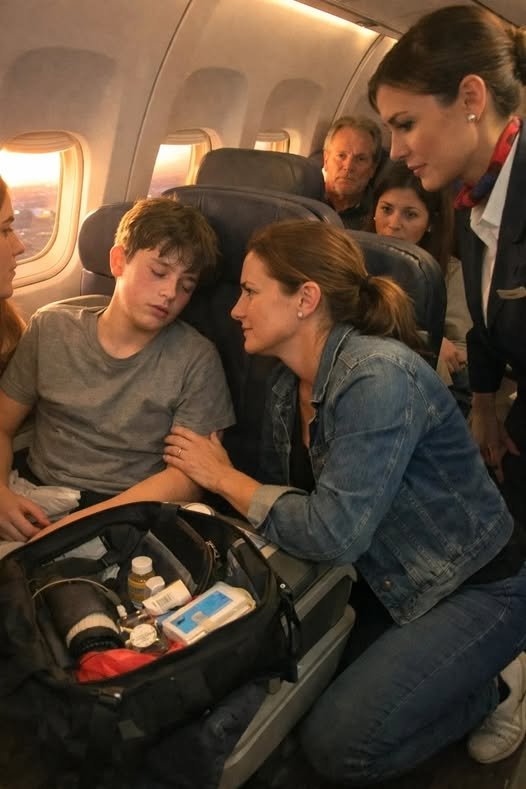
I grabbed the boy’s backpack and unzipped it. Inside was a pouch labeled in careful block letters: DIABETES SUPPLIES. Glucose tablets. A meter. A glucagon kit.
I placed two tablets between his lips. “Chew for me, okay?”
He didn’t.
Marjorie seized my arm. “Stop this now.”
“Let go of me,” I said, my voice steady in a way that surprised even me.
The man across the aisle held up a small bottle. “I grabbed juice from the galley.”
I took it, tilted the boy’s head, and dribbled a few drops into his mouth.
Then he went limp.
Something in me hardened.
I pushed past Marjorie and lifted the intercom phone. “This is a medical emergency. I am a nurse. There is an unconscious diabetic passenger in row eight. I need the captain immediately.”
She ripped the phone from my hand. “You just committed a federal offense.”
The overhead speakers crackled. “This is Captain Herrera. Did someone report a medical emergency?”
“Yes!” voices shouted. “A kid passed out!” “She won’t help!”
The cabin shifted from quiet to electric.
“Flight attendant Cole, report to the cockpit,” the captain ordered.
Marjorie stormed forward.
I knelt again and prepared the glucagon. “I’m going to help you, buddy,” I whispered, reading his name from the card. “Hold on, Aaron.”
I injected his thigh.
Minutes stretched. A woman cried softly behind me. Phones hovered in the air.
Then his fingers twitched.
His eyes fluttered.
“Aaron,” I said. “You’re safe.”
He swallowed. “Where… am I?”
“On a plane. You got low.”
Paramedics met us on an emergency landing in Albuquerque. His blood sugar was 34. The lead medic looked at me and said quietly, “You saved him.”
At Newark, airline representatives waited with a police officer, their smiles sharpened.
They accused me of assault. Of interference. Of illegal medical care.
I walked away shaking.
That night, the video went live.
Marjorie’s voice—That is a federal offense—looped beside a boy slumping unconscious.
By morning, the world had seen it.
My hospital stood behind me. A civil rights attorney called. Aaron’s mother wept on the phone and told me her son was alive.
The airline released a statement that said nothing and meant less.
Three weeks later, they announced Marjorie’s termination and a new medical-response policy. They issued a public apology—to Aaron, and to me.
I met Aaron months later in a small park outside his hospital. He handed me a folded paper.
Inside was a drawing of a plane and a stick figure holding another’s hand.
It read: Thank you for not giving up on me.
I keep it in my wallet.
Because sometimes the right thing feels like rebellion.
And sometimes, it saves a life.
Website Disclaimer
The information provided on this website is for general informational and educational purposes only. While we strive to ensure that all content is accurate and up to date, we make no guarantees regarding the completeness, reliability, or accuracy of any information published.
The views and opinions expressed in articles belong to their respective authors and do not necessarily reflect the views of this website. Any action you take based on the information found on this website is strictly at your own risk. We will not be liable for any losses, damages, or inconveniences arising from the use of our content.
Some articles may contain opinions, third-party information, or external links. We do not endorse or guarantee the accuracy of content on external websites and are not responsible for their practices or policies.
All content on this website is provided in good faith and is intended for informational purposes only. Readers are encouraged to verify information independently and seek professional advice where appropriate.