The first thing Margaret Holloway noticed when the side door clicked open was how cold freedom smelled.
Not the sweet, candle-store version of fresh air. The real kind—sharp pine, damp asphalt, the metallic bite of rain somewhere far off. It hit her lungs like a slap and a blessing at the same time.
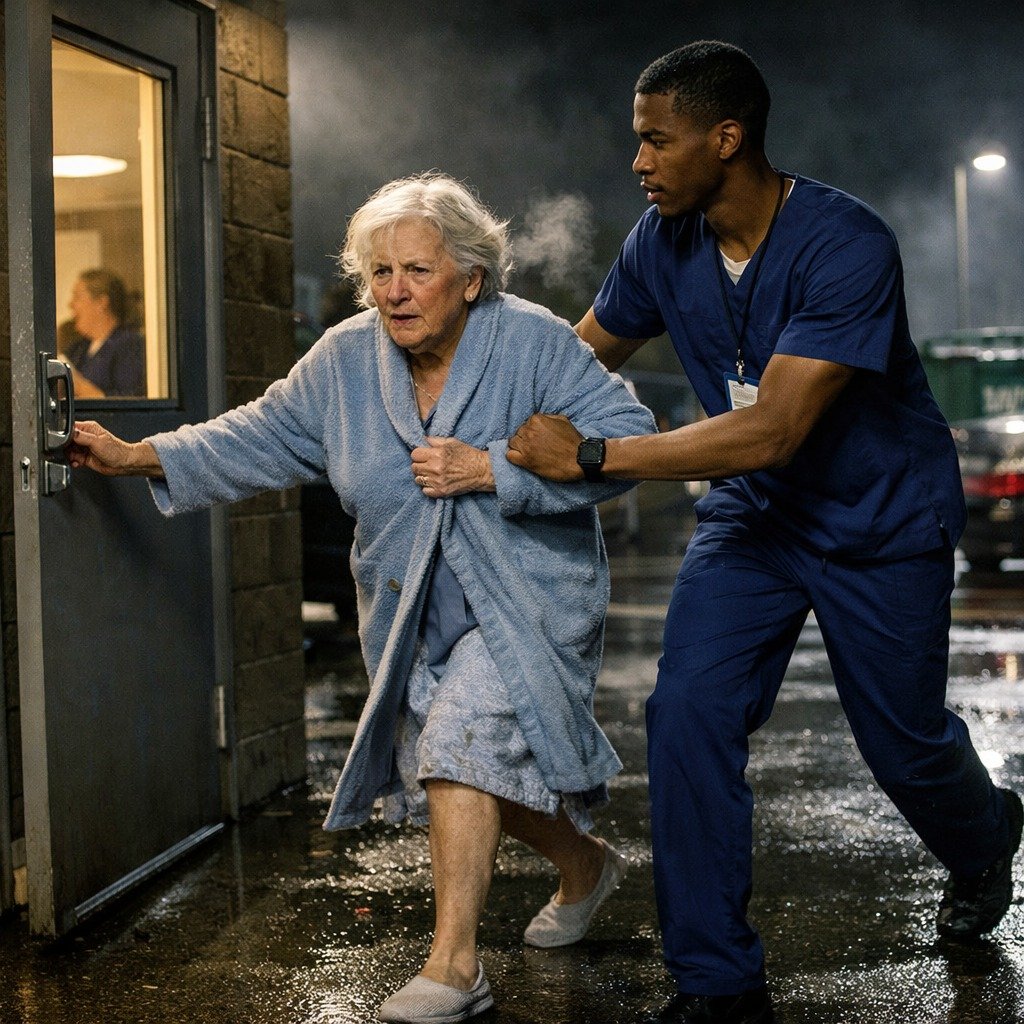
Jerome Williams held the door with one hand and braced her elbow with the other. He was twenty-three, tall and lean, wearing navy scrubs and a lanyard that identified him as an orderly at Shady Pines Care Center—three towns away from the life Margaret had been living for seventy-eight years.
The badge bounced against his chest as he whispered, “Now.”
Margaret’s heart hammered so hard she thought the night might hear it and snitch. She stepped over the threshold in thin facility slippers, wrapped in a robe that smelled like industrial detergent, and for a wild moment she imagined the building behind her opening its mouth and swallowing her back.
But it didn’t.
The door stayed closed.
The parking lot sprawled ahead like an obstacle course: dim security lights, puddles, cars sleeping under a thin sheen of dew. Somewhere inside, the night nurse—Patricia—laughed at a sitcom, oblivious, her phone glowing in the break room while Shady Pines continued to do what it did best.
Keep people quiet.
Keep them managed.
Keep them forgettable.
Margaret didn’t forget.
She couldn’t afford to.
Jerome pointed toward the far end of the lot. “My Civic’s by the dumpsters. We’ve got about a hundred yards.”
Margaret swallowed, mouth dry. “That’s all?”
Jerome tried for a smile. It came out tight. “That’s all.”
A hundred yards might as well have been a hundred miles after six months of fluorescent hallways, scheduled meals, and a daily war with her own file. Six months of watching her protests get translated into “agitation.” Six months of flushing pills down a toilet because she refused to become the woman they kept insisting she already was.
She took one step.
Then another.
Her legs shook, weak and offended at being asked to work again. Her hip barked with pain. The gravel underfoot felt unfamiliar, like a language she used to speak and had almost forgotten.
Halfway there, headlights swung across the lot.
Margaret froze so hard her bones locked.
Jerome pulled her behind a parked sedan without thinking, his hand firm at her back. They held their breath.
A car rolled slowly past the front entrance—security doing a lazy check, or maybe someone coming in late, or maybe, in Margaret’s paranoid new reality, someone coming for her.
The headlights moved on.
The lot darkened again.
Jerome exhaled first. “Okay. Okay. We’re good.”
Margaret nodded once. Her hands were trembling, but her voice came out steady. “Keep going.”
They reached the Civic. Jerome opened the passenger door, shoved a blanket across the seat, and guided her in. Margaret sank into it like she’d just landed on a different planet.
Jerome jogged around to the driver’s side, slid in, and started the engine.
The dashboard lit up. The radio flashed the time.
12:38 A.M.
Margaret stared at it like it was a countdown clock.
Jerome backed out without turning on the overhead light. He kept his movements smooth, calm, like he was trying to convince the universe they belonged here.
And then the Civic rolled off Shady Pines property.
Margaret looked back through the rear window.
The care center sat under yellow lights, neat and silent, an innocent-looking box where people went to be stored. It grew smaller in the distance.
Her chest tightened with a strange grief—grief for the version of herself who had trusted her own son enough to sign papers she hadn’t read.
Grief for six months she’d never get back.
Then the grief burned into something harder.
Anger.
The kind of anger that didn’t scream.
The kind that sharpened.
Jerome glanced at her. “You okay?”
Margaret let out a shaky breath. “No.”
Jerome nodded. “Fair.”
She turned her head toward the passenger window, watching the dark road unspool. “How long to Maple Ridge?”
“About an hour and a half,” Jerome said. “But we’re stopping at Walmart first. You need clothes. And we need documents. Proof.”
Margaret’s jaw tightened. “I have proof in my head.”
“I believe you,” Jerome said quickly. “But the world doesn’t run on belief. It runs on paperwork.”
Margaret knew that better than anyone now.
Because for the last six months, paperwork had been the weapon used against her.
A single phrase in a file—early-stage dementia with episodes of paranoia—had been enough to turn every sentence she spoke into a symptom.
She looked down at her hands in her lap, thin and veined and trembling. Hands that had cooked Thanksgiving dinners and signed school permission slips, hands that had held her husband’s hand as he died.
Hands that had signed away her own life in a hospital bed while her son smiled.
“How much time do I have?” she asked, though she already knew.
Jerome swallowed. “Auction’s Saturday at two.”
Margaret’s throat burned. “That’s—”
“Seventy-two hours,” Jerome finished quietly. “Less, really.”
Margaret closed her eyes.
Somewhere, three towns away, her house was being prepared like a corpse for viewing. Strangers would walk through her rooms with clipboards, comment on the “potential,” and bid on the place where she’d buried her husband from the front porch.
And Dennis—her youngest—would stand there in a suit, charming and calm, and sell fifty-two years of her life to pay off something he had not even confessed to her.
Something so dark he’d rather erase his own mother than let it surface.
Margaret opened her eyes again.
“Then we don’t waste a second,” she said.
Jerome nodded once, and the Civic kept moving.
The house at 247 Maple Ridge Lane wasn’t just a house.
It was a timeline.
It had been built in 1962 by Margaret’s father, Bill Holloway, who worked construction during the day and came home every evening covered in sawdust and determination. He’d framed the walls after dinner, hammered shingles on weekends, and refused to hire anyone else because he liked the idea that his family would live inside something he’d made with his own two hands.
Margaret still remembered sitting on an overturned bucket as a little girl, swinging her legs while her father measured studs. Her mother, Eleanor, would bring lemonade in a sweating glass and sandwiches wrapped in wax paper, and she’d sit nearby with her hand on her pregnant belly—Margaret herself—watching Bill build their future.
Margaret grew up in that house.
She took her first steps on hardwood floors her father installed board by board. She learned to ride a bike on the long gravel driveway, her father jogging beside her until she screamed, “Let go!” and discovered she could balance on her own.
She married Robert Holloway in the early seventies. He was steady where she was fiery, quiet where she was loud, the kind of man who fixed things without announcing it.
When Bill and Eleanor died within a year of each other, Margaret and Robert moved into 247 Maple Ridge Lane. They raised three children there.
Linda first. Michael second. And Dennis—Dennis came last, a surprise baby when Margaret was thirty-nine and her friends were already talking about menopause. Robert had laughed the day they found out.
“A miracle,” he’d called Dennis.
Maybe that was the problem.
Maybe they’d loved Dennis too fiercely, protected him too often, smoothed his rough edges until he believed he didn’t need consequences.
Dennis was charming from day one.
As a toddler, he could knock over a vase and then grin at you like he’d done you a favor, and somehow you’d end up laughing while you cleaned up the mess. In school he was the class clown, the boy teachers pretended to scold while secretly enjoying him. In college he was the guy who always knew a guy, who could get you into a party, who could talk his way out of trouble.
And when he grew up, Dennis became the kind of adult who still relied on charm the way other people relied on honesty.
Margaret loved all three of her children.
But Dennis… Dennis was the one who made people forget why they were mad.
Until the day he didn’t.
The stroke happened on March 15th, 2023.
Margaret remembered the date like it was tattooed into her spine.
She’d been standing in her kitchen making chamomile tea when her left hand stopped cooperating. The mug slipped. It shattered on the floor. The tea puddled across the tile like spilled sunlight.
For a few seconds she just stared at it, confused. Then the left side of her face went numb, and fear—real fear—rose in her throat.
Margaret had never been a woman prone to panic. She’d raised three kids while working full-time. She’d buried her husband. She’d lived through storms and layoffs and grief.
But this was her body betraying her.
She called 911.
Paramedics arrived within eight minutes. By the time they loaded her into the ambulance, sensation was returning. At the hospital, doctors told her it had been a transient ischemic attack. A mini-stroke. A warning shot, not a death sentence.
“You’ll need meds,” the doctor said. “Some lifestyle changes. But you can go home. You’re cognitively intact.”
Those words mattered. They were the truth.
Dennis showed up three hours later, breathless, shirt untucked, playing the role of devoted son like it was a costume tailored to him.
“Mom,” he said, taking her hand. “Oh my God. I was so scared.”
Margaret squeezed his fingers, weak but relieved. Despite the nagging feeling she’d had for years—that Dennis’s life was always slightly out of control—she was glad to see him.
“I’m okay,” she said. “They say I can go home in a day or two.”
Dennis nodded slowly, eyes shining with concern.
“Right,” he said. “About that… I’ve been thinking.”
Margaret narrowed her eyes. “Thinking what?”
“Options,” Dennis said gently. “You’re seventy-eight. You’ve been alone since Dad passed. What if something worse happens next time? What if you fall and no one finds you for days?”
He squeezed her hand, voice thick with practiced worry. “I couldn’t live with myself.”
Margaret studied his face. He looked sincere. He always looked sincere. That was his gift.
“I’m not moving into a nursing home,” she said firmly.
Dennis held up both hands. “No, no—nothing like that. I’m just saying we should have… safeguards. Like power of attorney. So I can handle bills if you’re ever incapacitated. Nothing changes day to day. It’s just a safety net.”
Margaret was tired. Her head ached. Her body felt strange, and her son was sitting there looking worried, asking for nothing more than the chance to help.
It sounded reasonable.
It sounded like love.
“I suppose that makes sense,” she said slowly.
Dennis smiled—the bright, uncomplicated smile she remembered from his childhood.
“I’ll bring the papers tomorrow,” he said. “Don’t worry about anything, Mom. I’m going to take care of everything.”
The next day, Dennis came with documents.
So many documents.
General power of attorney. Healthcare proxy. A property authority form she barely glanced at.
Margaret signed and signed and signed while Dennis watched, nodding, murmuring, “Good… good… just initial there…”
He kissed her forehead afterward like a saint.
Two weeks later, Margaret wasn’t in her house anymore.
One morning she’d been drinking coffee in her bathrobe. The next, an ambulance arrived at her door.
Two paramedics stood awkwardly on her porch.
“Mrs. Holloway,” the young woman said gently, “we’re taking you to a rehabilitation facility for extended recovery.”
Margaret blinked. “I don’t understand. The doctors said I was fine. I have follow-up appointments.”
The paramedic looked uncomfortable. “The orders came from your healthcare proxy.”
Margaret’s stomach dropped.
“My son?” she whispered.
“Yes, ma’am.”
Margaret turned, reaching for her phone.
It wasn’t on the counter.
It wasn’t in her purse.
It wasn’t anywhere.
“My phone,” she said sharply. “Where is my phone?”
“We need to get going,” the male paramedic said, eyes avoiding hers. “The facility is expecting you.”
And just like that, Margaret Holloway—still in her bathrobe—was loaded into an ambulance.
As they drove away, she watched through the back windows as 247 Maple Ridge Lane shrank into the distance.
Her house.
Her life.
Vanishing around a corner.
Shady Pines Care Center was clean enough. Polite enough. The staff smiled.
But from the moment Margaret arrived, her skin crawled.
At intake, a coordinator read from paperwork Dennis had filed.
“This is Margaret Holloway,” she said, voice bright, “history of stroke, early-stage dementia with episodes of confusion and paranoia. Son reports difficulty managing daily activities, danger to herself living alone.”
Margaret’s blood turned to ice.
“Dementia?” she snapped. “I don’t have dementia. I had a mini-stroke. My cognition is intact.”
The coordinator smiled the way you smile at a child insisting there are monsters under the bed.
“Of course, Mrs. Holloway,” she said gently. “Let’s get you settled. We can discuss concerns after the doctor evaluates you.”
“I want a phone,” Margaret demanded. “I want to call my daughter. My other son. My lawyer.”
“We’ll see about phone privileges once you’ve had time to settle in,” the coordinator said, still smiling. “For now, why don’t you rest?”
Two orderlies appeared, their hands gentle but firm.
Margaret realized in that moment that arguing was useless.
Because in Shady Pines, arguing wasn’t a sign of injustice.
It was a symptom.
Her room was small. One bed. One nightstand. A window overlooking the parking lot. No phone. No television. No belongings.
“Stored for safekeeping,” they told her.
Margaret sat on the edge of the bed in her bathrobe and cried for the first time since Robert died.
Then, as tears dried, something else rose.
Anger.
The kind nobody was prepared to face.
The first week taught Margaret something brutal about aging:
Once someone in authority decides you’re confused, everything you say becomes proof.
She told nurses she didn’t have dementia.
They noted denial.
She demanded to see her medical records.
They noted agitation.
She insisted she was being held against her will.
They noted paranoia.
Every protest became evidence of the very thing she protested.
On day three, a nurse she’d never seen brought a paper cup with two pills.
“What are those?” Margaret asked.
“Something to help you relax,” the nurse said. “Doctor’s orders.”
“I don’t want to relax,” Margaret said. “I want to know what’s happening with my house.”
The nurse’s tone stayed soft. “Your son visited yesterday. He said everything is handled. You’re safe.”
Dennis hadn’t visited her room. Dennis never looked her in the eye.
Margaret stared at the pills and understood something with bone-deep certainty:
If she started taking them, she might never stop.
“No,” she said.
The nurse’s smile flickered for a moment. Then it returned, patient and patronizing.
“I’ll let the doctor know you’re being resistant,” the nurse said. “We may need to discuss other options.”
When the nurse left, Margaret carried the cup into the bathroom and flushed the pills.
She did it again the next day.
And the next.
For six months.
Dennis visited twice in the first month. Both times he spoke only with staff. Never with her. Staff told Margaret afterward, “Your son really cares about you.”
Margaret smiled and nodded, because she’d learned screaming only tightened the cage.
The worst part wasn’t the confinement.
It was not knowing what was happening to her house.
Was anyone checking the pipes? Feeding the stray cat she’d left food out for? Collecting mail? Or was her home sitting empty, decaying, waiting for someone to claim it?
Linda and Michael called once, early on.
“Dennis says you’re doing better,” Linda said. “He says the doctors think you’ll respond well.”
“Linda,” Margaret begged, “listen to me. I don’t have dementia. Dennis lied. I need you to—”
Linda’s voice turned careful, distant. “Dennis warned us you might say this. The doctors said paranoia is common.”
“I’m not paranoid,” Margaret said, voice shaking. “I am trapped.”
A pause.
Then: “Mom, you should rest. We’ll visit when things settle.”
The line went dead.
Margaret stared at the receiver like it had betrayed her too.
That was the moment she understood she was alone.
Whatever happened next, she would have to do it herself.
So she adapted.
She stopped arguing.
She watched.
She listened.
She learned rhythms.
Who was kind. Who was cruel. Who reported everything. Who rolled their eyes and looked away.
She learned night shift was skeleton staffed: two nurses, one orderly.
She learned the side door near laundry didn’t latch right.
She learned the back hallway camera had been broken for months.
Information became her currency.
Then came Tuesday in September.
Margaret sat in the common room pretending to watch The Price is Right when she heard two aides whispering.
“Such a shame about Mrs. Holloway’s place,” one said.
Margaret’s heart stopped.
“What do you mean?” the other asked.
“Her son’s selling it,” the aide replied. “Estate auction. I think next month. He’s clearing everything out.”
Margaret’s hands started trembling so hard she had to fold them into her lap.
Selling it.
Auction.
Dennis wasn’t just holding her prisoner.
He was erasing her life.
That night, Margaret lay awake staring at the ceiling, mind racing through obstacles like a trapped animal.
She needed help.
But who?
The answer came in the shape of a young man who didn’t look at her like she was already gone.
Jerome Williams.
Twenty-three. Night shift orderly. Nursing student. The only staff member who spoke to residents like they were human.
When Jerome helped Mrs. Patterson to the bathroom, he didn’t rush her.
When Mr. Okono wanted to talk about his grandkids, Jerome listened.
And from day one, Jerome looked at Margaret with something in his eyes that wasn’t pity.
It was curiosity.
Like he wasn’t sure he believed her file.
Three nights after overhearing the aides, Margaret waited until Jerome checked her room after midnight.
He stepped in, surprised to see her sitting upright, eyes sharp.
“Mrs. Holloway? Everything okay?”
“Close the door,” Margaret said quietly. “Please.”
Jerome hesitated. Closing doors during checks was against protocol.
But something in Margaret’s face made him do it anyway. He pushed it mostly shut.
“What’s going on?” he whispered.
Margaret took a breath.
“I don’t have dementia,” she said. “I never did. My son had me committed so he could control my assets. Now he’s auctioning my house. I need you to look up my address online and tell me what you find.”
Jerome stared at her, arms crossed, studying her the way a good nurse studies a patient—not dismissing, but evaluating.
“Why are you telling me?” he asked.
Because you’re the only person here who looks at me like I might be telling the truth, Margaret thought.
She said it out loud. “Because you’re the only one who sees me.”
A long pause.
Jerome’s voice dropped. “What’s the address?”
“247 Maple Ridge Lane,” Margaret said. The words tasted like home.
Jerome nodded once. “I’ll see what I can find.”
Two nights later, Jerome returned pale, hands shaking slightly. He pulled a folded paper from his pocket.
“I found it,” he whispered. “Mrs. Holloway… I’m sorry.”
Margaret unfolded it with trembling fingers.
A printout. Bold letters at the top:
AUCTION: Residential Property — 247 Maple Ridge Lane
Saturday, October 14th — 2:00 P.M.
House, Contents, Land. All Sales Final.
Margaret’s vision blurred.
“That’s… Saturday,” she whispered.
Jerome nodded. “Three days.”
Margaret’s throat tightened with something like grief, then hardened into steel.
“Jerome,” she said, voice steady, “I need to ask you for something else.”
Jerome swallowed. “What?”
“I need you to help me escape.”
Jerome’s eyes widened. He looked toward the door like it might suddenly grow ears.
“That’s… that’s against the rules,” he whispered. “It could be considered kidnapping.”
“You’d be helping a competent adult leave a facility she was placed in under fraudulent pretenses,” Margaret said. “That’s not kidnapping. That’s rescue.”
Jerome’s jaw tightened. He wrestled with something—job, future, fear.
Then he thought of someone else.
“My grandmother,” he said quietly. “She died in a place like this. She kept begging to go home. They wrote it down as confusion. They increased sedation.”
He looked at Margaret, eyes wet.
“I swore I’d never let that happen again if I could stop it,” he said.
Margaret’s chest squeezed.
Jerome exhaled. “Okay. But we need a plan.”
Dennis Holloway’s plan had been running long before Margaret ever realized she was part of it.
Because Dennis didn’t just need money.
He needed silence.
For years, his problem had worn different costumes.
In his twenties it was sports betting with friends. In his thirties it was weekend trips to Atlantic City he called “conferences.” In his forties it became online poker, then bigger bets, then riskier deals.
By fifty-two, Dennis owed money to people who didn’t send polite letters.
People who sent men.
People who collected.
But what Dennis never told anyone—not his wife, not his siblings, not his mother—was that the debt wasn’t only financial.
It was evidence.
Two years earlier, Dennis had been driving home from a private poker game outside Atlantic City when he hit something on a back road.
Not something.
Someone.
A man walking with a reflective vest, carrying a toolbox. A contractor heading to a night job. Dennis had been drinking. Not falling-down drunk, he told himself, just “buzzed.”
His car clipped the man at forty miles an hour.
The man’s body rolled into the ditch.
Dennis stopped.
For about three seconds.
Then he saw headlights in the distance.
Panic took the wheel.
Dennis drove away.
The next morning, the news reported a hit-and-run. The man died. The police had no plate number.
Dennis had nearly convinced himself it would disappear—until, months later, a man named Wes Caldwell showed up at his office.
Wes was polite, clean-cut, the kind of guy you might mistake for an insurance salesman.
He slid a phone across Dennis’s desk.
On the screen: grainy security footage from a gas station down the road. Dennis’s car, dented. Dennis’s face in the driver’s seat, lit by fluorescent glare.
Wes smiled softly. “That’s you.”
Dennis’s mouth went dry.
“I don’t know what you’re talking about,” Dennis whispered.
Wes leaned in, voice gentle. “I’m not the police. I’m not here to ruin your life.”
He tapped the phone.
“I’m here to make sure you don’t ruin mine,” Wes said. “You owe a lot of people money, Dennis. Including people I work with. And I happen to have something… valuable.”
Dennis stared, heart pounding.
Wes slid a folded paper across the desk.
A number written on it.
$75,000.
“That’s what it costs for this to stay buried,” Wes said.
Dennis couldn’t get seventy-five thousand.
But Dennis could buy time.
He made payments. He borrowed. He lied. He moved money. He told his wife they needed a “loan for renovations.”
Wes kept coming.
The number grew.
And by March 2023, Dennis was out of rope.
He needed real money.
Fast.
Then Margaret had her stroke.
And Dennis saw the easiest exit he’d ever been offered.
His mother’s house was worth nearly four hundred thousand dollars.
And she was vulnerable—tired, medicated, scared.
Dennis didn’t plan to hurt her, he told himself. He just needed a solution.
He just needed time.
He just needed the money before Wes decided to go to the police anyway.
So Dennis did what he’d always done.
He smiled.
He convinced.
He took.
Jerome’s plan was simple because complicated plans get caught.
Friday night. Patricia on duty. Netflix in the break room. Broken cameras. Faulty latch.
He brought Margaret out through the laundry door at 12:30 A.M. and into his Civic.
He drove her to a 24-hour Walmart for clothes and supplies.
Under fluorescent lights, Margaret looked like a woman resurrected—hair messy, eyes fierce, skin pale from months indoors. She changed into elastic-waist pants, a warm sweater, a coat on clearance. Jerome bought her proper shoes.
At the self-service printing station, Jerome printed everything he could:
The auction listing.
State regulations about competency evaluations.
A copy of the physician “evaluation” used to justify her commitment.
Margaret stared at the date.
March 22nd, 2023.
“I was still in the hospital that day,” she whispered. “I never saw a Dr. Hansen.”
Jerome nodded grimly. “Exactly.”
Margaret folded the papers and tucked them inside her coat like they were weapons.
Then Jerome drove her to Maple Ridge Lane as dawn rose.
Margaret’s street looked the same from a distance.
Then she got closer.
The lawn was overgrown. Weeds choked her flowerbeds. A shutter hung crooked like a broken arm. Her porch steps looked gray and neglected.
And in the yard, staked into the ground like an insult, was a sign:
AUCTION TODAY — 2 P.M.
Margaret’s chest cracked open.
“He let it rot,” she whispered. “He didn’t even pretend to care.”
Jerome parked across the street. “We can go to the police,” he said quietly. “Show them the documents.”
Margaret stared at her house. Her father’s house. Her husband’s house.
If she went to police first, they might send her back to Shady Pines while they “verified.”
The auction would proceed.
Paperwork would win.
“No,” Margaret said slowly. “We wait. We let the auction start.”
Jerome frowned. “That’s risky.”
Margaret turned to him, eyes hard. “So was staying.”
She gripped the arms of the wheelchair Jerome had borrowed—ironic, using Shady Pines equipment for her own escape.
“I’m done being quiet,” she said.
Jerome stared at her, then nodded once.
“Okay,” he said. “Then we do it your way.”
They spent the morning at a diner, Margaret eating scrambled eggs and bacon like she was relearning what real food tasted like.
Jerome checked his phone constantly, scanning messages he wasn’t answering.
“What?” Margaret asked finally.
Jerome hesitated. “Someone’s been calling the facility. They’re going to realize you’re gone.”
Margaret’s jaw tightened. “Let them.”
By noon, cars began arriving on Maple Ridge Lane.
Strangers stepped onto Margaret’s lawn with clipboards. They peered into her windows. They pointed at features like they were already planning renovations.
Margaret sat in Jerome’s car across the street, fists clenched inside her coat pockets.
Then at 1:47 P.M., a silver BMW pulled into the driveway.
Dennis Holloway stepped out in a suit Margaret had never seen—expensive, tailored, the kind he couldn’t afford on a normal salary.
His hair was slicked back. He smiled as he shook hands with a man in a gray blazer holding a microphone.
The auctioneer.
Dennis looked relaxed.
Happy.
Like he’d already spent the money.
Margaret’s stomach turned.
Then she noticed something else.
A black SUV parked down the street, engine idling. Two men leaned against it, watching.
They didn’t look like neighbors.
They looked like collectors.
Jerome followed her gaze. His face tightened. “Who are they?”
Margaret didn’t know yet.
But she felt it.
Dennis wasn’t just selling her house for fun.
He was being hunted.
“It’s time,” Margaret said.
Jerome helped her out of the car. He steadied her as she gripped the wheelchair handles and began rolling herself toward the crowd.
Her legs screamed. Her hip throbbed. But she kept moving.
Because the porch ahead wasn’t just wood.
It was her history.
The auctioneer’s voice carried across the lawn.
“Beautiful four-bedroom home, original hardwood floors, updated kitchen. Let’s start the bidding at two hundred thousand! Do I have two hundred?”
A hand went up. Then another.
“Two-ten! Two-twenty! Thank you, sir!”
Margaret rolled closer.
“Two-thirty! Two-forty!”
People started noticing her. Heads turned. Brows furrowed.
The auctioneer faltered for half a second, then kept going.
“Two-fifty! Do I have two-sixty?”
Margaret reached the edge of the crowd.
Dennis still hadn’t seen her.
He stood near the porch steps, arms crossed, satisfaction on his face.
The collectors near the black SUV watched him like they were timing a meal.
Margaret’s throat tightened.
She drew in a breath—cold air, hot rage—and raised her voice.
“STOP THIS AUCTION!”
Her words cut through the auctioneer’s rhythm like a siren.
Silence slammed down.
Bidding paddles lowered.
The auctioneer froze.
Dennis turned.
And when he saw his mother, his face went so white it looked painted.
For a second, Margaret saw something in his eyes that almost looked like fear of ghosts.
“Mom,” Dennis whispered. “What—how—”
Margaret rolled forward, and the crowd instinctively parted like she was the law in human form.
“That’s my house,” she said, voice steady. “My name is Margaret Holloway. I am the legal owner of this property, and I have never authorized its sale.”
A murmur rippled through the crowd.
Phones came out. People started recording.
Dennis took a step back like he might fall off the porch.
“You’re supposed to be—” he started.
“In the facility you locked me in?” Margaret snapped. “Yes. That one. Three towns over. The one where you told staff I had dementia.”
Dennis lifted his hands, palms out, the universal gesture of innocence.
“Mom, you had a stroke,” he said quickly. “The doctors said—”
“Which doctors?” Margaret cut in. “Dr. Richard Hansen? The one who signed off on my dementia diagnosis on March 22nd, 2023—while I was still in the hospital?”
Dennis’s mouth opened, then closed.
Margaret reached into her coat and pulled out the printed evaluation, holding it up like a courtroom exhibit.
“I have the document,” she said loudly so everyone could hear. “Signed and dated. The problem is, it’s fraudulent. I was never evaluated. I never had dementia.”
Dennis’s voice rose, tight with panic. “You’re confused! This is exactly what they warned me about—paranoid delusions—”
“I am not confused,” Margaret said, voice climbing with six months of suppressed rage. “I am seventy-eight years old. I raised you in this house. I taught you to ride a bike in that driveway. I buried your father from this porch.”
Tears spilled down her face now. She didn’t wipe them.
“I trusted you,” she said, voice breaking. “You were my baby. My miracle. And you betrayed me.”
Dennis’s face flushed red.
The mask cracked.
“You don’t understand,” he hissed, dropping the concerned tone. “You weren’t safe alone. You could’ve died. I was—”
“Saving yourself,” Margaret finished.
Dennis jerked his gaze toward the street—toward the black SUV. His eyes flicked quickly back.
Margaret saw it.
The fear wasn’t only about her.
It was about whatever waited in that SUV.
A woman pushed forward from the crowd, holding a phone. Mid-forties, professional-looking, sharp eyes.
“My name is Victoria Chen,” she announced. “I’m a real estate attorney. I came here considering a bid.”
She turned to Dennis, her expression chillingly calm.
“What I’ve just witnessed raises serious legal concerns,” Victoria said. “If this woman is the owner and did not authorize the sale, this auction is invalid. Proceeding would expose all parties to litigation. And you, sir, could be facing criminal charges for elder abuse, fraud, and theft.”
Dennis snarled. “She’s crazy. She has dementia.”
Victoria’s gaze flicked to Margaret, then back to Dennis. “She seems perfectly lucid. Coherent. Oriented. Meanwhile, you’re loud and accusatory with no evidence.”
She smiled slightly. “In my experience, guilty people get loud when cornered.”
Dennis’s nostrils flared. For a second Margaret saw the boy he used to be—then watched it dissolve into something harder.
“Call the police,” Dennis snapped, voice sharp enough to cut. “She escaped. She needs to be taken back.”
A few people in the crowd looked uncertain.
Margaret didn’t.
She lifted her chin.
“Call them,” she said.
Dennis blinked like he hadn’t expected her to agree.
Police arrived seven minutes later.
Two squad cars rolled up, lights flashing. Officers stepped out and immediately clocked the chaos—the auction setup, the crowd, the phones filming, the older woman in a wheelchair staring down a man in an expensive suit.
A female officer approached first, calm and firm.
“I’m Officer Patricia Reyes,” she said. “What’s going on here?”
Dennis stepped forward quickly, forcing his smile back into place like a mask he’d practiced.
“Officer, thank God,” he said. “My mother has dementia. She escaped from her facility. She’s confused, making accusations. We just need to get her back where she belongs.”
Officer Reyes held up a hand. “Sir, step back.”
Dennis blinked, thrown off.
“We’ve received multiple reports,” Officer Reyes continued. “We’re going to sort out what’s happening.”
She turned to Margaret. Her tone softened slightly.
“Ma’am,” she said, “can you tell me your name?”
Margaret met her gaze.
“My name is Margaret Holloway,” she said. “I’m seventy-eight. I’m the owner of this house. Six months ago I had a minor stroke and recovered. My son convinced me to sign power of attorney in the hospital, then had me placed in Shady Pines Care Center under false pretenses. He told them I had dementia. He told my other children I wanted to be left alone. He told me my house was being renovated.”
Margaret gestured toward the auctioneer’s podium.
“He’s selling it today without my consent.”
Officer Reyes listened, eyes moving between Margaret and Dennis.
“Do you have documentation?” she asked.
Margaret held out the printed evaluation and auction listing.
Jerome stepped closer and quietly handed Officer Reyes an additional folder—state regs, the listing that called Margaret “incapacitated,” everything Jerome had printed.
Officer Reyes scanned quickly, jaw tightening. Then she spoke into her radio.
Dennis tried again, voice sharpening. “Officer, she’s lying. She doesn’t remember—”
“Sir,” Officer Reyes said without looking up, “if you interrupt again, I will remove you from this conversation.”
Dennis shut his mouth.
The auctioneer hovered near the porch, sweating.
Victoria stood nearby, arms crossed, watching like a hawk.
Officer Reyes looked up.
“I’m halting this auction,” she announced. “Effective immediately. No sale proceeds today until ownership and capacity are verified.”
A collective exhale swept through the crowd.
Disappointment flashed on some faces. Relief on others.
Margaret felt her knees go weak even though she wasn’t standing.
Her house wasn’t sold.
Not yet.
Dennis’s face twisted. “You can’t—this is legal—”
Officer Reyes looked at him sharply. “Not anymore.”
That’s when one of the men near the black SUV stepped forward.
He was big, mid-thirties, wearing a black jacket despite the mild fall weather. His hair was cropped short. His eyes didn’t look curious like the neighbors’.
They looked hungry.
He walked up behind Dennis and spoke low enough that only the closest people could hear.
“Time’s up,” the man said.
Dennis went rigid.
Margaret’s stomach dropped. She recognized that kind of fear.
Fear of someone you can’t charm.
Dennis spun slightly, hissing, “Not now.”
The man’s gaze flicked to Margaret. Then to Officer Reyes.
He smiled without humor. “That your mom? Cute.”
Officer Reyes stepped between them immediately.
“Sir,” she said, “identify yourself.”
The man raised his hands halfway. “Just a concerned citizen.”
Victoria’s eyes narrowed. “He’s not a neighbor.”
Jerome’s voice came quiet beside Margaret. “Those are the guys I was worried about.”
Dennis’s face was slick with sweat now.
“Officer,” he said quickly, “this man is—he’s harassing me—”
Officer Reyes stared at the man. “Step back to the curb.”
The man didn’t move.
Instead, he leaned closer to Dennis and murmured, “If you don’t pay Wes, he’s gonna pay in a different way.”
Margaret’s heart lurched.
Wes.
A name like a shadow.
Dennis flinched as if the name itself burned.
Officer Reyes reached for her radio again. “Backup.”
The man finally stepped back, but his eyes stayed on Dennis like a hook.
Dennis swallowed hard, then did something Margaret had never seen him do.
He snapped.
“This is your fault!” Dennis shouted at Margaret, voice cracking. “You had to show up and embarrass me. You had to ruin—”
“Ruin what?” Margaret shot back, voice like steel. “Your plan to sell my life?”
Dennis’s eyes went wild, and for a second he looked like a stranger wearing her son’s face.
“I didn’t have a choice,” he hissed.
Margaret stared. “You always have a choice.”
Dennis shook his head, laughing once, broken. “You don’t know what you’re talking about.”
And then, in front of everyone—neighbors, bidders, police—Dennis’s mouth betrayed him.
“He’s going to ruin everything,” Dennis blurted, eyes darting toward the black SUV. “He has proof.”
The crowd murmured again.
Officer Reyes stiffened. “Proof of what?”
Dennis’s lips trembled. He looked at Margaret, and for one second she saw something raw there.
Guilt.
Then fear swallowed it.
“I can’t,” Dennis whispered.
Officer Reyes’s voice stayed firm. “Sir. Proof of what?”
Victoria stepped closer. “Mr. Holloway, if you’re being coerced, you need to say that. Right now.”
Dennis’s eyes snapped to hers, then to Margaret, then to the man in the black jacket.
His voice came out strangled. “I—”
The man laughed quietly. “Don’t.”
Dennis flinched.
Officer Reyes’s posture hardened. “Sir, step away from him. Now.”
The man’s smile faded. “This isn’t your business, officer.”
Officer Reyes didn’t blink. “Everything on this lawn is my business right now.”
The man hesitated—just a half-second too long.
Another squad car rolled up, then another. More officers stepped out.
The man took one step back toward the SUV like he’d suddenly remembered he had somewhere else to be.
Officer Reyes pointed. “Stop.”
The man stopped.
Dennis looked like he might collapse.
Margaret watched it all and felt something crack inside her chest—not pity this time, but something worse.
Realization.
Dennis hadn’t only been stealing.
He’d been running.
From consequences.
From a secret.
And he’d been willing to bury his own mother to stay ahead of it.
Officer Reyes turned back to Margaret, voice softening slightly. “Ma’am, I need you to come with us to the station to make a statement. We’ll also contact Shady Pines immediately.”
Margaret nodded. Her hands were shaking again, but not from weakness.
From adrenaline.
Jerome leaned in. “You did it,” he whispered.
Margaret stared at Dennis.
Dennis stared at her like she was the judge.
“What did you do?” she asked him quietly.
Dennis swallowed hard. “I was trying to fix it.”
Margaret’s eyes burned. “You tried to erase me.”
Dennis flinched.
Victoria stepped closer to Margaret. “I’ll represent you,” she said quietly. “Pro bono. If you want.”
Margaret looked at her, surprised.
Victoria’s gaze was unwavering. “I’ve seen ugly family disputes. This is… beyond.”
Margaret nodded once. “Yes,” she whispered. “I want.”
Officer Reyes gestured toward the porch. “Auction is over. Everyone needs to clear out.”
Neighbors murmured as they dispersed. The auctioneer disappeared like a man escaping a fire.
Dennis stayed frozen, trapped between officers and the black SUV.
The man in the black jacket watched him, then finally turned away, jaw tight, like the game had changed.
Margaret rolled past Dennis slowly in her borrowed wheelchair.
She stopped directly in front of him.
“You look me in the eye,” she said.
Dennis’s eyes lifted.
For a moment, Margaret saw the baby boy she’d rocked at midnight. The teenager she’d defended when teachers called him “a troublemaker.” The man who’d kissed her forehead in the hospital and promised to take care of everything.
Then she saw the stranger.
“What did you need the money for?” she asked.
Dennis’s mouth worked like he was swallowing glass.
His voice came out barely audible.
“I hit someone,” he whispered. “Two years ago. I left.”
Margaret felt her world tilt.
“What?” she breathed.
Dennis’s eyes filled with something like horror. “I didn’t mean to. I was scared. And then… then they had video. They’ve been blackmailing me. I tried to pay. I couldn’t. And then you had the stroke and—”
He broke off, voice cracking.
“I thought if I sold the house, I could make it go away,” he whispered.
Margaret stared at him, stunned.
All those years.
All those hugs.
All those Sunday dinners.
And underneath, this.
A death.
A lie.
A blackmail chain wrapped around her son’s throat—and he’d tightened it around hers to save himself.
Margaret’s voice went quiet, deadly calm.
“You killed someone,” she said.
Dennis’s face crumpled. “I didn’t want—”
“And you locked me away,” Margaret continued, “to keep your secret buried.”
Dennis sobbed once, ugly. “I’m sorry.”
Margaret’s eyes filled with tears again, but her voice didn’t soften.
“Sorry doesn’t rebuild what you tried to burn,” she said.
She rolled past him, leaving him standing on the lawn of the house he’d almost sold.
The investigation moved faster than Dennis expected.
Because once the police had to touch the paperwork, the paperwork started talking.
Officer Reyes contacted Shady Pines that same afternoon. The facility’s administrator insisted Margaret was “a vulnerable dementia patient.”
Officer Reyes requested the evaluation.
The date didn’t match hospital records.
The physician’s signature belonged to Dr. Richard Hansen, a man whose medical license had been suspended years earlier for fraudulent prescriptions.
When officers tracked Hansen down, he cracked quickly—because men like Hansen always do when the heat is real.
He admitted he’d been paid cash to sign an evaluation without meeting Margaret. He claimed Dennis said it was “just paperwork” so the facility could accept her.
Shady Pines, already understaffed and hungry for patients, didn’t ask questions.
Margaret’s case became a match tossed onto a pile of dry leaves.
Inspectors found other irregular admissions. Other “dementia diagnoses” based on family claims. Other residents who seemed more lucid than their charts suggested.
Shady Pines went from “care center” to crime scene in weeks.
Victoria Chen filed an emergency motion to revoke Dennis’s power of attorney. She obtained a temporary injunction halting any sale or transfer of 247 Maple Ridge Lane pending investigation.
Linda and Michael—Margaret’s other children—arrived at Maple Ridge Lane two days after the auction, pale and shaking.
Linda burst into tears on the porch.
“Mom,” she whispered. “Oh my God. We didn’t know.”
Margaret stared at her daughter, feeling something complicated rise in her chest—love mixed with hurt.
“You believed him,” Margaret said simply.
Linda sobbed harder. “He said you wanted to be left alone. He said you were paranoid. The facility—”
“The facility believed him because it was easier,” Margaret said, voice flat. “So did you.”
Michael looked sick. “Mom, I’m so sorry.”
Margaret didn’t forgive immediately. Forgiveness wasn’t a switch.
But she let them into the house.
That meant something.
Dennis was arrested on October 28th.
Not just for elder abuse and fraud.
For the hit-and-run.
Because blackmailers can keep secrets only until they stop getting paid.
The moment Dennis’s plan collapsed at the auction, Wes Caldwell got nervous.
Nervous people make mistakes.
Wes tried to move the video evidence to a new location. Officers intercepted him, and suddenly the whole extortion ring became part of the case.
Dennis was charged with:
Elder abuse
Fraud and forgery
Theft by deception
Unlawful restraint (via false commitment)
And criminal charges tied to the fatal hit-and-run
He was denied bail after prosecutors argued he was a flight risk. They found evidence he’d been Googling “countries without extradition” the week before the auction.
Margaret sat in her living room the day Victoria called with the arrest news.
Dust coated furniture. The air smelled stale. Dennis had left the house to rot while planning to sell it.
But the walls were still standing.
The address was still hers.
“How do you feel?” Victoria asked gently.
Margaret looked around the room where Robert had once watched baseball, where her children had opened Christmas gifts, where her father’s hammer marks were still hidden in the bones of the structure.
“I don’t know,” Margaret admitted.
Relief. Rage. Grief. Shame. Love. Betrayal.
It was all tangled.
“That’s normal,” Victoria said. “What your son did is a betrayal on every level.”
Margaret’s voice went small. “I keep thinking about when he was little. He was happy. Laughing. How did he become—”
Victoria cut in softly but firmly. “This is not your fault.”
Mothers always want to carry blame. It’s part of the job.
Margaret didn’t know if she believed Victoria yet.
But she wanted to.
The sentencing hearing took place in February 2024.
Margaret walked into the courtroom on her own feet.
Her hip still ached, but she refused the wheelchair.
Jerome sat beside her, wearing a borrowed suit that didn’t quite fit, eyes serious. Victoria sat on Margaret’s other side, calm and sharp.
Linda and Michael sat behind them, both of them pale with shame.
Dennis stood before the judge in an orange jumpsuit, wrists cuffed, face gaunt from months in county jail.
He didn’t look at Margaret.
He stared at the floor like it might open and swallow him.
The judge read the charges slowly, carefully, because the law likes precision.
Seven years in state prison, eligibility for parole in four, plus additional time tied to the hit-and-run case and fraud scheme.
It wasn’t enough.
It would never be enough.
But it was something.
When the bailiff led Dennis away, he finally turned.
His eyes met Margaret’s.
Margaret saw the boy he’d been, buried deep. She saw regret. Shame. Something that might have been love twisted into something poisonous.
Dennis’s mouth moved like he wanted to speak.
Margaret didn’t.
She didn’t nod.
She didn’t shake her head.
She didn’t offer closure like a gift he could carry into prison and feel better about himself.
Dennis was led away.
And the courtroom doors closed behind him.
Margaret exhaled like she’d been holding her breath for two years without realizing it.
Jerome leaned in, voice quiet. “You okay?”
Margaret stared ahead. “I’m… here.”
Jerome nodded like he understood exactly what that meant.
Shady Pines didn’t survive the investigation.
By summer, the state shut it down after inspectors uncovered dozens of residents committed without proper evaluation. Lawsuits followed. Charges were filed against administrators who had looked the other way.
Margaret’s case became a headline in the local paper.
The story was always framed as shocking—because Americans like to believe elder abuse is rare, something that happens in “bad neighborhoods” or “bad families.”
But Margaret learned it wasn’t rare.
It was just quiet.
Victoria helped Margaret establish safeguards.
She revoked the power of attorney legally and permanently.
She set up a trust so no single person could ever again control Margaret’s house without oversight.
Margaret changed locks. Installed cameras. Hired a handyman to repair the broken shutter, mow the lawn, replant her flowerbeds.
Slowly, the house started to look like home again.
Linda visited once a month from Portland, always bringing groceries Margaret didn’t ask for, always hovering like guilt had made her nervous.
Michael called every Sunday evening, voice soft, trying to rebuild trust one conversation at a time.
It wasn’t perfect.
But it was something.
Jerome stopped by between hospital shifts once he got hired as a nurse’s aide at a real hospital after Shady Pines shut down.
He always brought something small—flowers, soup, a new battery for Margaret’s smoke detector.
He never made it feel like charity.
He made it feel like community.
One evening, about two months after sentencing, Margaret sat with Jerome in her living room, sunlight slanting through curtains she’d finally washed.
Jerome looked exhausted. Dark circles under his eyes.
“Nursing school’s killing me,” he admitted with a small laugh.
Margaret studied him. “How much do you have left?”
Jerome shrugged. “A year and a half. If I can keep paying tuition. If I can keep working nights.”
Margaret stood and walked to a drawer in her study. She pulled out an envelope.
Jerome frowned as she handed it to him. “What’s that?”
“Open it,” Margaret said.
Jerome did.
Inside was a check.
His eyes widened so fast it looked like pain.
“Margaret,” he whispered, “I can’t—”
“Yes, you can,” Margaret said firmly.
Jerome shook his head. “That’s too much. I didn’t help you for money.”
“I know,” Margaret said. “That’s exactly why you deserve it.”
Jerome’s eyes glistened.
“My grandmother,” he whispered. “She would’ve—”
“She raised a good man,” Margaret said gently. “Let me do something good for you, Jerome. Let me return the favor.”
Jerome swallowed hard, then nodded once, the way someone nods when they realize refusing would be an insult.
“Thank you,” he whispered.
Margaret smiled, small but real. “You gave me back my life.”
A year later, Margaret sat on her porch at dusk watching fireflies rise over the yard.
The lawn was trimmed again. The flowerbeds bloomed. The porch still needed paint, and the third step still squeaked—just like it always had.
Margaret’s hip ached when rain came, and sometimes she misplaced her glasses.
But her mind was sharp.
Her house was hers.
And the silence around her now wasn’t the silence of being erased.
It was the silence of safety.
Jerome graduated nursing school in May 2025.
Margaret sat in the audience and clapped louder than anyone, tears streaming down her face with no shame at all. Linda and Michael sat beside her, quieter, humbled, but present.
After the ceremony, Jerome hugged Margaret tightly and whispered, “You’re family now.”
Margaret patted his back. “I always thought family was blood,” she said. “Turns out it’s courage.”
One evening that summer, Margaret received a letter.
Prison stationery. Handwritten.
Dear Mom, I don’t expect you to forgive me…
Margaret read it once.
Then she folded it carefully and placed it in a drawer.
Maybe someday she’d read it again.
Maybe not.
Some bridges don’t rebuild.
Some ashes stay ashes.
And sometimes the kindest thing you can do for yourself is accept that the person you loved doesn’t exist anymore—maybe never did—and keep living anyway.
Margaret leaned back in her porch chair, watching fireflies.
She thought about her father building these walls.
She thought about Robert saying, You’ve still got fire in you, Maggie. That’s why I married you.
She felt that fire now.
Not loud.
Not destructive.
Steady.
Burning.
The house at 247 Maple Ridge Lane stood the way it had for over sixty years—imperfect, squeaky, stubborn.
Still home.
And nobody—not Dennis, not paperwork, not a system that tried to erase her—was ever taking it away again.
THE END
Website Disclaimer
The information provided on this website is for general informational and educational purposes only. While we strive to ensure that all content is accurate and up to date, we make no guarantees regarding the completeness, reliability, or accuracy of any information published.
The views and opinions expressed in articles belong to their respective authors and do not necessarily reflect the views of this website. Any action you take based on the information found on this website is strictly at your own risk. We will not be liable for any losses, damages, or inconveniences arising from the use of our content.
Some articles may contain opinions, third-party information, or external links. We do not endorse or guarantee the accuracy of content on external websites and are not responsible for their practices or policies.
All content on this website is provided in good faith and is intended for informational purposes only. Readers are encouraged to verify information independently and seek professional advice where appropriate.